Showing posts with label Studio Tatsunoko Production. Show all posts

Saturday, 20 July 2024

#277: Casshan - Robot Hunter (1993–1994)


Studio: Tatsunoko, Artmic

Director: Hiroyuki Fukushima, Masashi Abe and Takashi Watanabe

Screenplay: Emu Arii, Hideki Kakinuma, Hiroyuki Fukushima and Shō Aikawa

Based on Neo-Human Casshern

Voice Cast: Takeshi Kusao as Tetsuya Azuma / Casshan, Yumi Touma as Luna Kozuki, Hirohiko Kakegawa as Admiral Montgomery Dr. Lester, Ikuya Sawaki as the Narrator, Issei Futamata as Akbone, Isshin Chiba as the Operator, Junichi Sugawara as Barashin, Juurouta Kosugi as Commander Tork, Keaton Yamada as Dr. Kotaro Azuma, Kenichi Ogata as Elder Asari, Kenji Utsumi as Buraiking Boss

Viewed in Japanese with English Subtitles


Tatsunoko, over its decades of existence since Tatsunoko, has been retelling and rebooting its franchises repeatedly, always trying to keep them in consciousness, and to their credit, they take artistic risks to do this. It is not just the nostalgic market or all the video game tie-ins over the years, but how their retellings of their most popular characters over the years can vary from the pretty radical, or in a case like this, at least stepping up to the new decade they were made within. It does not always work - rebooting Speed Racer (1967–1968) in the nineties led to an animated series Mach GoGoGo (1997) which most may not know of, a take which told one giant race for a large portion of its length alongside changed the character dynamics. Some have been really drastic, like Gatchaman Crowds (2013/2015), readapting its tokusatsu team dynamic that some may know from its Westernised Battle of the Planets form, and turning it into something which striped the costumes, changed the tone, and was a superhero series over two seasons about mobile phone and online technology's potential to corrupt but also do good. Casshan himself has had some really idiosyncratic takes, created in 1973 as a superhero of android form defeating the robot empire of Buraiking Boss, who have enslaved humanity as this nineties re-adaptation sets up.  I think if I was to return to it, I would even defend the 2004 live action film, which was done in then-era CGI green screen with more emphasis on philosophical dialogue, for at least trying to be different. The 2008-9 Casshan Sins adaptation is the more radical for being a depressing epilogue to the original story, suggesting Earth is doomed anyway, as there is a rust-like virus even kills robots, and Casshan has to accept he is to blame for it over the series.

Robot Hunter is the least radical of the three, closer to its source premise even if with dashing of more adult content for the straight-to-video market, four half hour episodes released between 1993 and 1994, compiled into a feature length work for the Western Manga Entertainment release. In the world, robots have taken over and enslaved humanity, effectively predating The Terminator in the 1973 source material if with the caveat that, rather than kill us all, the Buraiking Boss realised we could be useful as slave labour in his robot factories. Casshan is spoken in reverence here, before his real introduction, as someone who will save humanity. He is actually Tetsuya Azuma, who in this story was a young man who willingly sacrificed himself to place his consciousness into an android to fight the Buraiking Boss, someone who, as in a lot of Japanese anime in terms of moral complexity, saw the only solution to preserve the Earth's natural resources and save the planet was to take over the planet.

The biggest issue with this adaptation is its length. It is nearly two hours long altogether, but if ever there was an anime that needed more episodes or lengthier ones over the forty minute mark even, Robot Hunter could have done with more elaboration on plot details. His father created Buraiking Boss whilst his mother's soul, literal and not metaphorically, was preserved by Buraiking inside a mechanical swan who without him realising she is passing her son information on his plans. There is enough in that in it, let alone the other plot aspects, to add greater melodrama to the proceedings. There is enough here even in this simple premise to pull form for at least a few more episodes, to elaborate on its science fiction premise, not just Casshan himself, accompanied by his android dog, man's best friend with flamethrower abilities, but also the human resistance. They still have enough forces and resources to fight back around the globe, but having to fight on the back foot. This includes the female lead Luna Kozuki, a love interest from Casshan's past that is yet emphasised as a member of the human resistance who is capable of handling herself.

She does emphasise the few moments of edginess this adaptation has too, not just the fact that, even in the apocalypse, she can dress resplendently in short skirt and immaculate ponytails. More telling alongside the few moments of blood, it is from an era where if even Chung-Li, the Street Fighter 2 video game character, had a gratuitous shower scene in the (uncensored) version of Street Fighter II: The Animated Movie (1994), and there is a blatant one here for Luna. That is crass to have to point out, but whilst she thankfully has enough moments of being a competent heroine herself, Robot Hunter's more curious aspects are these nudges of adult content which stick out more because most of this is not close to the edgier titles Manga Entertainment were realising in the United Kingdom for the "beer and curry anime" image on videotapes. Most of this could be shown to a younger audience than the one it has for a few scenes, rated as suitable for twelve year olds in Britain, and with content in live action that would be fifteen certificate if still tamer than most action films at that rating. Barring the few nude scenes, the grittiness of seeing people shot by the villains, and one revolutionary's unfortunate end, crushed under a bridge girder with lots of raspberry jam around him in one moment in episode three, it really is not a gritty adaptation whatsoever, with the robot enemies effectively allowing one to get away with cartoonish violence. Maybe it is over thinking this when the bar for edginess, even in terms of additional swearing added to the English dubs from Manga Entertainment, but it feels like a concession with some of these scenes for this release. The shower scene especially feels like fan service for the sake of it.

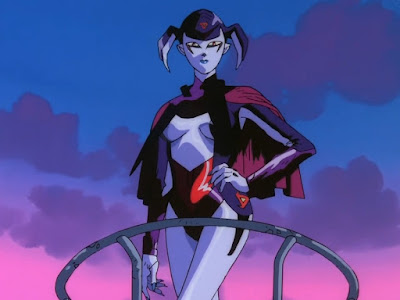
The actual production is solid, though this is a case where three directors and four screenwriters does evoke, even if not necessarily the issue here, of a title which lack a complete voice of one figure. There is Shō Aikawa among the screenwriters, once a notorious screenwriter of ultra-violent work who became a more acclaimed one, but there is also the consistent voice of Yasuomi Umetsu as one of the production's two character designers. Notorious for his work in hentai, and titles like Kite (1998) that could only be created originally under that genre, Umetsu is nonetheless well regarded for his craft and detail, and alongside Tomonori Kogawa as his co-character designer, you get a then-update to the franchise which is good and would have been spectacular to image with an expanded narrative which let the pair take the designs they had further. Even Luna's character design, despite my joke about her immaculate costume jarring against the world, is still memorable, alongside whoever (including other designers on the title) who decided to give the Buraiking Boss a Goth female robot henchwoman, looking like cyber harlequin in black eyeliner. (For obvious reasons as well, with its elaborate action scenes, the mecha designers and animators also deserve their credits for their hard work too). Working with Tatsunoko, the studio Artmic are a product of this era, with their last work in the late nineties. Their catalogue of films and straight-to-video work is a cornucopia of nineties and eighties anime aesthetics and tropes in a filmography, from Bubblegum Crisis (1987-1991) to Genocyber (1994), always collaborating with other studios on their projects.

All my issues are with the plot structure. The plot as it is mapped out makes perfect sense - setting up the world and Casshan, with the final conflict as played here between him and Buraiking Boss as well done as you could hope - but is more the sense we could have done with more story beats. There is teased more androids with the ability to control the ecosystem, living on an isolated island, who sadly never properly appear, and the middle of the production, episodes two and three, could have been have multiplied and increased into more tangents and depth to details like these figures, from episode three, or the main characters themselves. Casshan himself, alongside the limitations of his body, including requiring solar energy to power, has the additional primary crisis of whether he will lose consciousness and become a killing machine, whilst Luna, from the original series, has the conflict of needing to both help save humanity, but naturally concerned for the man she loved and hoping for the likelihood of him becoming Tetsuya Azuma again once the fight is over. There could have, in general, been more elaboration on the scenario, more emphasis on the human rebellion and the Buraiking Boss' forces, including a general sense of the grit and stakes at hand, especially with the uncomfortable idea leant into Buraiking's desire to replace humanity comes from his belief we humans will just destroy our planet, our failure to preserve it causing his existence to be. The slightness of some straight-to-video works has been a problem I have seen in quite a titles, and sadly this is a case, where everything here is perfect and could have been spectacular even as just a fun OVA, but we are just missing enough detail to nag.

Wednesday, 31 May 2023

#253: Karas - The Prophecy and The Revelation (2005-2007)


Studio: Tatsunoko VCR

Director: Keiichi Sato

Screenplay: Shin Yoshida

Voice Cast: Asuka Shibuya as Hinaru; Kasumi Suzuki as Yurine; Keiji Fujiwara as Nue; Toshihiro Wada as Otoha; Hiroto Torihata as Kure Narumi; Hitomi Nabatame as Homura; Kiyoyuki Yanada as Suiko ; Mai Nakahara as Chizuru / Mery ; Rokurō Naya as the Chief; Saeko Chiba as Sagizaka Yoshiko; Takahiro Sakurai as Houshun'in Ekou; Tetsuo Goto as Minoru Sagisaka

Viewed in Japanese with English Subtitles


Created to commemorate the 40th anniversary of Tatsunoko studios, the best way to describe Karas is an ambitious and very interesting premise but one, including the notable delay in between releases of all six episodes, which needed time to breath, rushing with all the ambition of a debut of a man, Keiichi Sato, who started out as a character and mecha designer who finally got to direct a production. It is a simple premise at its heart combining Tatsunoko's history of superhero characters in their animation like Gatchaman or Yatterman, with horror and Japanese folklore, and then-modern CGI animation which is meant for style for the sake of style even if the premise is elaborate in lore. Considering this has sword welding armoured figures fighting in the sky of Shinjuku at Christmas at the beginning of the first episode, the style is there, as is the director Keiichi Sato spelling his own name out in episode one with ants.

Karas is absolutely of its era, very much of the 2000s in style with the CGI and looking as expensive as possible, alongside the emphasis on a more muted art style. Voice casting for the English dub, which brought in Matthew Lillard and Jay Hernandez for key roles, definitely evokes how by the mid 2000s there was a push for making anime more mainstream, and as a straight-to-video project licensed by Manga Entertainment, this is also of the time. Whilst there were a few prominent ones at the time like this, that format was losing traction for these types of projects and TV series were easier to access on DVD finally at that point, Manga Entertainment eventually becoming less prominent as a British and US distributor, and more British one who releases mostly television series and some key films in the decade onwards. Karas however to its credit has a fascinating premise - in Shinjuku a mysterious figure known as Karas, a denoted figure meant to protect the city on behalf of the demons and the yōkai of the city from evil doers, stops demons from killing the humans and consuming their blood. The current one is Otoha, a man in a coma for the first three episodes who spends his time as a doctor for the yōkai in their world. A demon hunter about to stop time, he is under the watch of Yurine, the woman behind our lead who a) is an unexpected catgirl, and b) exists as a concept, more than one Yurine in existence as part of this lore using both Japanese mythology and various Asian disciplines of spirituality as its influence, Yurine existing for all the Karas and all looking the same, including for Eko, the former Karas of Tokyo who, having become disillusioned to its corruption, seeks to annihilate all humans there with what is effectively a plan to turn everyone into his own personal tap of human blood to be able to power his ultimate form.

The style, even under all the CGI, which is used for Karas and his opponents, mechanically altered supernatural demons, is inspired, running both with this idiosyncratic style but also melding it with ancient Japanese folklore.  The first monster emphasises this, whilst pulling no punches even if the later episodes are much gorier, with a water demon draining human blood from victims in a specific public bathroom near the subway, introducing us too to Narumi, a new police officer assigned to the one man behind their paranormal department, with his own concerns with his daughter in a mental asylum for seeing her whole classroom massacre by a demon. You however also see that Karas' first episode is arguably stylish to the point you cannot understand half of it, and also rushing through a premise which had legs for longer episodes than the thirty each gets. Effectively taking horror monsters, and having them as life draining robot ones, tackled by a doctor for good yōkai, a huma, who returns to his world to slay evil ones from a former Karas, we have a premise that is rewarding, but this show really needed to have been longer even if it was forty minute episodes. The first three episodes known as The Prophecy for Western release from Manga Entertainment feels like it is bolting through so much without explaining enough, including a demon in human disguise named Nue, after Eko and his monsters too. There are aspects you have to expect are there for the creativity of the production, like all Karas being able to turn into fighter planes for combat, but it is telling, alongside there being too many characters, that The Revelation as the last three episodes are called, all released two years after in 2007, has to start episode four with a huge amount of exposition to explain itself. Characters who barely get detail on them, like a female female Karas and her Yurine watching on as a preppy girl, get more to do, and it explains key lore points alongside Otaha's back story as a mob enforcer.

As quickly as his tortured history is disposed of, even if it means quickly getting past his crime father and an unexpected bromance that dies a quick death, The Revelation however has to quickly deal with ending the show, so even this is rushed despite explaining the premise. The rush undercuts Karas so much as by those three episodes, we are already into an apocalypse scenario where, with the notable shift in more gore and limb severing, we are in a far more violent doomsday tendril situation. As a result of the rush, even this, which is a scary and gruesome scenario, actually gets into something I have I have always hated in anime - just killing random bystanders off in vast amounts in elaborately gory scenarios as we see here. It is odd but, even with the trashiest of horror anime I have seen that are bad, they seem more justifiable even with an archetype once you known them a little, even one dimensional stereotypes, to be able to exist as a singular figure with their own existences for how long the tale is. Focusing on having their death as one person than merely part of a mass, no matter how gruesome especially with the eighties straight to video era, takes it into an exclamation mark to the scene that works. Here because you do not have enough time to digest the stakes, sadly Karas despite its moody nature even ups with randomly drawn bystanders getting horrifying ends which feels like shock value. This even makes the ending of the notorious Urotsukidôji: The Legend of the Overfiend (1989), its own world ending scenario, powerful ina horrifying way because we had more build up and warning of the threat at stake in that film in spite of its own problematic nature.

A lot of Karas'  fault is that, with this premise, Karas is an imaginative and vivid production which had so much work and production preparation clearly placed into it, but was really rushed to a scenario that, even in another slightly longer OVA work, would have needed slightly longer to reach what is this extreme an end. It is also a conventional superhero plot at its heart, despite the gore, that made a bad decision to not get the exposition out of the way or having time to slow down and let its lore sink in even if the production wanted to avoiding too much talking. What stands out in its tone, its horror-occult premise, is pushed to the backburner, which becomes its biggest sin. Particularly with how the designs are so elaborate and idiosyncratic even with clichés - there is requisite spider woman on the evil side, but her monster form and how she drains the blood for humans by hundreds of tiny spiders is entirely idiosyncratic here - it feels gauche to rush through a premise which has at its heart the additional subtext of modernisation conflicting with Japan's past. Details I can expect most will miss, such as how to activate the Karas form, Yurine chants a Shinto mantra, but there is an elaborate metaphor here that anime has tackled a lot and is worth doing so over and over, modernisation and Japan's past in conflict, the old traditions and the modernisation clashing as the demons of yore are forgotten and humanity in the city sinks into crime and corruption. Details like the mayor of Tokyo betraying humanity due to his hatred for all the crime, in another adaptation, would have become more loaded if allowed to breathe.

You can see the production value onscreen, not just in the computer effects, but costume design touches, like the Yurine all having goggles with idiosyncratic and cute markings for eyes on them, or that people cared for this work's lore, that in this world cities are still alive with the unnatural, the crows to the stray cats part of the spirits living in them that denote a human to become a Karas and keep all under control. As a result, this does have the disappointment of what could have been. For me this was always a title from this era getting into anime I wished to get around to, but never did. I am glad to see there was so much passion to the production as an original premise, which I have to admire now I have seen Karas and realised more was on its mind than presumed, but it is with the cost that, unfortunately, it missed the mark. This premise with the cost of its style clearly put on the production in time and effort did not get to the stage it needed to in being fully fleshed out, and it also needed to have been worked on more carefully before it came out. Thankfully, the epilogue of this production is that someone like Keiichi Sato, with this debut as a director, would go on to make helm more productions into the modern day, such as the first series of Tiger & Bunny (2011), so this ambition would lead onwards into other productions.

Sunday, 30 May 2021

#188: Nurse Witch Komugi (2002-4)


Director: Masato Tamagawa, Masatsugu Arakawa, Yasuhiro Takemoto and Yoshitomo Yonetani

Screenplay: Armstrong Takizawa and Tsuyoshi Tamai

Voice Cast: Halko Momoi as Komugi Nakahara; Ikue Ōtani as Koyori Kokubunji; Yūji Ueda as Mugimaru; Ai Shimizu as Posokichi; Akiko Hiramatsu as Yui Kirihara; Atsuko Enomoto as Megumi Akiba; Ikue Ōtani as Goddess Maya; Masaya Onosaka as Shiro Mibu; Michiko Neya as Runa Tokisaka; Mitsuki Saiga as Kyousuke Date; Yukari Tamura as Asuka Sakurai

Viewed in Japanese with English Subtitles


The immediate detail about Nurse Witch Komugi, a five episode OVA release, is that it is a spin-off to a 2001 television series called The SoulTaker, a very early directorial effort from Akiyuki Shinbo, before he became more famous, which was a dark supernatural story and an attempt by the legendary studio Tatsunoko Production to create a more adult work. Ironically, the humorous tie-in following a side character, recognisable in her nurse's outfit and was a smaller character in the cast, has completely obscured the original work entirely in history. The main lead character, a bland male named Kyosuke, becomes the male love interest for the titular Komugi to become more known as a protagonist, a girl blessed with the power to become a bunny nurse themes magical girl to fight humanised viruses. If ever there was an argument that female characters are usually more interesting as leads for your show, a character that stood out in visual design, allowed to become a bumbling if lovable protagonist is a good example, more so the case as, whilst The SoulTaker vanished, Kumogi got two further straight to video episodes in 2004, and a 2016 reboot in the form of a television series.

The resulting title, which was released without context by itself in the United Kingdom by ADV Films, itself requires no previous knowledge of the original series, another in a line of madcap comedies from the time I saw a lot. This one, following Komugi with her cute bunny mascot Mugi-maru, both the poor subject of abuse but also an undefeatable pervert in certain contexts, is definitely a title that borders on a guilty pleasure, as well being a title that you need to get onto its wavelength to fully appreciate. I will say now, what was once an average OVA when I first saw it has grown on me both in nostalgia from seeing titles like this, affectively a nostalgia for an ADV Vision/Manga Entertainment world of my first anime years, but also because the world and the characters have the virtue that you could elaborate on them in a longer format and, if you kept the same absurdities and colourfulness in look, it would have been great.

It is notable a remake came a decade later, although alongside a clear sense of the character being one with fondness for, or at least the potential to return to as a magical girl parody, they have changed the character designs over time. This is a shame in a way, without wanting to dismiss the 2016 remake in case it proved great in itself, but the premise of the original if funny and open enough to work with. An evil virus has escaped an alternative world, called Vaccine World, and invades ours, using a stand-in called Magical Maid Koyori, an evil representation of maid cafe staff member with magical abilities, to find hotspots that can generate monsters, whether the tensions of a tech convention or distilling a highway's worth of road rage. Komugi is not a perfect heroine, a cosplay idol part of a talent agency called Kiri Pro that is scrapping by, with her own career kneecapped by her continually having to go in her secret persona to fight the monsters. At times greedy and egotistical, Komugi is nonetheless likable, but an added joke (and potential bit of tension) is that Magical Maid Koyori is actually her best friend Koyori Kokubunji, a likable young girl her age who however has a split personality, one she is completely unaware of, which is evil and takes over at unexpected times.

Definitely one of the factors to bear in mind with the original OVA is that, for what I enjoyed about the show, some of the humour has aged considerably. Openly, just to give you a perspective of what some of the humour is, and why the short show can be a title some readers will struggle, can be shown in how one of the most prominent changes I can glace at is that Koyori's character design is significantly less busty. There is no way to move around this, but a lot of Komugi's humour, alongside slapstick and being a Tatsunoko that can parody their back catalogue, is sex comedy, from Mugi-maru being a pervert who keeps making the mistake of being in the bathroom when Komugi bathes, but also about characters obsessing about their lack of a bust or vast amounts of on others. Again this is a title that causes me to wonder whether there is a cultural issue in Japan about the status of a woman's bust, or whether this is just a trope male writers have repeated as a gag in their expense. Particularly with Komgui and her follow Kiri Pro co-member Megumi, who derides Komugi as being as flat as an ironing board whilst she is more physically round in areas, you are going to have to put up with a lot of this humour throughout, just like the skimpy outfits, or the scenes (without actual nudity) of bathing, or a final episode villain, an alien schoolteacher who brainwashes most of Japan and has been comically over-provided in anatomy. Worse and more lasciviousness examples exist in anime I have seen from this period, but the sex humour definitely makes the OVA have some guilt to its enjoyment. More so because it is not subtle, nor really inspired, more an excuse to gander at drawn busts like young boys, which gets repetitive for ever other joke that lands.

You have to bear in mind as well many obscurer (by a Western eyepiece) anime references too, specifically among many Komugi's tendency befitting a cosplayer to suddenly appear in costume as a character from another show for a minute. It is, as a result, meant for a fan base that gets the references. It gets to the point "Nabeshin", the animated persona of anime director Shinichi Watanabe, makes a cameo a character that came to the West thanks to ADV Vision releases, especially Excel Saga (1999-2000), where his animated persona, synonymous for his red jacket with yellow tie and an afro, has an entire running side plot by himself. Merely a cameo here as a disgruntled anime director, he even name checks Puni Puni Poemy (2001), an OVA from this era which is a far more notorious work for its lewd humour and weirdness that managed to be banned in New Zealand. Some of the jokes here even had to be censored, in the Japanese dub and visually on a sign, likely because of crossing Japanese copyright, and in the first, probably referencing a real life case of an otaku who committed a horrible crime for a very sick joke.

Thankfully, within mentality of throwing anything at the wall to see what sticks, you get many which work. This mentality also makes Komugi unpredictable and, with an interest set of characters to work with, it manages to hit the mark a lot between its scattershot of jokes. You may not know about Science Ninja Team Gatchaman, the original version of the Tatsunoko animated series nor its Westernised Battle of the Planets version, but the joke where Komugi suddenly turns into a five person team and their elderly male mentor on a screen, duplicating herself, to ride in a super combat plane is still potentially funny because a) she is fighting a building, which was once for a comics convention, turned into a giant robot, b) because Mugi-maru spends the scenario completely baffled what the hell is going on, and c) with missiles on the plane too dangerous to use, this boils down to the tactic of blowing up one's plane and smashing it into one's opponent for a final move. The show is deeply silly, and for every joke which you do not get the reference for, or has not aged well, a lot are ridiculous and run for the strangest idea.

Surprisingly for an early 2000s title, it is still unfortunately relevant when the first virus monster turns people into internet forum members arguing over fetishes and getting into spats, only with less toxicity. You get a Speed Racer joke, but also a piss take of early computer animated anime where even Mugi-maru comments the frame rate has become broken mid-shot. Episode 3 devotes itself to Komugi being dead for most of it, due to truck, left to languish haunting her colleagues when they are grateful she is gone, and even having a new life become many new lives when she keeps dying. Scattershot is definitely the right choice of term for the show, among many with their manic tones I have seen over the years, but many of these titles as well have their own deliciously surreal mentalities you can easily gloss over if you watch a lot of anime. The show is aware of this as, for its end credit song, you have a bright female sung pop song but with nonsensical lyrics whose strangeness are part of its theme.

This awareness even comes with the way the show had to work around delays per episodes releasing, promising they will get the show out at a certain date or having a seventies giant robot parody with that aforementioned building-robot for an ending preview gag. There is even an Episode 2.5, which is effectively padding and its own special, an excuse for two music videos with their own distinct looks, but also in itself lovable. For what is a tangent, in terms of the show settling down and, set during Komugi and her colleagues working in a festival cafe, allowing for some character building, it adds to the unpredictable nature in its own sedateness. Eventually this is a show where every Japanese monument, set to a licensed Toho studios orchestral march, transforming into a robot or self defence weapon from a kaiju film to defeat a villain, including a scathing critique (even if fictional) of a building which collapses and is merely called a waste of tax payers' money. For ever joke which caused me to roll my eyes, so much revisiting Nurse Witch Komugi was funnier for me. Whilst as much of this is, again as mentioned, nostalgia, as much of that fondness in itself comes from this type of work, specifically as well these early 2000s OVAs, where in little time they do have their own quirks and idiosyncrasies if you were lucky to have had a good one licensed in the United Kingdom. It is with criticisms, but especially with interest in the 2016 television series, there was enough to appreciate on this return too.