Showing posts with label Gothic. Show all posts

Sunday, 27 October 2024

Re-Review: Darkside Blues (1994)


Studio: J.C. Staff

Director: Nobuyasu Furukawa

Screenplay: Mayori Sekijima

Based on the manga by Hideyuki Kikuchi and Yuho Ashibe

Voice Cast: Akio Ohtsuka as Kenzou; Hideyuki Hori as Gren; Kotono Mitsuishi as Mai; Kouichi Yamadera as Enji; Masako Katsuki as Tamaki; Maya Okamoto as Selia; Natsuki Sakan as Darkside; Nozomu Sasaki as Katari; Shinichiro Miki as Chris; Yasunori Matsumoto as Tatsuya

Viewed in English Dub


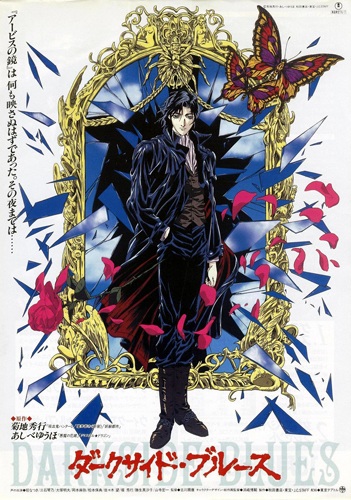
In the opening scene, you do get a pretty gruesome set up to Darkside Blues, evoking that this will be another anime adaptation of the work by Hideyuki Kikuchi like the infamous Wicked City (1987), in which a female freedom fighter stripped to the waist about to be tortured by another. It is still nasty what happens, but sets up less a lurid anime shocker from the past, but a really curious hybrid of horror, science fiction dystopia and magic, in which the poor victim is slowly turned into gold whilst alive through a science-meets-alchemy pincher machine that sticks in both sides around her stomach. From that point onwards, nothing is as extreme, and instead these genre combinations take over instead. It is a really idiosyncratic world that we encounter, barely in some ways in less than nineties minutes, in which the villainess is part of the Persona Century Corporation who rules the world, their lair high above the planet Earth on a satellite with its own giant laser. In a world where they have almost bought everything, where science and magic have intermingled, there are finally forces after dethroning them, such as the youthful leader of the anti Persona group Messiah, Mai, and those who stand with her. The titular Darkside, named by where he first appears from a dimension of the darkness is their trump card, initially intermingling as a mere psionic healer but possesses absolute power of darkness and magic. He wishes to renew the world for the better from its bleak situation, and he will start to help those fighting for justice and freedom when asked to.

Set within a world where futuristic sci-fi is intertwined with mysticism, robots against magic welding mutant assassin, and enough horror aspects to really apply for the genre tag even if a tertiary one, it befits novelist and manga author Hideyuki Kikuchi as he has, alongside a prolific career, a habit of bleeding together genres into one work. His most famous franchise Vampire Hunter D, with the vital contributions of legendary illustrator Yoshitaka Amano, was a post apocalyptic sci-fi horror story which has western genre aesthetics least in the animated adaptations. Darkside Blues sadly didn't get an additional animated adaptation, knowing this source material only lasted for two manga, so there is the fact that, sadly, there wouldn't have been much left to adapt, leaving one with enough tantalising what-ifs of how to continue in this world. This is a shame as, throwing the viewer in media res in the midst of the world and not having a resolution that resolves the dystopian world it begins with, I still found so much to this supernaturally tinged sci-fi hybrid I really liked. This is an example where you see the really interesting side to Japanese animation where it allows story tropes and ideas to bleed together in really idiosyncratic ways, more so as this has style to burn against its pulpy story.

What you do get with Darkside Blues thankfully repays the patient viewer with pure atmosphere. This particular one is even different by itself because it is laced in a slow, deliberate mood and emphasises characters, surprising for a film merely eighty minutes long. Immediately made clear is also the sharp contrast between its dystopian story against gothic production design, a fascinating melding which works beautifully, depicting pure urban sprawl and a tale of a corporation in total control which (unfortunately) stays relevant thirty plus years later, all with the one slum that the villains haven't bought the centre of the heroes' activity. In spite of having some actions scenes and gore, this entire story is a deliberately moody work, intercutting moments of contemplation to contrast these pulpier scenes, to a spider in a room with red lace or silent contemplation against those aforementioned action scenes. Even if the characters don't get a lot of time onscreen, we see Mia forced to confront her own memories through dream therapy with Darkside, or see a surviving member of a freedom fighting group, a young man, and a female ex-nurse whose family was wiped out by the Persona satellite laser fall in love as she rediscovers her need to help fight for the cause.

As a theatrical production from J.C. Staff, a prolific animation studio who started in 1986 and thus wasn't that old to even endeavour on this production, they produced a mere snapshot of a larger world, which is depressing as the story has to be hastily wrapped up, but there is enough here to tantalise. The first time I saw this film, the first moment this won me over is when the first showdown between heroes and villains is scored to an honest-to-God blues song in the traditional of American ones with English vocals. With original lyrics evoking the musical genre and the story's own title, whilst fitting the world's themes of repression and rebellion, that was one of the first idiosyncratic touches that came throughout this that really caught interest.


Then there's Darkside himself, who despite being your typical anime trope of the dark and handsome stranger with unnatural powers from the void he came from, is intentionally passive. He feels like he's from the same template as D, Kikuchi's most famous creation in his quiet manner and elegance, but taken to a further extreme that he deliberately inert in his involvements. He will lash back when provoked, but deliberately stays off to the sides, intervening to heal other characters and stop the villains from harming people even by the finale. He spends most of his time throughout the film, in the most intriguing aspect of the world building, within a motel ran by an old woman where characters are pulled by a magic force to the room they want to go, where among his potential abilities (including maybe even extending the life further of the old woman's pet cat) is counselling of clients' memories and dreams, healing them and (even outside the hotel) using this ability to push the protagonists to major decisions, through pulling them into their traumas and memories to stop them from running from them. Literally, he's a counsellor to the real main characters, who just happens to be a quietly spoken man capable of horrifying dark void abilities if anyone was insane to push him.

In another twist, although it's sadly lost when it comes to the English dub which casts Matthew Harrington, is that a female voice actress named Natsuki Sakan voices Darkside rather than a man, which adds a unique dynamic for viewers. It's her sole acting role in the anime industry, which is just as mysterious. She sings the end theme, Paradise Lost, which presents the idea that this production was as meant to promote her, but with her singing voice a deeper and sombre one, it is a compelling idea to see that, to promote her, she voices the main male lead. This is actually more fleshed out when you learn that the character is credited to Ou Natsuki instead on other sites1, and that she has a history in the Takarazuka Revue. The Revue, based in Takarazuka, Hyōgo Prefecture, Japan, started in 1913 and perform to this day elaborate all-female Broadway-style productions with the all-female cast playing both the male and female parts of their productions, Ou Natsuki playing many of the male roles in the shows she was involved with until her retirement2,3. They have adapted everything from folktales to manga, and they have had a huge influence on anime and manga, be it the legendary Osamu Tezuka being inspired from growing up with their performances, to a legendary J.C. Staff animated production, the series Revolutionary Girl Utena (1997), being inspired by it too. I am not surprised that for one cast, an anime had an inspired idea to hire a former Takarazuka Revue performer to play a major male role when she would have done so in her career beforehand

It's the female characters for the most part too who are the most interesting. That's not to say there's some curious characterisations for the better, most if not all the characters even for the few minutes having unique details, such as the enforcer sent against Darkside having a heroic moment rescuing a woman from a group of men which complicates things, despite the fact he will turn an entire crowd of bystanders into stone which break to pieces (and presumably die if not already), deciding one of the henchmen for Persona, an artificially created hit man with monofilament wire, should look like a middle aged employee from an office in a polo shirt and slacks, wearing glasses and with balding hair, undercutting his menace in a really sick humoured way. But in terms of complex characters, Mai as the leader of the Messiah group, who holds a vaguely told back-story of trauma, is interesting as the strong willed but thoughtful leader, she and her motley crew finding themselves further against Persona especially when a militarised rebel escapes into their midst. Another character, the nurse named Selia I have already nodded to, is even more interesting and is the figure who gets the real ending of the adaptation; with even greater trauma in his life due to her family being victims of the giant space laser Persona own, she keeps her father's rifle as a traumatic memento, her progression from being a mere friend to Mai's cause onwards where the resolution of the film comes from.

Thankfully, this means Darkside Blues, unlike other anime, actually has an ending, unlike too many especially from the straight-to-video format of this time period which ended abruptly, but it's fascinating that this ending is a miniscule character drama set within a huge world left untouched. It is as if a fragment of what could've gone obviously for longer. Again, the slither of virtues is rewarding even if I wished this had lasted onwards to more. Production wise, it's gorgeous. This era of anime gladly lavished even the most lurid of stories with a distinct production design, and generally have a sense of flair both in background and character designs that stood out, details that could easily be ignored especially in some of the worst, less cared for OVAs from this same era. All that would've been as painstaking as everything else to include,  such as having the lead male villain wear a golden mask in public, deliberately designed to look robotic and faceless for ominous. The combination of Goth aesthetic with science fiction does stand out as do the moments where horror are felt, as whilst not really the genre this truly belongs too, it exists in the supernatural melding to the science fiction world, the moments of darkened mood or the lingering fear of one's' traumatic memories, let along the decision to depict Darkside as having a supernatural horse drawn carriage which can even fly, which is one of the coolest forms of transport ever to have whilst completely Gothic in image. It's distinctions stand out so much so that, yes, that it has no large scale resolution and never had any animated sequels or remakes which is disappointing, alongside the fact that original releases of this are now very old DVDs, and were never in the United Kingdom. This also includes the likelihood of finding the ADV Manga translation of the manga adaptation, which will probably only be found by readers through pure luck and an excavation through countless second hand dealer boxes and warehouses of stock for long dissolved companies. One has to gnash their teeth, as I have, when the material is as compelling as this and wish it had a lot more attention drawn to its virtues.


=====

1) MyAnimeList page for Ou, Natsuki.

2) Takawiki entry on Ou Natsuki.

3) Weblio page on Natsuki Ou. [Japanese language]

Monday, 5 December 2022

#236: Lament of the Lamb (2003-4)


Studio: Madhouse

Director: Gisaburō Sugii

Screenplay: Gisaburō Sugii

Based on the manga by Kei Toume

Voice Cast: Megumi Hayashibara as Chizuna Takashiro; Tomokazu Seki as Kazuna Takashiro; Jūrōta Kosugi as Akira Eda; Kenichi Suzumura as Kinoshita; Kikuko Inoue as Momoko Takashiro; Miki Nagasawa as Emi; Satsuki Yukino as Shou Yaegashi; Shinichiro Miki as Minase; Yoko Sasaki as Natsuko Eda

Viewed in Japanese with English subtitles


In terms of an obscure title, Lament of the Lamb sticks out as a fascinating melodrama enclosed in a horror premise, which most will only know as the source manga was released by the manga publisher Tokyopop in the West. The anime however entices as it is produced by Madhouse, its female lead is voiced by Megumi Hayashibara, a mega star in the industry, and it is, whilst a more obscurer figure in comparison, directed by Gisaburō Sugii, who also wrote the scripts for all four episodes and worked on the storyboards. His career is marked with helming the theatrical film Night of the Galactic Railroad (1985), a highly regarded animated film attempting to adapt Kenji Miyazawa's post humorous novel, a challenge to adapt the un-filmable and unfinished book dealing with mortality and life for a young audience that is hugely well received, and a masterpiece of eighties theatrical anime. He also directed Street Fighter II: The Animated Movie (1994), a huge curveball in tones to these two other titles, but to consider important in showing his talents as it is one of the only well regarded fighting game anime in existence. It was a staple in the West from Manga Entertainment even if Alice in Chains and KMFDM had to be added to the soundtrack, which shows that Sugii was no slouch in terms of a director.

Kei Toume is also another case of a prolific manga artist whose work, and knowledge of her, is sadly limited in terms of English language access, Lament of the Lamb by itself having been released in the west, but also having a radio drama and a 2001 live action film to its name. Her story begins with Kazuna, who is a teenager left with his aunt and uncle by his father as a child, a famous doctor who disappeared from his life soon afterwards. Fate conspires to weave him back to his family as, whilst his father to his shock is dead, his older sister Chizuna who lived with him returns into Kazuna’s life. It is very obvious from the beginning, when the illness of the family is brought up, it is clearly a form of vampirism, a craving for the taste of blood, but this is instead a story whose horror is a psychodrama, as Kazuna, who was to be spared from the family to have a normal life, is starting to suffer the cravings for blood, as he is drawn to his sister.


With a moody electronic score, intercut with drum and bass freak outs by Ken Miyazawa, more prolific for his contributions to Detective Conan films, Lament of the Lamb stands out with interest as a macabre melodrama that enticed me with its tone and telling of this drama. The bloodlines is cursed with a craving for blood which is depicted differently to many vampire stories, including how instead of being undead or supernatural abilities, there is a greater danger of physical and/or mental damage to the family itself, something Kazuna can attest to in her memories of their late mother. The concern, especially for Kazuna is worse as it includes desiring his female student friend’s neck. Said friend, Yaegashi, is a student in love with him but feeling pushed away, as dynamic a character in her own emotional turmoil, as there is also an explicit sense of incest to the story between Kazuna and his older student. Unlike the titillation of other anime, this feels here a more potent edge to the proceedings, grave and platonic barring the neck biting sequence, which fully embraces the taboo and emphasizes how vampirism became symbolic of sexuality centuries before and is embraced here.

Even in mind of how more obscurer this is, i.e. you will likely see this as a rip, Lament also has a deliberately washed out aesthetic, of pale faces and even certain character designs (especially with Yaegashi) having a wider span between the eyes, almost more cartoonish but adding to the tone. It feels disconcerting, especially as whilst a slow burn drama, even in episode 1 blood is spilt and it is depicted in deep red. The resulting production is gothic melodrama in the modern day, especially as there is also the character of Minase, a young male doctor who is in love with Chizuna and himself has a great angst in regards to her growing platonic relationship to her younger brother, especially as despite the initial appearance she shows, she is physically being damaged by her illness, even in terms of the medication needed to control it having physical harm to her heart. The take on vampirism here, a psychological and physical craving which causes dizzy spells, physically wrecking spells and mental collapse is distinct here in terms of imaging the literalisation of this. The slower tone is a change of pace for a horror anime, and telling a whole story to its bleak end, without feeling morose in the slightest, the only real reason this likely never got picked up for the West is considering the state of anime releases at the time. The original video anime format was still viable but decreasing in number, and for everyone still released at the time, you find as many titles from the time which never came to the West as you fall over them from the eighties. It is a weird missed opportinity in terms of selling it from the back of Madhouse, who were highly regarded at the time, and on Megumi Hayashibara, a huge name to those who watched the original subbed versions of the likes of Neon Genesis Evangelion.

The only thing close, in terms of further adaptations of the manga to the West, was at the Tokyo Project Gathering on the 22nd October 2006, a segment of TIFFCOM, where Mr. Stuart Levy, CEO of Tokyopop, presented the Lament of the Lamb live-action movie project as a future plan. It was meant to begin production in 2007, and be shot in Romania1, which does emphasize how Tokyopop's reputation started to slip in the mid-2000s and hubris as well, the closest thing to a live action film from them being Van Von Hunter (2010), a low budget adaptation of a Western parody of manga, by Mike Schwark and Ron Kaulfersch, Levy helped co-write. By 2008, Tokyopop after their success had to restructure their business due to changes in the manga industry, and neither helping was that the significant licenses they made their name from - Kodansha published titles, manga created by CLAMP - were being taken away from them. Lament of the Lamb's review should focus on the material, this adaptation a little gem whose absence is sad as, in terms of a horror anime, this is very different from many as a very compelling gothic drama.


=====

1) Tokyo Project Gathering Anime Related Projects, written by Christopher Macdonald and published by Anime News Network on 23rd October 2006.

Thursday, 26 July 2018

#56: Darkside Blues (1994)

From http://garaitimi.hu/blog/wp-content
/uploads/2011/03/darsideblues.jpg


Director: Yoriyasu Kogawa
Screenplay: Mayori Sekijima
Based on the manga by Hideyuki Kikuchi
Voice Cast: Akio Ohtsuka as Kenzou; Hideyuki Hori as Gren; Kotono Mitsuishi as Mai; Kouichi Yamadera as Enji; Masako Katsuki as Tamaki; Maya Okamoto as Selia; Natsuki Sakan as Darkside; Nozomu Sasaki as Katari; Shinichiro Miki as Chris; Yasunori Matsumoto as Tatsuya
Viewed in English Dub

Synopsis: In dystopian Japan, one giant corporation named the Persona Century Corporation rules the world, their lair high above the planet Earth on a satellite with its own giant laser. However, in a world where science and magic have intermingled, a figure who dubs himself Darkside appears on the street of the same name one night, out of a void in a horse drawn carriage. Living within a hotel, Darkside only intermingles as a psionic healer, but his influence on Mai, the youthful leader of the anti Persona group dubbed Messiah, is going to have an immense effect on her and those she stands side-by-side with.

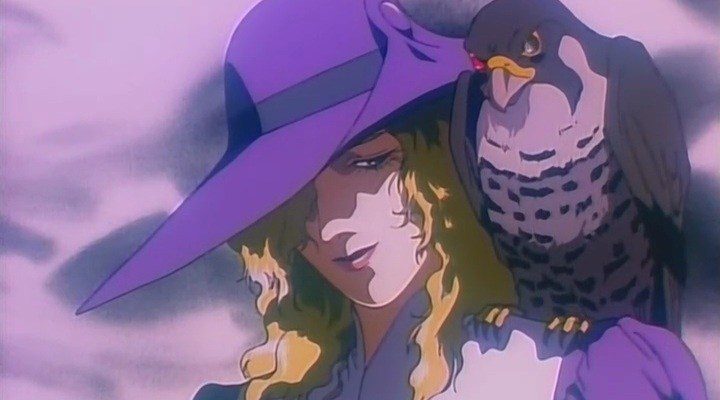
Opening scene, fearing this would turn into something gristly when a woman is stripped to the waist about to be tortured by another, more so as Darkside Blues' original author (both the manga and short story) also wrote the source material for Wicked City (1987). Instead, whilst it's still nasty, the villainess, as she monologues with a pet bird on her shoulder, plans to torture what is revealed to be a female rebel against the Persona Century Corporation by slowly turning her into gold whilst alive through a science-meets-alchemy pincher machine that sticks in both sides around her stomach. This is fair warning, and apt introduction, to the curious world of Darkside Blues, a world where futuristic sci-fi is intertwined with mysticism, robots against magic welding mutant assassins. 

It stresses that, in terms of anime of a certain generation, novelist and manga author Hideyuki Kikuchi has had such a profound influence. I've mentioned one of his more infamous works, at least with the anime adaptation with its transgressive content, but he also (with the vital contributions of legendary illustrator Yoshitaka Amano) created Vampire Hunter D, a series which has had a lasting legacy. Alongside other titles I will inevitably get to, as he has had a lot of material adapted into anime, his style of crossing various genres is very idiosyncratic to any project based on his work, allowing animated adaptations a lot of leeway to work with.

From https://www.film-rezensionen.de/wp-content/uploads/2017/
02/Darkside-Blues-Frontpage-720x400.jpg

Darkside Blues
is such an example but with the warning that, sadly, this is all we got in terms of a proper adaptation of Kikuchi's source material, throwing the viewer in media res in the midst of the world and not having a resolution that resolves the dystopian world it begins with. It is not a film which ends with good triumphing over evil, but a character, not even the protagonists, deciding to join the fight against the big bad. Like a lot of anime, it's a film which teases you with such an enticing world only for it to be a mere slither of the source material. So many anime have been promotional material for manga, sometimes (a lot of times) without the original novels or manga even being available in the West. When it is good, it's always tragic to witness.

What you do get with Darkside Blues thankfully repays the patient viewer with pure atmosphere. The hybrid of genres which is common in anime but adaptations of Kikuchi's work are distinct. This particular one is even different by itself because it is laced in a slow, deliberate mood and emphasises characters, surprising for a film merely eighty minutes long. Immediately made clear is also the sharp contrast between its dystopian story against gothic production design, a fascinating melding which works beautifully as it does in the 2000 adaption Vampire Hunter D: Bloodlust, only here it's not the post-apocalypse but pure urban sprawl as a setting within one of the last environments the villains haven't bought. All of this story is whilst, in spite of having some actions scenes and gore, being a deliberately moody work, intercutting moments of a spider in a room with red lace or silent contemplation against those aforementioned action scenes. That it's a mere snapshot of a larger world is both despairing but also adds to the power to the film. In anime, for whatever reason, you can have these titles (especially from the nineties) which never had proper endings but still developed fans, all of us gnawing at our knuckles as to why there was never a sequel, but loving the final result nonetheless. It immediately won me over, when the opening credits are finally shown, but scoring the first shown down between heroes and villains to an honest-to-God American blues song.

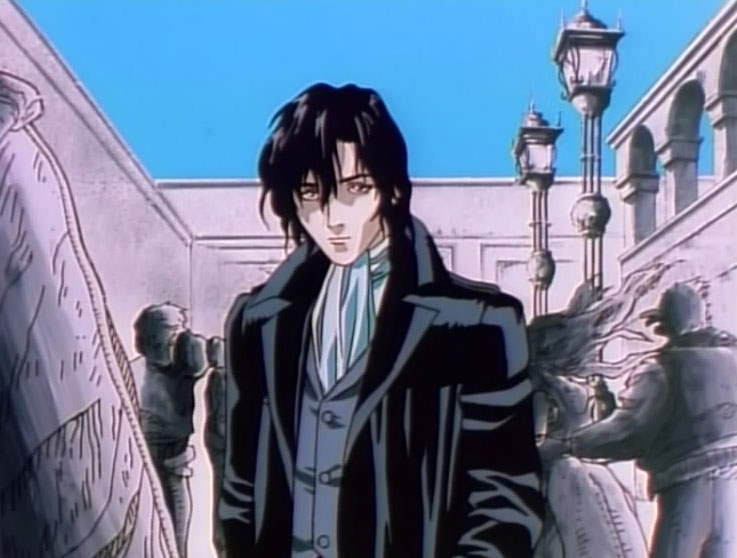
It's rewarding as well as, for what little time you spend in this world, its characters are unconventional for anime. Darkside, despite being your typical dark and handsome stranger with unnatural powers from the void he came from, is intentionally passive. He feels like he's from the same template as D, Kikuchi's most famous creation in his quiet manner and elegance, but taken to a further extreme that he deliberately inert in his involvements. He will lash back, but always deflecting bullets and magic missiles fired at himself, instead deliberately stays off to the sides, intervening to heal other characters and stop the villains from harming people. He spends most of his time throughout the film, in the most intriguing aspect of the world building, within a motel ran by an old woman where characters are pulled by a magic force to the room they want to go, where among his potential abilities (including maybe even extending the life further of the old woman's pet cat) is counselling of clients' memories and dreams, healing them and (even outside the hotel) using this ability to push the protagonists to major decisions but pulling them into their traumas and memories. Literally he's a counsellor to the real main characters, who just happens to be a quietly spoken man capable of horrifying dark void abilities if anyone was insane to push him. Even individuals specifically sent in by the Persona Century Corporation to deal with him that have their own special abilities, able to turn entire crowds of bystanders into stone which break to pieces (and presumably die if not already) in the combat soon after, find themselves against someone very conventional as protagonists within this type of nineties adult anime. In another twist, although its sadly lost when it comes to the English dub, is that a female voice actress named Natsuki Sakan voices Darkside rather than a man, which adds a unique dynamic for viewers.

From https://i.ytimg.com/vi/nZh2z2xZsBY/hqdefault.jpg

Instead it's the female characters who are the most interesting. That's not to say there's some curious characterisations for the better, most if not all the characters even for the few minutes they have curious and unique, such as that enforcer sent against Darkside having a heroic moment rescuing a woman from a group of men which complicates things, or the mutant magic welding assassin who literally looks like an older, chubby Japanese salaryman. But in terms of complex characters, Mai as the leader of the Messiah group, who holds a vaguely told back-story of trauma, is interesting as the strong willed but thoughtful leader, she and her motley crew finding themselves further against Persona especially when a militarised rebel escapes into their midst. Another character, a nurse named Selia, is even more interesting and is the figure who gets the real ending of the adaptation; with even greater trauma in his life due to her family being victims of the giant space laser Persona own, she keeps her father's rifle as a traumatic memento, her progression from being a mere friend to Mai's cause onwards where the resolution of the film comes from. Thankfully this means Darkside Blues, unlike other anime, actually has an ending but it's fascinating that this ending is a miniscule character drama set within a huge world left untouched, as if a fragment of what could've gone obviously for longer. Again, the slither of virtues is rewarding even if I wished this had lasted onwards to more.

Production wise, its gorgeous. This era of anime gladly lavished even the most lurid of stories with a distinct production design, and generally have a sense of flair both in background and character designs that stood out, details that could easily be ignored especially in some of the worst, less cared for OVAs from this same era. All that would've been as painstaking as everything else to include,  such as having the lead male villain wear a golden mask in public, deliberately designed to look robotic and faceless for ominous. It's a style that could've easily turned into clichéd Goth aesthetic, a lot of black and moody characterisation, were it not for the curious inclusion of genres like science fiction. Arguably, when it comes to adapting Hideyuki Kikuchi's work, there's no fear in the slightest of it ever become clichéd, even the more cartoonish 1985 anime of Vampire Hunter D being distinct. So much so that, yes, that it has no large scale resolution and never had any animated sequels or remakes is disappointing. [And the likelihood of finding the ADV Manga translation of the manga adaptation is only through pure luck and an excavation through countless second hand dealer boxes and warehouses of stock for long dissolved companies.] So one has to gnash their teeth, like I have, when the material is as compelling as this.

From https://www.animeclick.it/images/
Anime_big/DarksideBlues/DarksideBlues33.jpg