Showing posts with label Satoshi Kon. Show all posts

Thursday, 29 October 2020

#165: Perfect Blue (1997)


Director: Satoshi Kon

Screenplay: Sadayuki Murai

Based on the novel by Yoshikazu Takeuchi

Voice Cast: Junko Iwao as Mima Kirigoe; Rica Matsumoto as Rumi; Emi Shinohara as Eri Ochiai; Emiko Furukawa as Yukiko; Hideyuki Hori as Sakuragi; Masashi Ebara as Murano; Shiho Niiyama as Rei; Shinichiro Miki as Taku; Shinpachi Tsuji as Tadokoro; Tohru Furusawa as Yatazaki; Yoku Shioya as Shibuya; Yousuke Akimoto as Tejima

Viewed in Japanese with English Subtitles


The following review is to be found on my other blog A Night of a Thousand Horror (Movies) as well as part of its Halloween season of thirty one reviews per day. (Also a great way to promote both of them too). If this is of interest to you the reader, follow the link HERE for many more reviews.


Who are you?

Once seen, a long time ago, Perfect Blue has stayed with me for a long time. The irony is that, in another context, this plot would have become a lurid and dumb thriller, as clichéd as the one in the television show, Double Bind, that lead Mima Kirigoe transitions to from an idol singer to an up-and-coming actress from her idol group Cham. Alongside the fact Satoshi Kon was a one-off, this also became an animated production, the tone and rules changed alongside the people behind the theatrical film taking the best route forwards to make a great film from such material. The irony is that this production was meant to be live action, adapting Yoshikazu Takeuchi's source material, only for the 1995 Kobe earthquake to prevent that version and an alternative animated version from Madhouse studios to be created on a lower budget. It says the final film's advantage that, even with a 2002 live action existing, this Kon helmed version is the definitive adaptation to many.

Returning to Perfect Blue, this film's deconstructive nature immediately begins with a live tokusatsu performance beginning the film as a cold opening. These are a cultural detail, especially with knowledge of this film getting such notice in the West it even inspired American filmmaker Darren Aronofsky, that I have seen in many anime but are very idiosyncratic and likely to be ignored without batting an eyelid, where actors dress as Power Ranger-like heroes or monstrous villains to entertain kids at theme parks or at least outside, two stating how disappointing this looked to the original television show. Cham are introduced, a three woman idol singing group who are struggling to find success, and the film intercuts the performance with the banality of our lead Mima away from work buying groceries.

Satoshi Kon, who tragically died at too early an age at only forty six, due to pancreatic cancer, would build a reputation as a director, baring Tokyo Godfathers (2003), of stories breaking down reality, exploring psychological states and even dreams. This is where, literalised, Perfect Blue takes a new level as a suspense thriller, where Mima is transitioned by her agency to become an actress, with a stalker soon to murder people "debasing" her. Throughout there is a meta tone, as when we are on the TV show Double Bind, where she is a secondary character on, there are scenes being acted out and also behind-the-scenes ones of the cast breaking character. Mima, as she fears a doppelganger of her exists, is also beholden to her old self to obsessive fans despite trying to grow as a person.

All the fans of the idol group with their own versions of Mima are seen, including the sinister Me-Mania, an obsessive fan connected to the doppelganger. I could not help but think of how much of the film now is tackling gender politics, as this film is structured around a fragmentation between an idealised version of Mima as the Cham idol singer, the star of a lurid TV show and who poses in nude photographs, and Mima Kirigoe herself, a twenty or so year old woman not from the metropolis, wandering along in this career of hers as work, who is neither. The idol singer is another cultural aspect from Japan that is distinct. It is in itself not a squeaky clean industry, but it is also prominent how strict some of the rules imposed on female idol singers can be, some including not even allowing their stars to date, to impose an idealised image for fandom without scandal.  

Mima, as she fears a doppelganger dressed in her old Cham costume haunts her, is beholden to her old self to obsessive fans. All the fans have their own versions of her as mentioned which we see, Kon himself tackling this subject of obsession in a negative light, from this to nostalgia, throughout his career, but in this particular case there is an added poignancy of following a young woman having to step out of her squeaky clean persona, an innocent who sings twee love songs only to now become a fully formed human being, who lives in a tiny apartment and has a regular life. Even though this was based on a novel by a man, and directed by a man, bearing in mind the animators and production team too, there was on this viewing a lot which stood out in terms of gender politics, a strikingly poignant line in particularly, when confronted by her doppelganger, when the other mocks her with the equivalent of "nobody likes idols with tarnished reputations".

But the other side is not glamorous either. Probably one of the darkest theatrical anime made, it has one of the most uncomfortable but morally well executed rape scenes in either live action or animation, involving one Mima acts out on the Double Blind TV show as her character turns to stripping only to be mobbed by the male pundits. It includes the behind-the-scenes of everyone breaking character, the main rapist just an actor asking between takes if she is okay, yet the scene is still uncomfortable with emotional aftershocks for her, acted out in the shooting of the film in full with complete intensity to the content. Now there is a new edge that, in the machinations, there is an added creepiness of the screenwriter writing a scene for an ex-idol, as spoken in the dialogue in regards to her agency wanting more of a role for her, to shed her innocence. Even that it leads to her character developing a multiple personality and being revealed to be the killer of women feels more like a lurid shock to get TV viewers on this viewing, Mima having to put up with this to become a great actor as she goes along.

Outside of notoriously lurid anime like Urotsukidôji or others with dangle precariously (or fall into) the same ball park, Perfect Blue is a dark and intense production in terms of adult content but without stepping over into trashiness. With industrial synth and eerie group vocals adding to the mood, by Masahiro Ikumi before Kon found his frequent collaborator Susumu Hirasawa, Perfect Blue does quality as a thriller but is definitely of the horror genre in mood and content. Even the one dated aspect, from a time when the internet was new and had weird terminology like "URLs", is still uncomfortably relevant about false personas, a false autobiographical diary of Mima's life she finds online scaring her, starting her psychological breakdown, because of how it even knows accurately what foot she steps off a subway train with first.

It is a bloody film, probably the most intense in Kon's career thought his work could be very adult, even over Paranoia Agent (2004) which did not shy away from subjects like suicide, but there is a tone and details here that in the modern day would startle even the world of uncut fan pleasing anime with erotic content. Some of it is unexpectedly subversive, such as how most of the victims in a series of murders are male characters. Some of it is the intensity of scenes of violence in general. One such thing is that, with Mima's nude photo shoot, you have depiction of female pubic hair. In Japanese culture, I have seen male and female genitals blurred in art, and even Japanese pornography is censored for depictions, and whether Perfect Blue was an exception in its home land or not, it would have a greater shock for a viewer (even Western fans outside of uncensored hentai) to see. One scene, where a male victim is stabbed to death with a phallic weapon of a screwdriver, even goes as far as have cuts to the nude photo shot mid-stab, and projected on the television in the background of the murder, intercutting an eroticised female body to a man being penetrated violently with a weapon.

Where Perfect Blue fully hits its stride is when all reality breaks down, starting with little tricks, such as seeing police sirens in the next scene but only to pull back to see a child riding a toy ride-on vehicle. With very realistic character designs, even having a playful touch of cutting to an exaggerated stereotype of a female anime character in one scene, a toy model with comically big eyes up against the camera, you could wonder why this could not be in live action aside from the fact that Kon's film is completely plastic in its ability to distort reality as a result. Literalising psychological states, contrasting the real Mima with a Cham idol Mima whose skin even glows and looks unreal, and with far more preciseness get away with the "it was all a dream" twists by television plotting invading her real life and bending reality. Double Blind scenes blur to psychological analysis Mima herself with obvious ideas, clichés from a trite TV show coming more meaningful when she herself is scrutinised. This became Kon's trademark, a willingness to bend his worlds to scrutinise its characters.

[Major Spoiler Warnings] You can argue this uses broad caricature. The culprit is actually Rumi, an older larger woman, and Me-Mania looks completely alien, but Perfect Blue is thankfully still more complicated than this. This is a very simple plot, with resolution, a clear conclusion where Mima even states in the last shot and line she has found herself, but the execution completely succeeds in adding weight...especially when the final scene I have mentioned, in the Japanese dub, has a play with which voice actor says the final line for added distortion of what is real. [Spoilers End]

Returning to Perfect Blue, it is still a success. It did not come from an abrupt spark of genius mind. Kon worked his way up as an animator, as well as in writing screenplays, and this was created by Madhouse, so this was a collaborative effort where everyone was on fire creating with. The great thing is that, making a lasting impression when Manga Entertainment acquired the licence, Perfect Blue is still held aloft, not an obscurity, and that Satoshi Kon in his brief career never dropped the ball after this initial promise.

Friday, 26 April 2019

#96: Paranoia Agent (2004)


Director: Satoshi Kon
Screenplay: Seishi Minakami and Tomomi Yoshino
Voice Cast: Daisuke Sakaguchi as Shonen Bat; Mamiko Noto as Tsukiko Sagi; Halko Momoi as Maromi; Makoto Tsumura as Shogo Ushiyama; Ryūji Saikachi as Old Person; Shōzō Iizuka as Keiichi Ikari; Toshihiko Nakajima as Masami Hirukawa; Toshihiko Seki as Detective Maniwa                                       
Viewed in Japanese with English Subtitles

Synopsis: One night a female illustrator Tsukiko Sagi is assaulted by whom she describes as a young male wearing golden inline skates with a bent, golden baseball bat. Thus "Lil' Slugger" (or Shonen Bat in the original Japanese) is christened, and to the police's bafflement, he can abruptly appear to all his targets, all of which are seemingly people either connected to each other and/or pushed to the edge of despair.

In his short and tragically short career, only living to forty six due to pancreatic cancer, Satoshi Kon made four films and this one anime series, but has developed a cult reputation that has even stepped outside of anime itself. When being in your forties is still considered a young upstart in the anime industry, Kon could've (and likely) would've pushed the medium of anime into more idiosyncratic directions. Based around various strands of ideas he felt shouldn't be wasted, what Paranoia Agent is isn't necessarily vignettes but all tied into a very elaborate thirteen episode series. Contrary to my original beliefs, such a long time since seeing this series, Paranoia Agent is a very precise tale.

Ten episodes follow the tale of Lil' Slugger, an urban legend who yet is actually responsible for smashing people in the skull with a golden baseball bat, strangely targeting people all interlinked by them reaching a crisis point in their lives. The three episodes which feel like side plots, the entirety of disc three of the original UK DVD release, back when anime used to be (inexplicably) released by three or four episodes over many months, are still connected to the main story and add character to the world being depicted.

In said world, as his other work, Kon blurred reality itself with the exception of Tokyo Godfathers (2003), tackling subjects like dreams or subjectivity under mental distress. Even when Paranoia Agent can only work as being supernatural for certain plot incidents, it's using a lot of visual metaphors to depict the distorting mental states of its cast. Flights into an idolised youth, literally a cardboard town of two dimensional people, a woman whose split personality in combat with her leaves answering machine messages, a police interview which (in the funniest episode) turns into a stereotypical Western high fantasy quest based on delusions of being in a video game, or the first victim of Lil' Slugger, character illustrator Tsukiko Sagi, having her mascot character Maromi as a talking figure who constantly tells her to just ignore any prang of concern she has about anything.

Ultimately, Kon emphasises a long trodden obsession of his of the absolute dangers of escaping reality no matter how painful it is, one of the only exceptions being Millennium Actress (2001), a tale of an aging actress which was clearly indebted to real life Japanese actresses Setsuko Hara and Hideko Takamine. Here in Paranoia Agent is his most overt thesis of this concern as it's the central plot. Following intertwined characters - Sagi, two cops Keiichi Ikari (older and old fashioned) and Mitsuhiro Maniwa (younger and dangerously open minded), and various reoccurring side characters - the tale of Lil' Slugger, at first seen merely as a hoodlum, is visibly even in the subjective world view of the series a supernatural entity or one giant metaphor for escape that has become an actual, real destructive force. He targets those pleading to escape pain - neurosis, anxiety, a downward spiral of crime, general chaos in one's life - called in hope he'll roll in on golden inline skates and in one case knock someone's skull in so hard they completely forget who they are and all they've suffered through.

From https://i0.wp.com/the-avocado.org/wp-content/uploads/
2018/02/PA12_shot4.png?zoom=2.625&resize=371%2C173&ssl=1

Not desiring to spoil the series, his mirror is Maromi, that lovable cartoon dog that Tsukiko Sagi created at the beginning of the series, a stand-in to a phenomenon like Hello Kitty who is an immediate success and becomes an insanely huge marketing property that the populous becomes obsessed with. We'll get to Susumu Hirasawa's music later, but it's not a surprise in lieu to how sinister this dog's influence is, at least in Kon's eye, that the end credits has every character laid asleep around a giant version of Maromi, in a grassy field, whilst an unnervingly calm but eerie piece of music is playing.

The series also an attempt at tackling various cultural issues; Kon's work all did, Tokyo Godfather breaking a taboo by talking about the homeless in Japan, but Paranoia Agent is basically sewing together various different issues at once through one long form project. The anime obsessed otaku, a minor side character, who in the gaze of all his female figurines hires a sex worker. The gossiping women, who have an episode, trying to have more elaborate tales about Lil' Slugger over the others. The episode on suicide, as three members of an online forum for this act meet up, an elderly man and a young man horrified the third in a young girl.* The general sense, coming to ahead in the finale, of a collective attempt to bury one's emotions that becomes completely destructive.

In lieu to how TV anime is likely more hectic to produce and with less time to manage resources, Paranoia Agent is still a great series in terms of craft, even with a sense of humour at the expensive of this area of the medium being incredibly stressful as, for an episode, it follows a lowly and useless staff member on an upcoming Maromi animated show, explaining various details of real staff member positions in digressions and probably touching on some real angst, being let out, of how utterly agonising working on a show production schedule probably is. Kon is also a fascinating case where, an absolute definition of an "auteur" where his directorial work bares his obsessions, he also shows how many auteurs how important voices working under them who don't negate their status as directors, but are great collaborators. Character designer Masashi Ando, who worked on him on Tokyo Godfather and his last film Paprika (2006), has helped a lot in terms of the trademark realistic character designs which have allowed a grounded sense of reality to these works, perfect for when they transition into the unnatural.

Likewise is his frequent musical collaborator Susumu Hirasawa, who started working with Kon fron Millennium Actress and, alongside his work in anime like the soundtracks for the various Berserk adaptations, is likely better known through them than his musical albums in the West. This is sad, but not a detrimental argument against said soundtracks, Paranoia Agent just as compelling. The best way to describe him is Peter Gabriel's soundtrack to Birdy (1984) crossed with New Age and electronic pop, folk ideas matched with all the peculiar electronic equipment he has had on stage over the years, all matched by a falsetto to die for. That, and I swear to this, even yodelling or the closest thing to it. Seeing his work in a TV series, whilst it does repeat motifs, is a very interesting change of pace, even an amusing choice of using the opening theme within an episode to freak a character out. And befittingly, whilst it's joyful, the lyrics in translation are aptly dark and for consideration alongside the opening credits animation itself, held with high regard as an opening itself by a puzzle box to decipher. Even the next episode previews, including a side character of an old man who is presumed to be delusional but has a strange knowledge, add to this by using animal nicknames for characters for part nonsense, part clue based monologues.

Sadly, this was Satoshi Kon's only television series, but among his small output, Paranoia Agent stands out as also one of the best series from the 2000s with good cause. Arguably, with a career that beforehand included being a manga author and working up in the anime industry itself to also consider, Kon had one of the best runs as a director regardless of medium, four films and one series which are as high a bar in talent as you could get. Again, its stepped in tragedy and loss, but God he was good.

From https://blog.sakugabooru.com/wp-content/
uploads/2017/12/tfw-houkai-1038x576.jpg

======
* Unfortunately, within the UK, whilst the offending scene is seen in the next episode preview beforehand, that episode was censored for a hanging scene and is still like this in 2019. At the same time, when this took place, an episode of Ren & Stimpy was censored for a gag about hanging too for DVD; despite Paranoia Agent being an adult work still rated for only eighteen year olds to see due to this episode, I have always speculated that it was picked on as well for being animated and depicting a form of suicide as well. It's still one of the biggest reasons, despite all their good virtues, I have always had a distrust of the British Board of Film Classification (BBFC) where every motion media work has to be rated through.

Monday, 6 June 2016

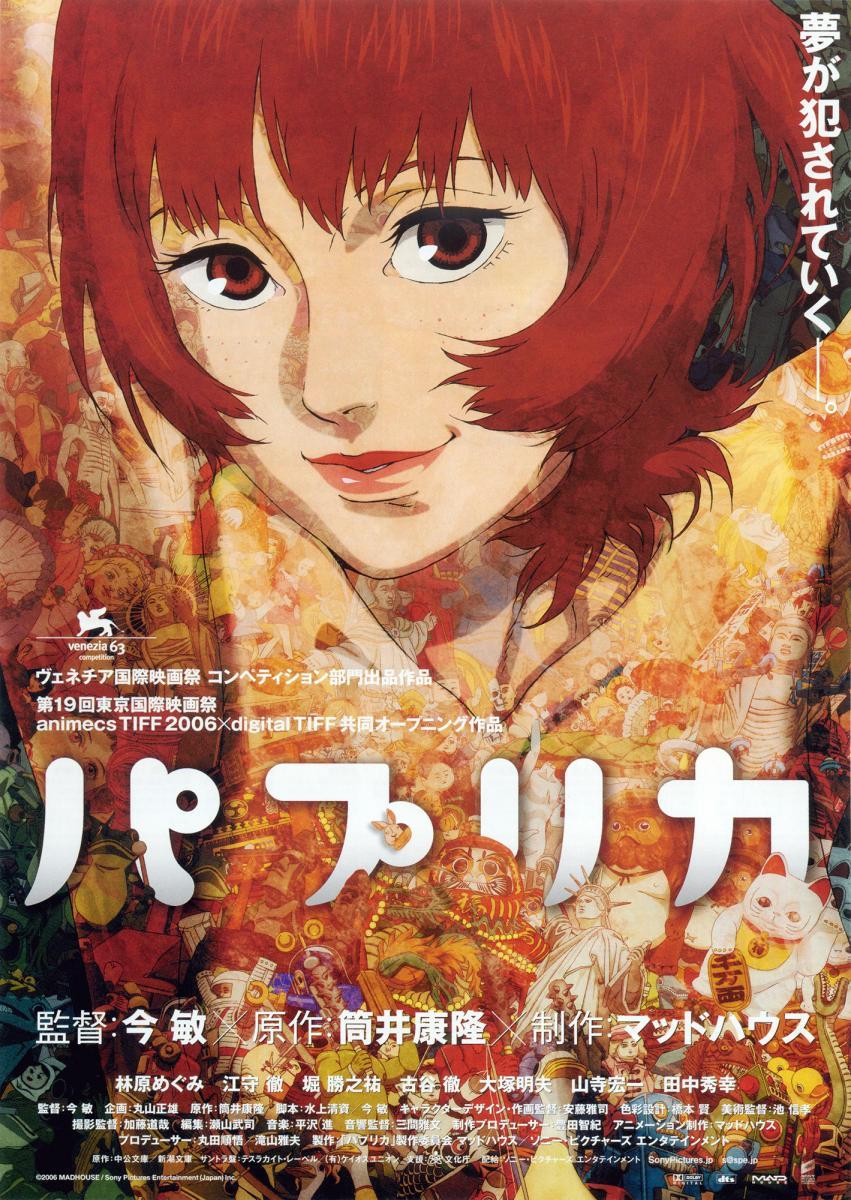
#26: Paprika (2006)

From http://pics.filmaffinity.com/Paprika_detective
_de_los_sue_os-439873032-large.jpg
Director: Satoshi Kon
Screenplay: Seishi Minakam and Satoshi Kon
Based on a novel by Yasutaka Tsutsui
Voice Cast: Megumi Hayashibara (as Doctor Atsuko Chiba/Paprika); Tōru Furuya (as Doctor Kōsaku Tokita); Tōru Emori (as Doctor Seijirō Inui); Katsunosuke Hori (as Doctor Toratarō Shima); Akio Ōtsuka (as Detective Toshimi Konakawa); Kōichi Yamadera (as Doctor Morio Osanai)

This would've been a difficult task - covering an anime by the late Satoshi Kon and explaining my admiration for him - regardless of which of his small filmography I choose, but it does also mean I got to revisit this film again and see why I admire him like so many do. Paprika is the one in his career which is the "flawed" film of his filmography, but you'll also see why I love it if you follow the link to the full review HERE.

From https://canime.files.wordpress.com/2007/11/paprika4.jpg