Showing posts with label The Collection (Manga Entertainment). Show all posts

Thursday, 23 July 2020

Bonus #12: Red Hawk: Weapon of Death (1995)


Directors: Jung Yul Hwang and Sangil Shim

Based on the original manhwa by Sang Wol Ji and Ju Wan So

Voice Cast: David Lucas as Jan Chang; Tessa Ariel as Hongylung; Dorothy Melendrez as Village Kid; George C. Cole as the Narrator; Jimmy Theodore as Liu; Jonathan Charles as Mounja; Mona Marshall as Ko Wan; Peter Spellos as Morlyung; Simon Isaacson as Lord Seobong; Sparky Thornton as Muklyong; Wendee Lee as Lunyung

Viewed in English Dub


Didn't they even give you a welcoming ceremony? How rude of them.

We return to a bonus review, a return to Korean animation, to which Manga Entertainment licensed two titles back in the era where, on VHS, they made themselves and their infamies within from the likes of The Legend of the Overfiend (1989) too. Armageddon (1996), becoming a guilty pleasure for me, and Red Hawk, in comparison a much more conventional and consistently put together production than that film or, (shudder), Blue Seagull (1994). This does raise an interesting question, in how things might have been different if Manga Entertainment, having decided to acquire these titles in the nineties, invested in others from other Asian countries beyond Japan alongside anime.

Sadly, as has been the issue with non-Japanese Asian animation and comic books, I seriously doubt they were released with any distinction of their origins, Red Hawk still finding itself in the Collection, my own personal obsession from the company, alongside Violence Jack (1986-1990) to Bubblegum Crash (1991) without any distinction. Tellingly neither Korean title even had an entry on the trailer to that Collection, burnt into my mind from playing it on their old DVDs for too long alongside Mad Capsule Market songs. Red Hawk was sold, likely, as the simple action tale it is. In period Korea in the past, a former ally of villains becomes Red Hawk, a mysterious hero for the people who is masked, wears red and has a hawk. He becomes embroiled in the death of an artisan and counterfeit money, all whilst a likable goof protagonist and a group of friends are on the same mystery. It does evoke how many of these titles were created for their own national audiences, which can be seen in the more esoteric anime which is based on lore or their history; likewise, alongside this, the English voice actors have to negotiate around Korean names as a further reminder of this.

Technically, it does feel more consistent to the other Korean animation I have seen. I will be honest that, however, whilst it is just okay, it is not really that interesting. The meat and potatoes are able to be turned into something interesting, even having a strong female lead who we are introduced to beating up a man the size of a small hill and his ninja lackeys, all of which could go to somewhere. The issue is entirely with execution, where there is a sense that Red Hawk was a production tentatively put together, possibly aware of Blue Seagull as a disaster, possibly not, but definitely cautious in its production. One of the directors made beforehand Street Fighter (1992), a knock-off of the Capcom videogame franchise with the cast now looking exceptionally cartoonish but definitely the copyrighted figures, meaning that this was definitely a foot into a different direction with higher aspirations.

There is a little spice, but this is a very basic film. It also shows that tropes do travel countries, as well as the fact that comedy and drama mix a great deal, as this has a lot of serious moments but also pure slapstick, the lead hero mostly acting like a prat, able to rescue a young girl from a bull but fleeing from being gored when she is safely out of its way. Unfortunately, the film is very predictable. The little spice is some of the few esoteric details - mainly one henchman who is a very elaborately dressed man, even designed to look flamboyant without becoming a stereotype, who deals in the likes of a "Dismal Spirit" poison down the throat that kills most people, to a dark room where spider web can be found that allows him to predict his opponents moves. He is the only idiosyncratic character on the villains' side, right down to the fact his boss still slaps him around despite being a dangerous figure, only acceptable because said leader, whilst an old man, can suddenly grow giant amounts of muscle and is clearly the final boss. It helps that, whilst the English dub is a terrible example of Manga Entertainment adding swearing to raise the age rating, this at least results with that henchman having a scathing comment when he is proved disposable.

Beyond this, sadly even Blue Seagull is compellingly awful, whilst this really does not stand out at all. This is a shame as, among the aforementioned Collection licenses from Manga Entertainment, this was the last of them for me to actually see, rather than review, tragically one of the least interesting of the lot. Beyond elaborating on the plot, which is a bad sign, even in terms of the production, it is not necessarily good or bad, just competent in context. (The only idiosyncratic touch turns out to be the nineties techno music that occasionally appears in the score.) Red Hawk leaves open the promise for a sequel which never came, as the real villain is left unscathed, but the two directors never went on to direct any more feature length anime.

Sangil Shim does have a career, which means I can at least be happy that they went on to continue working and with a lot of fascinating little tangents in their filmography, working in a lot of animation for the United States and Japan too, between Æon Flux (1991) and The LeBrons (2011) to Claymore (2007)1. If their IMDB credits are right, they have even been a "food and food stylist" which raises a fascinating little question of what that job entails, especially as it involved working on Park Chan-Wook's 2009 vampire film Thirst. Jung Yul Hwang I cannot find anything on, whilst another fascinating detail is that, for the Korean dub, the only figure who went on to greater roles is Gwang Jang, an actor who has acted in live action and for voice acting who has been prolific, especially into the 2010s, and even narrated Thomas & Friends, which means I can inexplicably end this review referencing Thomas the Tank Engine with credibility.

====

1) Also Skysurfer Strike Force  (1995-6), an American production I am amazed managed two seasons, one of the many ridiculous American cartoons that came from the nineties, though not one I watched, but trying to chase the trend for sky surfing. Yes, I would like to watch the two seasons.

Monday, 6 July 2020

#150: Tokyo Revelation (1995)


Director: Osamu Yamasaki

Screenplay: Mamiya Fujimura

Based on the Megami Tensei franchise

Voice Cast: Hikaru Midorikawa/David Lucas as Kojirō Sōma; Nobuyuki Hiyama/Alexis Lang as Akihito Kobayashi; Hekiru Shiina as Kyōko Shibusawa; Hideyuki Umezu as Gagyson; Kōichi Yamadera as Takehiko Kuki; Kotono Mitsuishi as Saki Yagami; Manami Komori/Debbie Derosa as Marika Kusaka; Toshiyuki Morikawa as Yōsuke Miura

Viewed in English Dub

[Some Major Plot Spoilers]


Teddy bears and knives, kinda weird.

An odd choice a special occasion, but also fitting as, to my surprise, the director of this obscure OVA also helmed Gesalt (1997), an obscure OVA that was the first I had ever covered. Also whilst one could have celebrated a rounded number with a known title, something like Tokyo Revelation is fascinating as much for what it stems from in terms of anime especially from the OVA era.

Tokyo Revelation is also not as special as I remember it, but I still see the strange if maligned aura it had that intrigued me. This is also another title from The Collection, a DVD series of old Manga Entertainment licenses from their VHS era that I am probably the only person obsessed over. Out of all of them, this is definitely one of the weirdest. It is also an apt choice for a special occasion as it's alternative name is Shin Megami Tensei: Tokyo Mokushiroku, which means it is a piece of a multi media behemoth called Shin Megumi Tensei that some of you might have recognised. Video gamers may know this franchise more than anyone else, if not from the Megumi Tensei games, but by its spin-off Persona, which is a big title from the 2010s on at least.

Megumi Tensei originates from a novel series Digital Devil Story by Aya Nishitani. Notable, the pieces of this franchise are not all necessarily connected, but instead can have separate single tales. In fact, reading on the franchise, it has always been drawing on many different inspirations - religion, occultism, philosophy, even Jungian psychology - which offer a great deal of variety of influences to the material. It is a branching tree as a result that has allowed a vast number of narratives to grow from its roots. Tokyo Revelations was the second anime in this franchise's history to be created, originally a two part OVA production at only an hour altogether, compiled as a fifty five minute film by Manga Entertainment. There is immediately the issue that this leaves very little time for this peculiar take on apocalyptic drama, crammed in details including its dated interests in virtual reality and really idiosyncratic touches.

The protagonist is Kojiro, who is likely a reincarnation of Masakado, the guardian of the Kanto region. This is explicitly Taira no Masakado, the real life samurai from the Heian period of Japan (794 to 1185), and a figure referred to other source, notably the lengthy Teito Monogatari, a seminal novel series (and debut) from polymath Hiroshi Aramata. Alongside becoming a figure of supernatural folklore, Masakado can claim credit to having influence a novel series which was adapted twice to live action, including in Akio Jissoji's blockbuster Tokyo: The Last Megalopolis (1988) and, in another Manga Entertainment license which did not translate over to the DVD era, the notorious Rintaro OVA adaptation Doomed Megalopolis (1991).

The villain, one of them, is Akito Kobayashi, introduced deliberately causing an airplane to explode midair to harvest a force known as "magnetite". He is an old childhood friend of Kojiro, coming to his school as the mysterious transfer student, a trope common to many anime, and interesting in his classmate Saki, a virtuous female student rich in magnetite, a magical essence of life needed to summon a major demon. There is another force trying to protect Saki. There is another, never really defined or detailed in the slightest, which stay out of this conflict and is only of note for another female student with supernatural abilities called Kyouko, a freshman who has a crush on Kojiro and wishes to protect him. Even if it means giving him knives imbued with moon energy on school grounds abruptly.

The OVA for me is both evident of the absurdity of the formal's golden era, but also how it could be brimming in creativity even if such examples like this are mocked decades later in YouTube videos. On one hand, when a group of four girls are immediately smitten with Akito, he has them brainwashed in a demonic ritual circle to have an orgy with each other until demons can possess their bodies and go kidnap Saki. It is utterly lurid and silly. On the other is the major plot point, even stressed in body language, that Akito is actually a tragic villain, explicitly attracted to Kojiro, his interactions (at least one clearly) with a romantic attachment that Kojiro sadly rejects. Of course, there is the stereotype of the tragic gay character, which is just as problematic if frequent by suggesting that not being heterosexual means a life of tragedy. That said the ending, with a huge spoiler, was always the aspect of Tokyo Revelation among others that stayed with me. That, redeeming himself, Akito is able to get his wish by way of what is effectively a synchronicity of souls, as he sacrifices himself but still exists in another body of a female character and her consciousness intermingled with his. Still potentially problematic depending on how you read it, but this no matter how rushed the production is stood out as surprisingly bold for a simplistic story.

Also this type of pulp, when it works or even has some nifty ideas, was always rich in creativity even when silly and lurid, even the ritual circle scene orgy matching the mood of the erotic and the grotesque anime is imaginative at. Another example comes when a female member of the good side is brainwashed, mouth to mouth, with an exceptionally phallic worm monster designed to spring out the same way at their base. It would work, with its explicitness, whether the host was male or female never feeling like it is crass or objectifying, all because the creature design and horror is appropriately nasty.

The other factor of interest for me, common in so much Japanese pop media, has been how these tales are always explicitly set, unless period tales, in modern Japan and especially in urban environments, empahsised more by how this obscure OVA even refers to a real life ancient samurai, a reminder that we forget that these are pieces of Japanese culture. It feels more of note when, for this one's OVA dub or any old Manga Entertainment dub (like many from The Collection DVD series), many of the voice actors are stumbling over Japanese names and terms frequently. True, we have tales like this in the West, but there is as much an attempt to distance them from us unless slasher tales, to the point we pushed the supernatural into gothic castles or underground clubs of the producer's imagination. Here, you have someone walking his dog in one scene in a park only to be attacked by a Cerberus dog at night in the middle of a city. In the logic of anime, even a messy and deeply OVA like this, you can have the atmosphere of the supernatural and the unconventional but spliced with the added later of the banality of modern life. Even the anime logic and clichés - a secret group of demon hunters, the mysterious transfer student, a second transfer student who is a cool motorbike riding young woman with pink hair - have to be threaded through these ordinary environments, helped as much by the fact (whether the case here or not) many productions have used real life locations and painstakingly copied them into animated form.

It cannot be ignored that Tokyo Revelation rushes along. Even without the Manga Entertainment dub, which has their notorious habit of additional swearing to the dialogue to up the age rating for the United Kingdom release, you have ridiculous combination of how much is just abruptly introduced and what exactly that entails. Such as the demons creating their own virtual reality back when that was a buzz word in the nineties, leading to one of my most beloved pleasures in anime of characters being sucked into strange environments, here one with a chequered black-and-white floor and floating metal orbs in the air, all whilst the characters are attacked by a jumble of mythological creatures like a harpy. The short space of time to cram so much of the plot, over what were originally two episodes less than thirty minutes each, including an apocalyptic scenario, is also one of the huge perils of the OVA format, even if this was a case with an actual ending. It feels hastily put together by the last act, ending in a battle between hero and a demon which you have no emotional weight to. In fact, the huge surprise for the story, involving the character Akito, is a virtue considering you could not give a damn about most everything else in the denouement.

Said ending is  also helped by how, in the final minutes, it is a strangely poetic one who's cast monologue in voiceover about the endless cycle back and forth between life and death, and how death comes to life again, befitting what in the plot for me was a sweet conclusion. If it is, truthfully, a deeply silly piece of pulp from this era, which did not mean it did not have its enjoyments and virtues.  So, add it in a growing list of animated guilty pleasures from Japan, doomed to be lost outside of web rips unless we think of them. The story is a generic mortal versus demons story crammed into 55 minutes which is not paced well in the slightest...and the results show. What makes it a pleasure though, aside from humorous moments that happen out of nowhere, is a surprising sexual streak in it that would give a Freud wannabe a field day and the surprising emotional layer to that area as well, all in spite of how abrupt it can be. Normally portrayals of sexuality in anime from what I have seen are toe curling at best, but here it is close to becoming surreal and in one case surprisingly progressive and inspired. If even this lurid OVA can pull that out of nowhere, then it says a lot of how good anime can be as a medium. Hence, it is perfect way to celebrate a hundred and fifty anime.


Friday, 24 May 2019

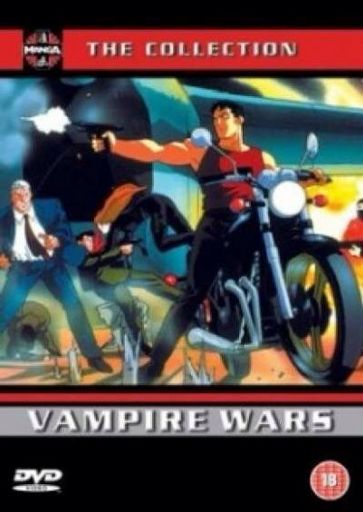
#101: Vampire Wars (1990)

From http://s2.narvii.com/image/
5akcllhpzigfdusunbdbvduw3qij5jpa_00.jpg


Director: Kazuhisa Takenouchi
Screenplay: Hiroyuki Hoshiyama
Based on a novel series by Kiyoshi Kasai
Voice Cast: Masashi Sugawara as Kōzaburō Kuki; Shūichi Ikeda as Milcea Millere; Yuka Koyama as Kiki Lamia Vindau; Kaneto Shiozawa as Muraki; Masaru Ikeda as Mirucha; Masashi Sugawara as Kuki; Takeshi Aono as Charlie Milan; Toshiya Ueda as George Lazare; Yuka Koyama as Kiki; Yūko Mita as Brigit
Viewed in English Dub

Considering the first review was an obscure OVA (Gestalt (1997)), its befitting number #101 is another obscure OVA, something ridiculous this time. Not to be confused with Psychic Wars (1991), but both were Manga Entertainment titles which were, yes, released on DVD again as part of "The Collection", likely an obsession for me because I've over watched the previews on them scored to classic music and the Mad Capsule Markets. Vampire Wars is also an example of Manga Entertainment's infamous tendencies for "15-ing", of adding swearing in the English dub to lift the age rating on their releases, but Vampire Wars is just about to hit "18-ing" in how comically potty mouthed the lead anti-hero gets to be. It does mean, whilst a fan base probably doesn't exist and reduces the chance of this ever happening, I wish I could've seen the original Japanese dub trying to be serious with this lurid material. This is an anime which tries to pack a story far too complex for less than fifty minutes without a conclusion or any major plot threads being finished, so the silliness of the expletives just makes the experience additionally absurd.

To start with, earning a MASSIVE SPOILER WARNING on the get-go, what is it with anime sometimes envisioning vampires coming from outer space? It's an obsession of mine I cannot really provide more than a handful for, but between this, Vampire Hunter D (which brought in gothic horror, dystopian sci-fi, even the western in its world) and Trinity Blood (2005) there were three titles I saw at an impressionable age that lead to this conclusion. All I can say is that, in exposition that never means anything of importance to the OVA even if a massive exposition dump near the end of its running time, we're told of two alien races, one who became our vampires, the others (who we never see) a technologically advance group who are a potential threat to Earth. None of this is worth when, truly, the plot is an utterly unlikable arsehole named Kōzaburō Kuki, a communist terrorist who has worked with figures who have killed many civilians, who is blackmailed by the French Secret Service to investigate a mysterious assault on a NASA base. This leads to vampires and a female celebrity Lamia who is being targeted by said vampires, and other human groups, who he does show some humanity to in protecting her.

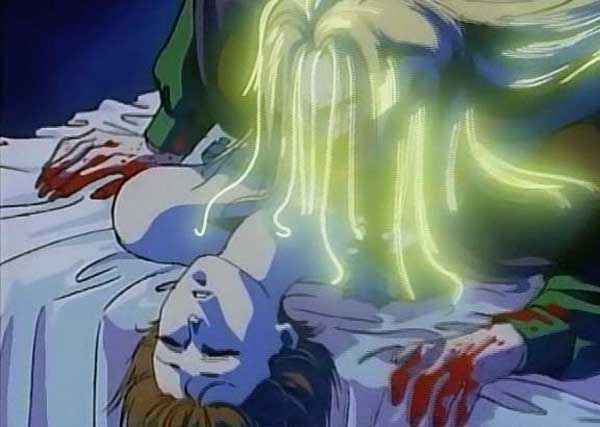
Vampire Wars does belong to the even bigger phenomenon of vampires in anime in general. Vampires aren't natural to Japanese mythology or folklore unless you get to hopping corpses and Chinese vampires, so they have always had a fascinating touch in that, in some cases, they will have to explain whether in live action or animation their mythos with interesting results. Sometimes they don't bother as here. There's one great detail at first I wish vampire stories tried again, where a female vampire doesn't need to worry about being shot in the head, so doesn't wear any armour but a bullet proof vest where stakes would be dangerous to her. After that, they aren't really interesting until they're revealed to be aliens who turned to channelling their spiritual energy, anime's New Age tendencies surprisingly prominent in stories like this, to the point only blood is needed to sustain them.

From https://m.media-amazon.com/images/M/MV5BNTk1MzUwYTMtMDQ4M
i00ZjYzLTljNDEtMTVlOGJlN2YwMzI2L2ltYWdlL2ltYWdlXkEyXkFqcGdeQXVyMzM4MjM0Nzg@._V1_.jpg

That there is no ending, no follow-up as a tie-in to a novel series, means Vampire Wars does suffer from being a diversion that lacks a lot of memorable detail in aesthetic, creativity or any sense of weirdness. Its definitely nasty, with the gore, the unfortunate treatment of French sex workers as one is murdered for blackmail, another punched in the face by the evil giant henchman, the general sense of sexism which sadly permeates this type of pulp, and with a slight moment of body horror with the vampire's mouths turning into maws when they need to eat, ripping throats out. It's not possible to take seriously in lieu of, unless you want to try to justify that nasty streak which is just grimy for the sake of it rather than dramatic and not advised. Obviously, the only sympathetic figure is Lamia, who is the stereotypical damsel in distress until (thankfully) she gets to unleash carnage in an airplane mid-air with a secret about herself and random objects, a nice touch too.

Like the rest of these Manga Entertainment titles, I find myself drawn to the likes of Vampire Wars nonetheless as time capsules as well as for morbidness. A Toei production, famous for the likes of the Dragonball franchise, it's a surprise to see something this violent like many other titles from this era. Not a lot of it is pleasant as mentioned, the tendency to macho touch (but boring) male characters and every women a damsel or victim is something we thankfully got past, but at the same time the mad dash to try to cram so much plot in such little time when its ultimately a doomed decision is strangely compelling. There's a fascinating premise inside the anime that could've made an interest multi-episode OVA, when your protagonist is completely hateable but goes through a literal transformation (even begrudgingly) to someone with a heart, all whilst in this crazy violent horror-action-science fiction hybrid. What you get instead is a sketch that lunges from a to p and skips letters in pace out. The English dub, comical in the swearing, feels appropriate for the material whilst also being utterly embarrassing too. How even in 1997, when titles like this were licensed and these dubs were churned out, this was considered a wise product for Manga Entertainment has to be asked even if affectionately.

And affectionately is to still be found as, from the hand drawn grime to the synth score, notable from Kazuhiko Toyama (who worked on the likes of Cyber City Oedo 808 (1990) and Darkside Blues (1994)), there are virtues in aesthetic to these little animated nasties that I wished were re-implemented in the modern day. Moments do show this - I wished Devilman: Crybaby (2018) was more readily available to see beyond Netflix as, by all accounts, letting an auteur like Masaaki Yuasa tackle a lurid Go Nagai premise meant the lurid hyper violent content was matched by a lot of rewarding content. I wish a lot of these titles borrowed even from the aesthetic of non-adult anime from the late eighties and nineties which Manga Entertainment also licensed (and sometimes add inappropriate swearing too) as, rather than nostalgia, switching out to J-pop for synths or just embracing old art styles, in a period of remaking old properties, feels like an artistic tool of interest. If Vampire Wars ever turned out to be a property to get a remake, which would be hilarious considering what it is, hopefully it might turn out to be a better vampire anime than a lot are and elaborate on this story further than you get here.


From https://www.clubdesmonstres.com/best/img/vampirewars1990e.jpg

Friday, 25 January 2019

#85: Amon Saga (1986)

From https://cdn-2.cinemaparadiso.co.uk/
040801101841_l.jpg


Director: Shunji Ōga
Screenplay: Noboru Shiroyama
Voice Cast: Kenyuu Horiuchi as Amon; Banjou Ginga as Ekuna; Ichirō Nagai as Mabo; Katsuji Mori as Alcan; Kiyoshi Kobayashi as Valhiss; Koji Toya as Ho; Kouji Totani as Ho; Mugihito as Gaius
Viewed in Japanese with English Subtitles

Synopsis: In a world far alien to ours, Amon is a wandering warrior who witnessed his mother being killed by marauding soldiers as a child. His quest for vengeance leads him to the army of the Valhiss, led by the evil Emperor (of the same name) whose army have kidnapped the princess of another nation of in hope of knowing the location of a city of gold.

From http://cartoonresearch.com/wp-content/
uploads/2016/04/AmonSaga25.jpg

In context of anime history, Amon Saga is pretty standard of its era, a piece probably more distinct in its original context as whilst fantasy stories have existed for a long while in anime, I'd obviously argue it's grown as a popular trend for television shows built off the back of their forefathers decades earlier. In terms of Manga Entertainment's The Collection DVD releases, it was a surprise. First because this actually had a Japanese dub track with subtitles, the one release with its own aesthetic style to the DVD menu; it's the kind of thing that'd cause the layperson to roll their eyes in disbelief of coveting an interactive screen on a video disc, but there's just the surprise to actually be able to hear the original Japanese cast rather than a potentially awful English dub only. It's also a production that, despite its averageness in the history of even just fantasy anime, was also a stand-out for just being watchable among some of the really generic material I've put up with within The Collection.

It had an immense advantage that, whilst it had to be interpreted out of his hands into a more conventional art style for the era, one of the most idiosyncratic figures from illustrative art design worked as a character and conceptual designer on the project, alongside being a main creator of the original premise, someone by the name of Yoshitaka Amano. Starting in the late sixties, working on anime series like Speed Racer when he was only a teenager, Amano has effectively transcended pop culture to become an artist by itself as a career, one which has left a mark in pop culture as he had a hand in the illustrations for the seminal Vampire Hunter D light novels and the Final Fantasy videogame series, alongside having enough of a reputation to work with the likes of Neil Gaiman in the West, created an illustrative adaptation of Wolfgang Amadeus Mozart's The Magic Flute, and live out a career where his work is shown in galleries.

From https://66.media.tumblr.com/ebf678dfb6db8bad024ccc5cba16fe05/
tumblr_ou819h6UUi1rhvtj2o4_500.png

And as his work attests to, he is an incredible illustrator who justified the acclaim, someone who is imaginative which means even a semblance of involvement with Amon Saga is probably where the good visual ideas, rather than the generic ones, probably came from which decorate the conventional fantasy tropes. It's clear from the get-go, with some knowledge of Amano's style, that he didn't necessarily have a great deal of influence on this obscurer anime OVA, more so as he had worked by this point directly with Mamoru Oshii on Angel's Egg (1985), the only collaboration in anime where the art looks like his illustrations and is sumptuous as a result.

Arguably, the real detraction from Amon Saga is that it's conventional - between the archetype of the fair princess to be rescued to the tough side kick who, introduced in a bar full of scum and villainy shows a heart of gold after he fights Amon, it all plays out as you'd expect from the premise. This does raise the question whether Amon Saga is actually any good - in comparison between this interesting creator behind the production and the conventional storytelling, ultimately what little of Amano's original ideas appear onscreen win even in spite of this issue but it has to be considered that the material is average or just fun at least, nothing more.

From http://www.the-unknown-movies.com/
unknownmovies/pictures/amon3.jpg

Amon Saga,
thankfully, has the creativity of Amano for its production so that even if this is the case, there's been enough here for me to appreciate hidden underneath it all and emphasising the stranger story it could've been. Stranger and more vivid in what does appear to, merely starting with having the villains fly around on dragons like horses or the protagonists being abruptly attacked by werewolves in the woodlands without context even for a fantasy world. Then you have to content with the main evil emperor looking like a giant golem robot in his full costume, whose entire empire if a moving landmass on the back of a giant turtle which travels around the world ransacking the local populaces. The anime even throws in an actual golem, a golden knight, who helps the heroes out briefly A facsimile of the elegance of Amano's work, which isn't perfect, what you get at least lets the curious touches be felt, all baring in mind it is within a conventional fantasy which has clearly defined villains and heroes.

Not surprisingly, the main hero is a blank next to everyone else, surrounded by funnier sidekicks and whose briefly witnessed mentor has a surprisingly similar appearance to the protagonist D from the Vampire Hunter D franchise, unpleased by his own decision to even train Amon in the first place. The evil minions also has a scene stealer in their diminutive evil wizard, whose eyes distort into a bird's when he makes an incantation, the sorcerers versus magician fight with him against three pits magical snakes versus magical rings a step above Amon's own final fight despite being off at the entrance of the city of gold. There's also the odd and hilarious fact that, whilst he is our protagonist and does prove himself in a battle by numerous mercenaries to climb up one of nine rope ladders which turns into a fatal battle royal, he has a living deux ex machina who is a lizardman archer, someone who saves his backside twice even in the climax out of nowhere. Moments and details like this are utterly ridiculous, but having feasted on some many anime productions like this particular, I am able to find a lot to still admire in Amon Saga even if I suggest caution except to someone who wants to dig into obscure fantasy anime before viewing this one.


From https://66.media.tumblr.com/b3ccc2d730c5c45a5656bcdbc
26bb8c9/tumblr_ou81djkSSZ1rhvtj2o5_500.png

Friday, 21 December 2018

#80: Landlock (1995)

From https://images-na.ssl-images-amazon.com/
images/I/51AH17D1Q6L._SY445_.jpg


Director: Yasuhiro Matsumura
Screenplay: ORCA
(Voice) Cast: Ally Coyote as Agahali; Darryl Borden as Luda; Howard Chen as Nosaku; J.F. Searle as Zanark; Mike Pustil as Volk; Sarah LaFleur as Ansa
Viewed in the English Dub

Synopsis: In the world of Zer’lue, a young boy named Luda (Darryl Borden) is assigned the power of the red eye of the Wind God, only for Zanark of the Zul’earth kingdom to invade and kill his father as a plan to have the red and blue eyes of said God for himself.

[Spoilers Throughout]

Landlock? Somehow in watching this generic 90s fantasy anime, part of the Manga Entertainment DVD collection of old licenses, I pine for Violence Jack (1986-1990) again of all things. I cannot even make the comment, admittedly cruel, that I'd never thought Ghost in the Shell author Masamune Shirow could pen a bland sci-fi fantasy anime...only to learn he only contributed to the (admittedly nice) character designs and Landlock has little beyond that in notoriety.

Being able to fish virtues out of any anime, even Landlock has moments of visual vibrancy, originally a two part OVA but put together as a theatrical length one-off by Manga Entertainment, who also (unfortunately) created a terrible English dub, one of the least worthwhile in a while from The Collection series. Visually, the anime at least has a colourful, sci-fi folk world of ancient period dress but with floating sky fortresses, mech robots and the sort of visual styling you would find on a prog rock or power metal album cover, which isn't a bad thing at all. Even the decision, based on providing a contrast between two halves of a godlike power based on red light/eye or blue light/eye, has a nice aesthetic appeal as well as being for an anime (by some unconfirmed and debatable source) that was going to have a Sega Saturn game tie-in that never came to be, thus would've been part of the power up aesthetic if it came to be.

From https://www.onthebox.com/wp-content/uploads/2015/11/Landlock-1.jpg

Unfortunately this in service of the most generic of properties; Shirow merely designing the characters is a shame as, whilst by all accounts as mad as a box of frogs from what he apparently went on to (weird porn and all) in his career afterwards, he would've gone somewhere interesting in ideas even if the results were a car crash. Instead this emphasises the dangers of fantasy as a genre, its reductions of Hero's Journey plotting, and bastardising mythology and religious tales continuing until it's the flavour of cardboard.

Only that sense of visual spectacle occasionally stands out among a really generic cast of characters - standard teenage male hero, quirky anthropologist who is pulled into the tale and does little, the hero's sister and so forth. The only real drama is to be found with the villainess who kill's the hero's father, revealed to be related, thus making her decisions in murder to have a horrible new context, all whilst one of her male squad members working under her is willing to changes sides with her as he is in love with her. It is in itself a fascinating side plot that, in another context, would have been fascinating to see even if there's the absurd notion that she's managing a squad despite being a teenager. That and the fan service nudity, which is creepy when its signposted the main characters are teenagers; it is one of those constantly bizarre decisions in anime found even into the modern day that, even as a fan of anime, has always baffled me when it made far more sense to have characters in their twenties instead of, even without shifting into Hubert Hubert territory, having a tasteless choice and a clear fear of aging.

From http://1.bp.blogspot.com/_Uk-HUnWYqN4/TT-raHqW85I/AAAAAAAAAKg/
-mk54AlQugw/s1600/vlcsnap-2011-01-22-21h58m14s3.png

After that, it's low in choice to find anything to fill a review up further from. The issues with The Collection, this reoccurring series that only a madman like myself will be obsessed with, is that as with any company Manga Entertainment licensed titles to push out product, and in any era of the anime industry they'll release material that you'd look back on with bafflement if you came across old VHS and DVDs as much as hidden gems, a phenomenon that exists still in the streaming world and probably is worse now. The OVA market, which fed into much of The Collection, is one that for every compelling work (for good or bad) also includes product like Landlock which feels like it squandered artists and ideas.

And Landlock, especially if you can cut a trailer set to Mad Capsule Markets as Manga Entertainment did, would have easily worked as a curious sci-fi tale which yet emphasises a medieval/possible Mesoamerican influenced world, one of a wind god and ritual statues of deities you can use to teleport over vast distances if you have the power, evoking Dune in the blurring the fantastical and the intergalactic. Plus no one would argue with the dynamic meat of a villain, female in this case, who is scarred by what she has been tricked into doing to changing sides for a legitimately profound reason, something more morally superior (and common in anime) than the Western tendency to kill  them of in revenge. Especially more so, as the hero himself is your generic male non-entity, that the female characters have a hell of a lot more cared for it their designs than any of the male characters in their own, another peculiar trait of anime I have less concern of even if there's a fear of a creepy fetishisation in a female character's hair colour.

From https://i.ytimg.com/vi/_Af2YLu2e1k/hqdefault.jpg

Instead, it's bland, that aforementioned dub terrible and also makes me pine for Violence Jack which, for all the horrible content removed from it, at least had a memorable dub. If anything at this stage going through The Collection, the closer to the mid-nineties and onwards the more interesting observations are to be found in the tropes that'd take over, like that weird fan service, and the increasing emphasis on bland male teenage heroes over gruff men. Distinctly, in its sense of colour and style, it's of the nineties only, looking very different from the eighties but different from the modern day after the transition to digital animation techniques.

There's also the sense that, if one is going to appreciate trash or have tropes that I am immediately smitten with, Landlock's too set on telling its generic tale without any sense of surprise or the fun of slightly going insane, a killjoy stubbornly telling an obvious story straight. There's not even a scene of the protagonist ending up in a phantom realm of swirling colours and objects, whilst a supernatural entity providing an exposition dump, that became a personal obsession of mine as a result of viewing The Collection titles, all in spite of the opportunity to in a story which gives you carte blanche for it to happen, and eventually leads to giant hands being summoned that can smash whole miles of forest canopy underneath them....that it wasn't included and could've just makes me feel more disappointed.


From https://i.ytimg.com/vi/s9vQifilWqo/hqdefault.jpg

Friday, 17 August 2018

#62: Bubblegum Crash! (1991)

From https://m.media-amazon.com/images/M/MV5BZGNmNWE5NDYtNmNhMS00YT
diLTk1NDgtNDFjN2ZmYzBlYzBlXkEy
XkFqcGdeQXVyNTAyODkwOQ@@._V1_SY1000_CR0,0,712,1000_AL_.jpg


Directors: Hiroshi Ishiodori (Episodes 1 and 3), Hiroyuki Fukushima (Episode 2)
Screenplay: Emu Arii
Voice Cast: Akiko Hiramatsu /Barbara Barnes [Manga UK Dub] as Nene Romanova; Michie Tomizawa/ Stacey Gregg [Manga UK Dub]  as Linna Yamazaki; Ryōko Tachikawa/ Julia Brahms [Manga UK Dub] as Priscilla S. "Priss" Asagiri; Yoshiko Sakakibara/ Tamsin Hollo [Manga UK Dub]  as Sylia Stingray; Kenyuu Horiuchi /Michael McGhee [Manga UK Dub] as Daley Wong, ; Toshio Furukawa /Matthew Sharp [Manga UK Dub] as Leon McNichol
Viewed in English

Synopsis: 2034, two years after they helped Tokyo deal with rouge "Boomers", humanoid robots who have malfunctioned, the all female group known as the Knight Sabres have vanished from the scene. Three members - pop star Priss Asagiri, hacker Nene Romanova and Linna Yamazaki - presume, as their leader Sylia Stingrayhas been absent, that their previous role is over. When Sylia returns however, it's time for them to put the powered armour back on as a series of Boomer related incidents rock Tokyo again.

In 1987, a straight-to-video series started called Bubblegum Crisis. Futuristic Japan, directly inspired by Ridley Scott's Blade Runner (1982) (and Walter Hill's rock 'n' roll action oddity Streets of Fire (1984), which was much more successful in Japan than in its homeland). A story where mass produced robots nicknamed "Boomers" exist, only for there to be the problem that exists in most anime and manga stories, that they can go kill-crazy and malfunction all the time. Four female leads donned cybernetic power armour, dubbed themselves the Knights Sabres and over eight episodes in 1991 dealt with tasks even the A.D. Police, specifically founded to deal with Boomer related crime, cannot handle. Bubblegum Crisis was a success, not only in Japan but with a following the West for a certain generation. Naturally striking the iron whilst it was still hot, not always something anime producers have done, this popular series was followed by two tie-ins. Inexplicably, whilst Bubblegum Crisis was released in the UK, you're more likely to find these tie-ins second hand still than the original, as they were licensed by our home-grown company Manga Entertainment, which gives you a peculiar issue where some have probably never seen the original unless they got those episodes from a separate company or imported US releases.

In general the story of the franchise after Bubblegum Crisis is not that well regarded either, lasting to 2003 and really given a critical dubbing. One of the only tie-ins to succeed for some, and it's a divisive creation for some still, was one of the entries Manga Entertainment picked up named A.D Police (1990). Made part of the way through the main series' releases, it is in vast contrast to the original or its sequel, A.D. Police not only a prequel set before the Knight Sabres existed, but a lurid and nasty cyberpunk noir with more gore, sleazy sexuality and a very bleak tone, even to the point of ridiculousness of how masochistic the dialogue could be. Less regarded however, out of Manga Entertainment's acquisitions, is the actual sequel Bubblegum Crash! started the same year Crisis finished. Even in context of one of their lesser releases - part of The Collection of licenses transferred from VHS to DVD, ropey English dub and removing the end credits screen for a black one with text - it feels like a bad follow on. Even without seeing the original Crisis, which I have to confess now before I feel like I'm lying, I utterly see why Crash! is not well regarded as, even without the original context, it's not a good sci-fi action anime even by itself.

From https://m.media-amazon.com/images/M/MV5BYTEwNjViZTM
tZjBjNi00YzY0LWI4YmYtNjh
kMGZjODE0MjJiXkEyXkFqcGdeQXVyNTAyODkwOQ@@._V1_.jpg

Crash!
, contrary to my original opinion, only takes half of its first episode to bring back the heroines properly, who stay as friends but returned to their old lives, rather than a whole episode. However, as the OVA series consists of only three episodes in the first place, there's not a lot of time to work with and what does happen it exceptionally bland. A little joy is found in Crash!, at least in its awesome opening theme song of eighties synth rock, but the rest feels like a missed opportunity. Episode one, having to devote time to bring back the gang, skims over a mercenary army with cybernetic implants, all part of the series wide plot of a shady figure behind the machinations as that particular group rob banks. Pretty basic, cheerful action sci-fi. More egregious, and wasting a whole episode with its clichés, is Episode  2 following a more advanced form of Boomer with its own consciousness who is the target for theft. The member of the Knights Sabres who hates Boomers, Priss, is naturally the one who ends up with him and, not justifying its tale of her overcoming her hatred for robots to admire him, is syrup poured onto clichés, death to sit through. Neither does it help that, without the context of the original series, these characters for all the series are not interesting. Figures without the spark and colour their appearances and power armour suggest. The English performances are egregious as well, particular as for the Manga UK release an entirely different English language cast for the four main leads was hired, in contrast to the same one for an alternative dub who played the characters in Bubblegum Crisis.

The only interesting aspects of the first two episodes are the background details, a world with its own character that should've been pushed into the foreground more. Advertising and goofy promotional films for the A.D. Police, who are practically useless through these episodes. How the two A.D. Police with personality, Leon and Daley, get scenes like having to deal with a female cafe Boomer whose internal coffee machine has failed, pouring out coffee beans instead of the desired beverage. Material that makes the first two episodes more tolerable, at least more interesting. It's also specifically the comedy and exponential material which has nothing to do with the Knight Sabres as, especially in the English dub, what should be by all right interesting, tough female characters are the blandest gang of four you can get, where someone like Priss (here tough and hard boiled, and little else) is out staged by how camp the English voice for her slimy music producer is.

From https://m.media-amazon.com/images/M/MV5BZjM3N2IyY
TYtOWYwYS00NDA3LWI3ZDEtMDE5
NWNmN2NlN2ZmXkEyXkFqcGdeQXVyNTAyODkwOQ@@._V1_.jpg

Episode 3, starting with construction site Boomers in hard hats and robo-dungarees going murder-death-kill on humans, is the one truly redeemable part of Bubblegum Crash. Still an average series, but in context of the motley group of titles Manga Entertainment put together called The Collection, the only episode out of three where there's the trashiness I can enjoy as in some of the dumber entries from that series. It's certainly a lot more energetic and proudly trashy in an inventive way, when Boomers on mass crowd in the streets due to a virus that causes them to rebel, forming together into a giant bio-mechanical beast latched on a skyscraper, and leading to the heroes having to fire at it from an aerial vehicle. Something that's at least novel next to the predictability of the rest before, at least with the English dub providing a hoot of a line where the monstrosity screams, after it intends to kill them, to steal their data in that order. The episodes reintroduces a character from the prequel, making it the only episode of importance even if the plot's built from the first two, and generally has more on the line. A nuclear power plant in danger that could blow up all of Tokyo. A giant, street sized war machine on treads. The Knight Sabres in actual trouble, with inventive and scary looking robot designs. Even my pet obsession with characters entering phantom zones out-of-body makes an appearance, common in these old Manga Entertainment acquisitions, in this case an excuse for nudity and floating above the Earth for a weird cross pollination of sci-fi and psychic imagery.

In lieu of all the old licences Manga Entertainment put together as The Collection, Bubblegum Crash! is one of only two that [so far in 2018] have been made available on DVD in the 2010s. (The other is unfortunately the infamous Violence Jack OVAs, but that's for another day's review). They make a vast contrast next to the company in the current day who licences more respectable work like Dragonball Z and live action Power Rangers series. Out of those so far in The Collection, however, Bubblegum Crash! barring that final episode is one of the least rewarding I've seen, even with the third episode sadly both the most well known of two but the least interesting even paired next to the likes of Psychic Wars (1991) [Reviewed HERE] or the shambolic South Korean failure Armageddon (1996) [Reviewed HERE], bland and adequate rather than an utter, compelling disaster or something good.

From https://m.media-amazon.com/images/M/MV5BYTFm
MGNkNDAtY2ZmNy00YTllLWE5N2UtZ
WE5MWZjNjY4ZGY5XkEyXkFqcGdeQXVyNTAyODkwOQ@@._V1_.jpg

Thursday, 12 July 2018

#55: Psychic Wars (1991)

From https://m.media-amazon.com/images/M/MV5BMTYxMTk3NDQ3N15
BMl5BanBnXkFtZTcwNTU1MzIyMQ@@._V1_.jpg


Director: Tetsuo Imazawa
Screenplay: Yasushi Ishikura
Adapted from a novel by Yasuaki Kadota
Voice Cast:

[Japanese] Hideyuki Tanaka as Retsu Ukyo; Hiromi Tsuru as Fuyuko Asahina; Hiromi Tsuru as Yashaō; Toshiko Fujita as Shun'yō-ni/ Youni Shun; Daisuke Gouri as Demon of Earth; Ikuya Sawaki as Demon of Water; Junko Hagimori as Shunmin-ni; Masaharu Satō as Demon of Sky; Masami Kamiyama as Shunkō-ni; Ryūji Saikachi as Elder; Shigeru Chiba as Prof. Takase

[English] Alan Blyton as Ukyo Retsu/Demon of Sky; Julia Brahms as Fuyuko Asahina; Lisa Ross as as Shun-You; Roger May as Prof. Takase

Viewed in English Dub

Synopsis: Surgeon Ukyo Retsu finds himself embroiled in a Millennia old struggle between human beings and demons, from a period before the birth of Japan as a civilisation, when he treats a mysterious old woman for a monstrous cancer.

Throw a pebble into the water and you'll hit an obscure OVA. Some of them managed to linger into even the DVD era, the likes of Manga Entertainment licensing titles from the video era and repackaging them into trailers sound tracked with The Mad Capsule Markets. As a result, among the obscure Psychic Wars is pretty known for an older anime fan or the curious who dig second hand bins. Enough to warrant a permanent place on the Anime News Network worst-of list, voted by all its users, alongside being generally pissed upon. It's strange as, less than an hour long and amongst some true duds in Japanese animation, I have suffered through worse. Although that could be bias as I've inexplicably bought second hand DVD copies more than once of the fifty minute anime.

Like many, it's a strange mix of various genres and tropes that are found within anime and still rear their head into the modern day. They intermingle and create weird hybrids you can decipher and pick apart from older titles, from ancient lost civilisations, in this case an alternative history of one back when Japan was merely land full of primitive early men, demons (as in many anime), time travel, science smashed head first into esoteric weirdness, and the fact that Japan's religious background (Shinto at least) feeds into the symbolism even if not explored with remotely any depth here. Psychic Wars also has the unique distinction, which gives it some infamy just from seeing it in the Manga Entertainment DVD trailer, of our hero Ukyo Retsu, who looks like Kenshiro from the Fist of the North Star series in glasses and a doctor's white coat, punching flying cancers to death.

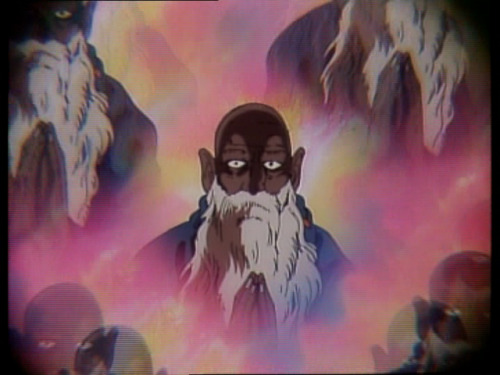
Hands up, I confess a love for these cheap anime productions for their gaudy horror/fantasy aesthetic and plots, colourful in a tacky way and the monsters all bulky toothed ogres who could be found in a Monster in My Pocket fanny pack. It is from Toei Animation, but could've been done by anyone. So much so that the one stylistic touch is so distinct, when Retsu first enters primitive Japan and the scene is entirely in monochrome until he defeats the horse riding demons, that you don't care if it was deliberately or cost effective. The other aspect I like from this anime, and is a personal obsession, is whenever a character finds themselves in a psychedelic alternative reality with weird landmarks (usually floating in the air) and backgrounds consisting of a couple of bold colours, be they in a phantom zone or being enlightened on a task by a mysterious figure. Here it's a kaleidoscope time vortex with priestesses floating in the air, part of this curious obsession of mine where, even with little to work with, animators were given a moment to be artistically creative regardless and without need for logic involved.

From http://i.imgur.com/KnmDoAj.png

The anime despite its short length is sluggish. Ultimately, it's not offensive to the eyes but among the many anime from this era that were churned out, even if they weren't carefully scripted or planned out, Psychic Wars is pretty rudimentary to stand out. Even considering its plot, depicting a period before Japan, one of the oldest civilisations, came to be even if that's depicted mainly through field and a demon city, it's not that different from other titles where alien entities intend to eliminate mankind and take over. How its managed to gain a reputation is arguably luck, and whilst I enjoy it immensely, I won't say it sets the world on fire even as a notoriously bad production. The tale of an evil demon race against human beings, its only the subplot with a generic nurse character which stands out in the end due to a cruel dynamic twist, one that's unpredictable to give the anime credit when it's pretty predictable everywhere else.

The rest is interesting because of the unintentional moments of humour. Punching cancers, which have giant teeth and turn into fleshy starfish, has already been mentioned, but there's also the fact that you can kick a giant, purple ogre demon in the testicles and still have an advantage over them. The minor character of a historian obsessed with his own theory of a secret civilisation, only to lament in horror at said destruction of a lost civilisation by unexplained destruction, or that the demons for all their advanced cityscape still keep enough explosives in one place to cause traumatic damage to the foundations. That the Fist of the North Star reference cannot be ignored as, whilst he looks vaguely different in the face, our hero's still a muscle man with unexplained martial arts and sword welding ability, the only difference between the North Star hero being that he needs  rifle to take down horseback riding demons rather than be able to make them explode with a mere touch.

I have used in regards to these types of Manga Entertainment release the term "beer and curry anime" in regards to their promotional tactics for them, attempting to sell them like a straight-to-video action watched drunk on a Friday night. I've probably overused the term, learnt from a long gone British anime review site, as it clung to me that Manga Entertainment were so adamant to try to sell even the likes of Psychic Wars as a commercial release. When released on DVD, there was always a sense alongside all the other titles in The Collection [A growing list already covered HERE] they were still after this market as well as exploitation old catalogue titles they still had the licenses to. It predates the growing gender balance and recognition of female anime fans, but I cannot help but view Psychic Wars in the same way as the stream of straight-to-video C-movies that came out in the nineties too, lurid edges usually with a little gore and sex, as is exactly the same here. (This even replicates a trope from American action films of its sole sex scene being all silhouettes in the dark). Something you need no context for, and anime would be released even when it had no proper ending anyway, exactly the same as those action films even if they had resolutions which were as predictable in plots and events as all the others, but you could still gain a lot from flooding the market with them. That sounds harsh but I look back to it with sympathy for these titles. As there's a fan base for those old action films, so I'm one of those individuals who are falling in love with the likes of Psychic Wars. Low hanging fruit in terms of taste, but it's not ironic love, instead understanding its place in the world and wanting a rerelease one day, no matter how illogical and unlikely to make back the cost of restoration that sort of decision would be.


From https://m.media-amazon.com/images/M/MV5BZjMxNzY2ZmItZ
Dk0ZS00MTRmLTg5NTEtNDhk
YjNmYjEwOTQwXkEyXkFqcGdeQXVyMzM4MjM0Nzg@._V1_.jpg

Wednesday, 4 July 2018

Bonus #7: Armageddon (1996)

From https://myanimelist.cdn-dena.com/
images/anime/3/8745.jpg


Director: Hyunse Lee
Screenplay: Hyunse Lee
Based on the novel by Hyunse Lee
Voice Cast: Alexis Lang as Heisung, the Delta Boy; Wendee Lee as Marie Kim/Pandora; Abe Lasser as Hades; Steve Blum as Commander Kaseros; Dougary Grant as Narrator; Gil Starberry as Tantharos; Jackson Daniels as Gamma 66-66; Melissa Williamson as Queen Hera
Viewed in English Dub

Synopsis: Heisung, a South Korean student, finds himself the one true hope for Earth's future called the "Delta Boy", part of an Millennia old tale of Earth being one of many planets created as part of an experiment. Rhose who evolved from dinosaurs on an alien world, the 'Eed', will soon to invade Earth and eliminate most of mankind in the future. Thrown into said future, when most of humanity has been wiped out, Heisung must become the chosen one to prevent this.

[Warning: This review will include a spoiler for a early plot twist. I will include a warning where it is and ends in the review so you, the reader, can skip it if you want to keep it secret to yourself.]

Cue a film that looks like a seventies rock album cover crossed with a remake of Space Adventure Cobra (1982). Yet the production is from South Korea, part of a very complicated history of the Korean animation industry. South Korea is famous for its studios which do outsourcing work for anything from anime from Japan to even The Simpsons, the later emphasised when artist Banksy's infamous couch gag, depicting their studio as a sweatshop, actually offended Akom, the Korean studio which has been helping to animate the legendary American series since 1989. This is complicated because, in spite of this or that they have created characters like Mashimaro the rabbit that are popular in other corners of the world, very little South Korean animation is known in the English language countries in the West.

Because of this, I could never give a proper history because I myself know as much (i.e. little) as many would. To however attempt to time stamp Armageddon, before its release in 1996 there have been many animated films made within that country, and not just Robot Taekwon V (1976) or the various infamous examples of studios copying directly from other sources (such as Space Gundam V (1983), a TV series which openly includes details from the likes of the Macross franchise from Japan). After Armageddon, things start to slowly expand out into the West in terms of knowledge of South Korean animation bit-by-bit to the current day. Armageddon was picked up by Manga Entertainment, alongside Red Hawk (1995), within that period. Things picked up considerably when Sky Blue (aka. Wonderful Days) (2003) was picked up by Tartan Video for Western release in the UK, which was arguably big in terms of international recognition. [Sadly Aachi and Ssipak (2006), a film included in promotional materials for the former Optimum Rising (now Studio Canal) DVD distributor, never came to British DVD]. Things picked up even more considerably in the 2010s when The King of Pigs (2011) gained critical buzz as well as international distribution. We are awaiting in terms of South Korean animation to be more widely available beyond this, the question of whether it will be as prolific in availability as with Japanese animation.

Now we return back to the nineties, when Manga Entertainment decides to acquire the licenses to a theatrical feature named Armageddon (1996), predating Michael Bay's tale of miners on an asteroid by two years. One has to be aware that, knowing Manga Entertainment's legacy for tampering with their acquisitions, such as adding gratuitous swearing to English dubs, that Armageddon as we know of it and can only really access it in the West on second hand DVD and video tape is probably different from the original version even if it terms of tone of the dialogue, so that must be in mind too. Credit where it's due, if we're talking about the production designers and background animation, they are to be applauded for at least trying their hardest with this theatrical production. Except CGI from the period, no one should complain about the elaborate intergalactic backgrounds or the details of the spaceships. Even if the dino-robot monster that appears at one-point, and the alien life forms in general, look like children's toys they have character, someone having fun designing them.

When this production is being imaginative, it musters a lot of ambition, especially as the director Hyunse Lee was also the author of the source material. It belongs to the kind of psychedelic, out there sci-fi I prefer over hard science fiction anyway, where the universe is a bizarre spiritual/gonzo reality of elaborate bright colours and strange entities. A galaxy, no matter how silly it sounds, where the main villain is ultimately revealed to be a giant brain in a jar. Even the protagonist's own brain upon entering it, when Heisung is briefly killed at one point, is a world of pulsating bio-bizarre environmental flesh and strange sights, feeding into my love even in the dodgiest of animation of whenever characters enter phantom zones, to either be instructed on their fates or because they've been trapped there, an excuse for the production designers to create the most intentionally unnatural places they can. (Usually with everything floating in the air, which sadly isn't the case here).

There is as well the deeply silly moments which also, in honestly have charm to them, this type of sci-fi being so over-the-top you have to admit it gets ridiculous too. You cannot take serious a film where said giant dinosaur robot does have a name you'd expect for a child's toy. Nor the inexplicably giant shark massacre, a pointless training scene for the protagonist which ends with him and another character getting into peril underwater, defeating the purpose of the practice, and gunning down giant sharks in gory detail for no justifiable reason.

From https://encrypted-tbn0.gstatic.com/images?q=tbn:ANd9GcQ3eKT8HupZLiSSNMhkehleFs_qoti39o95mu2f9tuprBfefGFj

However I will confess that, whilst Armageddon has charm, it's also plagued by the many traits of bad sci-fi in general. Whilst I admire its bright and colourful look, if we're talking about the humanoid characters however, stretches and limitations are there and they are awkward. Alongside the plot itself, the film stretches its limitations with some amateurish issues. The character's faces, especially their facial expressions, are just amiss even for a viewer like myself with no animation training in the slightest. This is more so as even into the final, more serious thirty minutes of Heisung going to fight an evil alien computer in a far off galaxy, there are still random slapstick comedy moments which are abrupt and, in attempting to crowbar a love story which is inherently with huge moral issues within it, enforce this problem when characters are acting comedically with exaggeration at one second and then have to be serious. The switch in plasticity in mannerisms is not well coordinated and, unlike the exaggeration in Japanese anime, a lot of it in this production (or another like Blue Seagull (1994)) feel like they're inspired by old Looney Tunes animation, which feels tonally off. The less said about your secondary villain Commander Kaseros - stoic and boring, a member of the Eed forces who starts to question his place in the world but ultimately wasting time in the plot - never being seen without his black sunglasses the better. It might work for Corey Hart to wear sunglasses at night, but here even when floating in outer space without need for suffocation, as he is at one point, its comical. More so when, due to plot reasons, he's a giant entity barechested and waving a sword, but still got to keep the sunglasses in his new state.

Baring in mind Manga Entertainment may have taken liberties with the script, Armageddon also has the script which crams so much into less than ninety minutes, that  there are plot turns which will give you whiplash. Ten minutes is all that you get for Heisung's personal life as a kid living in present South Korea. His family is briefly kidnapped early on by Eed assassins only to whisked away to safety and never seen again, likely long dead when Heisung travels to the future. Even then his mother's reduced to the Obi-Wan Kenobi state of passing on meaningful encouragement from flashbacks. Heisung's brief moments in his normal is also means he looks like a ten year old, his alien protector and potential love interest Pandora looking like an adult in contrast when she appears to protect him, which makes their romantic montage scored to K-pop weird. Even when he's fully developed into the hero with muscle and gruffness, the man-child's romance with Pandora is so limited in development that the emotional scenes can only use footage from earlier in the film for later.

[Spoiler Warning]

Which is worse when Pandora is killed half thirty minutes in. The sad montage Heisung has, when looking at a replica of her in included in her home planet's hall of heroes, involves all the footage within the previous length of the film that isn't even from romantic scenes with the hero, causing one to want to shout at Armageddon that it hasn't earned the emotional beat. Insult is added to injury when her twin sister, and ruler of her home planet, becomes the new love interest in a way inherently problematic as if one twin can replaced the other. Even her aide and guide for Heisung on his way to becoming the Delta Boy gets into the creepiness by desiring to get the two to fall in love merely to propagate a child, clearly as an alien not used to this idea that one should naturally becoming romantic at least from the beliefs of human beings.

[Spoiler Ends]

The abruptness of the plot twists is intermingled with how the inherent ridiculousness of the plot. An example of sci-fi which blurs scientism with post-New Age tone in imagining giant computers creating worlds, our true villain a literal giant brain in a jar, yet with all the cod-philosophy of such a horrible concoction and a figure literally named Gaia who is the soul of the Earth...in spite of the fact it's within the same story as Earth being micromanaged by a giant computer. If one ever wanted to see, in CGI of the time, giant sperm entering a vortex in space and (by intentional suggestion) give birth to a giant dinosaur head sticking out in space, and then a primate head, than this is the film for you, but after that its why that as much as I love out there, idiosyncratic (and sometimes utterly corny) sci-fi when its cosmic ideas and willingness to bend conventions of reality, when the tone's muddled like this I realise why I have very little interest in science fiction of any sort. Armageddon as a result is the kind of animation, if you can still appreciate some of the production, that's better with the sound turned off. This is not the horrible disaster that is Blue Seagull, just a film from some time later which is undeniably bad but one can still gain some satisfaction from in places. As a result, its definitely a guilty pleasure, as all the flaws mentioned are impossible to dismiss.

From http://www.craiglotter.co.za/wp-content/uploads/2012/02/
armageddon-korean-anime-screenshot.png