Showing posts with label Director: Mamoru Oshii. Show all posts

Tuesday, 3 January 2023

#238: Patlabor 2 – The Movie (1993)


Studio: Production I.G.

Director: Mamoru Oshii

Screenplay: Kazunori Itō

Voice Cast: Jinpachi Nezu as Yukihito Tsuge; Ryunosuke Ohbayashi as Kiichi Gotoh; Yoshiko Sakakibara as Shinobu Nagumo; Daisuke Gouri as Hiromi Yamazaki; Issei Futamata as Mikiyasu Shinshi; Michihiro Ikemizu as Isao Ohta; Miina Tominaga as Noa Izumi; Naoto Takenaka as Shigeki Arakawa; Osamu Saka as Seitaro Sakaki; Shigeru Chiba as Shigeo Shiba; Tomomichi Nishimura as Detective Matsui; Toshio Furukawa as Asuma Shinohara

Viewed in Japanese with English Subtitles


Moving on from the first 1989 Patlabor film, a great deal changed even in terms of character designs, the original character designs of Akemi Takada from the first film (with Masami Yūki contributing here) moving to a notably more realistic tone alongside the mood of this sequel. That is not to say all has changed – humour is still here, as this franchise follows Tokyo Metropolitan Police Special Vehicle Section 2, Division 2, consisting of a large lovable nitwits kept together by Kiichi Gotoh.

This film’s story however feels like a proper start to director Mamoru Oshii’s serious era as a director, in mind to the likes of Angel’s Egg (1985) in-between his comedies beforehand, with a huge emphasis needed to for how screenwriter Kazunori Itō is an integral part to the film’s virtues and deserves his credit greatly. The tonal shift is noticeable though, in mind that over the three films for this franchise, let alone the OVA series and the other entries, the Patlabor project created by Headgear - a group consisting of manga artist Masami Yūki, director Mamoru Oshii, screenwriter Kazunori Itō, mecha designer Yutaka Izubuchi, and character designer Akemi Takada - the franchise has juggled multiple tones over the multi-media formats it has been adapted into. There has been an emphasis on different characters in Division 2 over these different tiles. Noa Izumi, the plucky female member who loves her Patlabor manga, was central to other entries, whilst over the three films you have Asuma Shinohara central to the first 1989 film's action mystery, and WXIII: Patlabor the Movie 3 (2001) focusing on police detectives Kusumi and Hata in what becomes a monster film. Patlabor 2 follows Kiichi Gotoh himself with Shinobu Nagumo, the female captain of Division 1, as the central leads in a political thriller.

A cerebral political thriller, which just exists in a future 2002, this begins in a prologue set in South America for a military skirmish, where a man named Yukihito Tsuge as the last survivor of his squad who intends his revenge a long time later on his homeland of Japan. This revenge is a terror campaign on Tokyo which, in its many stages, exploits all the flaws in the bureaucracy. How this is show is startling and where the themes come in, dealing with a post World War II Japan which has lived in peace, Goto representing this and Tsuge becoming a figure who wishes to bring the terror of war to the Japanese public. Tsuge's plan uses something as seemingly simplistic as exploding a car on a bridge, without casualties, to start the domino effect where everything starts to collapse to his advantage. There is a heightened piece of melodrama as, disgracing her early in her career and undercutting her ability to progress, Nagumo had a romantic affair Tsuge when he was married and teaching her in the early stages of her career, causing a drama in how she will have to be the one to catch Tsuge when possible, the emotions hanging over her head.


The Japanese Self-Defense Force is a target of the film, the film created in the aftermath, in 1992, when the National Diet, the legislative branch of Japan’s government, passed the U.N. Peacekeeping Cooperation Law that permits the JSDF to participate in U.N. operations under strictly limited conditions, which led to the JSDF participating in U.N. peacekeeping and monitoring operations in Cambodia and Mozambique1. Oshii and Kazunori Itō's film clearly viewed this in a very negative light, as the prologue is set in such a peacekeeping operation where, not allowed to directly attack the enemy, former JSDF member Yukihito Tsuge as a captain found his entire squad wiped out, and his revenge involves using the resulting power struggle he creates between the Tokyo Metropolitan PD and the JSDF to his advantage. This story, and how it becomes part of the discussions on war as a concept against peace in Patlabor 2, is more meaningful when one is aware of this history footnote.

How the plan Tsuge has goes is fascinating, including the film still tapping into salient details of how organizations can make huge mistakes, all timeless in spite of this film being set into the 2000s. Hubris and a terrorist group able to exploit this come into mind here, such as deliberately bringing suspicions to the military for the car explosion, or having the police and military at each other’s throats in a misguided power flex from the police’s leaders. Other tactics, like blowing up bridges or finding a way to take out military vehicles with ease, i.e. causing martial law to have to be brought into place so they are on the streets like sitting ducks, are uncomfortable realistic as tactics if there were enough resources for someone to use. Even more overtly tropes from action films, like blimps which fake out mock chemical gas attacks when shot down, come with the theme in this of Tsuge to cause terror on a public who have never seen conflict. This is obvious but prescient in mind to how, when in a war back in the 30s and 40s, Japan was utterly destroyed and required to be rebuilt from the ground up decades, leaving lasting scars anime like this have tackled as a theme decades later.

It is an Oshii film as an auteur, his focus on contemplative scenes and dialogue exchanges fully here. Even the one playful touch of including a Bassett hound in a cameo throughout his career at this point onwards, a breed of dog he is obsessed with, appears here near the end. This is however a team effort and screenwriter Kazunori Itō just with this film would have won currency from fans of the medium for how well done this is. Production I.G. is on top form here, and whilst there is a noticeable change in the character designs, it is not as drastic as presumed. The characters are far more realistic in appearance, but it is credit to the film, alongside some of the intricate mechanical animation here, that it feels not as abrupt a change between two films. Again as well, there were three films, and the third film, not involving Mamoru Oshii nor Itō, looks just as different as a film into the 2000s where the switch to digitally animation techniques is noticeable on productions, so the franchise has always had an edge of letting each of the stories, least for these films, be different. The music by Kenji Kawai, as with the first film, shows as well why he was as integral to the image of Mamoru Oshii films, or more aptly also how they sound, adding an additional depth to what has gained significance as one of the best anime films from the nineties with considerable reason.

This is more so as, in another team’s hands, it would be still a good film if done well, an action anime which could still tell this story but in a more overtly comedic and over-the-top fashion. This could work as a more pulpy narrative, and still could have been a great anime, and it says a lot that when the humour is here, such as the sudden mission to buy everything edible in a store from Division 2 members, it still matches Patlabor 1 because the characters were established as a team of miscreants who just happened to be a police force. The decision, even with these characters, to take this cerebral tone which Oshii himself would run with from Ghost in the Shell (1995), the lengthy contemplative visual scenes, the extended philosophical discussions between characters, and match it with action scenes, when they happen, which was distinct and effective at its best. Together both films are admirable in their virtues, and it is not a surprise as well how greatly regarded the sequel is just by itself.  


======

1) Patlabor: The Movie 2 (1993) Movie Review, written by Erick Kown for Beyond Hollywood, published on October 11th 2004.

Monday, 19 December 2022

#237: Patlabor - The Movie (1989)


Director: Mamoru Oshii

Screenplay: Kazunori Itō

Voice Cast: Miina Tominaga as Noa Izumi; Daisuke Gouri as Hiromi Yamazaki; Issei Futamata as Mikiyasu Shinshi; Kouji Tsujitani as Kataoka; Michihiro Ikemizu as Isao Ohta; Osamu Saka as Seitaro Sakaki; Ryunosuke Ohbayashi as Kiichi Goto; Shigeru Chiba as Shiba Shigeo; Tomomichi Nishimura as Detective Matsui; Toshio Furukawa as Asuma Shinohara; Yoshiko Sakakibara as Shinobu Nagumo; You Inoue as Kanuka Clancy

Based on the manga by Masami Yuki

Viewed in Japanese with English Subtitles


I feel like I’m playing computer games against God.

Patlabor gets the time frame wrong – the film is set in 1999, and we have yet to get to “Patlabor” work mechs even knee deep into the Millennium – but this follow up to the 1988-9 straight to video series is still very relevant in its themes. Getting very good distribution back in the day through Manga Entertainment with its 1993 sequel, this Mamoru Oshii helmed work, with screenplay by Kazunori Itō, still comes with a lot of salient points decades on with the context and exposition raising many ideas. In futuristic Tokyo, the Babylon Project has been set up to reclaim land in Tokyo Bay, to overcome lack of land in the country and overcrowding, alongside the goal to turn the capital into a cosmopolis. In this world, as mentioned, it has giant bipedal robots but, even if there are some combat machines and a division of the police force, this is a reality where the “labor” is seen as the equivalent of farming and construction machines, the advancement of a bulldozer for a new age.

The film does presume you have seen the straight-to-video series before, but that never becomes an issue here, and as the Manga Entertainment release in the United Kingdom came for VHS and DVD, this was a rare case of a title where the lack of context was never going to be an issue. The film presents the world in a way anyone can quickly catch up on its set-up, in that, after establishing this context of a Japan which uses giant robots for practical use, there is the issue that they can malfunction, and that the police naturally also needed their own, and even divisions to deal with issues involving them, whether abused or out of control. Division 2, our lead team, are unfortunately the cartoonish group in their police force, and it shows their status when they strike fear into a construction worker they are trying to save from his labor going out of control. The recent spate of labor rampages, opening the film, is alarming for them especially Asuma Shinohara, the hot headed young police member, and his seniors, leading them to dig up the cause. It is Patlabor 2, the sequel, which is held the highest, as it became a far more serious political thriller, but this even as a lighter toned work has its pointed moments of relevance. Mamoru Oshii and his screenwriter Kazunori Itō here also have passages of introspection which would be seen in Oshii’s work before and especially grow in the time after Ghost in the Shell (1995) caught peoples’ attentions. Itō was not a stranger for the unconventional and the cerebral, future screenwriter for both Ghost in the Shell and Patlabor 2, as well as live action films such as one of the last of Seijun Suzuki's films, Pistol Opera (2001), an unsung and bizarre crime pastiche, to the late nineties Gamera reboots, and his name deserves to be nodded to for his talents with the narrative too.

This is also however a comedy too, which may surprise some, as until Vlad Love (2021), Oshii’s return to television anime, a large period of time in his directorial career in live action and animation, in mind to many titles of his never leaving his home land, focused more on cerebral and somber existential tones post Ghost in the Shell. The humour here from the previous stories in this franchise, following the misfits of Division 2, including female lead Noa Izumi and her beloved police mecha, does help this film greatly, especially as when the introspection does appear. It means a lot more when brought in when we can also appreciate these characters being ordinary police and even doofuses, especially in mind to the Division 2 leader Captain Kiichi Gotō, held in high regard as talented officer who ended up there for being too good, someone who turned this band of misfits into a family who fish in their off time outside and grow tomatoes on sight when not dealing with the labor rampages.


Central to its main plot, as more labors are going berserk, is the connection to new hardware software for them, its creator a mysterious man we never see a clear image of and is already dead in the first scene, having committed suicide, but we learn so much of regardless of this. He is the Harry Lime figure that Gotō has detectives from other police sections learn of, his tale emphasizing so much philosophy and existentialism Oshii and Kazunori Itō get into. Even spiritual ideas are there as explicit Old Testament references are rife throughout, including the Tower of Babylon, the building which God was said to struck down when humans dared to make a tower reach Him, re-contextualized in an existential debate here of Japan losing its consciousness as industrialization and capitalist grow progresses into the future. I dare not claim any true knowledge of Japanese culture, but even as far back as a film like Stray Dog (1949) by Akira Kurosawa, made just after Japan lost World War II, destroyed and forced to have to build back up over the fifties and sixties, that film touched on these ideas found here a long time after. Existential concerns beyond the film itself are found of the old Japan being lost as more metropolises and advancement leads to more of their consciousness being lost, something anime has covered greatly, and Oshii would get into the nineties further with even the consciousness of human beings. The sites the mystery man at the center of lived in, creator of a diabolical plant for countrywide labor rampages, turn out to be old buildings which are being demolished when the detectives reach them, emphasizing for the characters as much as the audience these grave concerns of old districts and communities disappearing without trace in the march for progression.

The reveal, full spoilers, also is uncomfortably realistic, that this is all due to software from a major business and tied to the government which has been coded with a deliberate hack to cause these rampages, which the government would happily like to deal with without hassle. Actually, and it says how more positive Oshii and Kazunori Itō especially were, or a drastically different attitude from Japanese business culture, that Patlabor could be seen as less realistic, all because of how quickly this is dealt with. No one pretends this has not been revealed, wishing to still have their boatload of cash from the deals, and deny malfunctioning hardware that could cause deaths ever came up, but that could be me merely being cynical.

There is a lighter touch to the first Patlabor film, especially as Patlabor 2 was a drastic change in tone even in terms of the character designs, but there is a lot to juggle which is a huge credit to the production. This is still an action film and a comedy, but one which has a mind to it, and even with the humour, you see the creativity Oshii had and could be neglected. The introspective scenes, including the symbolism of empty birdcages and abandoned old derelicts, are shown with incredible cinematic style through the animators of Studio Deen and Production I.G., and there are unexpected production choices here which caught me off-guard returning to this film. One of them, one of the best of the film, is the unexpected and inspired use of a fisheye lens for a comedy scene. A fisheye lens is an ultra wide-angle lens that produces strong visual distortion intended to create a wide panoramic or hemispherical image, and for obvious reasons, this would be something you had to animate, and back in this hand drawn era, it makes this an incredibly ambitious visual choice, especially as it is for a moment when a character snaps and gets into an argument with his senior officer, which makes the scene funnier.

Patlabor 2, as mentioned, is the big one of the films, the third film WXIII: Patlabor the Movie 3 (2002) not connected to the Oshii films with different collaborators, but the first film does deserve considerable praise.  It has to juggle the comedy and the moments of contemplative philosophy, really pertinent ideas of Japan’s technological advances, which is an ambitious task in itself within a film that is beautifully cinematic. This is before the personality is shown in how the film is made, let alone with its idiosyncratic visual touches, including a hair-raising moment evoking Alfred Hitchcock’s The Birds (1963), and action scenes with elaborate mechanical animation, including the finale involving storming a heavily guarded location. The resulting film, all beautifully put together, is exceptional, and whilst this is absolutely a case of a film where multiple figures who are important to its virtues, this in context for Mamoru Oshii is also a good film to return to bring a perspective to him. As a person who I view as an auteur who brings his own voice to the work, Patlabor is fascinating to return back to in showing his flexibility.

Sunday, 23 January 2022

#210: Jin-Roh - The Wolf Brigade (1999)


Director: Hiroyuki Okiura

Screenplay: Mamoru Oshii

Voice Cast: Eri Sendai as Nanami Agawa; Kenji Nakagawa as Isao Aniya; Kousei Hirota as Bunmei Muroto; Ryuichi Horibe as Shiroh Tatsumi; Yukihiro Yoshida as Hajime Handa

Viewed in Japanese with English Subtitles


Despite the weight of his name, a lot of Mamoru Oshii as a creator is obscurer then you would think in what most know him for. Ghost in the Shell (1995) is a significant anime film, not just for him, but by itself, it really does not contain all of the man. Few may have known he started in comedy, only growing as his work for the Urusei Yatsura franchise has been more freely available in the West, and coming back in an unexpected moment of revenge with Vladlove (2020-1), his first animated television series for decades. That he left animation, for live action films, for large periods of time is another obscurer and divisive section of his career - I hold a film like Avalon (2001) as a hidden gem, but it is a divisive area especially for fans. And, tying into this, there is the entirety of his multimedia creation the Kerberos Saga, to which Jin-Roh is probably the most well known piece of, but is written by Oshii and directed by Hiroyuki Okiura.

The Kerberos Saga feels like the world of post-Japanese culture in the sixties and seventies, of political protests and even the left wing terrorist group the Japanese Red Army, if it has extended to an extreme. The actual world building is even bleaker in how this is set in an alternative timeline when Germany won World War II, and yet the atomic bombs and post-war Japan of reality still took place with Japan finding itself at the place where the government has created a separate counter-terrorist group called Kerberos Panzer Corps. They are, as the iconic image of the entire franchise, figures as ferocious and morally dubious in their appearance as they are also seen in Jin-Roh, with their startling full body armour with red eyes, able to withstand explosions just by them, with mini-guns as standard weaponry.

The Kerberos Saga, despite its dystopia world being one you could sell, has become to Mamoru Oshii what the unfinished manga Phoenix (1955-86) was for Osamu Tezuka, what the Byston Well world is to Gundam creator Yoshiyuki Tomino, Oshii's personal obsession and "life's work" not as well regarded by the world as their best. Phoenix was simply one of many titles from the Godfather of manga, whose Astroboy alone became an institution, Tomino's Byston Well projects, because of titles like Garzey's Wing (1996) for the straight to video anime market, is divisive as much as Gundam became a legendary franchise. The Kerberos Saga is lesser known as Oshii took some frankly unconventional directions with this world, Jin-Roh as a theatrical animated film the most well known of a project which has existed in comic books, radio plays, films and even action figures and garage kits based on this dystopia.

Oshii himself adapted the world of his into low budget live action films like Stray Dog: Kerberos Panzer Cops (1991). Oshii made the live action The Red Spectacles (1987), a film I admire, but is a surreal adventure in the dystopia set around a missing woman. Oshii, to really emphasis the weird tangents you get as much as he himself is a very serious philosophical one too, the true dichotomy of the man who nearly became a Catholic priest only to become an anime/live action director, is how the one detail Jin-Roh never covers is the "Tachigui", stand up noodle shops from Japan. A reoccurring aspect of the world, in other sources, were how the Tachigui are illegal in the Kerberos world, becoming underground as is depicted in countless pieces of its own saga and characters, such as in a segment of The Red Spectacles, and being the subject of an entire experimental animated film from Oshii called Tachigui: The Amazing Lives of the Fast Food Grifters (2006).

Jin-Roh itself, baring one moment of a drunken salary man inadvertently catching a police officer's attention, is completely sombre. It is a bleak animated film, set in this alternative world dystopia, where even if it is based on fiction and lies, the one semblance of humanity is the concept of love, compromised by the cruelty of the world itself. Here our lead is Kazuki Fuse, a Kerberos member demoted back to training after an encounter with a "Red Riding Hood". The script continually refers to this fairy tale, in an alternative, in which the Red Riding Hoods are young women, in connection to real life cases of members of the public assisting terrorist groups, who transport bombs in bags for members to use against the police during riots. One is caught by Fuse and his squad, detonating herself, and Fuse's hesitance, a flicker of humanity, leaves him with nightmares and remorse expounded when a woman claiming to be her sister enters his life and love begins to bloom.

Even if it becomes a conspiracy, of those wishing to curb the Kerberos' power and the "Wolf Brigade", diehard members, this love between Fuse and the young woman Kei Amemiya is the closest thing to something meaningful even if this is a bleak film in resolution. The humanity to be found here contrasts Oshii's reputation for philosophising, especially as a very simple narrative drama is nestled within a conundrum which reflects back on his deeper thoughts. Even with context of this multimedia narrative's full back-story, the film seen by its own is one aware that its apparent heroes, the Kerberos Panzer Corps, whilst seen as ordinary people struggling through training here are still members of a military force whose basic firearms, a mini-gun, cut through people like tissue paper, and are a literal iron fist. That even their enemies, whilst in full context left wing figure fighting a fascistic world, are still locked in a war where innocent bystanders die, this is not a morally black and white world as a result. Even Fuse himself is dualistic, the soldier and the human being, as he is paired to Red Riding Hood as the wolf who devours her.

Anymore detail would not really explain what has to be seen and felt. From Production I.G., with realistic character designs from Tetsuya Nishio, this looks beautiful in its depressed urban environments. The music by composer/cellist Hajime Mizoguchi is touching and it is a film slowly paced, with moments of violence not comfortable at all to experience even if an action film in parts. Reoccurring haunting of the first Red Riding Hood, or nightmares of shooting down Kei, or his breathe of actual wolves mauling her, are a trauma Fuse has, which have a horror mood to them. The film's tone is, again, bleak and that is worth emphasising, as returning to Jin-Roh I was levelled by its virtues. Director Hiroyuki Okiura, with Mamoru Oshii and the production team all succeeded. Even if this still emphasised Mamoru Oshii as an auteur, the screenwriter and his voice still present, not only does it show the more complex nature of him as a creator, but you have seen everyone contributed their voices and turning Jin-Roh into an unsung gem as a result.

Thursday, 30 May 2019

Bonus#11: In the Aftermath (1988)


Directors: Carl Colpaert (Based on a film by Mamoru Oshii)
Screenplay: Carl Colpaert (Based on a film by Mamoru Oshii and Yoshitaka Amano)
Cast: Katie Leigh as Angel (voice); Tony Markes as Frank; Rainbow Dolan as Angel; Kenneth McCabe as Goose; Kurtiss J. Tews as the Psycho Soldier; Bryan Ellenburg as the Soldier; Ian Ruskin as Jonathan (voice); Lisa Maxwell as the Older Angel (voice); Filiz Tully as Dr. Sarah; Mike Hickam as the Officer

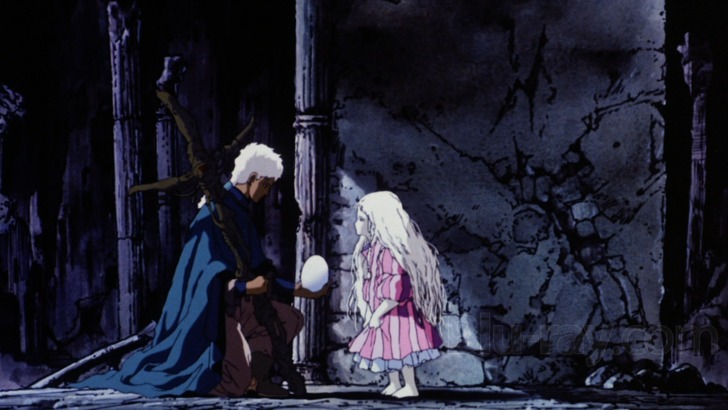
Let's begin with the obvious - how Mamoru Oshii's original version of Angel's Egg (1985) isn't available in the West but this notorious American reinterpretation from Roger Corman's New World Pictures is baffled me as it has for many. I don't blame those who licensed this version mind, neither Code Red in the United States or Arrow Video in the United Kingdom, as its likely the sad case the license for Angel's Egg is difficult to acquire or priced too high. (If by any chance it's due to New World Pictures or Lakeshore Pictures, the later owning this license, then someone would've grumbled about it by now, but bear in mind anime has been notoriously pricy at times to license from Japanese companies). In contrast, In the Aftermath was, from the looks of things, an entirely different license as a New World Pictures creation, Lakeshore Picture owning the rights since 2002. And honestly, whilst it's a ridiculous train wreck at many points and inferior to the original Angel's Egg, I'm glad we still have a 2k restoration of In the Aftermath, even if my own idealised version would'e been as an extra to the superior Japanese production.

As it goes New World Pictures ended up with the license for Angel's Egg, to which the likes of producer Tom Dugan thought it was an incomprehensible work. Angel's Egg, for those who don't know what it is, is an experimental theatrical animation by Mamoru Oshii, cult anime/live action director of the likes of Ghost in the Shell (1995), in collaboration with the legendary illustrator Yoshitaka Amano, who'd become acclaimed enough to have his work in art galleries after a career starting in anime production in the late sixties. Oshii, originally desiring to become a Catholic priest, clearly made Angel's Egg as a parable about religious doubt, with what you do see in In the Aftermath in terms of original footage enough to show it was very open in the conclusion without ever drawing a line onto either side, the title referencing an egg the iconic animated girl character had which either was an angel's or had nothing inside it. The New World Pictures version still also includes the sequence of fishermen trying to catch shadows of giant fish which cling to their city walls, only destroying what they try to hit with harpoons, a metaphorical sequence that, even if Oshii views the film more of a mood piece nowadays, still has this visible message within itself.

A lot of Angel's Egg is understandably abstract, intentionally so and soaked in a post-apocalypse built around the best representation of Amano own work and some of the best animators on staff from the eighties anime boom. It could've, however, been sold to an American audience by New World Pictures, rather than making an even less comprehensible version in In The Aftermath, if you'd just sold it to the art house crowd Roger Corman once did with Federico Fellini and other European films. Hell, for the visuals alone, this could've appealed to the cult film crowd even if the original film has very little dialogue and a lot of slow, languid scenes as it's a trippy, strange film even without the visible existential message.

Somehow, trying to make the film more sellable, another issue being that at seventy or so minutes Angel's Egg was seen as too short, the people behind In the Aftermath making something even less coherent at times just to fit their perceived parameters. To see it to the VHS market (though it did have an Australian theatrical release), the animation is used as an alternative world overlooking ours, actually like the angels of It's A Wonderful Life (1946) where the original protagonists, the white haired girl and a young male soldier, are now siblings and with the young girl to be sent to Earth, in live action, which is a wasteland where the ozone is poisoned and clean air is a precious resource.

It's actually not as disastrous as the reputation is. The infamy is how not only someone thinking this was a good idea, not helped by the original film not being available in the West still, but that to "make sense" Colpaert, an apprentice to Peter Bogdanovich, wrote a new script of utterly ridiculous (and quotable) dialogue about men crying about a world without fish and the girl being spanked by her older brother with asteroids as punishment for falling asleep. The project, even if I wished an English dubbed version of Angel's Egg was the version released rather than this misbegotten belief of trying to make a more "sellable" version to the West, is still compelling now we know it's an utterly perplexing creative decision, a time capsule to this bizarre cultural reinterpretation to sell films that still happened into the 2000s, whenever Miramax got hold of work like martial arts films for example, but is also alien to many world cinema fans as a practice. In 2K resolution on a Blu Ray, Angel's Egg as an animated production is incredible, causing one to weep that it is available outside Japan barring bootlegs; it is a project of the era, a box office failure whose production was only possible due to how the bubble economy grew in Japan during the eighties and, before the bubble burst at the end, there was enough money going around including in the animation industry to fund these bold projects.

From https://images2.static-bluray.com/reviews/14844_1.jpg

Oshii
himself, whilst he can be difficult for many, is an intellectual auteur, who even when he now claims the film is vague in meaning laced the film with too much clear symbology of his own spiritual crisis. This, as mentioned, is the only project to fully capture Yoshitaka Amano's art style too, so it is painstaking in capturing his gorgeous yet highly detailed illustration right down to the difficulty the animators would've had in just animating the movement of the clothes and hair of characters. The production team, with individuals who'd go on to the like of Akira (1988) to My Neighbour Totoro (1988), were not slouches either.

The live action isn't, even if low budget, letting the side down however in ingenuity. I will mock the point of even creating the film as it was, and mock the script, a really bad case of presuming an audience couldn't catch the vibe of the original or even just admiring the pretty pictures in spite of finding it slow, but I won't deny it's a great example in terms of clearly having so little to work with, two locations for sets and a few actors, and trying with some damn good ideas to make something interesting even if the script is gleefully gibberish at point. The two locations were chosen well, the factory in particular also used for Terminator 2: Judgement Day (1991), the kind of evocative set you could find in Andrei Tarkovsky's Stalker (1979) to a b-movie; by all accounts, an actual closed factory, it might've been dangerous to film there with those dust clouds onscreen looking too irradiated in chemicals abandoned there for comfort. Cinematographer Geza Sinkovics does his hardest to help the live action sequences, but its score composer Anthony Moore who deserves a moment of praise. An experimental composer who has worked with the likes of Henry Cow and Pink Floyd, he's a vital element in improving this film, in tandem to some of the other visual tricks at hand the person who comes close to matching the original source material in evocative mood.

Even when the animation is spliced into the live action, to try to make it work, there's also an eeriness that works. The premise, an "angel" sent to save Earth from environmental devastation is depicted by only six cast members (including lead Tony Markes), groans under trying to rationalise an art film into a pulp b-flick, but there's a sense of the unnatural to still appreciate because of this. The anime still has power even in this bastardised form, and the live action is appropriately eerie when you ignore the story.

Instead, the script, by the director, should be appreciated for going into non-sequiturs even weirder than the source, which was strange for its open ended ideas and the psychedelic dialogue but, when characters actually spoke, was very precise and sombre, building to the themes of spiritual ambiguity. Some of what is found here is potent whilst still strange, Markes in a gas mask playing a piano to a female doctor (Filiz Tully) he encounters, but spanking people with asteroids is just the kind of line screaming for baffled reactions. Angel's Egg had limited dialogue, a lot of silence that was clearly seen as unsellable considering the decision to cram voiceover to sell it, all of which adds an unintentional absurdity. Thankfully, it wasn't dull, pedestrian sci-fi exposition; instead, its lore that makes no sense but is fascinating in how this is an attempt to make the original work "makes sense" but becoming something gloriously off. The largest monologue in Angel's Egg, the young soldier retelling the tale of Noah's Ark with the boat drifting on an ocean never finding land, is turned into a nonsensical tale of deception where fish floating in the air on a planet are stolen that has to be heard to be believed.

It makes no sense why this executed plan was meant to be more marketable, but whilst I imagine an alternative world where Angel's Egg was sold as a more avant-garde Ingmar Bergman movie to art film audiences, In the Aftermath was what we got and is still rewarding for how odd it is. The real tragedy is that, whilst it helped introduce Westerners to Angel's Egg, it never lead to Angel's Egg actually being released; New World Pictures, among their work, also released an "Americanized" version of Nausicaä of the Valley of the Wind (1984) as Warriors of the Wind, the original pre-Studio Ghibli film now available whilst that version has vanished, yet nonetheless for a certain generation probably thanked for letting them still see anime for the first time. We thankfully left this need for alternative versions of foreign titles, but considering how extreme and peculiar In the Aftermath is, I am glad it's still available. That it's not an extra to the source and the only restored version in the West of the two films is tragic, but the oddity shouldn't be blamed for that.


From https://admitonefilmaddict.files.wordpress.com/2019/01
/In-the-aftermat-2.jpg?w=672&h=372&crop=1

Thursday, 9 May 2019

#98: Urusei Yatsura 2: Beautiful Dreamer (1984)

From https://images-na.ssl-images-amazon.com/
images/I/51ZCHjkRLJL._SY450_.jpg


Director: Mamoru Oshii
Screenplay: Mamoru Oshii
Based on the manga by Rumiko Takahashi
Voice Cast: Fumi Hirano as Lum Invader; Toshio Furukawa as Ataru Moroboshi; Akira Kamiya as Shutaro Mendou; Kazuko Sugiyama as Ten; Saeko Shimazu as Shinobu Miyake; Machiko Washio as Sakura; Mayumi Tanaka as Ryuunosuke Fujinami; Shigeru Chiba as Megane; Akira Murayama as Perm; Shinji Nomura as Kakugari; Issei Futamata as Chibi; Kenichi Ogata as Ataru's Father; Natsumi Sakuma as Ataru's Mother; Michihiro Ikemizu as Onsen-Mark; Masahiro Anzai as Ryuunosuke's Father; Tomomichi Nishimura as the Principal; Ichirō Nagai as Cherry; Takuya Fujioka as Mujaki
Viewed in Japanese with English subtitles

Coming up to their school festival, the cast of comedy fantasy series Urusei Yatsura, from dumb horny Ataru Moroboshi to space alien princess Lum, slowly realise the day repeats over and over again. As people vanish and the world changes, questions arise to how this has come about in this Mamoru Oshii directed and scripted tale. Now with this premise in mind, to come to the world of Beautiful Dreamer (as I have) blind to the Urusei Yatsua franchise does add another detail to this plot that, whilst Beautiful Dreamer has gained a reputation by itself, you're throw into the deep end with these characters already existing. That the plot is about something else asks where the space princess who can fly and shoot lightning comes from alongside all the other miscreants who are our protagonists.

Some of you are probably blanking over the fact that, yes, you'd never presume the serious director Mamoru Oshii once animated comedy before he made films like Ghost in the Shell (1995).

Let's go back in history then to explain....legendary manga author Rumiko Takahashi, who'd create hits like Ranma ½ and Inuyasha thus becoming one of the most successful and financially well off manga authors of all time, started Urusei Yatsua in 1978, which was successful enough to start an animated series in 1981. It was only when Oshii, who started on the first episode, and the production changed the tone of the series halfway through that it is said the series gained its own successful reputation, a madcap series which lasted four seasons, six films (which Beautiful Dreamer belongs to) and twelve OVA episodes up to 2008. It was a franchise which played on absurd premises, comedy and mythology, Lum the space princess in her trademark tiger print bikini explicitly referencing a costume of Japanese omi (demons) among generally ridiculous jokes.

The premise is that Ataru Moroboshi, your typical sex obsessed teen male, was chosen as the human being to protect the Earth from a race of aliens by means of a game of tag between him and their representative Lum, an event explicitly reinterpreted in a later segment of Beautiful Dreamer. A misinterpretation, whilst he won, caused Lum to think he proposed to her as a wife, thus leading to her living on Earth, electrocuting him with super powers whenever he pervs on others; the other male students, led by military obsessed Shutaro Mendou1, were not happy of this situation so, as referenced in the film, have a group to protect Lum from him or at least try to make his life a living hell. Neither was Ataru's original human girlfriend Shinobu Miyake impressed too, a girl with superhuman strength stuck on the side to this farce.

From https://i.imgur.com/x3siNcbh.jpg

Beautiful Dreamer
is a film given a huge amount of weight by itself due to Mamoru Oshii's history, a director of a lot of comedy as well as cerebral material even into his early nineties run of live action work, something we don't know a lot about past the Millennium when he fully dived down on sombre writing. The sole screenwriter, lifting from a premise they used in an episode of the series but expanded in scope to full blown surrealism, this is still visible Oshii's work and no one else's. That it's in lieu to a comedy, and a beloved franchise that was already using carte blanche in its premise is the truly unique thing at hand; even without the original context, I was looking at something, even if Beautiful Dreamer was not a high budget work in its time, which went beyond and magnificently into the experimental and creative.

In this world, the introduction immediately sets up the chaotic slapstick and chaos when the initial premise is preparing for a school festival, the incredible energy and invention of the animation team felt fully. The characters are numerous, but you can establish their personalities with ease from their quirks, particularly as, when the film occasionally becomes very serious and existential, their simplicity allows them to suddenly develop nuisance. Even when there's material that might raise an eyebrow, the Nazi themed cafe somehow a good festival choice for your class, there's plenty already in the initial premise onscreen, like the numerous ridiculous pratfalls and sight gags, to amuse and catch your attention away. Even the issue that one of our protagonists is a pervert, Ataru, is thankfully something that also becomes nuisance, his clear romance with Lum something which becomes a huge part of the plot in the end; even when literally given his fantasy, as a result of plot machinations, her absence from him is felt and immediately called out. Plus there are so many characters onscreen, and others who take on just as many important roles, that it balances everything out. The truth is that, ironically, it's Lum herself despite being a huge figure in the franchise, and of this film's crux in terms of the resolution, who takes a background part, an interesting issue when a sci-fi supernatural figure like herself would've been the central premise in any other circumstance.

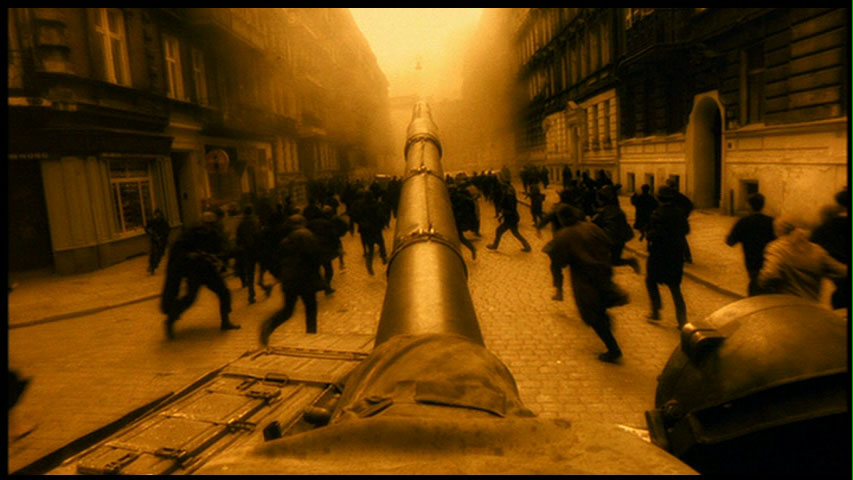
As for the world itself, of these lovable food obsessed and manic figures, their idyllic farce is undercut by the scenario when reality itself is distorted, where even when Lum exists as an alien who can fly and has a miniature friend called Chibi she is no way near as odd as when the tank abruptly appears in the school swimming pool, puddles of water teleport people, and individuals vanish. As time stops, enough for a room to be entirely covered in fungus and dust, and people eventually start to disappear, the film for all its light heartedness gets serious when it needs to, two diametrically different tones managing by pure, perfect preciseness to succeed. The constant changes to reality are vividly depicted, the various houses of the world being altered, from new floors to the school becoming a M.C. Escher illustration that bend physics, to the plot eventfully turning the world into a post apocalypse where the rules are even odder about their environment yet the buildings are ruined. Knowing Beautiful Dreamer is not the highest budgeted work, but still from this era of hand drawn animation, adds to how incredible an achievement it is, especially as the later plot machinations go as far as to include turning into genre vignettes and full blown cosmic psychedelic with characters on strands of DNA. When its revealed what is going on, thankfully it has a personification that its immediately memorable as a figure, one who you feel sorry for even if they are as much responsible for turning the film into an even greater spectrum of strangeness, between sci-fi pulp tragedy to even half finished scenarios built with cardboard.

And the style is matched by the moments of seriousness, which never override its comedic tone but work around it to actually have a startling effect. The Oshii I grew up with is here, first witnessed fully in one of the best scenes when nurse Sakura encounters the being behind it in a taxi cab, possessing the driver and getting into a conversation in a dark tunnel about how time is merely a construct of human beings, a sober atmosphere but detailing Oshii's obsession with characters having long philosophical discussions. Famously it would go even further to the point as if deliberately goading the viewer - his tie-in novel to Blood: The Last Vampire (2000) called Night of the Beasts, an action vampire story, stops halfway through for chapters of long discussion on vampire mythology around a table - but here it works perfectly. The legend of Urashima Tarō, a man who rode a turtle and did not age famous in Japanese culture, their equivalent to Rip Van Winkle, is evoked as is the idea of Zhuangzi, the Daoist thinker who dreamt he was a butterfly dreaming he was a man and developed an existential crisis as a result.

This all is still a comedy, one which resolves everything for a new day, a new story, but the production pushed the premise in drama and scope to an undeniable scale. It's for me because Oshii is such an obsessive for extrapolating on ideas, that he's able to push these premises into interesting tangents. Seeing one of his most overtly comedic works for the first time, it's also amazing for who could be a cold director to also see his heart, a whimsy here that is utterly lovably as well than absolutely suited to slapstick and school days bonding, something I've never seen yet in his career. Sadly he'd depart from the TV series by episode 106, going on far longer afterwards, his relationship with the original creator Rumiko Takahashi not by all accounts a great one and prone to conflict over ideas; what he produced here, resolved around the love between Ataru and Lum, is such a lovely, strange and delirious production I adored.

From https://i.pinimg.com/736x/3c/49/d4/3c49d4a5261cc6
1cb7e01f0109885356---anime-manga.jpg

=======
1) One character who immediately won me over, because his voice actor Akira Kamiya was incredible, is Shutaro Mendou, a diehard military obsessive who, in this world, can acquire an actual tank for the school festival cafe, has access to a fighter plane and yet, for his seriousness, can break out in a higher pitched exasperation when challenged or hoisted by his petard.

Saturday, 27 October 2018

Bonus#10: Avalon (2001)

From http://2.bp.blogspot.com/-pNL6aOmmUX8/U6DxOrukkZI/
AAAAAAAAEEE/CA292vELw0g/s1600/2014-06-18+01:53:11++00001.jpg


Director: Mamoru Oshii
Screenplay: Kazunori Itō
Cast: Małgorzata Foremniak as Ash, Władysław Kowalski as Game Master, Jerzy Gudejko as Murphy, Dariusz Biskupski as Bishop, Bartek Świderski as Stunner, Katarzyna Bargielowska as the Receptionist, Alicja Sapryk as Jill, Michał Breitenwald as Murphy of Nine Sisters, Zuzanna Kasz as the Ghost
Viewed in Polish with English Subtitles

Synopsis: In futuristic Poland, Ash (Małgorzata Foremniak) is a successful player of an illegal virtual reality game named Avalon. Her awareness of someone who has been watching her from afar within the game, who cannot be identified, leads her to the search for the Seven Sisters and a secret level of Avalon only accessed by a literal ghost in the game.

Mamoru Oshii's career trajectory is fascinating. On one hand, he's known for the likes of Ghost in the Shell (1995) and works like the first two Patlabor theatrical films. For most of his career however, with the exception of starting with the likes of the Urusei Yatsura franchise, he's always been an experimental director who yet managed one major success, one that broke into the mainstream and altered pop culture as a result, and has thankfully had the ability to be constantly in work even if his post-2000s work is mainly difficult to find and divisive even for Oshii fans. Beyond this, he was always this experimental director even at the beginning, one of his contributions to Urusei Yatsura the feature film Beautiful Dreamer (1984), a experimental rumination on reality, or Angel's Egg (1985), exploring his own lapsed religious faith by way of Yoshitaka Amano's gorgeous art. He was always "difficult", even in Ghost in the Shell with its turns into philosophy in the middle of action scenes, especially the divisive 2004 sequel. He's also made a lot of live action work since 1987's The Red Spectacles.

From http://1.bp.blogspot.com/-7H1KKPrQIts/U6Dzngw7k0I/
AAAAAAAAEFQ/qbuRn0DPIHE/s1600/2014-06-18+02:03:50++00001.jpg

With this in mind, Avalon's an interesting one-off for Oshii as its a Japanese production but set and co-produced with Poland, a curious choice that yet works to Avalon's favour. The spectre of Communist Europe is felt large in the mostly sepia tone and futuristic drudgery of this world, lost in time and with Avalon the whole point of life for many in response to this, an illegal game where many devote their time and can be able to afford luxuries with the pay from, in spite of posters on the walls proclaiming it should stop. The VR game itself is a constant war zone which exists in ruins and isolated industrial environments, evoking the Cold War era but also World War II. Also, it should be kept in mind that Mamoru Oshii has always been influenced by Western culture - as a man who has packed so much philosophy in his world, he references Western culture as much as Japanese culture so it's not surprising he'd eventually make one film outside his homeland once. Avalon the film is entirely about the search for the titular "Avalon" as well, the afterlife realm for heroes found in Arthurian legend, at one point in his trademark exposition dialogue linking it to another similar idea in Norse mythology too, in this futuristic world the closest thing a virtual reality game which allows Oshii to play with the notion of our perception of what reality truly is whilst offering a world for a player to find those lost in a form of afterlife.

If Avalon has a message, it is still a very relevant take on both the subjectivity of reality, as Ash ultimately ends up in an experimental stage where the film manages to pull a rug under another rug it pulled at the start of the segment, a rarity it manages to make work, and also the increasing sense as video games and virtual reality become more precedent in terms of their relation to reality and our lives, where one can make a career out of it and feels more true life than ours out of it. The decision to depict it through an antiquated, post-Cold War aesthetic absolutely helps avoid technical obsoletion in the themes, the computers here inherently old back in 2001, and the world in and out the Avalon game is barring flashes of colour in sepia.

From https://thefunambulistdotnet.files.wordpress.com/2010/12/avalon8.jpg

As with all Oshii works, unless we're talking about the reoccurring Bassett hounds in his work (an animal lover by all accounts), all his films are precise in their references and symbolism. Arguably, Avalon is one of his simpler stories to understand, one that would reward upon repeat viewings but can be absorbed on the first viewing in story and in terms of the spectacle. The film, deliberately artificial in its CGI, dating with grace due to this factor, is matched by its sense of the grandiose, emphasised further by Kenji Kawai's score or the use of classical music especially in the most emotionally powerful moment, an entire performance of the Warsaw Philharmonic Orchestra intercut between an important dramatic incidents in the plot. Whilst known as a cerebral director to a fault for some viewers, Mamoru Oshii was always concerned with human drama and happy to blend it with action, and in this world this is implicit throughout.

This is as well with the danger of the virtual world being unable to be taken seriously. If videogames have a distance to them, then one could never be able to take any threat seriously or any drama involved with it without any sense of absurdity. Here the threat is there, especially when a giant monolithic moving fortress appears at one moment; the drama is here too, Ash part of an undefeated group who collapsed due a moment of failure, or how one member with her in that group has been left comatose in a hospital, the game of Avalon and VR in this world with danger to its use. Whilst it may sound ridiculous to have this type of seriousness to games, Oshii sees games as being worthy of elaborate existentialism, as with even his more light hearted material of yore. And Avalon ultimately succeeds, enough that I wish the film was better known. Unfortunately, Oshii's availability especially from the 2000s, and his career in general, in terms of filmography, is still an issue. A shame especially as Avalon proves worthy of re-evaluation as with a lot of his career.


From https://drnorth.files.wordpress.com/2009/01/vlcsnap-614491.png