Showing posts with label Experimental. Show all posts

Monday, 12 August 2024

#278: Cybervenus FeiFei (2001)


Studio: Blue Moon Studio

Viewed in Japanese with English Subtitles


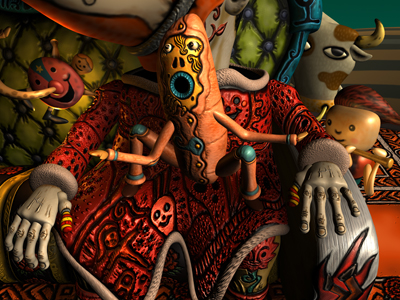
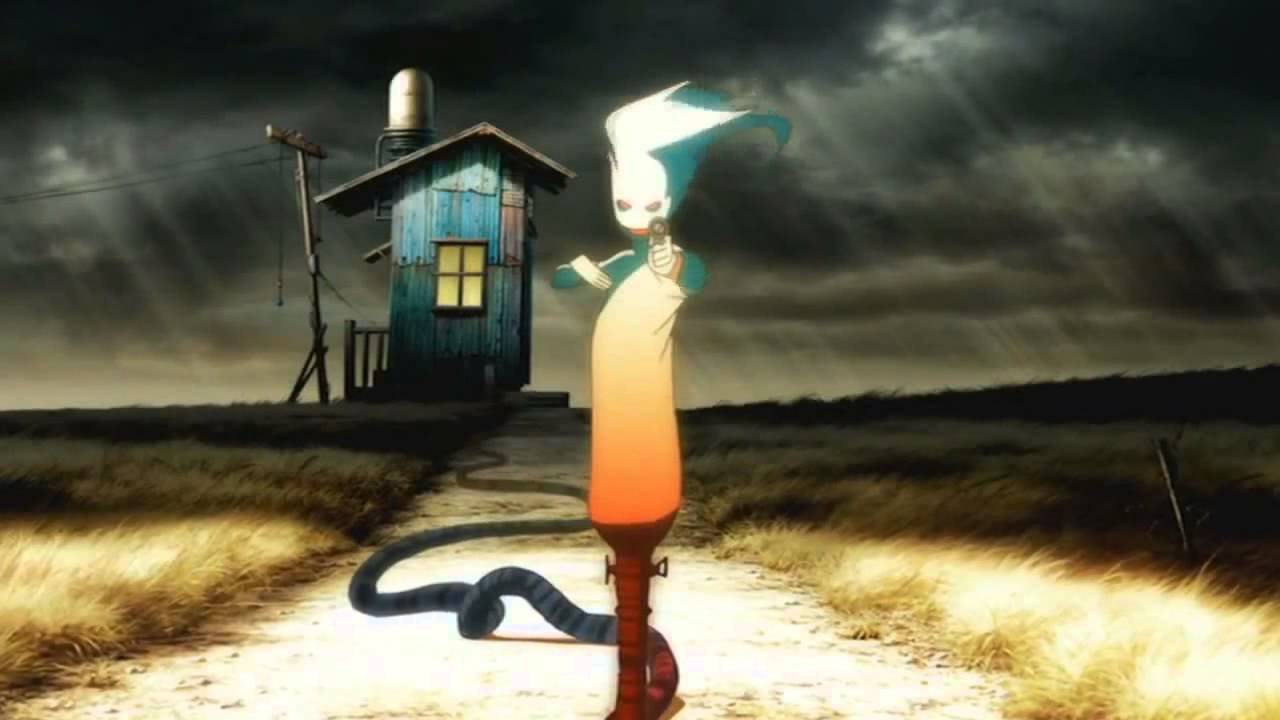
In my obsession with digging up obscurities, I finally close off the trilogy of three Virtual Idol releases which got DVD releases in the United Kingdom. They exist in an unconventional place in terms of anime, as CGI productions connected to Pony Canyon, a publisher huge in the Japanese music industry with involvement other pop culture industries like anime, but as DVD directed collections of segments which were released in the boom period of British DVD distribution when the format was new. This film in its trailers promised a fourth, which feels like it was falling back into the idea of the sexy virtual female idols of the other titles I have covered, but the three we got were Yuki Terai - Secrets (2000), Virtual Stars (2002), and Cybervenus FeiFei, which focuses on a Chinese woman who was created through motion capturing the movements of real actress. It feels like, from the three we got, this was the most ambitious in terms of ideas and artistic presentation, making the fact this was not the final one somewhat strange. Virtual Stars was really falling back into the idea of sex appeal of their virtual starlets, whilst this feels more like it should be the conclusion, where Blue Moon Studio wanted to figure out where they could go with this production concept they had, as FeiFei becomes significantly more existential in tone than appealing to a cute idol who can appear in music videos.

Like the others, this is a collection of shorts, beginning with Doll, where FeiFei initially is wandering through giant cogs. Ahead of time, I find the computer effects here compelling, beautifully obsolete, especially in mind that there is a clear care to make FeiFei as realistic as possible, as will be seen in the later shorts, even if prioritized over overtly detailed locations. As a result, she is a proto-virtual idol in the truest sense of pushing the realism to a quality you can admire, but aside from actual live action footage being used later on, the journey through mazes in this first short is very abstract in comparison to the person wandering them. Add the ambient techno the scores the segment as she finds feminine robots and a transparent monolith, and it is brain candy for Millennials. RGB takes this further by looking like the cool Dreamcast game we never got, FeiFei cybersurfing a spiral environment in pure white void which wandered out of the videogame Rez (2001). Even the spoken word fuzz rock that scores this segment feels like something Sega would commission whilst she is riding a metallic shark in a green sea of fish. Arguably the best thing about this entire project, as here, is how work like this can have a pretense of a plot but also be purely dreamlogic as FeiFei’s birth, as this short is meant to represent, includes all the following but also requires her gaining colour pigmentation for his body beyond grey.


These shorts all have poetic introductions to them, suggesting Blue Moon Studio were more earnest in their work with this one in terms of meaning. Voice, as FeiFei travels through a room in its own existence and learns to speak, also brings in the touch distinct to this collection of animations, blending live action with FeiFei interacting with the real world. The soundtracks are a smorgasbord of the era – whale sounds, nu jazz, ambient lounge and dub music, sometimes in the same short as with Real, focusing on more live action as FeiFei sees the world through the pieces of recorded footage, and is interacting with a real actress who can talk to her through a laptop. These shorts build a narrative over these segments, unlike the others in the series, where she is slowly growing into a real person fully immersed in our world, which also makes understanding the dialogue more a concern. “Dream and reality are the same” is spoken at one point, and whilst we are seeing the limits of the animation at times, we see something very ambitious in spite of this. By Messenger, we are definitely seeing a more New Age tone to the project too, Messenger emphasizing this as an experiment in a character as a radio host, or waiting in-between her recordings of messages from listeners.  We have moved from random zombies being fought off by a sexy dancer in Virtual Stars or music videos to more perfected movements for speaking dialogue or communicating her messages of love in turntablism.

Labyrinth is the most ambitious of them all for being seventeen minutes long. Splicing our lead into real footage of Rome, they do have to fudge around her presence around real people in the streets, like a ghost no one sees, but even in painstakingly animating her operating a phone booth, the short is trying for a more ambitious short film with emphasis on mood. It begins attempting a plot of FeiFei trying to find a man she cares for living in Italy, only for reality to start to bleed and distort in digital code, all with knowledge eventually he has disappeared. As she travels around Rome, witnessing masks with her face on them in store windows or with the walls closing in on her, it is cool to see Blue Moon Studio suddenly take the project series to this point, feeling like the last thematically in their ambition in spite of the true chronology of the releases. After FeiFei goes to a church the short becomes more abstract, a mood piece where she is transported to a tropical island, eventually to her painting herself on the moon on grassy field. It might be seen as a cop-out, but in mind that this entire product feels like the right mix of old CGI, dream logic and these moments of expanding the production with ambition, I would let Labyrinth have a pass if it was entirely just obsolete CGI being used in imaginative ways by this studio, only to also admire that they were wanting to push their interest in terms of artistry too. Sadly, this entire series of works are as obscure as you could get, and in mind that we even got DVD releases of these in the United Kingdom, I ponder whether any of this, from the films themselves to the making of documentary material also included, are even properly preserved. Finally closing the trilogy off they are a compelling dead end in the history of Japanese animation, though it is clear to see that we would have not gotten a Cybervenus FeiFei even if the project continued into the 2010s. When Virtual Stars was released, the production realized the sex appeal sold more, so even if they were able to prosper, this more esoteric tone would have likely been ditched soon after anyway.

Wednesday, 27 November 2019

#127: Key the Metal Idol (1994-7)

From https://images-na.ssl-images-amazon.com
/images/I/51278GVX1AL.jpg


Director: Hiroaki Satō
Screenplay: Hiroaki Satō
Voice Cast: Junko Iwao as Tokiko "Key" Mima; Hiroshi Yanaka as Tomoyo Wakagi; Jūrōta Kosugi as Sergei / "D"; Miki Nagasawa as Sakura Kuriyagawa; Sho Hayami as Jinsaku Ajo; Toshiyuki Morikawa as Shuuichi Tataki; Akio Ohtsuka as Aoi; Chiyako Shibahara as Beniko Komori / Miho Utsuse
Viewed in Japanese with English Subtitles

If you look at Key the Metal Idol altogether, this was such an ambitious and peculiarly project for the better. In anime, straight to video work (OVAs) could be multiple episodes released on multiple videotapes; Key the Metal Idol took a huge risk when at over fifteen episodes, it gives me wonder on what prices the viewers would have paid for all the tapes1. Whatever the practical nature of the release, this was at least an ambitious tale of androids and robots, idol singing and conspiracy. The one catch to mention is that, after an initial set of thirteen episodes which are structured at a usual anime TV length of twenty five to thirty minutes, Key the Metal Idol eventually leads to two feature length conclusions, which meant many drastic changes.

With the time available for animation to be slicker than most television and for a more detailed plot than OVAs which have significantly less time to play with, it layers on an odd mix of science fiction, spirituality and all in the midst of a premise which initially suggests robot idol singers. Whilst there are episode directors, the chief director of the OVA is Hiroaki Sato, the animation director of the legendary Akira (1988) who sadly didn't helm much at all or even work in a lot of anime next to his peers, only directing one other thing in Yoshimune (2006), an utterly obscurity.

The titular Key herself is by all accounts, least for most of the show, a robot girl created by Dr. Murao Mima. On his deathbed, he passes on a message to his granddaughter Key she can become human by finding over 30,000 friends. Going to a metropolise, she encounters Sakura, who comes form the same rural village, but also the Ajo Heavy Industries and Production Minos led by Jinsaku Ajo, who are responsible for her grandfather's death ultimately and happen to be ran by a madman, one whose corporation is later revealed to be harvesting "gel" from unwilling victims, the homeless and their enemies, the solidified life force of human beings used to power robots which are remote controlled by people. In a curious plot choice, which is openly known before the details mentioned above in the narrative, is that their best way to test the robots is Miho, an idol singer who is actually remote controlling a robot version of herself, a pawn kept by Ajo as a pet who demonstrates some really creepy sexualised obsessions with robotics and playing God. Key herself, unaware of any of this, upon discovering Miho considers, despite being a timid and quiet figure, this the best director to find 30,000 people.

It's such an odd premise, if a compelling one, one which hangs on a huge cultural aspect that exists in Japan of idol singers. "Idols" don't necessarily have to be singers, but it's the most commonly known version, manufactured icons for managers and talent agencies. Idols have a dark underbelly too - they can be controlled by their management even to the point of any concept of romance and personal lives, not to mention that when it involves female idols (including teenagers) there's a really uncomfortable aspect to consider in this too. Satoshi Kon's 1997 film Perfect Blue was a fascinating take on this from the perspective of a member of an idol trio who, trying to grow as an actress in a new career, lead to a psychodrama which looked in the darker side of idol fan culture too. (And how fitting, without realising the connection at first, that voice actress Junko Iwao, who plays Key, also voices that idol singer protagonist in Perfect Blue). Here, there's a perverse metaphor, whatever your opinions of various idol groups and singers' managements, of a company who are literally controlling women, making robot versions of them, and with Ajo going as far as even assaulting their backup lead singers with violence or draining them emotionally until they are on death's door constantly.

Another factor of significance is that, in lieu to probably the original plan, the series until the final feature length episodes drip feeds its plot and never really explains a lot towards the final two pieces, which make up most of the OVA leaving many questions. Key when she briefly turns human throughout the series, in emotionally intense moments or in crowds, has incredible psychic powers. This leads to the introduction of Prince Snake-Eye, a cult leader whose characterisation takes a fascinating path, but to keep some secrets involves trying to sabotage Key's idol singer career, and leads to her literally healing a child from near death, which does raise some new issues at hand with who she is. The show, despite its science fiction plot, jumps fully into spiritual themes, especially in Key's back-story as a shrine maiden is a memory she has, from a curious slant as its going eventually be interpreted through science fiction details.

There's also the inherent fact that there's a very idiosyncratic attitude here to characterisation which at first requires a lot to get used to, might even be perceived as wooden or characters not actual like regular people, but I came to realise was individuals on the production staff trying to actually write characters who were more realistic even if it has to contrasts an inherently over-the-top plot. The character of Sakura is the best example of this, a figure who bites her tongue a lot despite having the brash and confidence attitude, one which leads her to conflict with Key's apparent robotic nature and nursing a growing affection for Shuichi Tataki, a handsome guy who is the head of the Miho fan club who slowly begins to realise something is very amiss with the star. Even the apparent villains have idiosyncrasies, figures having darker layers to them, where even if he is the outright villain Ajo is a former World War II veteran whose obsession with the opportunities with robotics became a violent God like mania. The dance choreographer and general artistic talent Hikaru Tsurugi, who is an abusive and cold man, is one of a figure distant to people, who attaches himself to Key when he considers her like him. Even Ajo's right hand man, a hulking former soldier named Sergi, is a man who thinks himself smarter than his employee, a man who can literally be described as superhuman but at a cost in his career of having becoming an addict to gel, which considering its solidified human life force really has a curious undercurrent meaning to it.

From https://www.syfy.com/sites/syfy/files/styles/1200x680/public/syfywire_
blog_post/2018/10/key-the-metail-idol-key1.png

Complicating the series was that, with the clear sense something happened in the production that forced the creative team to work on these and release them in 1997, which they had to have two feature length final episodes.  Before, not a lot of back story was explained, to which this means the first film is a giant exposition dump, where it becomes quite obvious the original plan had to be scrapped and this was the result. It's fascinating when you learnt the context, reaching as far back as 1950s Japan back into the story's modern setting in a web of characters like Key who get fully formed, but its sudden and involves two characters having a long conversation in a park to explain this all. A whole new character is even introduced just to add context to one side even, so I would not in the slightest hold back any person, if they go out to find this series, really has issues with episode fourteen, as it's such a sudden lunge into so much plot detail, even if it gets into a lot of fascinating material including a sub current theme of women being dominated by men and the inherently horrifying nature of it.

The final episode does do a lot though that succeeds after the fact, even against the obvious jarring change in pacing. It ultimately reveals as well how sad the story really becomes - only one major character dies in the whole OVA, but it's one you come to love, a normal person, and it's treated with the immense sadness even if the others have to move on quickly in dangerous circumstances. The result is one of the best attempts at depicting a death bed scene or a death when anime can bungle it so badly or, in the midst of an ultraviolent one, it just becomes a ghoulish background noise. The series altogether, even when it may come off as haphazard, does make the success of not pulling punches. Even when there are some contrivances when characters might've reacted fasted, most of the series thankfully has it there's a reason acts don't take place, like Sergi being too injured to actually continue, that a location when finally learnt of is immediately acted upon, or that it's known that, as the series progresses, Key's unseen abilities even scare Ajo and his lackeys. The show doesn't hide how dangerous the villain is, but there's reason to why he acts the way he does, even if the explanation like using his own scientists for gel extraction is the act of a lunatic. It is, in all honestly, a nuisance filled production that'll develop layers if I revisit the whole series.

The show is also elusive and slow burn for the better. I cannot help but think of the shadow of influence Neon Genesis Evangelion (1995-6) had on this series and others as, whilst the OVA originally started in 1994 and is its own unique creation, the ending of Key the Metal Idol when it becomes a phantasmagorical head-trip, and a concert hall is entirely filled with purple life force gel, feels like something that could only exist after Neon Genesis Evangelion, and the unleashing of The End of Evangelion (1997) on Japanese cinema goers, took such strange and surreal risks with anime. As a result of when this OVA start, it technically doesn't belong to the school of unique and risky anime productions, mostly in television, that Neon Genesis Evangelion encouraged the creation of by being so popular, from Serial Experiments Lain (1998) to argubly the original Boogiepop Phantom series from the year 2000. I'd gladly put Key the Metal Idol as a prototypical entry, not to suggest that there wasn't this type of idiosyncratic animation before the mid nineties, but that as of yet my only knowledge comes from it usually being in theatrical work or experimental anime. The OVA market, when it first started in the early eighties, really helped the encouragement of idiosyncratic productions. Key the Metal Idol is nonetheless a curious being even here as, due to the structure, it's a lot longer than most OVAs I have encountered so takes on the pacing and structure of a regular anime series2.

The OVA was created by Pierrot, a company whose track record includes a lot of huge mainstream hits in anime, some like the Naruto franchise probably known even outside of hardcore anime fan circles. A higher animation quality over TV is here as there was significantly less restrictive time scales per episode allowing for more. It also allowed for more mature content but its wisely used; there's nudity, but its matter of fact, and the violence is not always there but a sudden shock, surprising in how nasty it is whilst making sense as, if there was a super powered robot involved in a scene, it could crush a human head like a grape.

There's also a wonderful dark mood, one which is helped by the richness of the style in colour and character designs. Character designer Keiichi Ishikura's work is very idiosyncratic here, which helps provide the show its own tone, and even if there's a lot of day scenes, the style of Key the Metal Idol can definitely be seen in its very rich use of dark colours and a very slow burn pace. The main opening song is also beautiful, a jazz pop ballad whose moody female vocals about lovesickness befit the show perfectly. For a story where music is going to be of importance, it executes as well the music and the visual depictions of performances with considerable affect - the Miho performances, even the behind the scenes moments we see throughout the story, have their own strangeness to them, anything from giant unused plants to a robotic cello group among the artistic touches. And of course, for anyone who has seen the show already reading this review, a huge plot point involves a song called "Lullaby", initially a mere incomprehensible mummer when Shuichi acquires it through his sources, but is built towards with considering nuisance.

It's together a flawed but utterly admirable piece for me, where even the aforementioned flaw (mainly the fourteen episode) instead becomes part of its personality and thus no longer a detraction for me after contemplating the show. This OVA series is something definitely (sadly) not as well known despite having an English dub, licensed by a company named Viz in 2000 for the American market, although thankfully in 2017 another named Discotek released it in the United States again for DVD.

It's a series, honestly, that should be more wider known beyond this, to which why I will also give credit to Crunchyroll making the OVA series available in Britain in 2019, the time when I saw the show. To not time stamp this review, sadly a lot of Discotek titles, or older anime in general even from the 2000s, were not as easily accessible in the United Kingdom in 2019 as one would presume or hope, dominated naturally by new titles advertised to bring forth revenue. One of Key the Metal Idol's virtues is good old elegant hand drawn animation, and its time stamped by the era it comes from, just in one of Sakura's night jobs being a videotape rental store, it is nonetheless timeless because it's still a fascinating one off, something difficult to categorise in terms of genre or expectations, whose presentation is even idiosyncratic and eventually, yes, embraces the unconventional fully. That kind of work, even outside of Japanese anime, I fall hard for.

From https://i.redd.it/k56xzhgmpx331.png

=====
1) Of interest, considering how anime has notoriously been too expensive from what I have heard in terms for Japanese fans, price gouging to us Westerners if we looked at the prices and in comparison to content, Key the Metal Idol may have had its first episodes released at a significantly cheaper price if the Wikepedia page is right. Sadly this is unsubstantiated information, without a reference source, so I had to take this piece of the review out and warn you of its potential falsity.  

2) There have been longer OVA works if you are curious. Legend of the Galactic Heroes is probably the most famously long OVA work, starting in 1988 and ending also in 1997, with its main series being over a hundred and ten episodes. That's not including side stories, feature films and remakes.

Tuesday, 17 September 2019

#119: Utsu-musume sayuri (2004)


a.k.a. Striking Daughter

Director: Takashi Kimura
Viewed in English Dub

Another work in the "worst of" anime list, but unlike a Mars of Destruction (2005), which is terrible in creation but too innocuous to really hate, Utsu-musume sayuri was built up as gross and terrible. In reality, whilst a weirdo one man CGI short, Striking Daughter (as its English title is) isn't deserving of such a list accolade. It comes off instead as if a segment from a weird midnight show meant to baffle drunken viewers coming in from a night in the town, even when it comes to the incredibly broken and wooden English dialogue.

It is the initiation of a daughter of a strange family, a group of varying shaped mutants who are like the denizens of a shunting ritual from Brian Yuzna's Society (1989) if they even allowed talking cows in at the door. That reference is appropriate as, whilst sexual, the short isn't as gross as I had built it up in my mind. The ritual instead is spanking on very pronouncedly drawn buttock on a wanting, which is far from the worst thing I have heard (thankfully rather than seen) in anime. Three years earlier, the OVA/film Malice@Doll (2001) would tackle creepier, icky imagery of sexuality by way of a fascinating early CGI anime I wish was better known.

It's a maligned subgenre, usually held as terrible but for me a fascinating little corner in anime's forgotten history killed off by Final Fantasy: The Spirit Within (2001). Into the 2010s, very bad CGI animation still exists, where as I view this early period purely experimental, which leaves the likes of Striking Daughter instead equivalent to early experimentation. Certainly, this short also belongs in general to the type of experimental animation that comes from Japan.

In knowledge one man, Takashi Kimura, animated and directed this, I cannot hold it as terrible baring being a strange oddity, merely what resources he had and a clear sense of being deliberately "weird" at that. Certainly, its grotesque looking, but I'm fascinated by grotesque/obsolete aesthetics anyway, to which that is aplenty here in the bold colours and style, particularly as in context to its history, its better animated by one man in lieu to its apparent awfulness. The bigger concern is that, at less than three minutes, it's just a slight snapshot where I would always posit that something significantly longer is more likely to be dreadful.  

The thing which is likely to be the bigger issue, and definitely is ridiculous, is the voice acting. One male voice, who for all I know is the director, speaking in incredibly fragmented pronunciation of English dialogue which is roughly recorded. It's bad, but God knows in this era people would deliberately create work which had details like this on purpose; in this decade, it'd be considered ironic.

The length prevents Striking Daughter from being the worst. Three minutes is bearable if you have courage - we will wait when the equivalent of this plays over a thirteen episode anime, alongside the fact that whenever I encounter anything boring and/or offensive is when the reader will likely find me write something vicious and very negative. Nothing here is that, Striking Daughter practically a mole hill over built when you could not only see it online but YouTube reaction videos of others watching it.  

As for the director? He directed an episode Koi Koi Seven (2005), about the only boy in an all-girl's school whose wars are literal and silly, and that's it. Unless we've got a case of two Takashi Kimuras in existence, that's pretty small as careers go. 

From http://history.bifan.kr/upload/movie2004/
Film/04FTS_UtsuMusumeSayauri_1.jpg

Saturday, 22 June 2019

#105: Serial Experiments Lain (1998)

From https://image.tmdb.org/t/p/w500_and_h282_face/
oM55x1xvdqfW9rJ48Dl7wEkBPC9.jpg


Director: Ryutaro Nakamura
Screenplay: Chiaki J. Konaka
Voice Cast: Ayako Kawasumi as Mika Iwakura; Rei Igarashi as Miho Iwakura; Ryunosuke Ohbayashi as Yasuo Iwakura; Yoko Asada as Alice Mizuki
Viewed in Japanese with English Subtitles

When Neon Genesis Evangelion (1995) became a massive cultural supernova, including its 1997 theatrical alternative ending End of Evangelion, there were many attempts to ride its coat tails in terms of more adult anime. There were many attempts at an "Evangelion Killer", mecha shows which tried to follow varying from highly regarded work like RahXephon (2002) to failures like Brain Powrd (1998). The other aspect about Evangelion is that it almost became a giant flag held aloft for more unconventional and experimental anime television series to appear even if it never had any direct influence. Certainly though, between the controversies surrounding some of Evangelion's content and that, in the last half, Hideaki Anno's known personal and mental health issues were literally leading to episodes using line drawings, the fact Envangelion actually succeeded rather than crashed and burned would've allowed braver work to appear more easily if other production companies wondered if there was now a market to start creating them. Certainly experimental OVAs and theatrical films existed, but in terms of television series before Evangelion? A question to consider, mainly due to the difficult in watching every show that came before and after Evangelion to plot out a history, especially as under its shadow into the modern day, there's been many odd and bold creative works in existence even in micro-series comedies that have appeared. One of the earliest to appear immediately after Evangelion, which can be confirmed, was the cerebral sci-fi series Serial Experiments Lain, which still has a warm reputation in the West to this day.

Lain's story is incredibly relevant in the 2010s, amazingly prescient on issues we are coming to terms with about the internet and the potential existential and sociological problems with it, all in mind that whilst the internet is briefly references, this exists in a world where it's been replaced with the Navi instead of computers and its own form of the internet called the "Wired". Thankfully, this means, regardless of visual details, there's no concern of this having dated anyway since the technology already looked alien to any world and the ideas are of greater concern. It helps, from this, the series never tried to create an accurate vision of the future, instead looking at the fears and concerns of this machinery even in terms of spirituality as we follow the titular Lain, a teenage girl stuck in perpetual childishness at first and utterly computer illiterate until she and the girls in her class start getting texts from a classmate who had commit suicide previously. As she becomes obsessed with the Wired, head screenwriter Chiaki J. Konaka nosedives as she does into a world of philosophy, a potential God on the Wired communicating to her, and some sobering and accurate predictions on concerns we are getting to twenty plus years later from Serial Experiments Lain.

Identity theft and the obscurity the web allows? Lain finds there's an alternative version of herself online who is much bolder and even evil. Data security and personal information being compromised? Said version of Lain leads to Lain herself being accused as a peeping tom at school. Secret online groups and computer hacking? The Knights of Eastern Calculus, eerily similar to the semi-fictional organisation of expert Lisp and Scheme hackers called the Knights of the Lambda Calculus, a hacking group who will even lead people to being harmed or maimed by attacking any technology, such as traffic light systems to blurring a children's tag game with a shooter, who want to break the barrier between the "Real" World and the digital one. Existentialism and post-humanism? The idea some individuals want to evolve human beings to leave their bodies and becoming permanent consciousnesses online. Hell, throw in conspiracy theories in general too, though the only weird detail, which is weird and the only one which dates the series to back when the nineties run of The X-Files was, is where the hell the cameo by a literal green alien came from in Konaka's mind.

Lain as a series does eventually become esoteric; at first, it skims the waters of horror so much it feels like it's going to become a permanent resident, with literal phantoms haunting Lain even in the day and the telephone lines bleeding. It also emphasises how good the show was aesthetically. Now, probably the biggest surprise for me returning was that, having always been available on DVD through MVM, the original version was incredibly muddy in hindsight to the point it added to the mood, leaving the experience of seeing this thirteen episode series again on a recent restoration looking like a brand new work. Its emphasised how even on a television budget the production took its potential restrictions as an advantage, boldness in its natural look contrasting heightened colour and lighting choices. Of note too, more pertinent now in comparison to each other, the character designer is Yoshitoshi ABe, creator of the original dōjinshi of Haibane Renmei, adapted into a 2002 anime which also feels like it's in the shadow of Evangelion in terms of very creative and utterly unique animated television, a very unconventional afterlife parable with the same muted style and slow burn pace Serial Experiments Lain has1.

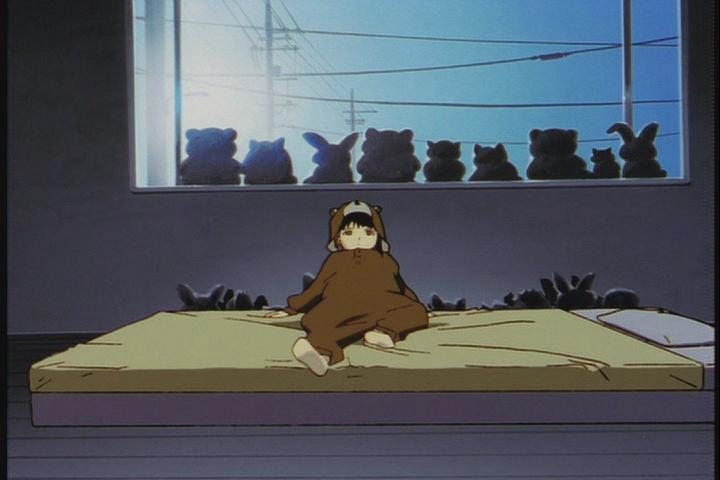
Again, as I've rightly remembered for years, the first few episodes feel like sci-fi horror, the images of humming electrical wires and the sense of desolate streets even in ordinary busy Japanese streets evoking what Kiyoshi Kurosawa would later go with for Pulse (2001). Contrast this with the night time scenes, with heavy neon green lighting, or the increasing influence of the computer technology through the plot, even turning into an almost bio-mechanical entity in Lain's bedroom, the floor wet in coolant, covering the entire room where once she still had plush toys everywhere. The world of the Wired is just as distinct and strange, metaphor and symbolically doing its best to perfectly imaging  an internet chatroom by representing gossiping avatars by being merely lips or eyes, or how in fear of others taking her identity, the same figures have mannequin heads of Lain on their shoulders in a darkened room in cyberspace. In knowledge that in this world, Lain herself practically enters the Wired beyond symbolic meaning, these literal visitations around unique environments are as much there to get to Chiaki J. Konaka's obsession with constantly breaking reality into pieces in most of what he writes, he both notorious and distinct in how the literal and the metaphorical are deliberately blurred in his work even for live action films like Evil Dead Trap 2 (1991); even for a children's show like Princess Tutu (2002) about ballet and fairy tales, when it gets to an inter-dimensional clockwork world where the "author" of the show exists, you can tell which episode Konaka was writing among other script writers when it's the one with the most meta and unconventional philosophy even if the target demographic was kids first.  

From https://i.imgur.com/a6PYSkO.jpg

Sound is also of importance, and not just for the inspired choice of a song by a British band on the opening credits, Bôa given a lasting cult reputation just from anime fans who had their song ] become an earworm, but on the emphasis too on sound design that crawls under the skin. It's completely comparable to Boogiepop Phantom (2000), another highly experimental show fromn this era, between them offering nuisance noise and electronic effects.

[Major Spoiler Warning]

As mentioned, this series is from Konaka, an incredibly divisive screenwriter who leads Lain to becoming difficult at points, early into the series shattering reality when even a giant deity like Lain, to her own surprise, appears up in the clouds for children to stare up to. Later episodes get into even arguments about the existence of God, an entire episode on intermingling real history of the internet and the likes of Project Xanadu with UFO conspiracy and the introduction of "Deus", a figure (Eiri) formerly human who has become a self proclaimed God of the Wired, and one episode (Infornography) whose first half if a compilation of images from previous episodes, all to represent Lain downloading an entire Navi system into her own brain, matched by a guitar riff you could grow a mullet from. Probably the biggest factor, though, which might divide viewers, is when Lain is shown not to merely by an ordinary character, who is brought into these strange events, but is part of a character arch of a unique one-off figure rediscovering her own abilities, a being (possibly through an ESP experiment talked of halfway through) capable of going beyond the Wired to actual God-like abilities. This is controversial as a plot point as, as shown in the worst examples of modern franchise blockbusters in fact, it does limit the connectability of the story from the viewer. I feel however that, especially as the first few episodes feel random, the narrowing of the narrative not only helps the show and but, as it focuses on specific characters, the real virtue of the characterisation appears.

[Spoilers End]

Another thing I forgot, for all its esoteric and eerie shenanigans, was how emotional the show eventually is. Here I admit, for its entire cool atmosphere, and general sense of complete strangeness, actually the real virtue turns out to be the bitter-sweet tale of Lain trying to find happiness. Only close to Alice Mizuki, a school friend, her isolation in the world and how attempt to grow on the Wired (literally) is fraught with further isolation, here a tale which does anchor the entire series with a greater meaning. All the philosophy is weighted ultimately by how as much it connects to her too, evoked when rather than the usual opening before the credits (a male voice over text) she opens the final episode talking directly to us about whether she actually exists or not. All the eccentricities are softened by how utterly emotional the show finally is within the final scenes.

This means Serial Experiments Lain earns its pretensions. Chiaki J. Konaka is notorious for his clear hatred for conventional linear storytelling, but there is so much about the dangers of the physical world against the digital one which have become ever more salient. It also makes sure the characters are of interest around Lain too. Her family, very disconnected, are so for a reason and builds itself to one single scene of emotional resonance; even two men in black, with cybernetic eyeglasses which stalk outside her house, get personalities and enough humanity to why they are there that their fate as everything turns pear shape is significant. That's ultimately, upon returning to this show, why I still love Serial Experiments Lain.

I once, on the first viewing, dismissed it with the same misguidedness I dismissed Boogiepop Phantom, another of these bold and innovative works from under the shadow of Neon Genesis Evangelion. Second time, many years later, it was the surreal and unconventional tone, on the borderline to horror and sci-fi, completely introspective and psychological, which won out. Now, this is in mind still but the drama is all what's left at the end and actually touching in the end. Certainly for me, when you start most series, you should hope for a progression where the final episode is that you'd never expect it to end as from just the first episode, said progression felt throughout natural or at least an escalation in drama, emotional and/or spectracle. Certainly, with Lain this is as good as you could get with this natural progression.

From https://ilarge.lisimg.com/image/754723/
740full-serial-experiments-lain-screenshot.jpg

=====
1) It would be an utter disservice not to mention producer Yasuyuki Ueda, who helped put together this show knowing the risk. He produced Lain, Haibane Renmei (working with Yoshitoshi ABe a lot), and a lot of work between the experimental to more adult, from Texhnolyze (2003) to Hellsing Ultimate (2006), that have been pretty well regarded and even successful.

Tuesday, 5 March 2019

#90: Genius Party Beyond (2008)


Directors: Various
Screenplay: Various
Voice Cast: Arata Furuta, Akiko Suzuki, Shôko Takada, Urara Takano
Viewed in Japanese with English Subtitles.

From http://1.bp.blogspot.com/-_A1oJF-NuzQ/VJyH
Kwlt_YI/AAAAAAAAPkU/h8B_mUl1Hg/s1600/Sem%2Bt%C3%ADtulo.jpg

Gala (Director: Mahiro Maeda)
From Genius Party (2007) to Genius Party Beyond, a sequel to Studio 4°C's anthology film, and from the beginning I'll confess this is a much weaker work as a sequel than the original prequel. Gala, by Mahiro Maeda, does thankfully start off the anthology well; what feels like a generic fantasy world tale, in which a giant meteorite lands in a high fantasy period Japan where there's a general male protagonist, gets more interesting when he and his allies (a young woman and an anthropomorphic cat) are hired to be magical musicians riding on giant instruments in the sky and enchanting musical compositions to help soothe the meteorite. Descending into everyone bringing their instruments out into a mass orchestra, it becomes a full blown and beautiful cacophony of music and visuals, the closest to a lot of the motifs in the original Genius Party as a result in aesthetic exhaustion.

From https://jfdb.jp/data/photo/movie/7a/fe/da/24/
af641bb0b6c9bd2260b652deb4097151_640.jpg

Moondrive (Director: Kazuto Nakazawa)
Moondrive's director Kazuto Nakazawa immediately stands out as the man who directed the animated segment of Kill Bill Vol. 1 (2003), one of the most striking moments for anime's recognition in Western culture in the early 2000s. Moondrive looks like the work of the same director only exaggerated even further, a crude farce, set on the moon in the future, about a motley group of thieves whose attempts to find treasure are constantly undercut by pitfalls (no money, losing money in a pool game, the transport not having enough fuel). It's a fun, misanthropic romp, with a distinct visual style although it does have a tasteless running gag which will immediately put many off where one of the two female members, a buxom blonde, is constantly bartered for sexual favours for people by the headstrong male leader who she calls masters. It's a joke, even if one has her audible being a dominatrix for one "client's" masochistic tendencies, which hasn't aged well at all in just a decade.

From http://1.bp.blogspot.com/_t6rfIoGCvjs/T
FwzLawVlNI/AAAAAAAAA2M/kY_tLQZ-Cf4/s1600/wanwa.jpg

Wanwa the Doggy (Director: Shinya Ohira)
Wanwa the Doggy by is definitely the most surreal of the five segments in this film, the fantasies of a young boy as his mother is in labour with a new sibling played out as a nightmarish journey against trolls who've kidnapped her. It evokes Masaki Yuasa's segment from the first Genius Party, notions of death and strange sights from an infant's perspective. Shinya Ohira's short takes a huge risk by making the segment look like a child's drawing in motion, sharp crude images and blocks of colour, It's a style which can became a little bit of an ugly and difficult to grasp in its final version. I have to defend the ambition even if doesn't completely work, although honestly the issue is just that it could've just had a little more pacing in structure to fully work. If that'd been the case, I'd be fully onboard with this ambition being an actual success because it befits what the premise is.

Noticeably with the first three segments, sadly not carried out in the last two, there's always an epilogue which feel meta or pull the rug under the viewer, going on longer than you'd presume in each short but with purpose. I won't spoil Gala's barring it being a circle of life that enters our world, but Moonride's reveals itself as having been a musical production on a red curtained stage with an orchestra, and Wanwa... does soften its flaws when a troll is revealed to be a man in a suit, sad to have not been in the dream we saw, only to be thankful that he got some screen time at the end.

From https://m.media-amazon.com/images/M/MV5BNjY5YWFlOG
MtZTBlNC00OWVhLTkxMWMtNWZiMWM2NDM2MzI5XkEyXkFqcGdeQXVyNTAyODkwOQ@@._V1_.jpg

Toujin Kit (Director: Tatsuyuki Tanaka)
Toujin Kit by Tatsuyuki Tanaka feels unlike the other segments, the most conventionally structure and aesthetically looking but also arguably the best, entering a dystopian world of police enforcers who are literal brains in jars on robot bodies and washed out grey industrial environments are all there is to see. The story simply follows a young woman illegally breeding multi-dimensional organisms within plush toys, giving the toys life as a result, only for law enforcement to crack down on her. Whether they are right to, believing the organisms will damage the dimensional form itself if they don't stop her, or it's a metaphor for the death of imagination is entirely for the viewer's discretion. The biggest surprise is that, expecting a big crescendo, you get an abrupt and bleak ending instead, which argues Toujin Kit is the best segment just for catching you off-guard completely next to everyone else.

From https://i.ytimg.com/vi/tkUukE3xBZo/maxresdefault.jpg

Dimension Bomb (Director: Koji Morimoto)
Sadly Dimension Bomb ends the short anthology on a flat note, more disappointed as its directed by Koji Morimoto, co-founder of Studio 4°C itself and a very good director himself known for stylistic innovation in his work. I'll probably warm to his segment, even understand what exactly it is about, in which you have a slightly spacey but intuitive young woman with powers and a demonic alien being she bonds with, but the immediate problem is that the short's a confusing if beautiful looking creation. Knowing how unconventional Morimoto can be, like with the short Noiseman Sound Insect (1997), the problem's entirely that of being merely confusing than compellingly vague, as well as being aesthetically beautiful in a more conventional way compared to some of his bolder experiments which stood out more.

Ultimately, Genius Party had far more rewarding pieces - as of this review, even Shinichirō Watanabe's Baby Blue (which I unfairly dismissed at first) became so much more stronger and good when thought about. In comparison, Genius Party Beyond feels like the runt of the little, charming but missing a great short in itself. As someone more sympathetic to anthologies than many, I'll warm up to it over time, but its definitely a weaker creation.

Saturday, 6 October 2018

#73: Boogiepop Phantom (2000)

From https://www.animeprintz.com/image/cache/b/
boogiepop-phantom-106211-8271-wd-800x500.jpg


Director: Takashi Watanabe
Screenplay: Sadayuki Murai
Based on the light novel series by Kouhei Kadono
Voice Cast: Mayumi Asano  as Boogiepop, Kyo Nagasawa as Kazuko Suema, Sanae Kobayashi as Manaka Kisaragi, Jun Fukuyama as Manticore Phantom, Rakuto Tochihara as Poom Poom, Kaori Shimizu as Touka Miyashita
Viewed in Japanese with English Subtitles
A Cinema of the Abstract Crossover

Into October, and Halloween, there should be some anime horror covered and this is a series that has taken me a long while to return to. Boogiepop Phantom was a series I viewed very early into my interest in the medium, and didn't understand in the slightest, one of the more challenging and innovated anime television shows in terms of structure.

My opinion now as an adult? Follow the link HERE and find out.


From https://img.fireden.net/a/image/1518/73/1518737297545.png

Friday, 21 July 2017

#47: Belladonna of Sadness (1973)

From https://dustyreels.files.wordpress.com/
2016/06/bellaofsadposter.jpg

Director: Eiichi Yamamoto
Screenplay: Eiichi Yamamoto and Yoshiyuki Fukuda
Based on the non -fiction book Satanism and Witchcraft by Jules Michelet
Voice Cast: Aiko Nagayama as Jeanne; Katsutaka Ito as Jean; Tatsuya Nakadai as The Devil; Masaya Takahashi as Milord; Shigaku Shimegi as Milady; Chinatsu Nakayama as Narrator; Masakane Yonekura as Catholic Priest
Viewed in Japanese with English Subtitles

Synopsis: Set in Medieval France, a farmer's wife by the name of Jeanne is lead towards Satan, spurn to him when originally raped by the Lord of her village and furthered to  the Dark One when trying to survive within the context of a poverty stricken environment under said Lord's thumb. Further incidents - the growing suspicions against her attempts at a better life with her husband John, the pressure of war and the need to fund it taking its toll on the village, the jealousy of the Lord's wife when Jeanne does command power - eventually lead Jeanne to fully embracing the Devil, becoming a fully formed, nymph-like witch of great power.

Belladonna of Sadness is unique. Ditto, an obvious assessment dumb to repeat but it's worth mentioning because of how idiosyncratic it is next to what anime is today. Subtle influence does exist - Kunihiko Ikuhara, the director of Yurikama Arashi (2015) (reviewed as #41 on this blog) and Revolutionary Utena (1997) is a known admirer deeply influenced by the feature - but like experimental animation from Japan from the same period its utterly alien next to what anime stereotypically means in the West. It feels like a project that threw caution to the wind and was, the last film created by Mushi Productions before its death. Founded by manga god Osamu Tezuka, his studio would innovate in terms of animation, but before 1973 he'd already left the sinking ship to start creating some of his darkest, adult manga like Ode to Kirihito (1970-71) in response to the more adult manga others were creating, the likes of director/co-writer Eiichi Yamamoto back at Mushi deciding, rather than play it safe, to finish off what was a trilogy of erotic animated films with an openly experimental and politically minded work. It's even alien to what the trilogy originally started as, attestable having seen Cleopatra (1970), a frankly bizarre take on the Egyptian figure full of surreal tangents and flourishes that I love but understand led to it being a box office bomb, the kind that helped led to Mushi Productions sinking financially in the first place. With that in mind, it emphasises how radically different Belladonna still is within anime when its different next to already unconventional productions from Mushi.

From http://files.offi.fr/evenement/61158/images/600/
14bbb3181bd3f29623d937ddb99fe0e0.jpg

The result with Belladonna is a period set erotic drama which sensualises witchcraft and occultism but inherently from its source text is about a figure kicking back at the world that pushes her down. Plenty of softcore, live action films from Europe from this period did the same to varying qualities, but whilst it has the gender politics of its time on the surface, Belladonna of Sadness is still exceptional when considering the period it originates from. Japanese cinema by this period and before reflects a vast conflict in terms of gender depictions, flip-flopping between films about women and their place in the world, from Kenji Mizoguchi to this, to the more problematic erotic and dramatic exploitation films. Even if trigger warnings may be appropriate to bring in when discussing Belladonna, its pertinent that for every individual who views it as being dated there's yet as many male and female to praise Belladonna regardless of it being a seventies film made by men with very explicit sexual content. A lot of the issue is a modern conundrum where inherently the idea of sexuality is immediately bias towards objectifying of women, that nudity and sexuality equals a male gaze, when pro-sexuality feminism and female writers, commentators and academics are pushing back on this bias and emphasising the greater complexity with this view in terms of films like it and how women, as viewers and/or fans of these movies, digest them. Whilst there are plenty of moments in Belladonna which are extreme and purposely transgress, it's a significantly more complicated narrative which, between the sensuality, eventually leads to a figure becoming a dominant, powerful female figure, muddying a response one can have to its attitude.

Jeanne, as merely a drawing of womanly perfection given life by art director Kuni Fukai's obsessive detailed and Western influenced illustration, and voice actress Aiko Nagayama's emotional tenors, is a sexual figure, found in many states of undress but feeling far less a figure of objectification than a figure of purity slowing gaining individuality in a patriarchal and utterly unfair world. Even if it's by means of an openly phallic Devil who starts as a little phallus than turns into a giant mushroom shaft - voiced by one of the greatest actors of all Japanese cinema Tatsuya Nakadai for added startlement - its only because of the evil of the world around her and hierarchal power that Jeanne becomes a witch, not openly embracing her sensuality but becoming a literal forest entity who transformation, much to her initial surprise, isn't the vindictive croon she wished to become but the figure of beauty and love. Paradoxically her hatred is channelled into helping the villagers when the Black Death arrives, the cost for them merely to join her in the bliss of countryside Satanic orgies where everyone is happy and is transmogrified into enough blatant imagery to give Sigmund Freud an aneurism. In fact, for a slight spoiler, the only reason her tale is a downfall is because Jeanne refuses to play ball with the hierarchy and stubbornly refuses to bend to them.

From http://www.theoasg.com/wp-content/uploads/2016/07/Belladonna.jpg

All of this is not something that can just be dismissed as merely erotic animated porn. Its openly sexual and willingly perverse, able to slide into utterly weird sequences of literal beast-human sexual organisms and conga-line coils of human sex trains that are strong images even in the current decade, but like the best of erotica (or porn, mincing terms) it's also utterly gorgeous and sticks a middle figure up to a lacksidasical ideal of this type of material being merely base or without meaning. It's too gorgeous, now restored when thought to be a mere obscurity, the weird uncle in erotic anime's closet, to view as anything but art; having known Belladonna when it was an obscurity covered on a podcast like Anime World Order as a mere fascinating dead-end in anime's history, only viewable on YouTube, seeing its resurrection by Cinelicious is utterly awe-inspiring because the artistry is so pronounced and successful. The story, while rich in meaning, is told (in the best decision) through its simple fairytale-like narrative that leads to tragedy, the focus instead in how to show its story onscreen.

Belladonna was a low budget production when Mushi Productions was on its last legs but used this context as its aesthetic template. The elegance of Fukai's work alongside the animators is helped by the fact most of Belladonna is actually still images, scrolls of illustration where time passes within the same canvas, bleeding through each other as the camera usually pans left or right along like a comic strip. When elaborate movement is done, legendary animator and director Gisaburō Sugii as the animation director for the production it's for the most subtle of facial or body language, or for the most extravagant and/or extreme moments. The willingness to push the form of the film goes as far as even breaking the historical context, suddenly breaking out a mad collage of modern sixties/seventies symbolism like cars and flairs suggesting Jeanne's full transformation into a witch allows one to see the enlightened pop art future centuries later. Keeping all of this sewn together is Masahiko Satoh's music, an academically trained jazz musician and musician who like many of his field willingly experimented into other genres, his here full scale acid rock that, far from feeling out of place as an anachronism, actually fits like many period genre films who flirted with this type of music because of its openly occult, hallucinogenic qualities appropriate for tales of classical mysticism and emotional melodrama you can synch up to wailing cosmic guitar solos.

From http://1125996089.rsc.cdn77.org/wp-content/uploads/2016/
12/BelladonnaofSadness_1973_belladona_hedder1.jpg

Altogether Belladonna of Sadness is an incredible film, one that I am grateful to see properly available and in restored form. Now what was for me a mysterious, vague film in the annuals of anime - like Angel's Egg (1985), a more well known but still difficult to access experimental anime from Mamoru Oshii, another person openly inspired by Belladonna of Sadness - is now available for more to see and had the kind of retrospective premieres and screenings one would find for legendary art house films. Having only known it as a weird cult oddity before, its lush artistry grows in 4k form as does its theme, a greater power in its finale where it suggests many women will become like Jeanne in the end, climaxing in a finale still image originally from a later cut of the film Cinelicious kept in, realising that as a finale, touching upon a legendary piece of French artistry, there was a sincere coda, a meaning, to the production that does strike the heartstrings. It may have taken decades to get to that point, barring its Berlin Film Festival premiere and its box office failure nailing the coffin for Mushi Productions, a least a DVD release in Japan and maybe Germany beforehand, but the wait was entirely worth it. 

From https://mattystanfield.files.wordpress.com/2016/08/use.jpg

Monday, 17 October 2016

#33: Midori (1992)

From https://66.media.tumblr.com/67853300b307050911c7e7c0d6
b5b4de/tumblr_o7m1i18wbM1vo6ykko1_500.jpg
Director: Hiroshi Harada
Screenplay: Hiroshi Harada
Based on the manga Mr. Arashi's Amazing Freak Show (1984) by Suehiro Maruo
Voice Cast: Minako Naka (as Midori); Norihiko Morishita (as Wonder Masanitsu (voice); Keinosuke Okamoto (as Koijirô Arashi); Kazuyoshi Hayashi (as Akaza); Yoshifumi Nomura (as Muchisute)

Synopsis: Midori is a teenage girl living in Japan in the 1920s, who comes home one day after selling flowers only to find her mother has died when she returns home. Completely alone in the world, she takes the advice of a hat wearing older man who regularly talks to her to join his business, only to be horrified that she has been brought into a travelling carnival freak show. Subjected to constant torment, Midori's salvation may lay in a dwarf magician, pulling larger crowds to the show when he's hired, who has fallen madly in love with her.

The background of Midori is exceptionally important in terms of how the final film, difficult for some to still see, ended up as it did. The Midori figure - which can be better learnt about from a expert in THIS ARTICLE that introduced me to this anime - originates from a paper play from the twenties, part of a style of storytelling in Japan where pictures were used. Legendary manga author Suehiro Maruo, who would innovate the ero-guro genre in comics, transformed the character into his most well known work Mr. Arashi's Amazing Freak Show; sadly I am yet to read the book, as its been out of print in the west for decades, but it's an important work still, a recent 2016 live action adaptation an emphasis on its importance to still be adapted.

From https://i.ytimg.com/vi/XwqdHcyAvAI/maxresdefault.jpg
The most notorious adaptation however is a creation of one man, dissatisfied animator Hiroshi Harada who left an industry he felt crushed his creativity in the late seventies and became an experimental, underground animator whose Midori was entirely funded by his own savings, made over five years with Maruo's blessing and with additional help, avant-garde musician J. A. Seazer creating the score and people from theatre clubs to S&M clubs helping along the way. The final result of this is a fragment, censored and only allowed to be screened in Japan through his specific screening rules, that it's the centre of an elaborate carnival setting. This background could easily overshadow a lesser animation were it not for the fact that Midori, whilst frankly a mess in places, is absolutely compelling too.

The first half is where the infamy of Midori is found, at its most gruesome and horrifying as Midori, who finds her mother dead being eaten by rats, finds herself amongst the carnival employees - an older woman who works with snakes, a boy acrobat who dresses and acts like a girl, a heavy bandaged man with no arms, a strongman etc - and the trauma she goes through at the beginning. The childhood innocent of fairy tales, attempting to survive the worst tendencies in people, is dumped in the midst of incredible taboos and transgression. Rape, being forced to briefly be the carnival geek who bites the heads of chickens and snakes, and general insults amongst the ways as she is broken down. There's also, a warning even though its animated, the sight of puppies Midori is looking after being graphically killed with fully detailed dog intestines and brain matter. I can fully understand anyone, from the first half of Midori, viewing it as misogynistic and vile but it's also a matter of how its structured that makes it the weakest part of the short film.

From http://2.bp.blogspot.com/-0Thy4loiAro/TmvoeYbArhI
/AAAAAAAALeQ/KBiJhsmwa4Y/s1600/Midori+%25281992%2529.2.jpg
From the beginning Midori is clearly an incredible artistic creation that one person may have literally bled to finish. Like Belladonna of Sadness (1973), it uses a lot of still images with minimal movement, saving the fluid animation for certain points which stand out more. The artistry is incredible from Hiroshi Harada - a professional animator before he abandoned it, this is exceptionally well made, detailed in backdrops and characters, highly colourful at points. It's in fact, if you compare it to images from the original manga, scarily accurate to Maruo's art style onscreen, making the first half more gross and disturbing. The first half however feels like a truncated collage of events from the original manga as well, likely where the censorship took place in how abruptly some of the scene transitions and scene edits feel, causing a barrage of atrocities to be felt at the same time that will more than likely put people off but also feel less coordinated in tone.

Midori is a flat figure, which makes the series of disturbing images and scenes more shocking, but a huge factor to ero-guro working is a pace, allowing the images to linger and be felt carefully, something which the first half fails in. It may have the most transgressive content that is marked within the genre - deformity, sexual perversions like eyeball licking, sexual violence and more - but, whether you find such stories morally acceptable or not, they need to be carefully paced and considered in their use of transgressions, and they need to contain a sense of purposely targeting the viewer with intent beyond merely shock value, or it becomes a mess like the beginning of this.

From https://i.ytimg.com/vi/A4PTQcB322o/hqdefault.jpg
The second half where Wonder Masanitsu, the dwarf magician who knows western magic and can use illusion to put himself into a glass bottle, is introduced is when Midori drastically changes for the better in presentation. Most of the short length of the film is devoted to this plot, offering a snapshot of a fascinating story where the carnival folk are impoverished and underpaid by their accountant, jealous of Masanitsu being able to pack in the crowds as his love for Midori, whilst possessive, is sincere and loving of her. Their romance even leads to some incredibly sweet moments which, in the midst of the horrible images shown between, do have a greater emotional punch to them, from an almost psychedelic take on their courtship, their heads on dragonflies in one shot for the most abstract moment within it, to him briefly letting Midori live out if her mother and father were still in her life. The story goes as far as include back story on Western magic being introduced into Japan, whether historically real or not, which offers brief moments of additional flesh to the material.

It's in the second half as well that the best aspect of Midori sticks out, its surreal and experimental nature producing unconventional flourishes. It immediately can be heard from the narration in the beginning of the film, over gothic Japanese art, which is very poetic and abstract, but continues further in the general tone. The art style emphasises it but the presentation in general especially as it paces itself more carefully creates a living drawing where every hand painted figure on screen stands out. The more phantasmagoric moments of the film, in the first and second half, emphasis this. Midori's nightmare of irrational behaviour and her limbs contorting in random directions. Quicksand with ants. Masanitsu finally snapping at his audience and mutating their bodies in pure hallucination, the centre piece of creepy images in the entire film as drawn bodies transform and explode. J. A. Seazer's music, while some of is ridiculous in terms of soft synth music, is also a major assistance in adding grandeur to the film; he would later manage to pull anime fans into his sonic headspace when he got to score music for Kunihiko Ikuhara's legendary TV series Revolutionary Girl Utena (1997)

From http://www.otrlydivak.cz/filmy/2013/img/midori02.jpg