Showing posts with label Period. Show all posts

Tuesday, 3 October 2023

#262: Doomed Megalopolis (1991-2)


Studio: Madhouse

Director: Rintaro

Screenplay: Akinori Endō, Masayuki and Rintaro

Based on the novel Teito Monogatari by Hiroshi Aramata

Voice Cast: Masaaki Okabe as the Narrator, Kouichi Yamadera as Jun'ichi Narutaki, Kyuusaku Shimada as Yasunori Kato, Gorou Naya as Yasumasa Hirai, Kan Tokumaru as Dr. Makoto Nishimura, Kaneto Shiozawa as Youichirou Tatsumiya, Keiko Han as Yukari Tatsumiya, Ken Yamaguchi as Kamo, Kenichi Ogata as Shigemaru Kuroda, Kouichi Kitamura as Junkichi Amano, Naoki Tatsuta as Torahiko Terada, Osamu Saka as Viscount Eiichi Shibusawa, Takaya Hashi as Noritsugu Hayakawa, Youko Asagami as Keiko Tatsumiya, Yuusaku Yara as Shigeyuki "Rohan Kouda" Kouda

Viewed in Japanese with English Subtitles


Before this adaptation, there were two live action films adapting Hiroshi Aramata's book series, Teito Monogatari, a single narrative across Japan in the 20th century broken up into volumes in its various publication forms. The first was the 1988 Tokyo: The Last Megalopolis, which with Doomed Megalopolis adapts the earlier parts of Hiroshi Aramata's story, whilst Tokyo: The Last War (1989) adapts the volumes dealing with the final days of the Pacific War. With Doomed Megalopolis, animation director Rintaro, who started in the beginning of the modern anime industry in the early sixties, came to this adaptation with great interest in the source material1, and took interest in depicting the more fantastical nature of its premise1, in which an alternative Japanese history of the 20th century involves immortal magician Yasunori Katō, a figure who wishes to destroy the city of Tokyo with his craft. Contextually it is important to realise its source author Hiroshi Aramata, a polymath and natural history researcher, whose career varied between translating classic Western fantasy literature to bringing Western natural historical texts to Japan, used this multi-volume work that cemented a legacy to focus on both Japanese history and real Asian occultism, the central theme of three of these episodes being Kato's desire to reawaken Taira no Masakado, until March 25, 940 when he was betrayed and decapitated. His head, with stories of it still being alert after assassination, was buried in Edo, the future Tokyo, where in real life, stories have suggested a curse that has lasted over decades to the point that, even in the modern day, his shrine in Tokyo is still held with great respect.

In Doomed Megalopolis, Kato wishes to awaken him even when Masakado himself wishes to be allowed to rest in his grave. He will even call forth a shrine maiden, Keiko, to represent him in episode three to get Kato to leave him alone, instead becoming almost a duality of Kato representing the real figure's rage of authority, wishing to level Tokyo fully, something which the film Tokyo: The Last War emphasised as him being thousands of years of slain and dead peoples' angers coming together to bring him back in 1945. Doomed Megalopolis' narrative begins in 1908, and in both the first live action film and this anime, all three adaptations include Kyuusaku Shimada, whose first film role was Kato, playing this figure at the end of the Meiji era going into the Taisho era of emperors beginning this quest to destroy Tokyo, connected to the real 1923 Kanto earthquake in both adaptations.

When I had heard of Doomed Megalopolis, it had a notoriety for being lurid, and in comparison to Akio Jissoji's adaptation of the 1988 live action film as a director, Rintaro's take here with studio Madhouse is a lot more explicit in both the horror content as much as gore and transgressive sexual content, though Tokyo: The Last War, bringing in legendary practical effects artist Screaming Mad George (Joji Tani for his birth name), had already brought in more overtly gory content itself to the adaptations. I also have to admit that, whilst I admire the 1988 feature film, and both adaptations have their virtues, Doomed Megalopolis has a huge advantage with its fantastical content as animation, a freedom to be vivid and vibrant with its phantasmagorical content fully. From the get-go, you have a work oozing in style, be it the idiosyncratic use of colour and framing scenes, to actually depicting the supernatural elements, such as the fact, when introduced, one of the initial leads by the name of Yukari, a maiden, is able to see the future, a target of Kato's goals whose visions and nightmares over the first two episodes would not be possible to depict in the live action film as vividly as this.

The Last Megalopolis to its credit used practical effects, including stop motion, but here you can have the horror grow and be fluidly animated, be it shadow demons formed of eyes and mouths in wrong places, like ink well creatures, to one of the more infamous moments I had heard about with this mini-series, the openly phallic stomach worm being vomited out of a victim's mouth which has an appropriately horrifying execution due to the animation quality. The work is more tonally appropriate for its medium - more action based - and not as entirely focused on the smaller details other adaptations did. The Last Megalopolis really made a deal of a key plot point, that this is a time when there is an attempt in the government to make Tokyo a capital city influential even outside the country, whilst here there is a lot more emphasis on the horror as well as more psycho dramatic plot turns for characters you never got in the live action film. There is significantly more rock guitar solos from Kazuhiko Toyama here in the score, but I will not complain about one of the anime's best aspects, that score, for this.


Moments are more explicit, but never feel tasteless for the sake of it. Probably the most extreme aspect is a subplot entirely jettisoned from their live action counterparts in Yukari and her brother, which becomes explicitly incestuous on his side in a bleak narrative stroke, one despite the luridness of the content becoming more the tragedy of how her character, bright and charismatic when introduced, is psychologically broken between Kato and her own brother, her daughter inheriting a greater weight of power and struggle as a result in this perverse psychodrama between brother and sister. Even this violent overtone never feels tasteless as, by episode two when we skip to 1923, this is allowed to breathe as a narrative in a way The Last Megalopolis was not able to, able to have greater emphasis on characterisation in ways that The Last Megalopolis could not even if that adaptation has touches of its own more fleshed out.

There are differences between both adaptations, which mean both have their virtues. By episode three, the character of Keiko here is a much more significant character than in the film, but in contrasted by how her introduction in the episode is a much abbreviated take on what becomes the finale of the film, including far less emphasis sadly on Gakutensoku, a real life robot, the first built in the East of the globe,  who is far more elaborated on in this fictional context in connection to the building of the first subway in Tokyo, shown here even with actual photos and designs from it but less focused on as a narrative concern in the anime adaptation.

This still however feels like its source, taking real spiritual and occultist beliefs, and melding them with history, even if details like a giant flying manta ray was not expected at all in context. You can argue that in terms of telling the history of Japan itself, Tokyo: The Last Megalopolis was doing more, especially as episode three here feels significantly more expanded in the live action film where it made the perfect conclusion for that story. There is however the fact this adaptation has additional content that continues after this for episode four, where never was mathematical sums and equations made more menacing as we enter alien territory, narrative beyond the film in which Lagrange’s equation of motion is brought in and you would have struggled with depicting its plot even with practical stop motion effects with where it goes. Here, Kato figures out that his solution is to move the Moon closer to the Earth and literally cause it to awaken a spiritual dragon, something even a big budget film from the Japanese movie industry would have had a hard time depicting but animation can. It definitely ends the animation at its most phantasmagoric and certainly with a left turn to conclude the mini-series, as unexpectedly love defeats the monster, something which with credit to a production adds a weight to it. For what is the most extreme in content from the three Teito Monogatari adaptations that came first, there is emphasis throughout on how, if you viewed these stories from afar, Yasunori Kato is a figure who will never succeed, in any other context a weak villain but in context to this adaptation by himself someone more symbolically complex in how he is inevitable, more a force that comes and will always fight with Tokyo itself as a symbol of the unrest that built the capital of Japan over a turbulent century.

Doomed Megalopolis was a surprise, a gravitas even among brethren in the more lurid horror anime coming out straight-to-video at this time, and won me over. Certainly next to the other live action films, this feels an entirely different take in terms of tone despite all that is clearly carried over from the original films, Kyuusaku Shimada notwithstanding, the pulpier take which however inherited the weight of the others’ taking on Japanese history and esotericism with an admirable attitude in depicting them. It is out of the three a striking work as pure horror anime too, with sights like a woman splitting open into a giant insect creature to a nightmare sequence involving a cat monster, something which when these titles have questionable content still retain incredible artistic flourishes and mood to the productions to admire in this genre.

=====

1) For the 2021 Blu-Ray release from Media Blasters, a small anime and live action distributor in the USA who have managed to continue over decades of changes in the US anime distribution industry, it includes fascinating short documentaries made for the Japanese audience, three of them about locations around Tokyo with spiritual and esoteric lore around them, whilst the forth contains promo interviews with actor Kyuusaku Shimada and briefly with Rintaro, though it is clear how the director came to this with admiration for the source novel and wishing to bring what was possible in animation against the two live action films already released by that point.

Sunday, 10 September 2023

#261: Inu-Oh (2021)


Studio: Science SARU

Director: Masaaki Yuasa            

Screenplay: Akiko Nogi

Based on the novel by Hideo Furukawa

Voice Cast: Avu-chan as INU-OH; Mirai Moriyama as Tomona; Kenjiro Tsuda as Inu-Oh's Father; Tasuku Emoto as Shogun Ashikaga Yoshimitsu; Yutaka Matsushige as Tomona's Father; Chikara Honda as Kakuichi

Viewed in Japanese with English Subtitles


Long ago, when Noh theatre was not even named as such, and Japan was split into two factions 600 years ago, one child is born in a performance deformed, an entity that is ostracized for being monsterous but will become a talented dancer. This child, INU-OH, will cross paths with Tomona. Tomona was the son of sea divers who search for treasure, and were assigned to find the artifacts of the Heike clan, lost during history, only for the sword that they find in the se to be blind Tomona as is disembowels his father when the later draws the blade. Thus begins a Masaaki Yuasa film, a historical piece based on a novel by Hideo Furukawa that will take an unexpected route. In its tale of these two helping each other with the curses around them based on the artifacts of the Heike, a clan that were decimated during the Battle of Dan-no-ura of April 25th 1185 on the sea, this serious tale of how the past will be interpreted and forced to tow the official line will be told itself by way of rock musical.

It is a wonderful thing to know Masaaki Yuasa was once an obscure cult figure, only to finally by the end of the 2010s to become an acclaimed animation director, with his work mostly available and with his growth in success from the 2010s without compromising his style. Inu-Oh continues this, with the studio Science Saru co-established by him in 2013 allowing the art style Yuasa has had with his productions to only refine here over two decades since his earliest 2000s works, cleaner here but having the flourishes still there when perfect for scenes, like using watercolor silhouettes for certain moments. The narrative itself is very simple with hindsight even if the real life history this is based upon being incredibly elaborate and to be more well understood for a Japanese audience. Contextually, this is dealing with how this important real life battle, the Battle of Dan-no-ura, has ramifications in the period setting a long time later when it is retold in song and stories, where Tomona, needing to free his dead father from the curse of that sword, one of a few artifacts connected to the Heike with supernatural power, encounters Inu-Oh, who is also as he is due to the curse of another artifact from the past, a demonic performance mask. Tomona, in his quest, joins the ranks of blind biwa players, those who tell through song the tales of the like of the Heike, whilst Inu-Oh, despite being banished by his father, still learns the techniques that would become Noh dance, his own curse with the touch that, the more he appeases the Heike ghosts around him, his limbs will turn into more human ones as he continues to perform. When the pair become aware, in a world where the supernatural is completely around humanity, of the Heike ghosts, Tomona becomes the hype man with his proto-rock star biwa playing to promote Inu-Oh’s renegade theatrical dance and song performances, where he is able to talk directly to the slain Heike soldiers, tell their tales in song, and rest their souls in his art.

This is where the film itself takes its most inventive turn as, with Inu-Oh only eventually needing to hide his face under a mask, and Tomona becoming a biwa god for the masses himself, this is deliberately anachronistic in tone. This predates Beatlemania by a good few centuries, in pre-Edo Japan rather than Liverpool, of screaming female fans, as there are also electric guitars in the soundtrack for these rock opera songs.  This is a real virtue to the film, as with music having played a good part in his earlier work – with opening and ending themes for Yuasa‘s television productions being idiosyncratic and brilliant – this is his first musical in his career, as it is his first ancient Japanese period story, and it really works perfectly. I can proudly write that, at one moment, a break dancing glowing samurai skeleton appears at one point within this, and that is not factoring in that the music itself, by Otomo Yoshihide, is insanely good. Not surprisingly, and wisely, one of your key leads to this playing the titular Inu-Oh is a musician, the lead vocalist and songwriter of the band Queen Bee by the name of Avu-chan, who is really good in their voice acting and performance. Mirai Moriyama, as Tomora, does as much a credible job in his role, singing and acting, with Avu-chan, Masaaki Yuasa, soundtrack musician Yohei Matsui, and the film's compouser Otomo Yoshihide creating the original songs' lyrics. Otomo Yoshihide is someone I know through the experimental rock group Ground Zero, and his work here as the main composer is just as perfect for this melding of rock opera, Japanese history, classic Japanese music, and even some songs you could get away with on a Halloween soundtrack, least the one (with a stage show in the film with Inu-Oh surrounded by fake severed hands) dealing with the poor unfortunate Heike soldiers, beaten and clinging to the enemy ships for dear life, having their hands cut off and leading to a tree to grow with them in.

This is all in reflection of a serious theme of this film, The Tale of the Heike, a huge epic account compiled prior to 1330, dealing with the struggle between the Taira (Heike) clan and Minamoto clan for control of Japan at the end of the 12th century in the 1180–1185 Genpei War 1180–1185. With origins blurred to history, and numerous different interpretations from an oral tradition, through the biwa playing bards Tomono here is part of, a theme here is the tale of Heike and trying to control it in power. Tomono and Inu-Oh bring the rich and varying forms of this story in all forms, whilst in contrast, you have a nod to biwa players being murdered to silence or steal the stories, or how tragedy comes into this film in its finale when, to have an official version of the tale that unites the country, any other interpretations must be silenced even if by execution.

Whilst this naturally leads to tragedy, the performances which make up the centre of the film are bombastic and vibrant, as staying within the world of this film rather than turning into their own sequences out of the period context, we see 20th century Japanese rock band performances reinterpreted in terms of how props like safety harnesses for choreography mid-air would transpire in an ancient setting, or how to depict with giant shadows the tale of summoning an unnatural whale made from a thousand dolphins the Heike clan call for mid-sea battle. As a result, including the eventual drama that comes in, including the envy of Inu-Oh’s father as his performances are being undermined by his son, this is a vibrant film to watch, insanely imaginative to view. Science Saru, whose productions include Western co-productions too, are a really good studio of talented animators just from seeing this film, where even their use of computers for the animation shows the best, when it is used for some very cinematic camera travelling shots, in scenes, that would be painstakingly difficult to have animated hand drawn back in the day and are incredible without context when they happen.

This is still one of Masaaki Yuasa’s more grounded productions in terms of style, in that he commits to the period setting, but with break dancing even transpiring among the peasantry here in this historical setting, the willingness to take Japanese cultural history and still be faithful to it with this sense of risk makes the plot more powerful by its end, including a bitter sweet conclusion where despite all that happens, old friends will reunite as ghosts in modern Japan and rock on together in the afterlife. This does not feel like a compromise at all where his sense of vibrancy as a director, including the talent of the studio behind this, show through, whether it is trying to integrate the modern rock aesthetic, even seventies and eighties glam rock/metal, to the world in visuals or music standing out in its melding of a period setting to its idiosyncratic touches. There is even as well streaks of horror storytelling that do crop up throughout and add to this story’s huge emphasis on the afterlife and the ghosts which haunt the living, including the least expected and gory explosion of a human being even if it contextually makes sense. In terms of its creator stretching himself into a different genre or two, Masaaki Yuasa completely succeeded here.

Friday, 26 May 2023

#252: Mugen Shinshi - Bōken Katsugeki Hen (1987)


a.k.a Dream Dimension Gentleman

Studio: Gallop / JVCKenwood Victor Entertainment

Director: Hatsuki Tsuji

Screenplay: Izô Hashimoto

Based on the manga by Yosuke Takahashi

Voice Cast: Keiko Toda as Mamiya Mugen; Hiroko Emori as Atsuko "Akko" Fukune; Banjou Ginga as Alucard; Ichirō Nagai as Dr. Jutarō Tomino; Jouji Yanami as Doctor Lao; Junpei Takiguchi as Inspector Edogawa; Kouji Totani as Koho

Viewed in Japanese with English Subtitles


Among the many ultra obscure straight-to-video titles from the eighties, Mugen Shinshi is a distinct one I wish would have been a longer franchise, even if at first you are caught off-guard by the protagonist, a young man named Mamiya Mugen, a detective who when we are introduced to him looks like a kid but is a good sharpshooter practicing in his office. Without time to breathe, a fifty or so minute production, a young woman who we will learn is an exotic dancer runs in on him and his servant Alardo/Alucard, in the midst of being pursued by Egyptian crocodile headed behemoths.


This, the only adaptation in anime, is sadly a really tantalizing image of the source material of Yosuke Takahashi. The art style is a cartoonish style close to “chibi” in how, a style usually meant to depict tiny and cute figures in anime/manga, the cast includes a lot of fresh faced and young figures despite being clearly adults, but this is a work of a prolific pulp and horror manga author. He is capable of creating grotesque sounding (and looking) work like Man Eater (1997), a horror short story collection, but here with Mugen Shinshi, he was clearly tapping into Japan’s history of mystery story telling, especially clear as the comedic side character, a bumbling detective for the police, is named Inspector Edogawa. He is named after the legendary author Edogawa Ranpo who, whilst known for creepy and twisted tales like “The Human Chair”, was also writing detective stories for adults and children. Mamiya Mugen could have easily found himself a detective character in the centre of The Black Lizard (1934), a tale in which a mysterious femme fatale kidnapping women and turning them into statues to preserve their beauty, which sets the tone for this adaptation perfectly even if at times, like a plane versus hot air blimp battle with dynamite, you can even see a touch of early Hayao Miyazaki in the tone too.

Mugen himself is in a pretty diabolical tale of his own, the tone set in how this is also set in the Showa era after 1926, where the exotic dancer Atsuko Fukune, a key character in the manga, is one of six women of notability to be kidnapped and sacrificed in a melding of Egyptian occultism and science, all to resurrect the secret underground leader of Japan. The production is a one off, but it would have been a perfect pilot to a larger work with enough characters to work from, not only with Edogawa, but Atsuko, who come off as the antagonistic love-hate love interesting to Mugen, and Alardo as I had him in the subtitles, the giant manservant who in the manga is Alucard, a vampire who we see here is a gentle man who yet, when needs to, can turn into his more monstrous form for subhuman strength. Its heightened, slapstick tone is also, with all the humour, fun to experience; even the villains behind the kidnapping of women of all fields of talent, one and his bumbling assistant, are as put upon especially when their staff have gone on strike for having to look after the kidnap victims for too long. It is a shame we only have this, as right away, this could have been an extended episode pilot for a very good series, or an OVA one which had the world of possibilities to it. There is intrigue with Mugen as a very good detective, even able to disguise himself as one of the female kidnap victims, who has quests can vary between the supernatural and world politics, as here you have the German, the French, the British and even Japanese armies staging a blow for blow gun battle in a pyramid over this arcane resurrection secret eventually. The horror is also there too in touches like the crocodile headed thugs. Sadly this never got more than this, adapting one of the many different retellings of the characters in manga form by his creator, and we never got it in the West either, one resurrected through the power of the internet and fan archiving for a secret gem.

Tuesday, 11 October 2022

#227: Blood Reign: Curse of the Yoma (1989)


Studio: J.C. Staff

Director: Takashi Anno

Screenplay: Shou Aikawa

Based on the manga by Kei Kusunoki

Voice Cast: Kenyuu Horiuchi as Hikage; Hiromi Tsuru as Aya #1; Kaneto Shiozawa as Marou; Miina Tominaga as Aya #2; Banjou Ginga as Brawny Koga; Eiji Maruyama as Old Bonze; Hideyuki Tanaka as Kazami; Jūrōta Kosugi as Majuumi no Miko / Shiranui; Kazumi Tanaka as Chain-Wielding Koga; Kōzō Shioya as Shiratsuyu

Viewed in Japanese with English Subtitles


Among many straight-to-video productions made in the eighties, Blood Reign is set in the 16th century, marked by the fact, as in real life, Oda Nobunaga, a legendary figure in Japanese history who would eventually be mythologized and demonised in pulp stories, is alive and trying to unify the country through bloody conflict. Set within this period, Blood Reign stands out with interest for me that its source material, a one shot manga, is penned and illustrated by a female author Kei Kusunoki, someone I am immediately interested in after this adaptation, if sadly with very little of her work translated into English. "Kei Kusunoki" her pen name, born Mayumi Ōhashi, her work varies between drama, comedy and horror, to which, prolific decades on, from Blood Reign's 1985-6 manga, this would not be the last time the later titles were adapted to anime, as Ogre Slayer (1994-5) now stands out with great interest. If this has any of the semblance of her touches in the adaption, than she is an interesting figure I wish was more readily available. As much of this is knowing Shou Aikawa is penning the scripts; unlike his more notorious work from this era, like Urotsukidôji, this whilst a very violence and ghoulish horror tale feels much more melancholic and moody in tone, given flaws in the plotting that will have to be brought up.

In context of its real historical setting, a ninja clan member Hikage has to kill his childhood friend and fellow ninja Marou on behest of the clan. Their master, in the midst of the bloody conflict, is killed and, wishing to hid this knowledge from the outside world for least three years, Marou has to be killed by their seniors, as he has fled and will be able to spread this knowledge if he so wishes. There are far bigger concerns though, as demons were involved with their master's death, and if the rival Iga clan ninja were already a problem for Hikage, worse is to be dealt with in that Marou is connected to monsters and demons lurking. Marou, it turns out, was "born of the ground", not specified if this meant he was born of a mother already buried in the grave, or literally from the underworld and the soil, but his form is of demonic origins, and he is being protected by monsters wishing to help his rebirth into a demon leader to lead an invasion of the human world.

Blood Reign's source manga was for Ribon Original, a shoujo manga magazine, which means it was targeted for adolescent girls and young woman. It very much undercuts any gender stereotyping as, if this anime production faithfully reproduced the source material, that manga was as sombre as this two part OVA was, alongside the fact for this J.C. Staff production, they embraced its phantasmagorical period horror aesthetic. It is insanely violent and morbid when it desires to be, if slanted in a moodiness contrasting other violent anime of any genre from the time period. The first episode sets this up, set around Hikage tracking Marou down to a strange inn, in the middle of nowhere, where lost souls gather to get drunk, a place where Aya will cross Hikage's life, one of two women with the same name he will encounter like fate. A woman with a facial disfigurement he comes close to, this chapter unfortunately comes to a doomed narrative as the place is a location  a spider demon was drawing the suicidal towards the area, those in that state for them suitable candidates, giving a little happiness, to feed on and feed to others.

Episode two escalates the danger as Marou, fully demonic and acquiring demon henchmen, intends to conquer the land. There is also Aya, a female ninja now without clan who starts to fall for Hikage as he now has to stop Marou for greater concerns. Blood Reign, almost feature long, does suffer from the fact the narrative feels slight even if by ten to twenty minutes, a work which could have had an additional episode, if was possible with the source material, and felt fully fleshed out. There is not enough here to stretch into a series, but this feels slighter here than needed to get the most from the content. What helps against it is being a good horror piece, one which contrasts its real nasty violence and body horror, such as a spider monster turning from human form or being able to dismember people with one leg, contrasted with its evocative supernatural aesthetic. This shows the virtue of anime in depicting a variety of genres in its inherently heightened form, horror's unnatural side found fully played even here. There are monstrous butterfly women, giant snake demons, talking tree faces, and processions of the dead wandering abandoned villages in the middle of the night.

There is also a demon thunder horse named Majuni, who rules the sea, talks and laps human blood of those who he tramples on, so Blood Reign also interests, without exoticising the content, as an inherently Japanese work in its setting context and the subjects of its narrative, adding something different. The drama feels the slightest of the work, which is why this could have done with a longer length, such as how the two Aya are slight, the second coming off mostly as a woman in peril, or that Marou and Hikage's relationship, clearly the tragedy it plays up to, should have been allowed to have been fleshed out. (A random female ghost, connected to Marou sacrificing his humanity earlier before the narrative, is so slight as a major plot thread to that is shows Blood Reign needed a little bit longer in terms of narrative to have told itself.) Everything else about the production however, barring that the rock guitar and synth are definitely not period appropriate in action scenes, is eerie even when a ninja action work at times, with a very distinct aesthetic style even in use of colour. It is one of the many fascinating obscurities of this era, released by ADV Films in the VHS and DVD era, but forgotten and lost since then. For its storytelling issues, this is shame considering the many virtues within the time it has.

Sunday, 2 October 2022

#225: Ayakashi - Samurai Horror Tales (2006)


Studio: Toei Animation

Directors: Hidehiko Kadota and Kouzou Nagayama (Tenshu Monogatari); Tetsuo Imazawa (Yotsuya Kaidan); Kenji Nakamura (Bakeneko)

Screenplays: Yuuji Sakamoto (Tenshu Monogatari); Chiaki J. Konaka (Yotsuya Kaidan); Michiko Yokote (Bakeneko)

Tenshu Monogatari adapted from the drama by Kyōka Izumi; Yotsuya Kaidan adapted from the play by Nanboku Tsuruya IV

Voice Actors:

a) Tenshu Monogatari

Hikaru Midorikawa / Kirby Morrow as Zushonosuke Himekawa; Houko Kuwashima / Willow Johnson as Tomi Hime;  Saeko Chiba / Tracey Power as Oshizu;  Yui Kano / Anna Cummer as Ominaeshi; Kappei Yamaguchi / Alec Willows as Kaikaimaru; Masaya Onosaka / Samuel Vincent as Kikimaru

Yotsuya Kaidan

Hiroaki Hirata / Brian Dobson as Iemon Tamiya; Mami Koyama / Nicole Oliver as Oiwa Tamiya;  Yūko Nagashima / Rebecca Shoichet as Osode Yotsuya; Keiichi Sonobe / Samuel Vincent as Gonbei Naosuke; Ryō Hirohashi / Lalainia Lindbjerg as Oume Ito; Wataru Takagi / Michael Adamthwaite as Yomoshichi Sato

Bake Neko

Takahiro Sakurai / Andrew Francis as Kusuriuri the Medicine Seller; Yukana / Kelly Sheridan as Kayo;  Tetsu Inada / Trevor Devall as Odajima; Chikao Ohtsuka / Scott McNeil as Clan Lord Yoshiyuki; Naoki Tatsuta / Paul Dobson as Lord Yoshikuni; Seiji Sasaki / John Novak as Lord Yoshiaki; Yōko Sōmi / Alison Matthews as Lady Mizue; Kozue Kamada / Tabitha St. Germain as Lady Mao; Yuu Shimaka / Ken Kramer as Katsuyama; Eiji Takemoto / Andrew Kavadas as Sasaoka; Yurika Hino / Tabitha St. Germain as Miss Sato; Kiyonobu Suzuki / Trevor Devall as Yahei

Viewed in Japanese with English Subtitles


Commissioned for Fuji TV's Noitamina block, highly regarded for its artistically and narratively different anime shows - where Masaaki Yuasa's The Tatami Galaxy (2010) or Princess Jellyfish (2010) came from - Ayakashi: Samurai Horror Tales befits the slot early in its existence, as it is three different horror tales between three to four episodes, of period set folktales and yōkai I am fascinated by. Two of the three are adapting classic authors for their tales too, adding to this an air of artistry, and even when the Noitamina started over the decades, from their 2005 inception to step away from a stereotypical young male target audience, to have more action and pulpier productions, this was not a bad thing either. This has led to shows like Samurai Flamenco (2013-14), and  with well regarded productions like The Promised Neverland (2019-2020) getting popular, the block can still claim respect for producing some of the best and most interesting in animated television series. My interest in Samurai Horror Tales beyond just horror anime would have been cemented by its connection to Mononoke (2007), another Noitamina block member and one of the most unique looking series of any genre, having been a spin-off from of the Ayakashi stories itself not based on a classic tale.

The three tales are very straightforward in what they are about, each taking very different directions to how to tell them however. Depending on how you watch this, the Discotek Blu Ray release, released on October 29th 20191, oddly has it that you can watch the second story's episodes, for Tenshu Monogatari, first before the others, but the structure was set up for broadcast as Yotsuya Kaidan (four episodes), Tenshu Monogatari (four episodes), and Bakeneko (three episodes). Going by how I had watched this, Tenshu Monogatari as the first watched is a supernatural melodrama, adapted from a drama by Kyōka Izumi. Izumi was a prolific novelist, dramatist and writer, who I am aware of for Demon Pond. It is a play even one of my favourite filmmakers Takashi Miike, in one of his many idiosyncratic leaps into any type of filmmaking he has wanted to try, tried his hand at filming, in a very good 2005 theatrical production he recorded, based on a Keishi Nagatsuka re-adaptation of the source material. It is a work too also adapted to cinema by Masahiro Shinoda in 1979.

In Tenshu Monogatari, a falconer named Zushonosuke, thanks to his evil feudal lord, has to retrieve a prized falcon only to find a mansion of forgotten gods, housing all women who as immortal beings, figures who succumb to hunger and consume the life force of any mortals who wander there. One, Tomi Hime, starts to fall for him, which has the issue that the more she is drawn to humanity, that will mean she loses her immortality, which is sadly also infectious to everyone else there in the mansion. The evil lord eventually catches wind of this, which leads to him sending his soldiers to take the mansion by the final episode, a tragedy of figures doomed to love each other despite them being different entities, or that at home Zushonosuke has a fiancée named Oshizu who is naturally heartbroken by all of this, becoming involved. This is the most conventional of the three narratives, but as a bittersweet story, that in itself is a curveball. It still has a ghoulish edge, and there is the fact that there are two monsters as a comedy duo and Greek chorus, two thieves who only help Zushonosuke out to steal from the mansion if they can. 


All the stories have their own distinct looks. Also of note is that, throughout the series, they have their own opening credits, with their own visual motifs and designs, even if they all have the same opening theme song. It is probably the least expected in such a context, HEAT ISLAND by Rhymester, a hip hop song with backing by a koto, a traditional Japanese string instrument, which is as strange as that songs but is yet an inspired choice, befitting a production which is idiosyncratic. It befits how, whilst Tenshu Monogatari is a very emotional drama at its heart, even the traditional ghost story, Yotsuya Kaidan, is not conventionally told at all, all the narratives here standing out with their idiosyncrasies. All the stories have their own authors, Tenshu Monogatari's Yuuji Sakamoto, who only has that one credit in their career strangely, Michiko Yokote for Bakeneko someone we will get to for that story later in the review, and a figure I know very well for Yotsuya Kaidan, Chiaki J. Konaka.

Konaka, someone I admired for his work, sadly has to be taken now by me as a fan with a pinch of salt in recent years. A divisive screenwriter for how obtuse he could be, from Serial Experiments Lain (1998) to one of the strangest narrative arches of Mononoke itself, I admire how esoteric and experimental his work is, even when, such as a live action film like Evil Dead Trap 2 (1992), figuring out what is transpiring and in what reality can be lost entirely even on multiple viewings. For a live reading of a script for Digimon Tamers, a follow up to the show that many of us (including myself) saw episodes of as a kid, he had a villain, which took on the form of "Political Correctness," that threatens the real and digital worlds, and had a special attack called "Cancel Culture"1. Thankfully nothing from this raised concerns of far greater and more problematic ideas he has had, but at a time where his own personal blog expressed questioning views on COVID-19's reporting in worldwide news2, sadly it did paint a picture for me of someone undermining himself when, if brutal to say, his work in screenwriting usually, even if frustrated viewers, was a lot more nuanced even with some of his hardest the grasp scripts in anime storytelling. When watching Yotsuya Kaidan even this came up here, as this is a really meta and clever retelling of the titular tale, which feels alien in comparison, originally written as a kabuki play by Tsuruya Nanboku IV, as Tōkaidō Yotsiya Kaidan, which becomes a story in itself as this version tells.

Nanboku himself is the narrator, and the play itself, as much as a new retelling here, is the subject. The story itself is about a woman Oiwa who, when her husband, Iemon Tamiya, is complicit in a poison she is given, which disfigures half of her face, and the disposal of her body after her death, taking revenge on him from the grave Iemon Tamiya is already established as a unscrupulous rōnin, who even killed Oiwa's father, pretending bandits had done so, to win her hand in marraige, before another woman wished him for her own and concocted the plan to disfigure and disgrace her. This is a morbid melodrama, where there is also her sister-in-law, lied to in a deceit by another man who kills her suitor and pretends bandits also did it, and the story takes on additional angst and wrought drama with its betrayals, seductions and heartbreaks. Konaka's take goes further in how the finale becomes Kaidan's lasting legacy, Tsuruya Nanboku IV revealed to have passed his mortal form and existing in an afterlife on the Earth, considering his story and how it has lasted in Japanese popular culture, even developing a curse around the plan where people adapting it have been maimed or even killed. Were it not for a certain tale coming afterwards which is clearly the gem of this entire anthology, I would hold this as a perfect piece in itself worth seeing. All three are, and Yotsuya Kaidan does feel like a perfect retelling of folklore in dissecting the text, something also for me to show Chiaki J. Konaka as a talented writer even if the real man stumbles in some bad ideas too in his thought process.

However it was Bakeneko which became a spin-off show in itself own right, and alongside that spin-off Mononoke, no anime looks and feels tonally like this these stories about a mysterious "Medicine Seller" at all. Bakeneko, alongside its distinct art style and character designs by Takashi Hashimoto, looks like it was illustrated on glossy waxed paper, done with digital animation as I aware of with Mononoke, but absolutely distinct in its composition. It is a horror story which yet uses bright colours, has a precise use of environment design (patterns, illustrations, even setting out locations), and where, clearly indebted to art styles from Japanese history, such as Japanese woodblock prints, it brings it into the modern era as a digitally animated production in movement. Even in mind that the series got Yoshitaka Amano to do the original character designs for Yotsuya Kaidan, and have his illustrations on the opening credits for that tale, one of the most iconic designers in anime and light novels who an acclaimed artist outside of the mediums, Bakeneko is an artistic masterpiece just in appearance, even in mind that this is a prototype to what became Mononoke the series.

It is also, with fair warning, a bleaker narrative than Mononoke could get, bearing in mind that the later series tackled heavy subjects, its first arch surrounding the ghosts of aborted foetuses of brothel workers. It says a lot in context however that Bakeneko manages to have the bleakest narrative of this world, introducing us here to the Medicine Seller, a figure here and in the later series whose job is exorcise demons, a magic sword on his person (alongside other tools) which can only be open when three criteria explaining the entity's existence come to light. A bride is killed on her wedding day in a proud samurai clan, and whilst suspicion comes on him, the Medicine Seller is quickly the only person able to deal with the problem, the Bekeneko. This is a "goblin cat", cats of supernatural form in Japanese mythology which are not necessarily as extreme as this, a monster claiming vengeance, but symbolically meaningful here with the context. This story will be uncomfortable for some, so fair warning is recommended, as this is the case as was in Mononoke that, as the truth and cause of the demon is revealed, it involves showing up the wrongs of human beings, alongside this explicitly dealing with how people lie, forget details or view it in a different perspective. Michiko Yokote was the screenwriter for this story, and whilst multiple writers all contributed good work to Mononoke, Chiaki J. Konaka, this is a great time, with the virtues she shows here, to praise Yokote. She is not someone I have frequently encountered, but I am aware of her, whilst not the only screenwriting contributor, for series composition, the person putting everything narratively together, for Princess Tutu (2002-3), an exceptional and unique fantasy tale about around ballet and fairy tales that, again with Konaka getting briefly involved, was a meta-text on fairy tales which was also a beautiful gem. Here, dealing with an incredibly umcomfortable subject exceptionally at the heart of this tale, the only not adapted from another source, I see another example of her talent.

And that is true as a warning for anyone interest. [Major Spoiler Warning] The cause of the bekeneko here is that the samurai patriarch kidnapped a woman, kept her in a cage as a sexual object, a peasant girl who was raped, beaten and left to starve to death, which is as grim a narrative reveal, too real for some, to consider. [Major Spoiler Warning]. All three tales to their virtue, but especially Bekeneko, show why I came to love these type of horror anime about folklore and figures like the Medicine Seller, stepping in to resolve supernatural entities, as they become morality tales and dramas with one-off characters, examinations of human beings which the Bekeneko pulls no punches in. Among them, for its artistic innovations, and how impactful the narrative in its centre is, clearly Bakeneko is the masterpiece of the entire set, though it is to the credit of the three tales altogether that they all succeed.


====

1) Discotek Media's announcement of Ayakashi: Samurai Horror Tales, dated on Facebook on August 13th 2019.

2) Digimon Tamers Writer Chiaki J. Konaka Responds to Overseas Backlash Over 20th Anniversary Stage Play, written by Kim Morrissy for Anime News Network, dated August 9th 2021.

Tuesday, 23 August 2022

#222: Another Lady Innocent (2004)


a.k.a. Front Innocence

Studio: ARMS

Director: Kinji Yoshimoto and Satoshi Urushihara

Voice Cast: Kazuhiko Inoue as John; Kumi Sakuma as Faye; Hiromi Hirata as Eichel; Kaname Yuzuki as Aine

Viewed in English Dub


Here with a Moonrock production, released by H.M.P., a company whose logo looks like it has three stone cherubs peeing, we are covering eroge ("hentai") anime, but with a distinct name involved. Known directors and actors, even voice actors, have worked on hentai, whether it was the likes of Hiroyuki Kitakubo cutting their teeth on the Cream Lemon series in the eighties, to Masami Obari around the early 2000s helming Angel Blade (2001-3). Satoshi Urushihara is the centre of Another Lady Innocence, co-director, Art Director, and Character Designer. He is a manga artist, anime director and illustrator with a very distinct art style, one which is not only known from anime he helmed like Plastic Little (1994), but also his work on the JRPG franchises like Langrisser and Growlanser. He is unapologetic though his female character designs and content of his work throughout the decades in depicting eroticism, which makes his decision to co-direct and be an auteurist voice in a pornographic straight-to-video series not that absurd. This is not the first time he worked on hentai either, as he was one of many cutting his teeth in the Cream Lemon days, a character designer on New Cream Lemon (1987), episode two called White Shadow.

The thing is, and connects with Another Lady Innocent as it was titled in the West for release, Urushihara's art style is exceptional, and he fetishes everything. The costumes for female characters, even armour for men and women, is resplendent; his male characters, as John in this show, can be just as elegant in their designs, and he is as obsessed with his female characters' faces and expressions, as is probably one of the more notorious aspects of his art style, the undeniable fact, without being too crass, he has gathered the title "Master of Breasts" at one point1, the kind of title honestly which would suggest far crasser work than he does. That title does raise a concern, when dealing with an artist whose male gaze is undeniably here, but is contrasted by how, if you look up his art whether sexually explicit or not, is also very good. This side of him, being very much obsessed with eroticism, but being insanely precise as an artist, is exactly what is at the centre of this title, a hentai release unlike many others that was well made, looking like it took years just to get this one episode created when hentai, truthfully, in the animated form can be rushed out as cheaply as live action porn can be.

Moonrock are a distributor for eroge anime, but also involved are ARMS, an animation company who would transition to mainstream anime this year even if they still kept their toes dipped into ecchi and sexually franker work even in this territory. I had known them, without knowing, for Elfen Lied (2004), a notorious but cult anime series, a company until its 2020 bankruptcy who could go from production assistance on Naruto entries as they were involved lurid titles like the Queen's Blade franchise. This, set within the North American past, meant to evoke a Southern melodrama like Gone with the Wind (1939), is unabashedly pornographic, as for most of its twenty nine minutes the work is the sex scenes themselves. There is a story here, which follows the lives of Faye, the daughter of a wealthy landowner, and two childhood friends, Sophia and John, the later dubbed by both young women "Big Brother John". Faye and Sophia are childhood friends but are, as ends the episode, romantically linked, and both are in love with John. Faye has returned home, and as a prologue to the main story, we see a sinister person named Lord Mark who clearly had intentions to have Faye all for himself, in a narrative we never were able to see as only one episode of this was ever completed and released.

The tone is exaggerated despite its period setting, one chosen clearly for the choice of elaborate period costumes, but with Faye's father living in a stately manor where all the young maids working there are both well dressed but not dressed at all, exposing everything on themselves erotically. Even Faye's costume is closer to other Urushihara female characters in style than Scarlett O'Hara, including a giant red bow that looks like red elf ears. The show is still meant to be porn, a show when released in the West had an English dub with actors credited as Pete Meat and Dick Hardon in the voice cast, the performances for my wish to not bury anyone just doing their job frankly terrible, including Miss Jane, an older matriarch Faye views as a sister and barely seen, literally monotone in her line readings.

There is a weird incestuous edge to the work as well, in that for a really icky joke, as the older patriarch has maids happily serving his needs and enjoying themselves, Faye does barge in on him mid-orgasm in the study, with two of the maids working for him, in an unintentionally funny (and icky) moment. He will also be spying on Sophia with her and John getting up to a lot in the stable, which emphasises a kinky transgression to the proceedings. Even if this was not there, if you are put off by porn, I do not recommend this, nor if you find animated drawings meant to be erotic off-putting too. The difference here, which makes this production interesting though, is how incredibly well animated and designed this is, which was likely the reason too why a second episode and any continuation did not happen. When hentai is usually very cheaply made, this production's aesthetic high bar clearly was not enough to sell, and too time and financially straining to continue with.

These are Satoshi Urushihara's designs fully, and it is an ode to the sexual act, uncensored for the Western release, as painstakingly drawn as it is as explicit as possible, all without crossing over into the unnatural barring that, like real life porn, certain considerations especially for the time period it is set in, like concerns of contraception, are ignored for the logic of porn regardless of the country of origin. It is also an ode to a relationship between two women and one man, a childhood friendship which became a sexual one for all of them, which is not something to criticise and is actually something that is in the work's favour even beyond being erotic fixated on animated sexual acts. If it may put some viewers off this very explicit erotica has flashbacks to these characters as little children meeting, and developing these earliest friendships, it is at least the show developing these characters so you care for them. Even if the short almost entirely, for this sole entry, is almost all the three having a lot of "activity" in a variety of ways, it is set around these three lovingly each other unconditionally in consensual sex which they all engage with. That the animation is actually well done, and intricate, to be frank, in the depiction of the human body in movement, this could have been so much worse, and the taboo of depicting the sexual act between human beings is the only thing that undercuts that, yes, with a male gaze involved that Satoshi Urushihara is painstakingly creating this ode to this act here and not slouching in the production quality.  In fact, this even takes a risk even having most of it set in a stable, as horses are by accounts some of the most difficult animals to render in animation in general, making them (not even seen with heads) in the background swaying and eating hay the closest to the budgetary ambitious stretching.

What this can be credited in having virtue for is to its credit, including the relationship between Faye and Sophia which, with the later acting like a maid to Faye out of preference, also is a physical one they devote themselves to. Even the incestuous aspect is less a taboo here, not like other hentai which does fetish the subject, or even non-erotic anime which does this as well, but more an icky comedy and that it is hinting at Faye's father being as attracted to Sophia as well. The only moment here which did concern me was problematic, an out-of-place introduction to Lord Mark, a character who would have been involved, where he and a gang of men in the countryside, whilst Faye passes in horse and carriage in the distance, have a women stripped on the grass with an uncomfortable sense of being a prelude to molestation or a gang rape.

This is something which sticks out in what is, even with the scenes like Faye bursting on her father having sex, very wholesome and celebratory of sex, the caution that, unfortunately, one of the reasons I myself have avoided eroge anime, alongside being not readily available to access in the United Kingdom, is that there are quite a few taboos including non- consensual sex which I want to distance myself from, sad knowing that a market for material which would welcome people to enjoy their sexuality, even if with some kinkiness, is welcome and probably exists more readily in manga. There is an end-of-credit preview for what would have been Episode 2, involving a masked costume ball that likely became an orgy, but it also notes at Lord Mark having his way, including a distressed Sophia in a shot with voice acting, likely an uncomfortable touch into non-consensual content that is a huge issue with hentai narratives and, even if this would have told a melodrama, could have easily made Another Lady Innocent a title for many to avoid for glamorising this type of content.

The other issue is that this is set during or around the American Civil War. There is no explicit reference to this being within a Northern or Southern state, nor any references to slavery, which presents a concern. This feels like a Southern melodrama, like Gone with the Wind, but as anyone can attest to with that film decades on, including in film criticism, such works are problematic for glamorising a period of deeply problematic culture, the American South, and depending on what Lady Innocence went could have added an additional moral quandary. Either it does not mention this at all, and would have become problematic, or it did, and either somehow managed to be a pornographic work that subtly tackled the issue with clarity, which would be a once-in-a-blue-moon moment, or be just as offensive. But that never came to be. Another Lady Innocent/Front Innocent never got a sequel. Satoshi Urushihara would go onto the likes of Key Animation on the Ikki Tousen franchise sequels, and there is a sense the hard work to even make one episode here was not worthy financially to be continued. A lot of what-ifs are here, and honestly, in the perfect world, no one would complain if there was a work set in North America, even in the past with all the problematic issues of their history their citizens have to struggle with, which was just a melodrama which some drama, but a lot of it being the romance between two women Sophia and Faye, in their master-maid relationship, and their protective boyfriend John, and had as much sex in as many different ways as we just get in twenty nine minutes here. No uncomfortable undercurrent of non-consensual content, choose a plot type that could dodge or nod to uncomfortable historical concerns, somehow do well enough to animate more than one episode this well, and let everyone enjoy.

Instead it is a curiosity, one with the sadder realisation, than unlike a regular straight-to-video one-off, that porn as in other mediums is done so quickly and cheap that, alongside trying to preserve or comment on it, trying to make something more artistically minded if like trying to push a boulder up the hill like Sisyphus.

=====

1) For an example of this nickname appearing, whilst looking at his work from an artistic standpoint, is Langrisser I & II Review: Legendary Weapons With A Side Of Tarnish, from Bella Blondeua, published by The Gamer on March 3rd 2020. With a review like this never mentioning where Satoshi Urushihara got the "Master of Breasts" name from, it feels like an elaborate Chinese whisper for a nickname which could undercut how, in the video game world at least let alone animation and manga, his work is as much a spectacle for how lavish and beautiful it is without the sexual content. Considering the review is a burial of replacing Urushihara's older art with a revamp from a new artist, his illustrative style clearly has more fans beyond their sexual content.

Saturday, 26 February 2022

#212: Porco Rosso (1992)


Director: Hayao Miyazaki

Screenplay: Hayao Miyazaki

Based on a manga by Hayao Miyazaki

Voice Cast: Shuuichirou Moriyama as Porco Rosso; Akemi Okamura as Fio; Akio Ohtsuka as Curtis; Tokiko Kato as Madame Gina; Hiroko Seki as Gramma; Sanshi Katsura as Old Man Piccolo

Viewed in Japanese with English Subtitles


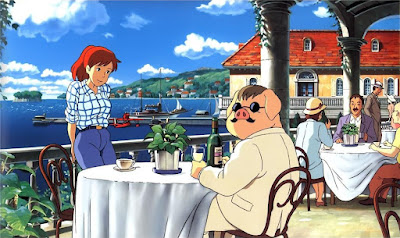
As someone who has stayed away from Studio Ghibli films, merely because I had not gotten around to these productions, it is still with a delight when I finally get to titles once and a while, able to see a film like Porco Rosso for the first time and arguably with a greater impact. There is less built up expectations as a result of how I have gotten to them, and Porco Rosso is fascinating from the get-go as I had a complete misassumption about the premise, based on a manga by Hayao Miyazaki with his love of planes and aviation, believing it was set during a war or was like an Indiana Jones adventure with more aerial dog fighting. What you get instead is still sweet with sombreness, with the lead a war veteran with the head of a pig, but is set in Italy after World War I. Despite being a light hearted work, it still evokes future real events as the eventual growth of fascism is explicitly detailed, the era of Benito Mussolini, even in this family friendly tale. This undercutting of the presumption I had was an added positive as, whilst having expected a war-set adventure story would have still been great, knowing Miyazaki's talent, the switch to a more playful but mature tale of aeronautics and love was a rewarding investment.

Saying Porco Rosso was great feels redundant, definitely not to waylay to the end of the review. This film does emphasis, despite his status for very popular crowd pleasing animated films, Hayao Miyazaki's position as a very adult filmmaker. Despite the reputation for a film like My Neighbour Totoro (1988), Miyazaki the man from his dour outlook to the times he has effectively retired, is an elder statesman, makes him very complex to view, someone who is simplified to the West in appearance both as a man (if you take into his very complicated relationship to his son Goro) to the films' themes as an auteur himself. Porco Rosso the titular character definitely feels like the lead of a film closest to Miyazaki himself. A grumpy but ultimately passionate figure, Porco Rosso is an outsider who, due to a curse never explicitly brought up in exposition or the narrative, has a pig head. The idealist younger man in flashbacks became a dashing and heroic older figure still, closer to middle age, but he hides on his desert beach on an island and leaves when paid to deal with sky plane pirates. Considering this character, even if wholesome, we undersell and simplify Miyazaki here in the West completely, and Porco Rosso's biggest virtue is how, in what is a slight story signposted around a growing rivalry with a hot headed American pilot named Curtis, this really has a lot a complexity in its heart.

The production of the film, during the outbreak of war in former Yugoslavia, clearly took on a different tone due to this reality outside. Originally meant to be a short funded by Japan Airlines, this however is a personal film, with the clear love and loving reinterpretation of bi-planes onscreen exquisite, but with mind to the consequences of conflict and politics. The setting is poignant, set between the twenties to thirties of Italy, its one eccentric touch of having a lead cursed with a pig's head more symbolic in hindsight, a plot point to being a defensive barrier from him and the world, including a woman from his childhood called Madame Gina who still pines for him in love, even if calm in her demeanour whilst others fall for her. The film is mostly fun in tone, set up immediately when Rosso, in his trademark red plane, has to deal with a motley crew of sea plane pirates having kidnapped a school of young girls, all of whom far more fascinating and excited by their predicament then scared.

The balance between humour, adventure and sombreness is a deft and perfect balance here. I admit my interest in Studio Ghibli over the years was more for Isao Takahata, a real underdog, but Miyazaki here has a complex film in mood and tone. The real setting is a surprise, in that all of this is set in a tremulous time in Europe where a growing ominous wave would eventually crossover. Porco Rosso never becomes bleak, but a weight is felt in how Rosso, a former WWI veteran, is part of a group of free people - mercenaries, sky pirates with hearts of gold - who will be outlawed and challenged, as a friend of his time from the war era comes to him to try to get him hired as part of the government's sponsored air force. Nowadays a film for a family audience would be called propaganda if the lead actually said "Better to be a pig than a fascist", and it is amazing to think we can turn to a line like this from an anime film as a needed motto to actually quote in the decades that have passed. Knowing the influence of the conflict in Yugoslavia at the time, which influenced a variety of films including Theo Angelopoulos' Ulysses' Gaze (1995) reflecting on the war, really makes a lot more sense of this film's more serious aspects fully now.

Even in the more light-hearted content, you see much politics and/or social comment in just how, needing his plane to be rebuilt, Rosso ends up with all the women of a town, where all the men have left for work, working on the machine as the film also introduces Fio. Continuing Miyazaki's strong hand for interesting female characters, the granddaughter of the designer called Fio is a really good character and a really nice introduction midway through the film. To Rosso, the world weary and cynical older pilot, the clichés of a more wide eyed and optimistic figure, a seventeen year old girl with a talent for aerial engineering and being outspoken, is when a cliché works entirely, a nice shot in the arm for the film. This does not talk down to viewers, children or adults, as a film which is a constant through its director's work, of a man who lives outside of society, with Fio the figure whose worldview brings what he treasures more upfront in his admiration for her. Even the sky pirates are eventually revealed to be noble when forced to, living in a world setting which here as in real life is becoming poisoned by the fascism of later, with them all who are truly free having to survive the growing change after the film ends. The surprise this did not take the route of a war film or Indiana Jones does bring a great deal of additional meaning for me now having seen what the movie is.

Instead of all things, this has an ending similar to John Ford's The Quiet Man (1952). Ford, a legendary American filmmaker known for many films but especially in Westerns, had ultimately a heartfelt attitude to life which The Quiet Man exemplified, where John Wayne as a man of Irish descent comes to Ireland to find himself. It is a film where a bitter rivalry with another male character is resolved in a prolonged fistfight to a huge crowd and friendship. That could be considered a spoiler for Porco Rosso, but ultimately it is not, as the figure of Curtis is not a villain either, and whilst real bullets are first used, their ultimate battle ends with those being ran out of and friendship coming after punching each other in the face. Not surprisingly, this theatrical film looks beautiful too, with a score by Joe Hisaishi which is great, but the film's juggling of tones and the moments which stand out really are special and why Porco Rosso succeeds. The humour stands but so does the most profound scenes - Gina's memories as a younger girl riding with Rosso on a plane, or the scene of Rosso himself recounting, during the war, of seeing his dead comrades in their planes rising up into the skies away from the Earth as heroes, whilst he was left to return back down. Porco Rosso is a personal film for Hayao Miyazaki but shows his skill with his production team, his deft touch in how the film can have its light heartedness with dashes of this serious grandeur truly rewarding.