Thursday, 7 July 2016

#29: Requiem From The Darkness (2003)

From https://flawfinder.files.wordpress.com/2013/08/requiem.jpg
Director: Hideki Tonokatsu
Screenplay: Hiroshi Takahashi, Sadayuki Murai, Yoshinaga Fujioka and Yuu Kanbara
Based on the short story anthology The Wicked and the Damned: A Hundred Tales of Karma by Natsuhiko Kyogoku
Voice Cast: Toshihiko Seki (as Momosuke Yamaoka); Ryusei Nakao (as Mataichi); Sanae Kobayashi (as Ogin); Norio Wakamoto (as Nagamimi)

Synopsis: In Edo era Japan aspiring writer Momosuke (Seki), who write children's riddles and desires to write a collection of hundred ghost stories, meets a trip of supernatural figures called the Ongyou in his travels. The trickster and leader Mataichi (Nakao), a diminutive priest who uses powers of illusion to distort reality; the puppeteer Ogin (Kobayashi), a voluptuous and beautiful young woman who uses a doll and disguises to create figures of memory; and the shape shifter Nagamimi (Wakamoto), a giant man who can reshape himself into others and is able to communicate with animals. Forcing individuals to confess their sins and punishing them, usually fatal, Momosuke finds himself stuff between normalcy and their circle of the supernatural influence as the dark machinations of the trio travel from place to place.

From http://images.myreviewer.co.uk/fullsize/0000154267.jpg
Like with how fairytales even with their predictable conclusions are so much more rewarding in their flexible storytelling and creating imaginative moments, ghost stories let alone horror tales have the same ability where mood and the journey to their endings are important to them and their ultimate reward. Requiem From The Darkness is an episodic series of grim adult stories wrapped around a sympathetic face, Momosuke, in his interactions with three supernatural beings called the Ongyou, the stories peeling back their interesting supernatural introductions and showing how human beings are significantly more evil than anything already dead. As a warning even to fans of serious adult horror stories, Requiem From The Darkness despite having a lot of its content implied shows no qualms with dealing with taboo subject matter which is going to put some off, let alone the fact that when its shown the gore is strong and graphic. The result is macabre to an extreme particularly against the structure of the show, an intentionally repetitive one where a set-up is created with characters introduced for an episode, the supernatural trio of Mataichi, Ogin and Nagamimi torment a guilty party with psychedelic or haunting imagery until they confess to their crime and are punished. Structurally it's not that dissimilar to a British teatime murder drama where its set-up to when a person confesses to a crime, whether they're revealed to be the guilty party at the beginning of the episode or its kept secret, the only difference being that this is significantly more gruesome with ghostly severed heads, cannibalism and atrocity prints being recreated, all set in a setting with wandering samurai and peasant villages.

From http://images.myreviewer.co.uk/fullsize/0000178259.jpg
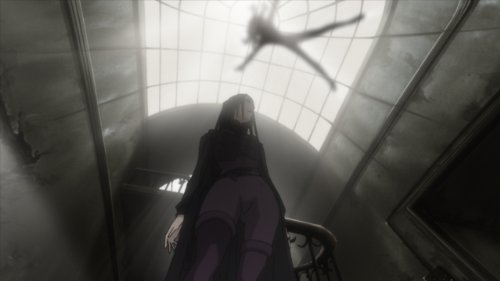
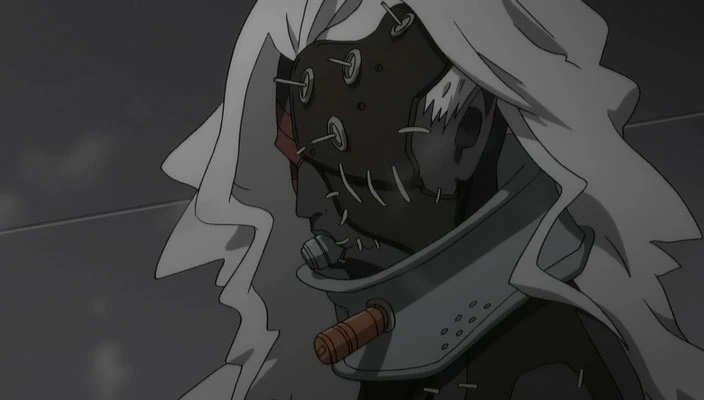
The aesthetic style of Requiem From The Darkness is what factors into the show standing out from this style of ghost story. Barring one or two details already dated after ten years - CGI sea effects for example - it possesses an incredibly distinct visual palette that's both beautiful and morbid. The look is comparable to a Japanese art scroll where the ink has melted and the image has become distorted - a historical period found in Japanese chambara (samurai) films but with the supernatural afterlife already effecting the environments with its darkened colour palette and obsession with the run-down and the decayed. Baring some of the main characters and background figures, depicted realistically, most of the cast onscreen is grossly exaggerated and alien, from Nagamimi's stilt legs and lack of eyes to the publisher who Momosuke works for being the size of Jimmy Cricket from Pinocchio (1940), a figure continually cranky due to Momosuke's laziness as a writer. Even a realistic character is Ogin, the pin-up figure shown in nude poses in the end credits alongside giant centipedes and death, has a gothic tone to her in her facial expressions and dress, the Edo period exaggerated to an extreme whilst not losing the historical tone. It's not only the bloody and visceral content which startles but the surreal touches which distort the world's reality, the small details such as the samurai who patrol the streets, and who aren't important characters for an episode, having wooden logs for heads like they were training dummies for trainee samurai or how houses take on the shapes and sizes comparable to German Expressionist design in films like The Cabinet of Dr. Caligari (1920). It's a Japanese form of Expressionism on hand in the show to match its bleak content, of mothers being forced to have their daughters taken away to become geishas or bandits terrorising the locals, where everything is unsettled. The fact that the exact period the show is set in is the transition from Edo period to the Meiji period in Japanese history, where significantly the isolationist policy from other countries for the country would weaken, is a good piece of information to know of as the show has the sense of being a world full of chaos just hidden under the normalcy.

From http://images.myreviewer.co.uk/fullsize/0000223034.jpg
The only disappointment with the series revisiting it, when it's a great little chiller that crawls under the skin, is that its only thirteen episodes long, the last two episodes finishing with a sub-plot where Ongyou start to question the authority figure the trio works for. This would've benefited from having double the amount of episodes if the structure was carefully sculpted and the episodic stories were all interesting, ten or more stories of the gristly and corrupt nature of humanity which would've been incredibly watchable and helped add to the characterisation. It would've also helped with the threadbare continuous plot hidden within the series, of both Momosuke questioning the trio and his romantic longings for Ogin, the additional episodes if done right likely to have helped fleshed out these barely touched upon plot threads. As it stands, Requiem From The Darkness thankfully merely leaves you wanting for more, the abruptness to how its end far from a detraction but a wish that it had lasted for a few more episodes.

From http://www.zupimages.net/up/14/52/72jr.png

Tuesday, 28 June 2016

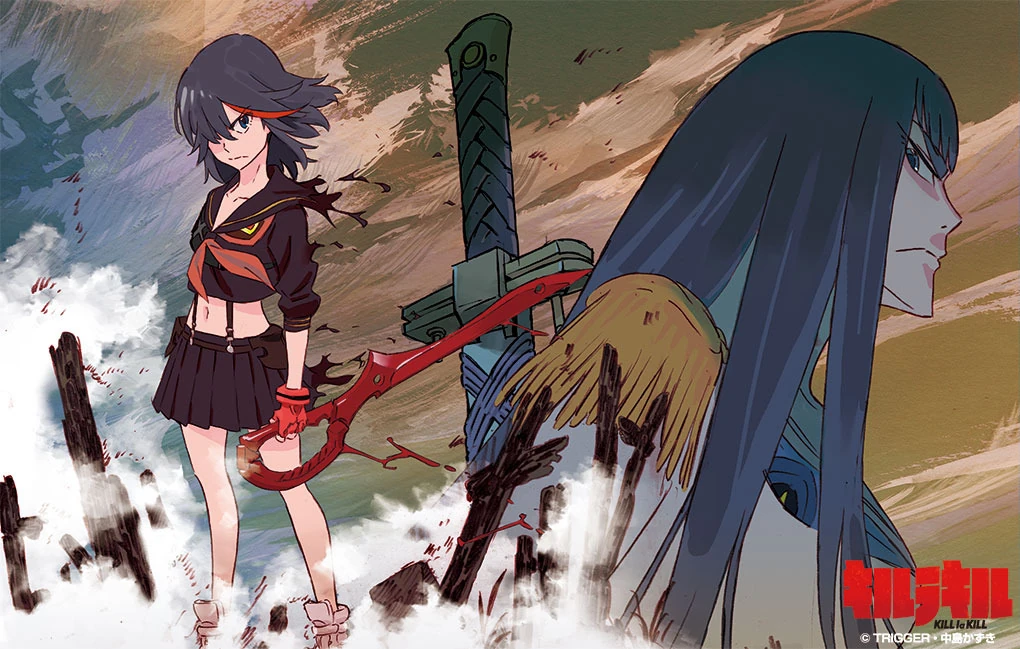
#28: Kill La Kill (2013-14)

From http://vignette1.wikia.nocookie.net/omniversal-crosswars
/images/a/ae/Kill-la-kill.jpg/revision/latest?cb=20140111135321
Director: Hiroyuki Imaishi
Screenplay: Kazuki Nakashima
Based on an Original Premise
Voice Cast: Ami Koshimizu (as Ryuuko Matoi); Ryoka Yuzuki (as Satsuki Kiryuuin); Aya Suzaki (as Mako Mankanshoku); Toshihiko Seki (as Senketsu); Hiroyuki Yoshino (as Hōka Inumuta); Katsuyuki Konishi (as Tsumugu Kinagase); Mayumi Shintani (as Nonon Jakuzure); Nobuyuki Hiyama (as Uzu Sanageyama)

Synopsis: At Honnouji Academy, the daughter of the head of a global fashion corporation called Satsuki Kiryuuin (Yuzuki) rules the student body and even the teachers with a velvet lined iron fist; the entire island right down to the homes are set in a class structure where the highest tiers were special school uniforms lined with life fibres, living fibres which allow for growth in superhuman abilities in the wearers. With an Elite Four under her to control the students - Ira Gamagoori, Uzu Sanageyama, Nonon Jakuzure and Houka Inumuta - Satsuki hopes to dominate the entire country of Japan in terms of the school system. However there's a new transfer student to the Academy called Ryuuko Matoi (Koshimizu) out for revenge for Satsuki killing her father; armed with a giant half scissor blade, able to destroy life fibres, and gaining a living schoolgirl's outfit she calls Senketsu (Seki), a living being which gives her greater strength than regular life fibre uniforms, she will be a problem for Satsuki. Helped by the hyperactive friend and personal cheerleader Mako (Suzaki) and an anti-life fibre rebel group of naturalists called the Nudist Beach led by Aikuro Mikisugi (Miki), Ryuuko intends to cut the heads of the Academy down to size.

From http://www.anime-evo.net/wp-content/uploads/
2013/10/kill-la-kill-01-09.jpg
What exactly can be added to the opinions on Kill La Kill when everyone else has already reviewed it, drawn fan art of it, cosplayed as characters from it, drawn erotic fan art of it and much more, something that is already seeb as a cult series that people will still talk of for a few years at least? That it's in hindsight Imaishi, after setting up his own studio called Trigger after leaving Gainax, created something that for all its ridiculous gore and hyper sexuality - famously Ryuuko's super transformation which hasn't put off male and female cosplayers dressing as her and even bringing about a special form of bra padding for sale - is really a tribute to the kind of action programming usually designed for children, usually episodic and can be understood by Westerners and those who even watched live action shows like Power Rangers. The type of show where each episode threw any threat at the heroes - mind control, betrayal and plenty of super powerful minions - only for the heroes to overcome it all through passion, courage and blood-mindedness. It's the kind of thing, slightly betrayed by the J-pop but forgiven in Kill La Kill because of its good music and a great end credits song for the first half of the series, that should be scored with the most bombastic and cheesy eighties guitar rock song possible. In comparison Gurren Lagann (2007), while in the same mould, was far more complicated as it literally split in plot with a drastic time jump forward in the narrative in the centre of the series, whilst Kill La Kill does all its plot twists and dynamics in a straight forward plot, set within only a few settings and the same time frame, which is charged through in its twenty four episodes and bonus ending episode with as much adrenaline as possible.

From http://cdn0.dailydot.com/uploaded/images/
original/2014/3/31/Kill-la-Kill-header.jpg
Since Imaishi 's trademark is very fast paced and hyper in pace, this means that the episodic tone of such shows is taken to an absurd extent where a strife can be thrown at the protagonists and be dealt with in the first fifteen minutes of an episode, more strife ready immediately afterwards in constant bombardment as plot twists keep appearing. Far from becoming problematic and eventually desensitizing, the show's tone works because it fully embraces the structure of serial storytelling to an extreme, the personality from the show's quirks and peculiar plot line intertwining fashion and fascism that was the original catalyst for the show. It's helped by the fact that Imaishi has never allowed bad animation into his directorial work, nor accepted anything aesthetically ugly to appear on his animation, unless it was deliberately chunky on purpose. The same kinetic tone of (entry # 23) Dead Leaves (2004), his debut, continues all the way to Kill La Kill nine years later with incredibly ridiculous action set pieces, the tone set by how much the bold, three dimensional red text onscreen in abused to name every character and move that appears and the general sense of deliberate overkill and exhilaration in the story's presentation.

From http://cdn-static.denofgeek.com/sites/denofgeek/files/styles/
insert_main_wide_image/public/0/02//kill_la_kill_2.jpg?itok=iVDwth4Q
It depends on your personal taste whether the tone of Kill La Kill is desensitising to a major fault or whether it's incredibly energising and leaves you on a constant high from all the cliff-hangers. The personality is what helps, Imaishi deciding to create a story based on the idea of clothing representing conformity and doctrine, where the clothes literally wear the wearers rather than the other way around, running with the clothing and sewing iconography in everything from the weapons to super-moves. Within this the characters are the stereotypes of anime giving Imaishi's trademark eccentricities and energy. Ryuuko Matoi is the tomboy protagonist who is blunt and hard-headed, the kind of figure capable of learning from mistakes and weaknesses for the sake of drama and surrounded by people willing to help her in her determined goal, all of them memorable in visual appearance and personality be they the good guys or bad guys. From Mako and her monologues with choreographed hand movements and random tangents to the Elite Four, tough but also mortal with their own quirks, the characters Imaishi has in his work have been the thing that wins viewers over ultimately. This becomes a masterstroke for the plot as well when the story starts to show more sympathetic sides to Satsuki Kiryuuin, the cold figure but one with a humane view of her henchmen, foreshadowing how the show twists the initial plot on its head in the finale in terms of the span of events.

From http://media.tumblr.com/bd5ca0548a2821fcfe552ad2e3ea173b/
tumblr_inline_muz71eYotr1qzxa0m.png
If there's any issues with Kill La Kill it's only that, like Imaishi's other work, he could've easily trip over if he wasn't careful and have something in his stories which make little sense or stick out like a sore thumb if you think about it too much. Kill La Kill jumps over plot points quickly and it could've easily devolved into illogical tangents which come off as confusion rather than ridiculous in an entertaining way. Sometimes its scorched earth policy in plotting offers great moments - the cliché of the hero renouncing their position in fear of becoming a monster gets swerved in a great way here. In the opposite spectrum it could've easily fell over something incredibly stupid - the one which nearly raised an eyebrow from myself is when the real villains are revealed to be incestuous lesbians with a fetish for fabric, thankfully side stepped knowing Imaishi has always had a very liberal viewpoint of sexuality - where there is a gay side character on the heroes side of Gurren Lagann whose despite his broad personality can be serious and competent when need be - and it's one of the most kinky anime directors in terms of equal opportunity and liberal fan service and sexuality, exemplified by the fact that the rebel team helping the heroine, Nudist Beach, is literally a nudist group whose leader gladly poses bare chested during his grand speeches with abs and nipples that glow purple when air reaches them. Imaishi has always tightrope walked between being merely tasteless and being deliberately absurd; Kill La Kill gets away with some abrupt plot twists, including outright absurd science fiction by the end, because it's manic tone pulls out the least expected things possible with such a simple plot. Somehow the series starts with Ryuuko and Mako negotiating a life threatening obstacle course to school that needs to be completed in a set time limit, like a more dangerous version of a plot found in a children's cartoon, and then ends over twenty four episodes later with the Earth at risk from living fibres on an apocalyptic level, the twists about who is who, what they are and who their relatives are, piled onto each other abruptly one after another, and manages to get away with it because the tone is dealt with perfectly. Anything that could be utterly clumsy is countered by Imaishi having always been an equal opportunity individual with a taste for the insane.

Because of such virtues, it's great to see such a fun and accomplished series do so well in terms of popularity whilst still being as weird and deliberately silly as it is. The only concern left after seeing this series finally, as I said in the Dead Leaves review, is that Imaishi should consider taking a whole 180 degree turn in tone for his next few projects so that he does not need to repeat himself, Kill La Kill perfect as it is and not needing to be spoilt by something repeating it's style with less interest. Space Patrol Luluco (2016), his latest, is a very short sci-fi comedy series which is hopefully a good start but I feel his next large scale project, if it comes, should be different from the action template as well; even even Panty and Stockings With Garterbelt, whilst an action series, was more of a Cartoon Network cartoon for adults, and if anything emphasising the comedy for a while might be perfect for him unless he decides to step into uncharted territory with another genre like drama. Might be insane to imagine it, but it would also be a shame when, including its bonus twenty fifth episode which ties the show up in a perfect little bow and clears out anything that would've been loose threads in the original finale, Kill La Kill after leaving with an emotional end and a smile on your face was spoilt by a rehashing of its best aspects.

Monday, 13 June 2016

#27: Roots Search (1986)

From https://bludragon.files.wordpress.com/2009/
10/roots-search-1986-ntsc.jpg
Director: Hisashi Sugai
Screenplay: Michiru Shimada
Voice Cast: Keiko Han (as Moira), Banjou Ginga (as Norman); Kenyuu Horiuchi (as Buzz); Osamu Kobayashi (as Marcus); Takao Horiuchi (as Buzz); Yusaku Yara (as Alien X)

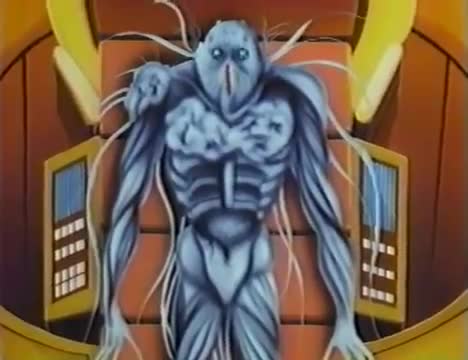
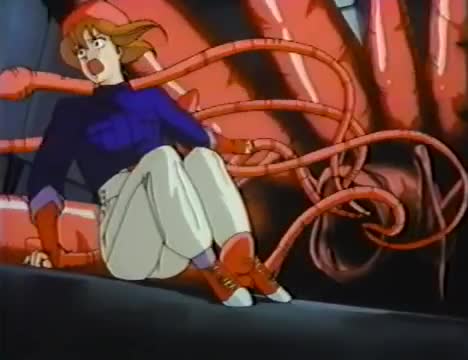
Amongst the obscurities that were made in the golden age of straight-to-video anime back in the eighties, Roots Search managed to both be notorious amongst older Western fans but managed to dig its way out of the vortex many obscurity is stuck in because of this infamy. A sci-fi horror story, a space station built to research ESP and psychic powers is unexpectedly graced with a deserted spaceship appearing in its dimension. With only one survivor on board called Buzz, the occupants of the station including its sole female member Moira find themselves up against a monstrous alien entity which, prefiguring Paul Thomas Anderson's Event Horizon (1997), changes itself into figures of guilt for each of its victims before gruesomely killing them. Amongst the ghosts the alien plays includes the ex-lover of one of the men and a soldier killed by a giant extraterrestrial dinosaur before one by one disposing of them.

From https://i.ytimg.com/vi/CM2qRd0cStU/hqdefault.jpg
Roots Search is a strange, malformed entity, only around forty minutes or so and managing in such a small space of time to feel like a line of grease and dirt has covered a viewer's eyes with its schlocky tone. In terms of actual virtue, it's a complete failure, too short to really be able to pace itself well and instead a catalogue of strange plot tangents for such a simplistic plot. Instead this is one of those anime that if you have a high tolerance for lack of quality, the virtues (and fun) is to be found in that griminess. For example, that aforementioned giant extraterrestrial dinosaur which Event Horizon could've made work but is a prominent part of this anime's scare tactics. There's also a subplot involving Moira and Buzz falling in love that will either clinch whether you hate the anime or appreciate it, Moira's precognitive abilities allowing her to have a premonition involving them naked running on a field, under a candy floss pink sky, and leading to the creation of what's effectively the star child from 2001: A Space Odyssey (1969). Moments like this cannot be taken seriously, so the anime depends on whether you find humour in it or not to find any entertainment within it.

From https://tokyobagero.files.wordpress.com/2016/02/macross2012roots-search
-ld-640x4801f9fcc2e-mkv_snapshot_35-20_2016-02-26_21-18-22.jpg?w=640
It's quite gristly as well, not only in gore that is gooey and bloody but in general body horror where people explode into tentacles and various forms of viscous dripping alien limbs or the contents of an anatomical book. It's no way as detailed or nasty as some of the more infamous anime of the eighties like Angel Cop (1989-1994) or Urotsukidoji (1987-89) but its veneer of grime is actually the thing for me personally that helps Roots Search have some saving grace to it as it leads to it having a personality. There's also a creepy sexual edge to it by accident or on purpose, such as the alien having, for a lack of a better term, a vagina dentata-like mouth, adding to the level of scuzz. The lurid tone is matched by an animation style which can, honestly, be summed up as a mess, about to collapse into the shambolic. Even on a VHS rip, there's a dirt ridden look which, despite the work of the production staff, cannot be ignored especially when it comes the character designs, varying between looking like many have been visibly devoured by their anxieties from the amount of black lines beneath their eyes to Moira's strangely giant eyes and incredibly large pink beret. It would've been a much duller anime if this hadn't happened as it actually makes the work far more memorable, the generic character designs and bland environments given over to gross body horror and characters who look like an eye is about to drift down to their cheek if they don't concentrate on keeping it in place. Paradoxically it's the mistakes which give some life to the aesthetic of the production if you're not just focusing on the horror aspects.

From http://blog-imgs-65-origin.fc2.com/t/s/u
/tsukihito2/cap2014-04-29-19h13m02s9.jpg
Plot wise it starts to get ridiculous as it goes along, the alien proclaiming itself to be God and metaphysical dialogue being crowbarred into a running length not long enough for it. Immediately after the station's captain is killed gruesomely, which should cause people to feel at unease or terrified, you have Moira suddenly starting up a polite conversation about the existence of God in the kind of abrupt change of pace that you expect failed live action horror movies from the West to commit, not an anime. The ending is entirely vague as well, sexual and anatomical imagery abound as the survivors suddenly end up in a womb-like, living environment walking optimistically into white light, no real conclusion when the credits kick in with a jazzy J-pop ballad.

Depending on your viewpoint of this anime watching it, it's in some ways for the better practically that an industry like the straight-to-video era where there was enough money about, before the Japanese economic bubble popped, to fund stuff like this doesn't exist anymore. But bad anime is still made in large quantities,  and for all its failed examples this system also lead to good anime and even beloved classics, making one pine for such a system to still exist. A contradiction yes, but that reflects how bad to the point of being charming Roots Search is in a sick way. Hilariously the same studio who made this also created Crystal Triangle (1987), melding Indiana Jones and a crackpot Dan Brown mystery plot into a memorably bonkers feature length anime. That's for another day however...

From http://blog-imgs-65-origin.fc2.com/t/s/u/
tsukihito2/cap2014-04-29-19h43m35s176.jpg

Monday, 6 June 2016

#26: Paprika (2006)

From http://pics.filmaffinity.com/Paprika_detective
_de_los_sue_os-439873032-large.jpg
Director: Satoshi Kon
Screenplay: Seishi Minakam and Satoshi Kon
Based on a novel by Yasutaka Tsutsui
Voice Cast: Megumi Hayashibara (as Doctor Atsuko Chiba/Paprika); Tōru Furuya (as Doctor Kōsaku Tokita); Tōru Emori (as Doctor Seijirō Inui); Katsunosuke Hori (as Doctor Toratarō Shima); Akio Ōtsuka (as Detective Toshimi Konakawa); Kōichi Yamadera (as Doctor Morio Osanai)

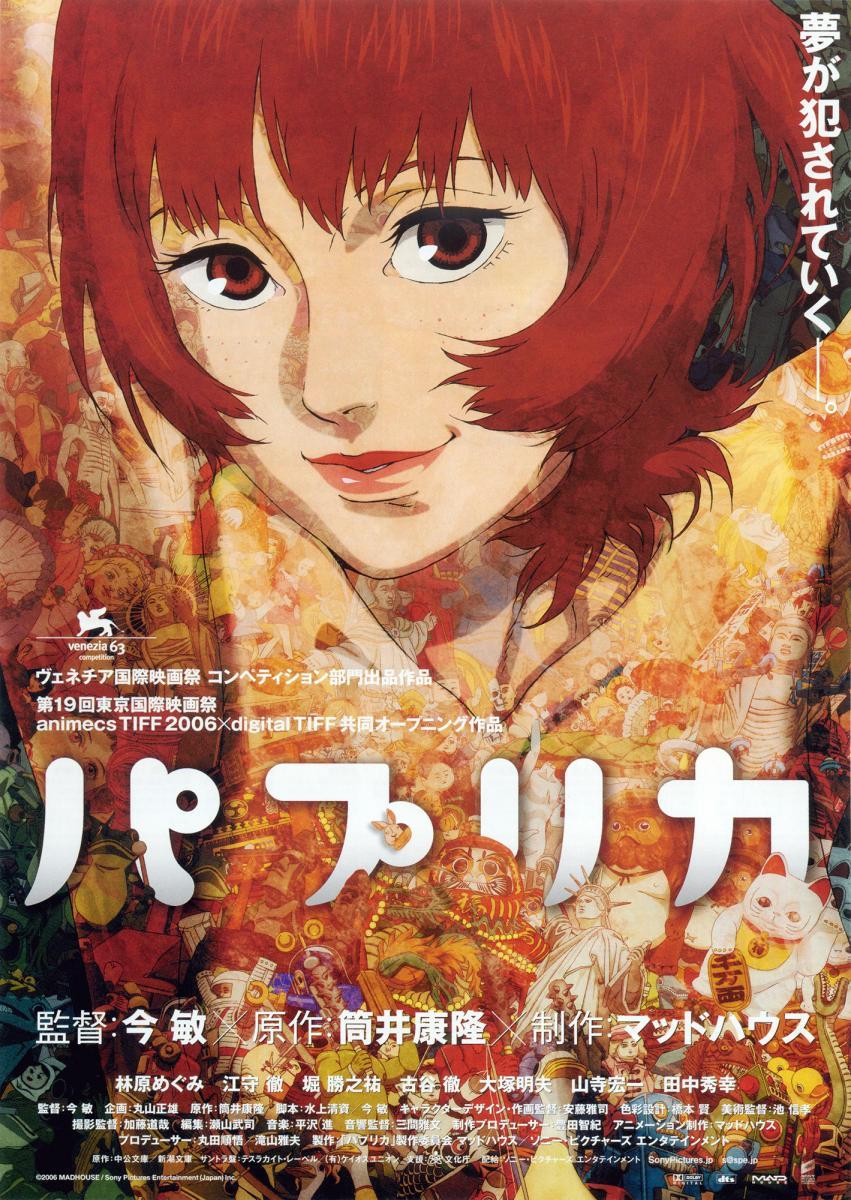
This would've been a difficult task - covering an anime by the late Satoshi Kon and explaining my admiration for him - regardless of which of his small filmography I choose, but it does also mean I got to revisit this film again and see why I admire him like so many do. Paprika is the one in his career which is the "flawed" film of his filmography, but you'll also see why I love it if you follow the link to the full review HERE.

From https://canime.files.wordpress.com/2007/11/paprika4.jpg

Friday, 13 May 2016

#25 Ergo Proxy (2006)

From http://img11.deviantart.net/b727/i/
2006/290/0/d/ergo_proxy2_by_sage666.jpg

Director: Shukō Murase
Screenplay: Dai Sato; Junichi Matsumoto; Naruki Nagakawa; Seiko Takagi; Yuuko Kawabe; Yuusuke Asayama
Based on an original premise
Voice Cast: Rie Saitou (as Re-l Mayar); Akiko Yajima (as Pino); Koji Yusa (as Vincent Law); Hikaru Hanada (as Raul Creed); Kiyomitsu Mizuuchi (as Iggy); Sachiko Kojima (as Monad); Sanae Kobayashi (as Daedalus Yumeno)

Ergo Proxy is a perfect case study of how an anime television series, especially when it has over twenty episodes rather than twelve or thirteen to work with, can be a rollercoaster in terms of how a show can drastically change from its first episode to the finale. Here, what begins as one type of story changes so much in terms of what happens to the characters that it feels like a lot of time and events have passed. Whether Ergo Proxy does succeed in doing this well is to be described throughout the review, but when it succeeds in other anime television, even if there're hiccups along the way, it's so much more rewarding in fact than some tight, thirteen episode anime or animated films in letting the world feel fleshed out and unpredictability becoming involved.

From https://canime.files.wordpress.com/2009/06/ergo6.jpg
Ergo Proxy starts as a dystopian sci-fi story set in a post-apocalypse world. In the last surviving city of Earth, Romdeau, the populous are controlled by the state, ran by a Regent assisted by intelligent artificial intelligences housed in animated Greek statues and various departments of control. Mankind is to control their emotions, following their robot assistants called "Entourages" carefully and consumer products. The granddaughter of the current Regent is Re-l, a member of Citizens Intelligence Bureau who is currently investigating the effects of the Cognito virus, causing self awareness and consciousness to grow in the entourages. While investigating this however, Re-l discovers the existence of a strange and monstrous figure the authorities are trying to suppress knowledge of. Discovering the monstrous figure is a "Proxy", and that there are more than one of them, she finds herself being watched even through her robotic partner Iggy and compromised by everyone including the security group led by Raul Creed.

From http://ecx.images-amazon.com/images/I/4106sNGWrCL.jpg
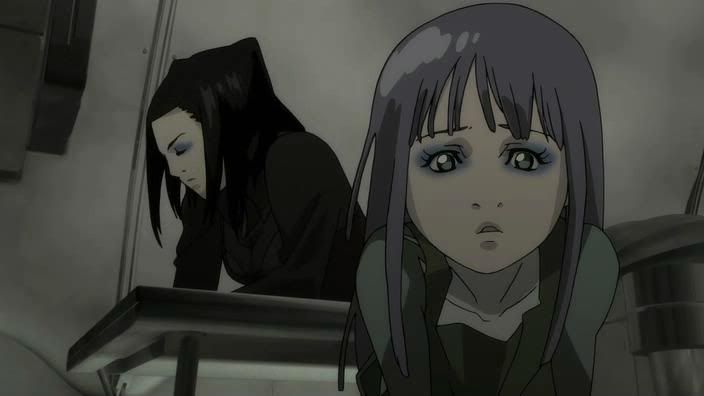
Very much catering to a Western audience, the first quarter of the series is a post-Ghost In The Shell franchise creation, very much trying to replicate the mix of seriousness and action of Mamoru Oshii's 1995 adaptation and the other adaptations from other directors after that. Significantly though, while Oshii's films, including the sequel, had actual philosophical discussions, Ergo Proxy merely tries to have philosophical sounding dialogue discussing fate and existence, placing it very much in the ballpark of anime earnestly taking on serious pathos to their material, mixing this with moments of action. It's black, grey and brown hued colour is immediately striking at first - Re-l is as Goth as you can get with her Panda eye purple eyeliner, black night clubbing clothes and boots, and a long trench coat - but it eventually becomes repetitive immediately after the first couple of episodes, causing one to desire more colour and the story to escape the oppressively drab Romdeau. Tonally it's better keeping you engaged, appropriately bleak without becoming morose, more so that in catering to its Western influences the production went as far as having Radiohead's Paranoid Android used as the end credits song, thankfully able to be kept for the Western releases out of permission from the band themselves and apt for the tone of the work.

From http://vignette4.wikia.nocookie.net/ergoproxy/images/8/80/
Monad-proxy.jpg/revision/latest?cb=20100711185939
Things become more interesting as the world opens up beyond Romdeau, when its revealed there's more to the world in spite of people dying in the wasteland if they are not treated to adjust to the contaminated air. Re-l with her robot partner Iggy encounter Vincent Law, an "immigrant" whose connection to the proxies force him on the run from Romdeau's forces, and Pino, a small robotic girl originally built as a surrogate child whose is infected by the Cognito virus, becoming more human than some actual humans as she acts like an actual girl who loves life and is naturally curious about everything around her. Vincent Law in particular is as stereotypical as you can get for the show, the shy guy whose secret dark side is another stereotype in itself when its finally revealed, but as the shows escapes the trappings of replicating a cyberpunk mystery the characters in spite of their stereotypical behaviours get more interesting as the show strays off its narrative path. Pino in particular is the most rewarding character in terms of entertainment; thankfully she is never viewed in a sexual light, and while she is the stereotypical cute child who wears a pink bunny costume a great deal, she is a lovable character who is far from annoying. Because of Akiko Yajima 's voice acting and how the character is depicted, she is loveable in an admirable way with her mimicking of other's behaviour and friendliness. That she's a robot with a soul adds to her character a great deal without blatantly discussing it at length as does when she has to learn of concepts such as death without the show becoming morbid about such moments.

From https://lh5.googleusercontent.com/-SZxS5AnrZUU/TnlbH7VkKwI/AAAAAAAAQyo/w1
7JrqJ_sBo/s800/Ergo%252520Proxy%252520-2.jpg
When the show reaches its halfway point it almost entirely severs itself from a direct narrative and the city of Romdeauas the protagonists explore the other cities in the wasteland. Not only does the aesthetic style improve as more of the world is shown - cities where only the robots remain to populate them doing their chores on deserted streets, an amusement park dome, dark caves containing mutants - but this is a case where it's the filler episodes, episodic tales, that prove to be stronger than the actual narrative in construction. I was not a fan of filler episodes once but that's changed as I realise how useful and fun they can be. It helps that this show's episodes still drip feed important plot points, as the show intercuts back to Romdeau to follow both Creed and Daedalus Yumeno, a young male doctor whose emotional connection to Re-l becomes problematically obsessive when she is gone, allowing a narrative to still be built. But the episodes where the protagonists step out of the main narrative, barring some small plot details, help flesh them out immensely. Some of the episodes are deliberately abstract in tone, facing possible doppelgangers or Vincent entering a subconscious encounter with his darker self involving a book seller, and others are deliberately jarring. What could become a monster of the week show when other proxies are revealed becomes more of the production team likely stepping out and experimenting with their material, thus letting down their hair and becoming incredibly creative.

From http://media9.fast-torrent.ru/media/files/s3/dm/ps/ergo-proksi.png
One episode for example, even playing with the opening credits for a fourth wall joke, is literally a game show, out of the blue and the best episode of the whole series as it crams major background story into its form, questions to baffled protagonists, and is completely jarring, the bright colours of a studio set drastic alongside its cheerful tone in spite of the fact the loser of the show's game will be killed. Another, which is another candidate for the best episode, involves the aforementioned amusement park dome, turning the serious show into a tribute to classic western animation like the Fleischer brothers and explicitly referencing Walt Disney. When the show does swerve into episodes like this, the virtues long form anime series can have with longer lengths is shown, adding to each characters' personality in spite of their stereotypical ticks and keeping material fresh; for another great example, one where the heroes are stranded in wasteland, you get to see Re-l develop into more than a moody female protagonist when she starts to go stir crazy over simple things as Vincent leaving the toilet seat up, bringing normalcy in a humorous way into a sci-fi story. Whilst a thirteen or so episode series can prevent a story from becoming meandering and improvising episodic plots badly, shows with longer lengths can allow to use the unpredictable to their advantage, the rollercoaster as mentioned in the beginning, where a serious show visibly and tonally in debt to Ghost in the Shell ends up with a character having two anthropomorphic comedy sidekicks for a late episode. This also helps as, once some colour and further personality beyond Romdeau's conformist greys and blacks is added, Ergo Proxy has a high artistic quality to admire. Great animation is added to the bleakness of the world, destroyed by an unknown plight and adding religious tones to the plots' secrets, fleshing it out further. It's clichéd as hell as a story, as massive and monstrous humanoids called proxies tear chunks out of each other if they cross paths, scored characters named after philosophers talking about fate to the cast, but once the filler episodes allow the animation to stretch its legs and do more, the seriousness starts to be sincerer.

From https://s-media-cache-ak0.pinimg.com/736x/a3/
d9/95/a3d995938c30554d307f225a7d64b9cc.jpg
It's unfortunate however, despite how rewarding the series is, that the last three episodes feel so abrupt, returning back to Romdeau with a sudden, undisclosed jump in time where chaos has reached the streets. One flaw with the Romdeau setting is that, despite there being background characters, the show from the beginning felt empty in terms of scope, with no one baring silhouettes in the background to add meat to the dystopian tones. When it returns to Romdeau in the midst of chaos, without showing the cause of it barring hinted dialogue in an earlier episode, and with only a few riots killing entourages to represent it, the shift is lacking. Trying to quickly tie together its narrative, it becomes a series of muddled monologues and unexpected religious imagery that, while eye catching, does jar with what came before unlike the game shows and Disney references which were playful and by themselves. The show's attempts at serious philosophy eventually collapse into one of the worst stereotypes of anime when characters deliver convoluted monologues in the middle of a final fight instead of trying to actually fight , vague and against the more rewarding material of before.

From http://i2.photobucket.com/albums/y7/n00dle_king/lolilil.jpg
And in lieu of how like a rollercoaster the show already is, its disarming that a science fiction story which does hint at spirituality and fantasy, but grinds it into some natural reality, suddenly ends with such a scene as a feather winged woman, a doppelganger of another, carrying another person by the hand up into the clouds in a mix of Icarus and an angel taking someone to heaven. While it could've worked perfectly if the religious overtones had been more prevalent in the earlier chapters, the ultimate flaw with Ergo Proxy is that its structure is a mess because of the ending, the main narrative far less interesting than the tangents it goes into with the attempts to make the narrative engaging by its end abrupt. What actually hit a great groove of quality from episode fifteen onwards, where even predictable episode plots sparkled with importance for characters and plot, is disappointed when the structure is lets the side down. Ergo Proxy still can raise its head high for some utterly memorable middle episodes, proof filler can be healthy for the show, but it fails when it needed to climax perfectly. 

From http://burrowowl.net/wordpress/wp-content/
uploads/2006/09/ergo_proxy_19_will.jpg

Sunday, 24 April 2016

#24: Yuki Terai - Secrets (2000)

From https://myanimeshelf.com/upload/
dynamic/2011-11/07/211.jpg
Based on a original premise
Viewed in Japanese with English Subtitles


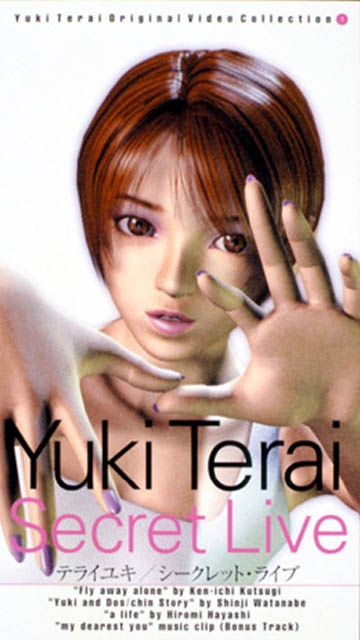
Yuki Terai - Secrets is an obscure compilation DVD, as obscure as you can get and probably for the better as in all honestly there's no real value to the set of shorts baring another curiosity in terms of early computer animated anime, another one covered for the blog but with an added factor that this is a portfolio for a fictitious female idol entirely created on a computer. This belongs to a series called Virtually Real that, in the weird early existence of DVD from 2000 and the first few years of that decade, was released in the UK alongside many a weird obscurity; in fact, from the trailers on the DTS sound enhanced disc, there are two more of these devoted to their own idols out there and can still be found on Amazon. Yuki Terai herself is a permanently seventeen year old girl who is brought to life by actresses in VR costumes and animators, able to star as multiple characters and show off many talents over the shorts contained in the disc. She is the titular figure of Comet the Thief, stealing a priceless guitar and fighting the owner over it in a fist fight, then a singer in a jazz club in Fly Away Home. She is trapped on a spaceship infected by a virus in Lazy Gui, the damsel whose love for an American is contrasted by being a spy in World War II in teaser Project BB-11. She sings, does her own action scenes, stars in a comedy with a cute robotic dog in Das/Chin or is terrorised by her own reflections in The Mirror.

From http://images.myreviewer.co.uk/fullsize/0000059814.jpg
Like the other proto-3D animated anime I've covered on the blog, this is another case of time being unkind to the material. A lot of it is clearly meant to demonstrate the graphical capabilities of the animators creating Terai, particularly an individual named Kenichi Kutsugi, a videogame visual effects and CGI cut scene designer, who overlooks this work altogether; unfortunately due to this emphasis, rather than plot or anything away from predictable stories, it lessens any chance for anything great to stand out now the animation is obsolete. Worse, this was released in the UK in 2002, after (entry #20) Final Fantasy: The Spirits Within (2001), making it look dated even back when it was first released. Comet the Thief, the first on the DVD menu, is a perfect warning of its lacklustre look, the fight scene in the middle between Terai and a male crime boss resulting in stilted character movements against basic backgrounds. It's detail in hindsight to viewing all these works - from this to (entry #3) A.Li.Ce (1999) - that is the ultimate crippling flaw of all the ones I've covered, the reason I have to flog a dead horse in these reviews of praising one called Malice@Doll (2001), an anime I need to review on the blog at one point,  for doing something different by melding 2D animated details on 3D models. This detail also has to be a personality too, which is why  The Spirits Within was bland even though the animation was innovative in its day on an extremely high budget. Particularly with Yuki Terai - Secrets I cannot help but compare it to old videogames, why once high calibre games which pushed graphics have mostly been forgotten but people still go back to old 2D Megadrive and SNES games, although from context its clear the compilation wasn't even the highest quality possible of its kind.

From http://images.myreviewer.co.uk/fullsize/0000059819.jpg
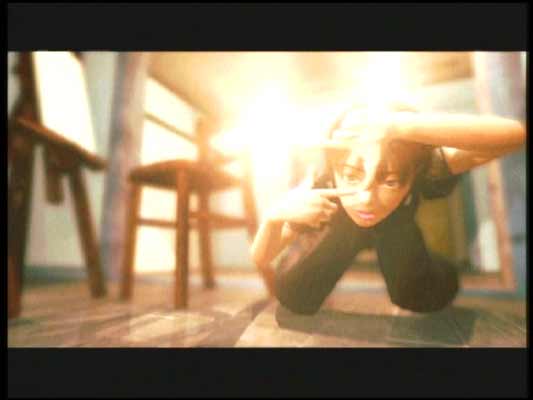
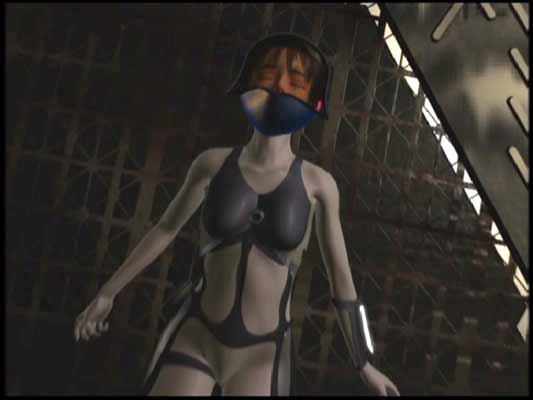
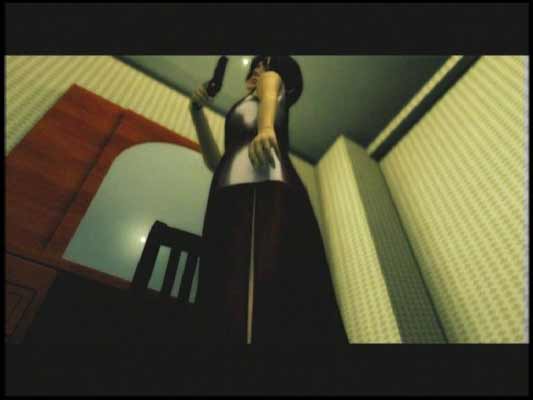
Most of this compilation is pretty bland, less than five minutes long a piece, which cannot get out of the mind set of test demos or plain old music videos in the case of Fly Away Home and especially My Dearest You, which is a clear music video with the model of Yuki Terai against what appears to be a lava lamp for a background. Whether it's the jazz club of Fly Away Home or the interior of a WWII battleship, there's little aesthetic style to these models or even a mood. Even in Lazy Gui when Terai is threatened by a virus that gets into the security system, cuts off her oxygen and even turns off the gravity, the short is mainly set in one corridor with a computer figure with no emotional draw or a quirk to make it stand out. Something like Dos/Chan only stands out because of the cute dog, with an iPhone for a face, which doesn't determine quality by itself. This is worse for a short like A Life, about Terai as a suicidal young woman, lacking any emotional connection especially as it ends with her shooting herself. The exception, which could've been utterly rewarding if polished and worked on by itself in terms of its visuals, maybe even animated in 2D rather than 3D, is The Mirror where there is a creative and bold story at hand about Terai being haunted by her mirror reflections. It's not a great short, but it manages to have a dreamlike tone where her doubles crawl from any reflective surface - mirrors, windows - they can and she can fell into a puddle of water into another reality. It goes as far as having countless duplicates pin her in the corner of a subway car, jumping out of it only to be hit by another train passing by and being absorbed into its reflective front window. The only real flaw with it is that, with a final rooftop battle between her and a double with a neon sign involved and a cheesy pop sign on the end credits, it does get a bit silly at the end, needing a drastic rewrite if it ever got remade.

From http://images.myreviewer.co.uk/fullsize/0000059818.jpg
Within all these shorts, Yuki Terai is a figure we're meant to emotionally engage with, created by Kenichi Kutsugi for a manga of his in 1997 and having a string of appearances by the time of this DVD. This is part of a long line of virtual idols that particularly exist in Japanese pop culture, the likes of Vocaloid, a voice synthesiser, can make possible, able to sustain a popular audience but contrasting with real female idols. It reminds me of Sharon Appleof Macross Plus (1994), a virtual pop idol who however could only exist, in that anime's plot, because a former idol has to implant her personality into its software. The virtual idol, especially when you get into the issue of virtual film actors th, is still stuck with being a figure that needs human life put into it to actually have a personality. The idea of actors being replaced by CGI ones, taken to its biggest extreme in the Ari Folman film The Congress (2013), has been brought up occasionally and was the case with Final Fantasy: The Spirits Within where the female protagonist, a mere 3D character design barring her voice actress, was meant to become a star in her own right who went on to other films in numerous roles. That never took place and it's an immensely failed idea as, not only was the "uncanny valley" as much a problem for a mega budget film like that let alone this compilation, but also there's the issue that these 3D figures can be completely bland and usually end up with tedious personalities as a result of their character designs and/or the narrative they're in.

From http://images.myreviewer.co.uk/fullsize/0000059827.jpg
Terai here is just a model of a seventeen year old as depicted by a male otaku, beyond a pretty face the kind of bland figure that'd sink a conventional anime TV series through her lack of personality. The character is meant, be it to the point of being exceptionally creepy or narrowly avoiding it, to personify a cuteness meant to attract male viewers; amongst the two other Virtually Real DVDs, one is of a stereotypical pin up with gravity defying breasts who in one of the scenes in her DVD's trailer is wearing only sexy underwear and body tattoos fighting zombies with katanas, thus showing that a fetishisation is as much part of the series as any other reason. Terai's lack of personality is also defined by her bland character design, which is ironic as she's clearly the only figure that has been giving some care of her design baring the robot dog. Like other 3D anime I've covered for the blog, the male side cast such as in Comet The Thief is comically rudimentary, like basic templates from a 3Ds Max programme, the obsession with bald heads probably better than the American soldier of Project BB-11's plastic blond hair. She herself is as much part of the problem with the whole compilation, neither protected by kitsch as early eighties and nineties CGI has been nor belonging in quality roles hiding behind a dated shell. Only the recognition of the animators pushing this animation really stands out for me, admiring their work despite the time that has passed, but for an anime of any sort it needs to actually engage beyond the technical details behind it. 

From http://images.myreviewer.co.uk/fullsize/0000059830.jpg

Friday, 15 April 2016

#23: Dead Leaves (2004)

From http://2.bp.blogspot.com/-ZOohJceHbdY/UVABsPSU1KI/
AAAAAAAAIv4/rAdH2BqhEnw/s1600/dead-leaves.jpg
Director: Hiroyuki Imaishi
Screenplay: Takeichi Honda
Voice Cast: Kappei Yamaguchi (as Retro); Takako Honda (as Pandy); Yuko Mizutani (as Galactica); 666 (as Mitsuo Iwata); 777 (as Kiyoyuki Yanada); Chinko (as Nobuo Tobita)
Viewed in Japanese with English Subtitles

In lieu of the unfortunate passing of Videotape Swapshop, I've decided to replace the absence of the tie-ins I planned for that site with linking this blog to my origin Cinema of the Abstract. This'll make a lot of sense with the more stranger and unconventional anime I'll end up covering, Dead Leaves a pretty great example of this type of anime with its maniac bullet heavy action. A link to the review can be found HERE