Friday, 9 September 2016

#32. Black Rock Shooter (2012)

From https://upload.wikimedia.org/wikipedia/
en/7/7a/Black_Rock_Shooter_cover.jpg
Director: Shinobu Yoshioka
Screenplay: Mari Okada
Voice Cast: Kana Hanazawa (as Mato Kuroi); Kana Asumi (as Yū Kōtari); Miyuki Sawashiro (as Yomi Takanashi); Eri Kitamura (as Kagari Izuriha); Mamiko Noto (as Saya Irino); Manami Numakura (as Arata Kohata)

Synopsis: At junior highschool, Mato Kuroi meets a quiet girl in her class called Yomi Takanashi, a bond developed between them undercut by Yomi's relationship with Kagari Izuriha, a housebound friend of Yomi's who has an unhealthy attachment to her alongside control through emotional manipulation. This problematic triangle opens out to include Yū Kōtari, Mato's best friend, Arata Kohata, the tomboy head of the basketball team, and Saya Irino, the guidance councillor for the students, all connected to another world where a mirror of Mato's called Black Rock Shooter fights other girls like her with superhuman abilities.

Black Rock Shooter is a difficult series to gauge, a work with immense ambition but also one that can be argued tries to bite on too much in terms of only having eight actual episodes being available at hand to tell a story, especially one that melds genres for a very emotionally deep plot. There's also the issue whether, based on a multi-media creation that went through videogames and manga already before this series came out, this spin-off could pull off something emotionally potent or is going to collapse into a half-hearted attempt on its subject matter. The Sword of Damocles hangs over this series and it's called Puella Magi Madoka Magica (2011), both of them about the angst of young teenage girls being filtered into fantastical figures with potentially fatal consequences for those involved. Despite all the tie-ins and cute merchandising, Magica is an incredibly dark story which takes the magical girl trope, girls able to transform into magic welding heroines to fight monsters, and makes it a Faustian pact with real death and razor lined plot twists that tear the heart out of a viewer's chest. Black Rock Shooter, in its first episodes, is an odd two sided mirror.

From https://dataportdoll.files.wordpress.com/2014/11/tiny_bird
_book_2_by_neneruki-d4smigx.jpg?w=618&h=346
As the drama of Mato's life unfolds, her emotional strife is shown through a heightened mix of videogame action and Gothic surrealism where fantastical feminine figures fire hundreds of clips of ammo at each other in apocalyptic fairytale wasteland, all of which is coordinated by Kill La Kill director Hiroyuki Imaishi. It's closer, at first, to Zack Synder's infamous live action film Sucker Punch (2011), where the emotions of its lead at specific times suddenly surge into fantasy action mini-sodes where pop culture tropes - school girl outfits, steampunk zombies, dragons - are all thrown together. The difference is that with Black Rock Shooter, there's an even more jarring change in that the real life scenes are played as melodrama set in a high school and that the world with Black Rock Shooter filters through imagery from that life, not only in the girls mirrored by doppelgangers, (horns, black trench coats, giant robot fists etc.), but also details like doll house imagery to macaroons being reinvented as giant explosive ammunition for a one girl tank carrier.

From http://s2.narvii.com/image/lzygghq2wqegtsctovcyoumrexwe3ufe_hq.jpg
[Spoiler Warning. Skip if you don't want to know plot details]

As the series progresses, this mirroring starts to connect more. The truth is that Saya, the guidance councillor, starts to become sinister as she purposes pushes female students into becoming more despondent and traumatised, the effect being their mirror selves become more monstrous and powerful in the other world. This continues in that, in reality, she is part of an unorthodox emotional treatment where when these other versions are killed the traumas literally die in the girls in real life, a form of amnesia surrounding anything that triggers the emotions for them but able to cope without any emotional pain thereon. It's never explained how the other world actually came to be, which is for the benefit of avoiding the show tripping over itself in convoluted exposition it didn't need, but the streamlined nature of the sole eight episodes means that this is definitely a premise which could've easily stretched out to a more longer story. Whether it'd actually work or not is up to debate, but at least with what's here there's an interesting attempt at depicting how traumas work - jealously, the sense of being unwanted like for Yomi, heartbreak like for Arata, Mato herself realising she runs away from any personal pain of her own rather than for others etc. - made more poignant with the common motif of a childhood book with a very sober ending about a bird which collects the colours of emotion only to become blackened by them and die. The decision to depict this through CG  aided action scenes is an odd choice here as the juxtaposition is one you have to suspend disbelief with even if its expanded upon, a show like Magica having more of a chance with thirteen episodes to weave these types of genre combinations more snugly together.

[Spoiler End]

From https://dataportdoll.files.wordpress.com/2014
/11/black-rock-shooter-tv-07-cap02.jpg
What's odd about the action related scenes is that, while tied up in a perfect bow at the end in terms of its plot, it's a chamber piece with only six characters of importance, five of them including the protagonist Mato young teenage girls, Saya the sole adult and also female. Even though it has other characters, and one sub-plot about unrequited love for a boy, it's a fascinating story to examine as its literally a character piece about five girls having to adjust to their own emotions as they become more adult. These types of subjects are common in anime and manga, blended into other genres, but this type of drama is not always this melodramatic as well. It's also interesting that a lot of these types of plot - about frayed friendships, traumas, running away from personal anxieties - are usually surrounding female characters only, one of the only distinct examples of a male going through such severe emotional currents being Shinji through the Neon Genesis Evangelion franchise. This is important here as, with a female screenwriter in Mari Okada able to bring more sincere depth to this type of drama about teenage girls, there is an unfortunate danger of cliché thick through Black Rock Shooter which under serves the great concept of such an internal drama having such a bombastic and frankly absurd outer coating. Sadly the show by its end used emotional shorthand for its last episode, which mars what good it builds up beforehand, when it could've taken more risks with its premise, like Magica or a series like Kunihiko Ikuhara's Mawaru Penguindrum (2011), in using its more "out-there" imagery and genre blending for depicting the emotions of its characters.

From https://dataportdoll.files.wordpress.com/2014/09/
vlcsnap-2014-03-27-19h20m10s180.png
This show does take its emotional current further into the hyper-emotion which differs it from the clichés, helping it a lot more - such as Kagari turning into a character from What Ever Happened To Baby Jane? (1962) when she threatens to Yomi to throw herself down a flight of stairs - but particularly with the ending, where only eight episodes to work with causes it to have to work hard to tie up the conclusion, there's moments where it falls a little bit below expectations because of the aforementioned emotional shorthand, ideas of believing in oneself and others that is something you really expect Western animation to fall foul of when Japan anime tends to have a more layered attitude to such a concept even for a happy ending. It makes sense in anime and manga to deal with issues of adolescent angst, clear there's a reason why its constantly depicted in terms of reflecting real life emotions the creators likely had but maximalised to a greater level, but Black Rock Shooter does balance precariously between the serious and the hollow in its drama because of its ending, spoiling it a little. For everything that works, such as Saya's kind hearted adult who offers cups of coffee to everyone turning more creepy as she keeps appearing, its ending feels like a cop out when it was working up to something more rewarding.

From https://dataportdoll.files.wordpress.com/2014/
11/vlcsnap-2014-11-12-11h03m00s130.png
Artistically this is an exceptional show, which helps soften the clichés further with some imagination behind how the drama is depicted. The other world is suitably freakish but in a beautiful, part Gothic Lolita but with sci-fi and post-apocalyptic aesthetics mixed in the best sort of way, anime and manga having a great knack for their own hybrids of aesthetic and pop culture style to make evocative imagery. From giant red irises eyes occasionally opening in the sky like a god looking down on the land to the near monochrome environment of rock chasms and mountains with mixes of bold colour in-between, the use of metaphors for the real world while obvious in their depictions helps add a greater weight to the content. By being so blatantly metaphorical, the disconnect between the mirroring plots is less out-of-place but entices the viewer to watch on to see how they work together. Musically, while its J-pop, the score is appropriate melancholic, and in a great little detail that shows how more taken care of the show is, the show occasionally plays establishing vocals and notes in the pre-credit openings that immediately jumps into the song for the opening credits like a prelude, adding a sense of grandeur to the procedures.

From http://dzt1km7tv28ex.cloudfront.net/u/
176968815362441216_m4g_d.jpg
Whether this all culminates into a great TV series however is up to debate, taking in a lot of clichés alongside great aspects to get to its finale.  The ending is a large part of why the show does feel flawed, and if it had more time to be more detailed, or an alternative ending was written, a lot of the problems in the show would've been covered up. I still find a great deal to love in Black Rock Shooter, its masala mix of horned, trench coat or black metal armoured Goth Lolita costumes fighting each other and high school drama a brave attempt at something original. It doesn't take as many risks as it should and the problems are clearly visible but it's a an admirable attempt regardless.  

Friday, 12 August 2016

#31: Vampire Hunter D: Bloodlust (2000)

From http://static1.comicvine.com/uploads/
original/3/38826/2379618-bloodlustposter.jpg
Director: Yoshiaki Kawajiri
Screenplay: Yoshiaki Kawajiri (and Brian Irving)
Based on the light novel Demon Deathchase by Hideyuki Kikuchi
Voice Cast: Andy Philpot (as D); Mike McShane (as D's Left Hand); John Rafter Lee (as Meier Link); Wendee Lee (as Charlotte Elbourne); Pamela Adlon (as Leila); Matt McKenzie (as Borgoff)
Viewed with English Dub

Synopsis: In the far future, the world is left in a post-apocalyptic state where vampires and other creatures of the night exist within the land. D, a half vampire and half human dhampir, is one of the best and most feared hunters of vampires, sent after the Baron Meier Link when he is said to have abducted the mortal woman Charlotte Elbourne. With another group called the Marcus Brothers, led by Borgoff, sent after the Count as competition, the result will become violent and morally complex with both the mutants hired to protect Meier Link extremely dangerous and the real nature of his relationship with Charlotte having real love behind it.

From http://comp.judging.it/content/Vampire%20Hunter%20D%20-%20Bloodlust/720p-1/Xell%20SD/Vampire.Hunter.D.Bloodlust.2000.German.DTS.ML
.576p.HDTV.x264-Xell_(00-01-22.415)_01.png
Many view Bloodlust as the superior take on Vampire Hunter D. I'd argue that if the 1985 anime adaptation represents its era - the bright coloured but phantasmagoric content of the era - than Bloodlust is the full blown gothic symphony in terms of aesthetic and presentation. Created as a Japanese-American co-production, the franchise gladly entrenched itself with Western influences which allows this version to work incredibly. Like the first adaptation, one of the best aspects of the world is how it combines numerous genres - gothic horror, sci-fi-, the western - into one seamless form which can cherry pick from them all in plot and visual palette.

From http://i2.photobucket.com/albums/y2/MaverickHunterZero
/936full-vampire-hunter-d-bloodlust-screenshot.jpg
Bloodlust more than the original takes advantage of this further, helped by the fact that the film is helmed by Kawajiri; known for making films like Ninja Scroll (1993) with simplistic plots but exceptional production quality, he also has the gift of having so many ideas that he attempts to cram into each work that the material around the plots is always compelling. It can be easily argued Bloodlust is one of his best films as, while the earlier work that made his name is notorious for its extreme content, this fully embraces the world's template for his most outlandish and imaginative ideas but is also haunting in how its depicted. While gory and violent it lashes onto the chance to be as elegant as possible. It's an anime which can have its cake and eat it, starting like a classic Universal horror movie with a phantom carriage traversing cobble streets from a Victorian city only to quickly become a sci-fi western hybrid when D is introduced, gunslingers with rifles on the beams of a gothic ruin when the dhampir takes on a bounty where, if Charlotte is turned into a vampire, he is asked to kill her.

From http://i.imgur.com/rS4PLgQ.png
The high quality of the feature film is matched by how imaginative it is. The realistic character designs that are a trademark of Kawajiri's productions, the emphasis on the characters looking like real people even when they're superhuman or distorted, allows the tone to get away with the more fantastical content. The world itself is already one of the truly strange and unexpected in terms of what the source material has, such as D's talking left hand, a parasitic entity with a face on his palm that, here, is a comedic sidekick who whinges or mocks D as they move along, taken further than in the original 1985 adaptation as a cranky but lovable entity. Kawajiri, known for his taste in the bizarre especially for villainous henchmen and writing the screenplay, is allowed to bring in henchmen with supernatural powers through the world's conceit of mutants also existing, from a demon clown with shadow abilities similar to a minion from Ninja Scroll to a wolfman who, in his full lycanthrope transformation, has a giant wolf's head with sharp teeth grow from his chest. With Bloodlust the world feels so detailed and fleshed out that the result has a visceral beauty to it; while the 1985 anime was a spectacle of morbid colourfulness, with splatter and nudity, this is closer to a symbolist's wet dream, one filtered through gorgeous animation and a score by Marco D'Ambrosio that fittingly crosses genres, classical orchestra mixed with soul stirring choral chants and brief moments of science fiction electronic hums.

From http://www.animeviews.com/images/screenshots/vhd3.jpg
The other significant reason Bloodlust is amongst Kawajiri's best work is that, for a man infamous for gore and simplistic action plots, this film attempted a greater emotional scope for him because of the source novel's plot and actually succeeded even if there's moments of sincerely naivety to it. The world of Bloodlust itself is depicted, after hundreds of years of the apocalypse reshaping the land, as both a threatening but also awe inspiring place, the usual signs of the wasteland found but also western frontier towns and magical places existing, from an immense garden where a key dramatic scene plays out or the desert landscape where giant, flying mantas - the aquatic creatures mixed with the worms from the Dune novels - flying out from under the sand on mass into the air. The high level of artistic production allows it to be a menacing but also colourful world that does add an emotional effect already. The other is in the plot itself, Kawajiri as the screenwriter stepping out of his comfort zone. The main plot is between D and Leila, a female member of the Marcus Brothers who develops a mutual bond with him, but the really interesting aspect is Meier Link and Charlotte, how they are actually in love with each other and how much of a conflict is involved with the bounty hunters after them when they realise this. Even when the real antagonist is introduced near the end, a full on vamp feeding into the characters' subconscious and a costume off a catwalk, the result is still gothic melodrama delightfully found in the midst of an action horror film. That Bloodlust is as dynamic in style as it is, where rocket ships like look like church spires with actual stain glass windows on their sides, adds to this emotion with morbid beauty.

From http://comicattack.net/wp-content/uploads/2012/
08/4687043505_4aed47b173_z.jpg
Of course, there's the one conundrum that, if this is an American co-production where the English dub came first, does this technically count as an anime for this blog? Yes for me in the sense that, based on a work legendary in its homeland, this feels like a connection of two different countries to create an epic regardless of which country is was designed to be released in first, paradoxically entrenched in gothic influences from the West but undeniably a Japanese anime in style and tone. The only real disappointment with Vampire Hunter D: Bloodlust is that, barring some other high profile American-Japanese co-productions (The Animatrix (2003) and Production I.G's animated sequence for Kill Bill Vol. 1 (2003), these type of productions dwindled immensely by the late 2000s. Especially for Kawajiri his later co-productions with the US became compromised creatively, Highlander: The Search of Vengeance (2007) having the potential to be great but merely a deeply flaw, and at times silly, curiosity. Thankfully there is a significant attempt from two American companies, Unified Pictures and Digital Frontier, to bring back Vampire Hunter D as a television series, giving this world another tale if they succeed. One of the most interesting things about Vampire Hunter D is that, not only have the light novels that originated it created a franchise that's lasted, but the franchise at least in the animated versions developed a following the US, Bloodlust likely to be one of the best ways to introduce a person new to anime to the medium in how it does everything right. While I still hold the 1985 version as a good anime itself, I realise its limitations, whilst Bloodlust is a high recommend and one of the best horror based anime of its kind, a magnum opus even if it's only ninety or so minutes that still stands strong in quality. 

From http://www.judging.it/wp-content/gallery/vampire-hunter-d/Judgment-
Vampire-Hunter-D-Bloodlust-55687BCB_01-24-02.496_01.png

Monday, 25 July 2016

#30: Salaryman Kintaro (2001)

From http://www.anime-planet.com/images/
anime/covers/salaryman-kintaro-1363.jpg
Director: Tomoharu Katsumata
Screenplay: Chikako Kobayashi and Sukehiro Tomita
Based on a manga by Hiroshi Motomiya
Voice Cast: Taisei Miyamoto (as Yajima Kintaro); Atsuko Tanaka (as Suenaga Misuzu); Masako Katsuki (as Sakurai Kyoko); Ryoka Yuzuki (as Suenaga Mimi); Katsuhisa Houki (as Kaminaga Hiroshi); Kiyoshi Kawakubo (as Tomokazu Morinosuke)

Synopsis: The Yamato Construction Company business hires a new salary man named Yajima Kintaro. To the horror of the staff and upper management, the man known as Kintaro hired by the company's elderly owner is the former leader of a giant motorcycle gang who doesn't act like other salary man - he's liable t talk back at those who he feels are unhonourable even in senior positions and likely to get into fights if need be. Yet this behaviour also starts to become a well of inspiration from those around him, rebellion and the desire to become better employees taking place; even romantic longing from women is to found alongside the allies in fellow employees, seniors and even yakuza. The widowed father of a young son, Kintaro is noble, brave and gladly goes out of his way to help those in need, his reckless powder keg personality likely to scrape against corrupt management and those who do backstage dealings in the world of Japanese construction industry.

Salaryman Kintaro is amongst the oddest anime I've covered in terms of actually being able to see it. It's very normal even by the stereotypes of anime, a melodramatic drama set in contemporary Japan about the least expected salaryman possible wanting an ordinary working life. Having seen it it's the the kind of anime that rarely gets released in the United Kingdom and feels like what anime actually is for Japanese viewers who aren't obsessive otaku - mainstream programming like an anime soap opera, not likely to be viewed at two in the morning like shows that get popular amongst Western anime fans are. Inexplicable all twenty episodes were released in the UK by the late DVD company Arts Magic in the early days of DVD alongside obscurer Takashi Miike films, who would direct a live action film based on Salaryman Kintaro, allowing me to see the absurdly sincere, coincidence heavy tale of a Mary Sue figure set around the world of the Japanese construction industry.

From http://i37.tinypic.com/9tigl4.png
Based on a manga that was also adapted into live action television later, Salaryman Kintaro is a pure masculine fantasy of what the perfect salary man should be rather than necessarily the reality of the Japanese workplace. This immediately brings out a charm in the show even if it feels like a retroactive throwback to older gender politics where men were men, Kintaro the opposite of someone who has to bow to others and is grinded down by his work, the nostalgic notion for other characters of when they were younger and more passionate before the work broke them common in the dialogue. A former punk who saves a company manager and asks to be hired as a thank you, Kintaro represents to an extreme the perfect male who will rescue toddlers from a burning nursery and stand out to corrupt upper management, so perfect in his humanity that his only flaws are his recklessness and habit of trying to fist fight people to defend goodness.

From http://i37.tinypic.com/2wmjnky.png
Soap opera is the operative word as the world of Salaryman Kintaro from the outside, if you cannot engage with its sincerely, can be ridiculous. Almost every person that encounters Kintaro eventually becomes his ally. Members of his former motorbike gang, from yakuza to a member who after a significant event decided he wanted to become a transgender woman, spot him out in the crowd and those who meet him either fall in love with him if they're women, such as a rich widowed heiress who becomes one of his main guides, or if they're male develop crushes like his fellow office workers do. Characters at points even bemoan how Kintaro is able to weave himself into people's lives with such complexity, letting the series have some sense of knowingness to its absurdities. The levels of how many lives Kintaro gets involved with get to the point of bizarre coincidences, such as a woman he helps when she is molested on a train turning out to be the fiancée of a yakuza working with a senior underworld chief who looks to Kintaro with admiration, or Kintaro saving the son of someone who is on the side of a corrupt company. How convoluted these descriptions sound is enough to show how elaborate the ties are between Kintaro, the magnet for everything else, and everyone around him to the point of the hyper fantastical.

From http://okanime.com/wp-content/uploads/2014/09/protectedimage.jpg
The fact that it's all set around the Japanese construction industry does add an oddness to the show's tone; for every real concern such as striking workers at a underground tunnel project, or fantastical ones such as the amount of times Kintaro has to dodge moving vehicles including a train, it's all set around white collar business at its most mundane. Even when employees attempt to oust their corrupt boss by hacking into the finances, that early plot event is dealt with through whether people are sitting or standing up in a senior staff meeting with elaborate speeches to cover the fact. While the show heightens the world of the construction industry with fighting, yakuza being hired to take out Kintaro and others being threatened, the mundanity of the world is not that far away. Adding to this is that it's an ordinary looking show, probably the most rudimentary anime in visual look I've reviewed on the site, not bad technically like at least one I've covered so far but matter of fact where one should expect a lot of speed lines and coloured backgrounds to show a character being shocked for dramatic reasons. That it's clearly hand drawn is a nice aspect but with its simple, bright colours its neither an elaborate feast for the eyes, depicting the ordinary world and concerned that the visuals prop up the drama.

From http://www.wakuwakuotaku.com/wp-content/
uploads/2015/07/salaryman-kintaro-2015-02.jpg
If there's any virtue to the series it's that it has a charisma because of its clichés. There's probably too many characters causing way too many plot threads to exist. The show also has an odd tonal attitude - for the most part it would be suitable for children to see baring the moments of actual female nudity and sexual references, scenes surprisingly upfront in lieu of the pleasant tone. Then, beyond the innuendo, there's moments that are exceptionally grim for a show like this to tackle like rape in a couple of episodes. It also gets surprisingly dark at points especially as it gets to the end which is as much why I've kept the old box set for so long. Some of the attempts are utterly absurd, such as when Kintaro helps the woman molested on the train find her perpetrator, with a prolonged bicycle pursuit and crying of manly tears in forgiveness, but others are more interesting. Despite Kintaro being the perfect, reckless hero eventually he can't just punch people out to win. This could come off as a conservative cop-out, as the ending may feel abrupt at only twenty episodes, but the idea that eventually Kintaro is revealed to be too reckless and needs to learn more subtle ways of becoming a better person does stand out with interest, suddenly such a mundane oddity developing some complexity. It could be seen as the reality, that such a salaryman could never exist even outside of Japan in business, too reckless and too good for a working man position, but on this viewing it proved to be interesting. There's also the fact that for all its absurdities I eventually caved in again and liked the show as I have before. Ultimately the reason the show retains anything of worth if that, altogether, there's a personality that I can't help but like in spite of its more chintzy aspects.

From http://film.thedigitalfix.com/protectedimage.php
?image=MattShingleton/kintaroone01.jpg

Thursday, 7 July 2016

#29: Requiem From The Darkness (2003)

From https://flawfinder.files.wordpress.com/2013/08/requiem.jpg
Director: Hideki Tonokatsu
Screenplay: Hiroshi Takahashi, Sadayuki Murai, Yoshinaga Fujioka and Yuu Kanbara
Based on the short story anthology The Wicked and the Damned: A Hundred Tales of Karma by Natsuhiko Kyogoku
Voice Cast: Toshihiko Seki (as Momosuke Yamaoka); Ryusei Nakao (as Mataichi); Sanae Kobayashi (as Ogin); Norio Wakamoto (as Nagamimi)

Synopsis: In Edo era Japan aspiring writer Momosuke (Seki), who write children's riddles and desires to write a collection of hundred ghost stories, meets a trip of supernatural figures called the Ongyou in his travels. The trickster and leader Mataichi (Nakao), a diminutive priest who uses powers of illusion to distort reality; the puppeteer Ogin (Kobayashi), a voluptuous and beautiful young woman who uses a doll and disguises to create figures of memory; and the shape shifter Nagamimi (Wakamoto), a giant man who can reshape himself into others and is able to communicate with animals. Forcing individuals to confess their sins and punishing them, usually fatal, Momosuke finds himself stuff between normalcy and their circle of the supernatural influence as the dark machinations of the trio travel from place to place.

From http://images.myreviewer.co.uk/fullsize/0000154267.jpg
Like with how fairytales even with their predictable conclusions are so much more rewarding in their flexible storytelling and creating imaginative moments, ghost stories let alone horror tales have the same ability where mood and the journey to their endings are important to them and their ultimate reward. Requiem From The Darkness is an episodic series of grim adult stories wrapped around a sympathetic face, Momosuke, in his interactions with three supernatural beings called the Ongyou, the stories peeling back their interesting supernatural introductions and showing how human beings are significantly more evil than anything already dead. As a warning even to fans of serious adult horror stories, Requiem From The Darkness despite having a lot of its content implied shows no qualms with dealing with taboo subject matter which is going to put some off, let alone the fact that when its shown the gore is strong and graphic. The result is macabre to an extreme particularly against the structure of the show, an intentionally repetitive one where a set-up is created with characters introduced for an episode, the supernatural trio of Mataichi, Ogin and Nagamimi torment a guilty party with psychedelic or haunting imagery until they confess to their crime and are punished. Structurally it's not that dissimilar to a British teatime murder drama where its set-up to when a person confesses to a crime, whether they're revealed to be the guilty party at the beginning of the episode or its kept secret, the only difference being that this is significantly more gruesome with ghostly severed heads, cannibalism and atrocity prints being recreated, all set in a setting with wandering samurai and peasant villages.

From http://images.myreviewer.co.uk/fullsize/0000178259.jpg
The aesthetic style of Requiem From The Darkness is what factors into the show standing out from this style of ghost story. Barring one or two details already dated after ten years - CGI sea effects for example - it possesses an incredibly distinct visual palette that's both beautiful and morbid. The look is comparable to a Japanese art scroll where the ink has melted and the image has become distorted - a historical period found in Japanese chambara (samurai) films but with the supernatural afterlife already effecting the environments with its darkened colour palette and obsession with the run-down and the decayed. Baring some of the main characters and background figures, depicted realistically, most of the cast onscreen is grossly exaggerated and alien, from Nagamimi's stilt legs and lack of eyes to the publisher who Momosuke works for being the size of Jimmy Cricket from Pinocchio (1940), a figure continually cranky due to Momosuke's laziness as a writer. Even a realistic character is Ogin, the pin-up figure shown in nude poses in the end credits alongside giant centipedes and death, has a gothic tone to her in her facial expressions and dress, the Edo period exaggerated to an extreme whilst not losing the historical tone. It's not only the bloody and visceral content which startles but the surreal touches which distort the world's reality, the small details such as the samurai who patrol the streets, and who aren't important characters for an episode, having wooden logs for heads like they were training dummies for trainee samurai or how houses take on the shapes and sizes comparable to German Expressionist design in films like The Cabinet of Dr. Caligari (1920). It's a Japanese form of Expressionism on hand in the show to match its bleak content, of mothers being forced to have their daughters taken away to become geishas or bandits terrorising the locals, where everything is unsettled. The fact that the exact period the show is set in is the transition from Edo period to the Meiji period in Japanese history, where significantly the isolationist policy from other countries for the country would weaken, is a good piece of information to know of as the show has the sense of being a world full of chaos just hidden under the normalcy.

From http://images.myreviewer.co.uk/fullsize/0000223034.jpg
The only disappointment with the series revisiting it, when it's a great little chiller that crawls under the skin, is that its only thirteen episodes long, the last two episodes finishing with a sub-plot where Ongyou start to question the authority figure the trio works for. This would've benefited from having double the amount of episodes if the structure was carefully sculpted and the episodic stories were all interesting, ten or more stories of the gristly and corrupt nature of humanity which would've been incredibly watchable and helped add to the characterisation. It would've also helped with the threadbare continuous plot hidden within the series, of both Momosuke questioning the trio and his romantic longings for Ogin, the additional episodes if done right likely to have helped fleshed out these barely touched upon plot threads. As it stands, Requiem From The Darkness thankfully merely leaves you wanting for more, the abruptness to how its end far from a detraction but a wish that it had lasted for a few more episodes.

From http://www.zupimages.net/up/14/52/72jr.png

Tuesday, 28 June 2016

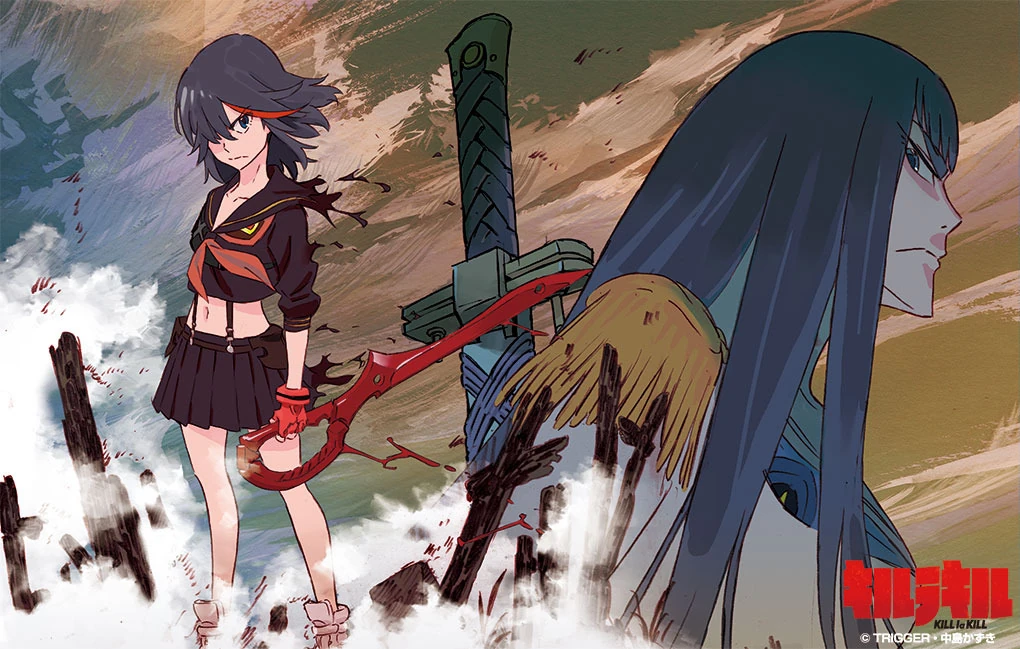
#28: Kill La Kill (2013-14)

From http://vignette1.wikia.nocookie.net/omniversal-crosswars
/images/a/ae/Kill-la-kill.jpg/revision/latest?cb=20140111135321
Director: Hiroyuki Imaishi
Screenplay: Kazuki Nakashima
Based on an Original Premise
Voice Cast: Ami Koshimizu (as Ryuuko Matoi); Ryoka Yuzuki (as Satsuki Kiryuuin); Aya Suzaki (as Mako Mankanshoku); Toshihiko Seki (as Senketsu); Hiroyuki Yoshino (as Hōka Inumuta); Katsuyuki Konishi (as Tsumugu Kinagase); Mayumi Shintani (as Nonon Jakuzure); Nobuyuki Hiyama (as Uzu Sanageyama)

Synopsis: At Honnouji Academy, the daughter of the head of a global fashion corporation called Satsuki Kiryuuin (Yuzuki) rules the student body and even the teachers with a velvet lined iron fist; the entire island right down to the homes are set in a class structure where the highest tiers were special school uniforms lined with life fibres, living fibres which allow for growth in superhuman abilities in the wearers. With an Elite Four under her to control the students - Ira Gamagoori, Uzu Sanageyama, Nonon Jakuzure and Houka Inumuta - Satsuki hopes to dominate the entire country of Japan in terms of the school system. However there's a new transfer student to the Academy called Ryuuko Matoi (Koshimizu) out for revenge for Satsuki killing her father; armed with a giant half scissor blade, able to destroy life fibres, and gaining a living schoolgirl's outfit she calls Senketsu (Seki), a living being which gives her greater strength than regular life fibre uniforms, she will be a problem for Satsuki. Helped by the hyperactive friend and personal cheerleader Mako (Suzaki) and an anti-life fibre rebel group of naturalists called the Nudist Beach led by Aikuro Mikisugi (Miki), Ryuuko intends to cut the heads of the Academy down to size.

From http://www.anime-evo.net/wp-content/uploads/
2013/10/kill-la-kill-01-09.jpg
What exactly can be added to the opinions on Kill La Kill when everyone else has already reviewed it, drawn fan art of it, cosplayed as characters from it, drawn erotic fan art of it and much more, something that is already seeb as a cult series that people will still talk of for a few years at least? That it's in hindsight Imaishi, after setting up his own studio called Trigger after leaving Gainax, created something that for all its ridiculous gore and hyper sexuality - famously Ryuuko's super transformation which hasn't put off male and female cosplayers dressing as her and even bringing about a special form of bra padding for sale - is really a tribute to the kind of action programming usually designed for children, usually episodic and can be understood by Westerners and those who even watched live action shows like Power Rangers. The type of show where each episode threw any threat at the heroes - mind control, betrayal and plenty of super powerful minions - only for the heroes to overcome it all through passion, courage and blood-mindedness. It's the kind of thing, slightly betrayed by the J-pop but forgiven in Kill La Kill because of its good music and a great end credits song for the first half of the series, that should be scored with the most bombastic and cheesy eighties guitar rock song possible. In comparison Gurren Lagann (2007), while in the same mould, was far more complicated as it literally split in plot with a drastic time jump forward in the narrative in the centre of the series, whilst Kill La Kill does all its plot twists and dynamics in a straight forward plot, set within only a few settings and the same time frame, which is charged through in its twenty four episodes and bonus ending episode with as much adrenaline as possible.

From http://cdn0.dailydot.com/uploaded/images/
original/2014/3/31/Kill-la-Kill-header.jpg
Since Imaishi 's trademark is very fast paced and hyper in pace, this means that the episodic tone of such shows is taken to an absurd extent where a strife can be thrown at the protagonists and be dealt with in the first fifteen minutes of an episode, more strife ready immediately afterwards in constant bombardment as plot twists keep appearing. Far from becoming problematic and eventually desensitizing, the show's tone works because it fully embraces the structure of serial storytelling to an extreme, the personality from the show's quirks and peculiar plot line intertwining fashion and fascism that was the original catalyst for the show. It's helped by the fact that Imaishi has never allowed bad animation into his directorial work, nor accepted anything aesthetically ugly to appear on his animation, unless it was deliberately chunky on purpose. The same kinetic tone of (entry # 23) Dead Leaves (2004), his debut, continues all the way to Kill La Kill nine years later with incredibly ridiculous action set pieces, the tone set by how much the bold, three dimensional red text onscreen in abused to name every character and move that appears and the general sense of deliberate overkill and exhilaration in the story's presentation.

From http://cdn-static.denofgeek.com/sites/denofgeek/files/styles/
insert_main_wide_image/public/0/02//kill_la_kill_2.jpg?itok=iVDwth4Q
It depends on your personal taste whether the tone of Kill La Kill is desensitising to a major fault or whether it's incredibly energising and leaves you on a constant high from all the cliff-hangers. The personality is what helps, Imaishi deciding to create a story based on the idea of clothing representing conformity and doctrine, where the clothes literally wear the wearers rather than the other way around, running with the clothing and sewing iconography in everything from the weapons to super-moves. Within this the characters are the stereotypes of anime giving Imaishi's trademark eccentricities and energy. Ryuuko Matoi is the tomboy protagonist who is blunt and hard-headed, the kind of figure capable of learning from mistakes and weaknesses for the sake of drama and surrounded by people willing to help her in her determined goal, all of them memorable in visual appearance and personality be they the good guys or bad guys. From Mako and her monologues with choreographed hand movements and random tangents to the Elite Four, tough but also mortal with their own quirks, the characters Imaishi has in his work have been the thing that wins viewers over ultimately. This becomes a masterstroke for the plot as well when the story starts to show more sympathetic sides to Satsuki Kiryuuin, the cold figure but one with a humane view of her henchmen, foreshadowing how the show twists the initial plot on its head in the finale in terms of the span of events.

From http://media.tumblr.com/bd5ca0548a2821fcfe552ad2e3ea173b/
tumblr_inline_muz71eYotr1qzxa0m.png
If there's any issues with Kill La Kill it's only that, like Imaishi's other work, he could've easily trip over if he wasn't careful and have something in his stories which make little sense or stick out like a sore thumb if you think about it too much. Kill La Kill jumps over plot points quickly and it could've easily devolved into illogical tangents which come off as confusion rather than ridiculous in an entertaining way. Sometimes its scorched earth policy in plotting offers great moments - the cliché of the hero renouncing their position in fear of becoming a monster gets swerved in a great way here. In the opposite spectrum it could've easily fell over something incredibly stupid - the one which nearly raised an eyebrow from myself is when the real villains are revealed to be incestuous lesbians with a fetish for fabric, thankfully side stepped knowing Imaishi has always had a very liberal viewpoint of sexuality - where there is a gay side character on the heroes side of Gurren Lagann whose despite his broad personality can be serious and competent when need be - and it's one of the most kinky anime directors in terms of equal opportunity and liberal fan service and sexuality, exemplified by the fact that the rebel team helping the heroine, Nudist Beach, is literally a nudist group whose leader gladly poses bare chested during his grand speeches with abs and nipples that glow purple when air reaches them. Imaishi has always tightrope walked between being merely tasteless and being deliberately absurd; Kill La Kill gets away with some abrupt plot twists, including outright absurd science fiction by the end, because it's manic tone pulls out the least expected things possible with such a simple plot. Somehow the series starts with Ryuuko and Mako negotiating a life threatening obstacle course to school that needs to be completed in a set time limit, like a more dangerous version of a plot found in a children's cartoon, and then ends over twenty four episodes later with the Earth at risk from living fibres on an apocalyptic level, the twists about who is who, what they are and who their relatives are, piled onto each other abruptly one after another, and manages to get away with it because the tone is dealt with perfectly. Anything that could be utterly clumsy is countered by Imaishi having always been an equal opportunity individual with a taste for the insane.

Because of such virtues, it's great to see such a fun and accomplished series do so well in terms of popularity whilst still being as weird and deliberately silly as it is. The only concern left after seeing this series finally, as I said in the Dead Leaves review, is that Imaishi should consider taking a whole 180 degree turn in tone for his next few projects so that he does not need to repeat himself, Kill La Kill perfect as it is and not needing to be spoilt by something repeating it's style with less interest. Space Patrol Luluco (2016), his latest, is a very short sci-fi comedy series which is hopefully a good start but I feel his next large scale project, if it comes, should be different from the action template as well; even even Panty and Stockings With Garterbelt, whilst an action series, was more of a Cartoon Network cartoon for adults, and if anything emphasising the comedy for a while might be perfect for him unless he decides to step into uncharted territory with another genre like drama. Might be insane to imagine it, but it would also be a shame when, including its bonus twenty fifth episode which ties the show up in a perfect little bow and clears out anything that would've been loose threads in the original finale, Kill La Kill after leaving with an emotional end and a smile on your face was spoilt by a rehashing of its best aspects.

Monday, 13 June 2016

#27: Roots Search (1986)

From https://bludragon.files.wordpress.com/2009/
10/roots-search-1986-ntsc.jpg
Director: Hisashi Sugai
Screenplay: Michiru Shimada
Voice Cast: Keiko Han (as Moira), Banjou Ginga (as Norman); Kenyuu Horiuchi (as Buzz); Osamu Kobayashi (as Marcus); Takao Horiuchi (as Buzz); Yusaku Yara (as Alien X)

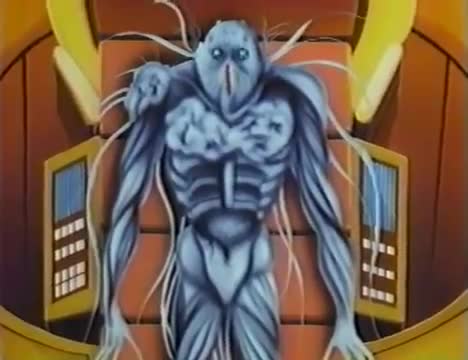
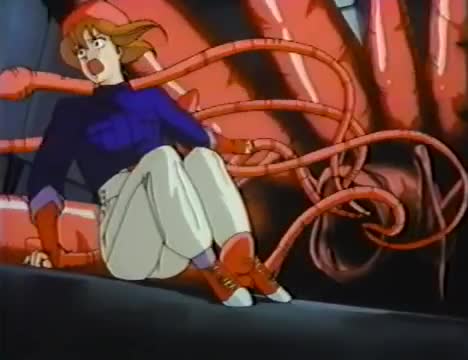
Amongst the obscurities that were made in the golden age of straight-to-video anime back in the eighties, Roots Search managed to both be notorious amongst older Western fans but managed to dig its way out of the vortex many obscurity is stuck in because of this infamy. A sci-fi horror story, a space station built to research ESP and psychic powers is unexpectedly graced with a deserted spaceship appearing in its dimension. With only one survivor on board called Buzz, the occupants of the station including its sole female member Moira find themselves up against a monstrous alien entity which, prefiguring Paul Thomas Anderson's Event Horizon (1997), changes itself into figures of guilt for each of its victims before gruesomely killing them. Amongst the ghosts the alien plays includes the ex-lover of one of the men and a soldier killed by a giant extraterrestrial dinosaur before one by one disposing of them.

From https://i.ytimg.com/vi/CM2qRd0cStU/hqdefault.jpg
Roots Search is a strange, malformed entity, only around forty minutes or so and managing in such a small space of time to feel like a line of grease and dirt has covered a viewer's eyes with its schlocky tone. In terms of actual virtue, it's a complete failure, too short to really be able to pace itself well and instead a catalogue of strange plot tangents for such a simplistic plot. Instead this is one of those anime that if you have a high tolerance for lack of quality, the virtues (and fun) is to be found in that griminess. For example, that aforementioned giant extraterrestrial dinosaur which Event Horizon could've made work but is a prominent part of this anime's scare tactics. There's also a subplot involving Moira and Buzz falling in love that will either clinch whether you hate the anime or appreciate it, Moira's precognitive abilities allowing her to have a premonition involving them naked running on a field, under a candy floss pink sky, and leading to the creation of what's effectively the star child from 2001: A Space Odyssey (1969). Moments like this cannot be taken seriously, so the anime depends on whether you find humour in it or not to find any entertainment within it.

From https://tokyobagero.files.wordpress.com/2016/02/macross2012roots-search
-ld-640x4801f9fcc2e-mkv_snapshot_35-20_2016-02-26_21-18-22.jpg?w=640
It's quite gristly as well, not only in gore that is gooey and bloody but in general body horror where people explode into tentacles and various forms of viscous dripping alien limbs or the contents of an anatomical book. It's no way as detailed or nasty as some of the more infamous anime of the eighties like Angel Cop (1989-1994) or Urotsukidoji (1987-89) but its veneer of grime is actually the thing for me personally that helps Roots Search have some saving grace to it as it leads to it having a personality. There's also a creepy sexual edge to it by accident or on purpose, such as the alien having, for a lack of a better term, a vagina dentata-like mouth, adding to the level of scuzz. The lurid tone is matched by an animation style which can, honestly, be summed up as a mess, about to collapse into the shambolic. Even on a VHS rip, there's a dirt ridden look which, despite the work of the production staff, cannot be ignored especially when it comes the character designs, varying between looking like many have been visibly devoured by their anxieties from the amount of black lines beneath their eyes to Moira's strangely giant eyes and incredibly large pink beret. It would've been a much duller anime if this hadn't happened as it actually makes the work far more memorable, the generic character designs and bland environments given over to gross body horror and characters who look like an eye is about to drift down to their cheek if they don't concentrate on keeping it in place. Paradoxically it's the mistakes which give some life to the aesthetic of the production if you're not just focusing on the horror aspects.

From http://blog-imgs-65-origin.fc2.com/t/s/u
/tsukihito2/cap2014-04-29-19h13m02s9.jpg
Plot wise it starts to get ridiculous as it goes along, the alien proclaiming itself to be God and metaphysical dialogue being crowbarred into a running length not long enough for it. Immediately after the station's captain is killed gruesomely, which should cause people to feel at unease or terrified, you have Moira suddenly starting up a polite conversation about the existence of God in the kind of abrupt change of pace that you expect failed live action horror movies from the West to commit, not an anime. The ending is entirely vague as well, sexual and anatomical imagery abound as the survivors suddenly end up in a womb-like, living environment walking optimistically into white light, no real conclusion when the credits kick in with a jazzy J-pop ballad.

Depending on your viewpoint of this anime watching it, it's in some ways for the better practically that an industry like the straight-to-video era where there was enough money about, before the Japanese economic bubble popped, to fund stuff like this doesn't exist anymore. But bad anime is still made in large quantities,  and for all its failed examples this system also lead to good anime and even beloved classics, making one pine for such a system to still exist. A contradiction yes, but that reflects how bad to the point of being charming Roots Search is in a sick way. Hilariously the same studio who made this also created Crystal Triangle (1987), melding Indiana Jones and a crackpot Dan Brown mystery plot into a memorably bonkers feature length anime. That's for another day however...

From http://blog-imgs-65-origin.fc2.com/t/s/u/
tsukihito2/cap2014-04-29-19h43m35s176.jpg

Monday, 6 June 2016

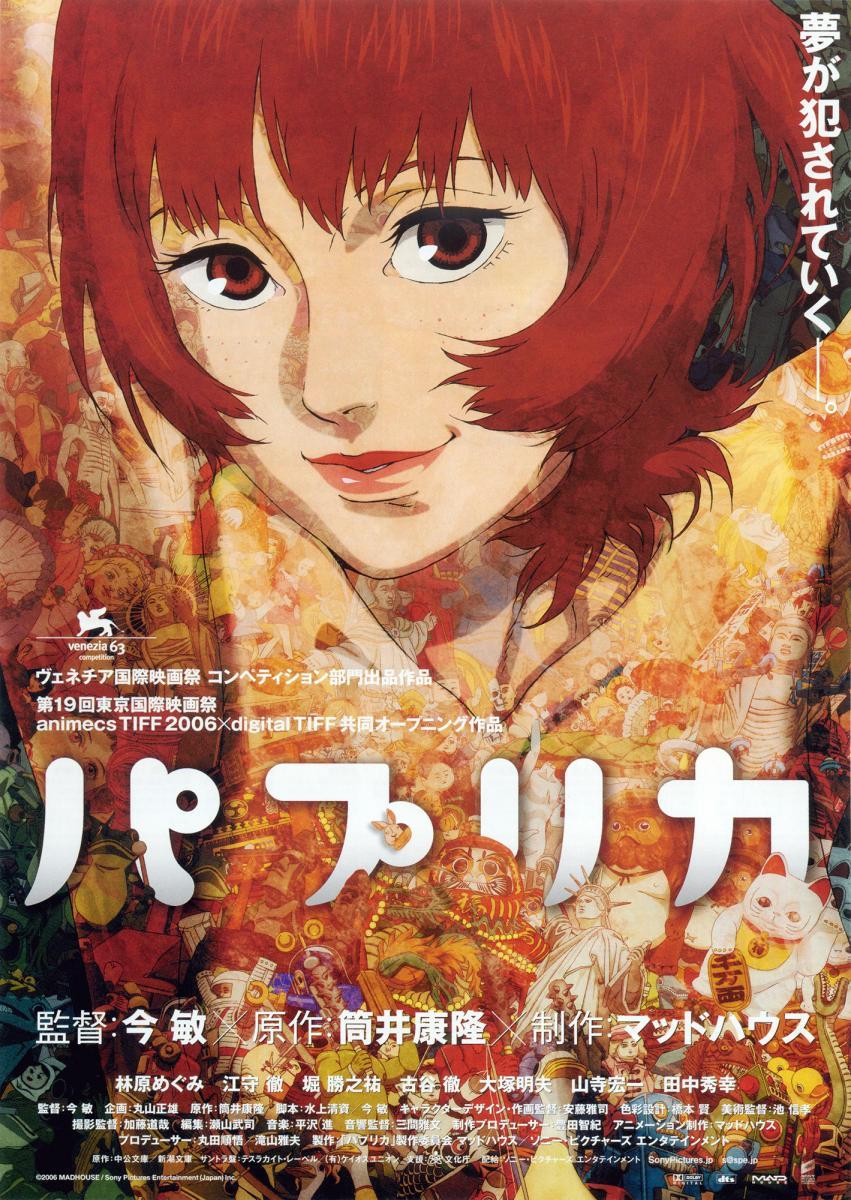
#26: Paprika (2006)

From http://pics.filmaffinity.com/Paprika_detective
_de_los_sue_os-439873032-large.jpg
Director: Satoshi Kon
Screenplay: Seishi Minakam and Satoshi Kon
Based on a novel by Yasutaka Tsutsui
Voice Cast: Megumi Hayashibara (as Doctor Atsuko Chiba/Paprika); Tōru Furuya (as Doctor Kōsaku Tokita); Tōru Emori (as Doctor Seijirō Inui); Katsunosuke Hori (as Doctor Toratarō Shima); Akio Ōtsuka (as Detective Toshimi Konakawa); Kōichi Yamadera (as Doctor Morio Osanai)

This would've been a difficult task - covering an anime by the late Satoshi Kon and explaining my admiration for him - regardless of which of his small filmography I choose, but it does also mean I got to revisit this film again and see why I admire him like so many do. Paprika is the one in his career which is the "flawed" film of his filmography, but you'll also see why I love it if you follow the link to the full review HERE.

From https://canime.files.wordpress.com/2007/11/paprika4.jpg