Thursday, 6 September 2018

#66: Armitage III - Poly-Matrix (1997)

From https://shinden.pl/res/images/genuine/201476.jpg


Directors: Hiroyuki Ochi, Satoshi Saga, Takuya Satō and Yukio Okamoto
Screenplay: Chiaki J. Konaka
Voice Cast: Elizabeth Berkley as Naomi Armitage, Kiefer Sutherland as Ross Sylibus, Dan Woren as D'anclaude, Barry Stigler as Asakura, Bryan Cranston as Eddie, Dorothy Fahn as Kathy/Kelly McCanon, Ellyn Stern as Rosalind

Synopsis: The moment he steps into a space port on colonised Mars, a member of Earth's police force Ross Sylibus (Kiefer Sutherland) finds himself immediately involved with a conspiracy when a female country singer is not only found murdered, but revealed to be a highly advanced form of bio-mechanical robot. Amidst Mars and the growing anti-robot sentiment among the human populous, he also meets the mysterious and cocky police officer Naomi Armitage (Elizabeth Berkley), a ball of fiery energy whose emotional investment in the case, as more advanced robots are targeted by a lunatic, is of great significance.

[Major Spoiler Warnings]

Armitage III: Poly-Matrix is a fascinating curiosity of earlier Western anime fandom. This is, significantly, a theatrical re-edit of a four episode 1995 OVA series where the run time is at least over two hours, making this a ninety minute production which still works as a story but had to excise a lot to get its length. It's also very well known for the casting of known Hollywood actors in the leads. The female lead Naomi Armitage by Elizabeth Berkley, post Save By The Bell and just after the infamy of Showgirls (1995), and as male lead Ross Sylibus by Kiefer Sutherland, son of Donald Sutherland and an underrated actor in his own right. As a result, I can review the original OVA version, which was released before and after the alternative English language cut, as a separate entity. When it comes to the feature version, there's both the virtues of the original material, and their problems, which ultimately stand out the most, the decisions to make the film marketable to English speaking countries afterwards merely slurring material that is curious and not perfectly explained in this version's form.
From http://www.capsulecomputers.com.au/wp-content/
uploads/2012/07/armitage-III-review-2.png

The story of Poly-Matrix is both interesting but scuppered. It does offer a fascinating idea that there are robots in this futuristic world so advanced to the point they both have real emotions but, mostly female, they can also even conceive children in their bio-mechanical forms. This leads to the one theme which could've been more interested if dwelt more carefully on but, especially in the truncated version, has severe flaws which could be accused as problematic. Its revealed just near the end of the film, which doesn't allow enough time to delve into this, but Earth has become a feminised society, with a female leader, who in potential talks with Mars are severely concerned with how the Martians, in a decadent dystopian future-scape, have female robotic sexbots and servants everywhere, for added touch many looking like stereotypical Moe anime heroines with big eyes and multi-coloured hair in contrast to ordinary human women. It has to be asked whether it's the truncation or the original story which is an issue as, once the conspiracy is revealed, it adds an unintentionally problematic spin on feminism by accident of the theatrical version not providing enough time to clearly define its ideas.

At the same time that leads to a fascinating spin that could've worked. That even Earth, with a female leader and meant to be progressive, can yet be being a conspiracy with deeply problematic moral sliding has a darker, more poignant touch in real life when the #MeToo movement and attempts at helping women, even by other women, sadly has been punctured by issues which harm women, even has women harming other women through unintentional means. (A good example I thought of in the middle of Poly-Matrix was when Meryl Streep, Kate Winslet, Emma Thompson and Lena Dunham challenged Amnesty International to withdraw support for decriminalisation of sex work, only for female sex workers to challenge these major figures back by arguing Amnesty International's decision would actual protect them, signing their own petitions back to have Amnesty stick to their choice1).
From https://static.anarchivism.org/cyberpunkreview-
archive/www.cyberpunkreview.com/images/armitage3-13.jpg

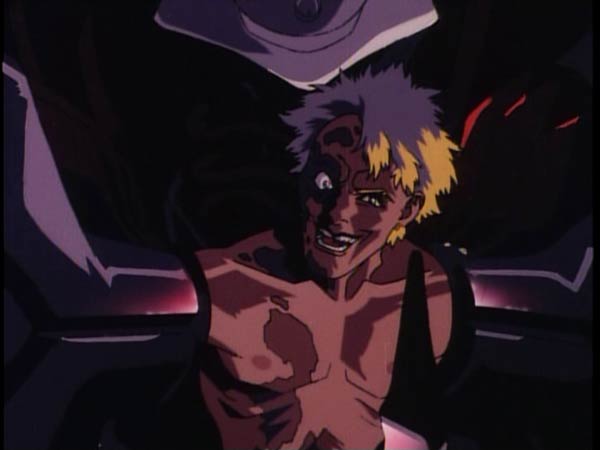
There is also the film tackling, as many sci-fi works, the relationship between human beings and machines.  There is a sobering nature to the Martian populous massacring robots in protests, the protests done with understandable reasons of losing work to the robots, but made horrifying as humanoid figures who are built to look like them are torched alive and their machinery piled up in morbid decorations around graveyards. The added issue that the robots seen punished are all female those which are generic machines already having uncomfortable connotations before you get to those in the story with actual emotions. Their deaths makes this intentionally more mortifying, one figure shown briefly to have a life and relationships, a romance with her female model as a painter, only to be a burnt husk on a pyre next to less advanced robots regardless of her real humanity. The end, where female robots watch on at a battle onscreen between the leads and an army sent to silence them, turning their heads with their big eyed gazes despite being merely functioning machinery, has a power to it as if hinting of a potential revolution.

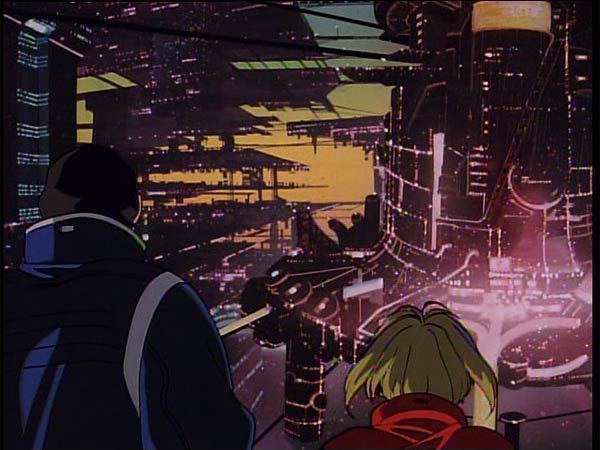
Unfortunately the material is not as refined and expanded upon as one would hope. It is built as well in a generic sci-fi action anime, like many from the era and not as unique as them. The issue that Poly-Matrix isn't that unique, baring it mind it was once a longer length production, is more surprising when its screenwriter is Chiaki J. Konaka. One of my favourite screenwriters, argubly an auteurist voice in his own right, who is known both for being esoteric and having frustrated many an anime fan with deliberately ambiguous endings and his work eventually undermining reality against unreality without defining which is which. For a very interesting screenwriter, a literal auteur in his penmanship, even a superfan like myself for every good idea this has confesses this is pretty conventional and sluggish by his standards. Barring an occasional taste of his unconventional style - eventually Sylibus and Armitage are in a desert compound where hulking robot-tree hybrids lumber around like gardening Ents - but he could've gone further to his weirder tendencies and especially clarified the themes he was tackling more carefully of gender politics.
From https://static.anarchivism.org/cyberpunkreview-archive/
www.cyberpunkreview.com/images/armitage3-17.jpg

There's also the elephant in the room called Ghost in the Shell (1995), which undercuts this production immensely. Mamoru Oshii's adaptation of the Masamune Shirow manga is difficult, in spite of being a seminal work in Japanese animation, long before Oshii became even more difficult and idiosyncratic with the 2004 sequel, but between hairpin turns from action to heavy philosophy he is a very good auteur when it comes to diving carefully into these type of ideas and tackling the likes of robotics and the nature of the human soul with very thoughtful ideas. Poly-Matrix relies on a lot of clichéd tropes common in sci-fi anime, such as the touch but scantily dressed heroine, and throughout you have to wade through an anime that feels significantly more dated than the two Oshii helmed Ghost in the Shell for said clichés. Oshii would've at least taken the potentially problematic gender politics and refined them to actually have a more pointed, morally thorough take with teeth. He would've even gone far, like his later work, to having an action sci-fi story abruptly stop for a long scene of characters sat down discussing gender politics and robotics, even if it enraged most anime viewers and lasted over ten minutes, just to make sure he was as thorough as possible on said subject2.

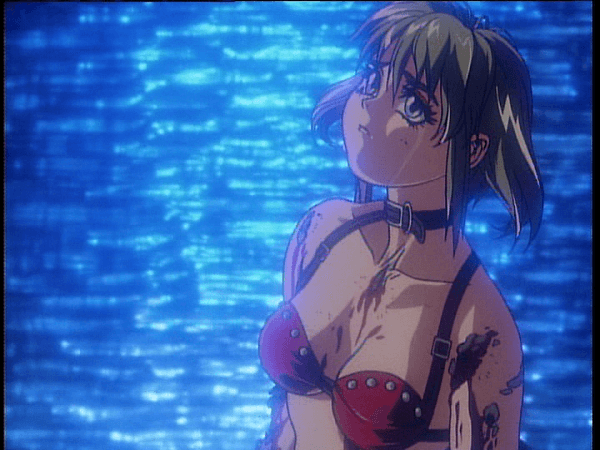
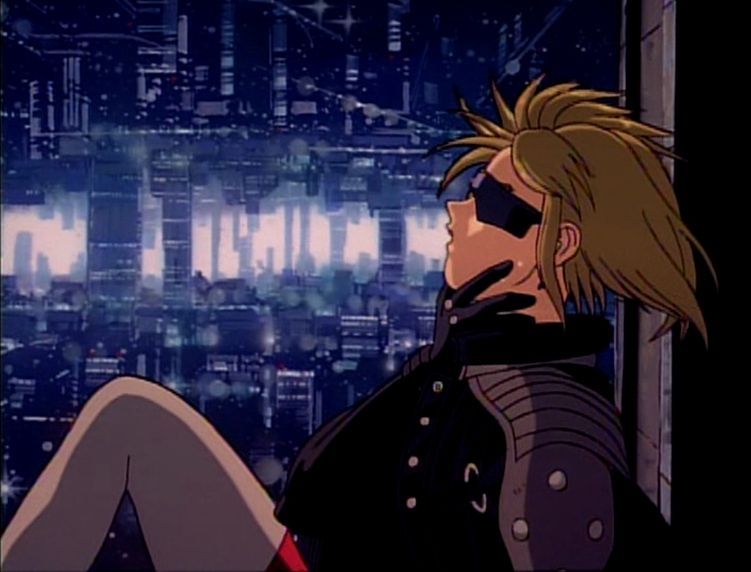
Production wise, the OVA quality artistry is good, missed dearly (when it was once so common) to have this type of insanely detailed, colourful dystopian cityscape of the future. Mars, as what we see, is already swollen with urban sprawl unless you go to a desert that has already had the atmospheric process from Total Recall taking place to allow breathable air. The lead characters are an issue though, in script, design and (English) voice acting. Not surprisingly, as individuals who work in this medium for their careers, the regulars of English anime voice acting like Steven Blum blend in perfectly. Ironically, or maybe not as they would have experience with anime voice acting, it's the regulars of a production like this like Steve Blum who blend in perfectly. Elizabeth Berkley, I confess, at least tries. We find her character Naomi in Showgirls to be ridiculous, but it suits the character of Naomi Armitage to have casted her. As with Showgirls, where Joe Eszterhas' script was as much an issue for Berkley to overcome, the same issue is here with Armitage being a paradox. Both the tough cop yet like a teenager in size and obsession with things like ice cream, a confusing figure for anyone to have to work with. The hot red leather shorts and shades are a giveaway Berkley was already dealing with the ridiculous tough yet sexy anime heroine stereotype from this era that would handicap anyone. If her performance is broad, its only because the character in spite of her dramatic narrative, being one of those bio-mechanical robots with her own consciousness, is a broad figure anyway.
From http://www.anime-kun.net/animes/screenshots/armitage-iii-3897.jpg

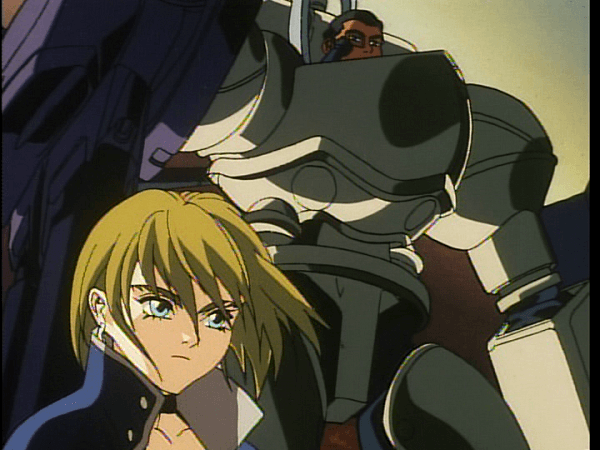
She at least tries. What happened to Kiefer Sutherland, and how he seems to be sleepwalking through his lines, is another thing entirely. It's an embarrassing vocal performance from an actor at this point in his career, even if he had loss his lustre of earlier work and had to wait until the 24 series to become known again, showed he was actually a great actor in oddities like Freeway (1996). For me, like his father Donald, Kiefer Sunderland has always been a character actor, the best kind who could front a major picture but like in Freeway could radiate pure, incredible acting chops in any circumstance. How lifeless his voice sounds as Ross Sylibus here is embarrassing. It neither helps his character is stricken with boring male protagonist syndrome, a plague in anime. This isn't even the worse example, when creators try to appeal more to otaku with blank and shy adolescents in the male lead roles, blank slates for viewers to place themselves as vicariously surrounded by many cute girls. But it's not a credit to Sylibus still as a lead, the stereotypical cop on edge who hates robots because one murdered his female partner, yet even with that or his growing romance with Armitage coming off as mandatory due to Sutherland's performance and the scriptwriting.  One of the most pertinent observations I've found as an anime fan that, even if it's in a fan service heavy and objectifying work, in most anime the female characters are the figures you remember with the most personality even when they are crass stereotypes, whilst the males meant to be protagonists have the personality of papier-mâché. Sylibus is effectively the protagonist, and even if Sutherland  wasn't sounding like he has dazed, that wouldn't be helped by the blandness of said character.

All in all, Armitage III: Poly-Matrix, followed by a sequel called Armitage: Dual-Matrix (2002) where Juliette Lewis took the titular role over, is fascinating as a curiosity. It earns enough to justify a revisit in terms of its ideas, but does with noticeable flaws both in its original material and the Western adaptation that cuts the legs off some of its best moments considerably. It does suffer under the weight of other anime which have tackled this material better or with more idiosyncrasies, but when there is a stand out moment, it does shine. The decision to compile it into a feature was, likely, a detriment and it's not a surprise that this is a rare case nowadays when the faithful, original versions of anime usually are released in the West too.
From http://www.capsulecomputers.com.au/wp-content/
uploads/2012/07/armitage-III-review-3.png

====

1) Whilst this strays far from this being a review of Armitage III: Poly-Matrix, and is likely to be controversial, I felt including articles discussing that example I gave will give you ideas of why I felt the comparison was apt:


2) Another tangent, but considering Oshii's own spin off of Blood: The Last Vampire (2000), a light novel named Blood: The Last Vampire: Night of the Beasts (2000), abruptly halts a vampire horror story halfway through for a prolonged, chapters long segments of characters at around  a table discussing mythology of vampires, Oshii even to the point of unintentional comedy or to deliberate screw with an audience would draw the philosophy out for a long, long period of time more than most if he felt like it was necessary.

Monday, 3 September 2018

#65: Dragon Half (1993)

From http://images2.static-bluray.com/
products/20/31313_1_front.jpg


Director: Shinya Sadamitsu
Screenplay: Shinya Sadamitsu
Based on the manga by Ryusuke Mita
Voice Cast: Kotono Mitsuishi as Mink, Mariko Kouda as Rufa, Rei Sakuma as Vena, Yasunori Matsumoto as Dick Saucer, Akio Ohtsuka as Damaramu, Kaneto Shiozawa as Rosario, Kenichi Ogata as King Siva, Kikuko Inoue as Mana
Viewed in Japanese with English Subtitles

Synopsis: In a fantasy land lives Mink the Dragon Half, father a dragonslayer and mother the red dragon he fell in love with, who desires to find a "People Potion" that'll allow her to be fully human, in love with the dragonslayer/pop idol Dick Saucer who, unfortunately, is a mortal enemy of dragons like her. Neither does it help the evil king Siva wants her mother, involving both his incompetent advisor Rosario, and a greater danger of his own daughter and a slime half, half girl half slime, named Vena who has magical abilities and hates Mink with a vengeance.

As mentioned in previous reviews1, one of the most frustrating experiences with anime is an older title, usually an OVA with an enticing premise, which barely covers the source material, has no ending and never got a follow-up and/or remake. Usually they were planned as mere tasters for the source material. Dragon Half, however, was originally meant to be longer but was one of the rare cases of a straight-to-video work clearly cancelled only after two episodes. It would've barely covered the Ryusuke Mita manga, but in its current form as only fifty five minutes altogether, these episodes are a paltry amount. Dragon Half nonetheless is clearly loved in the West even to the point it was got brought back out again on DVD in the 2010s by Discotek.

From https://fantasyanime.com/anime/
images/dragonhalf1/dragonhalf1_shot03.jpg

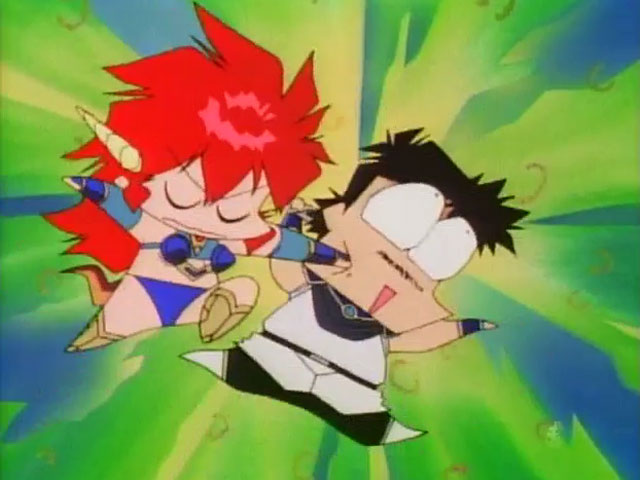
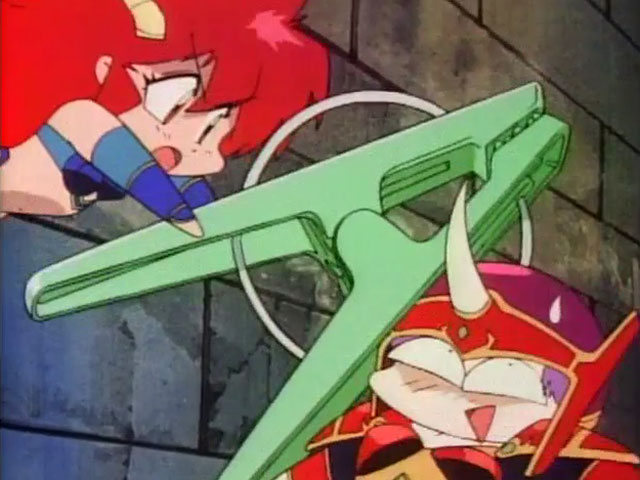
Seeing Dragon Half finally, that's not a surprise. This is a slice, common as a delicacy in anime, of mad and hyper energised comedy. The difference is the premise, taking the piss out of the tropes of Western high fantasy. Japan has anime based on tropes more common the Lord of the Rings series and Dungeons and Dragons - usually serious work like adaptations of Berserk or Record of Lodoss War (1990-1), literally adaptations of D&D campaigns turned into their own fantasy books, the franchise that OVA started even including its own comedy spin-off Rune Soldier (2001). However Dragon Half goes further, not only in this fantasy world inexplicably having pop idols and CDs and television, despite being medieval, but in archetypes defying expectations. The dragonslayer, rather than killing the female dragon, took her hand, ran off together and sired our protagonist Mink, who is a little ditzy but a strong girl who just happens to have dragon traits like a tail. Her friends include an elf whose ancestral wand is practically a friendly fire weapon, and the diminutive dwarf girl whose pet hamster turns into an enormous monster if enraged. The evil wizard who helps the king brings his own bucket of dried ice for introductions, the King having married a slime who took the People Potion and sired Vera, a slime half born like a blob like her mother only for magic to assist her. Even Dick Saucer, the Bishōnen (beautiful young) male who sings his own theme tune and is voiced by Yasunori Matsumoto as the debonair and heroic heartthrob...only to be constantly undermined, even by a laxative slipped to him by complete accident.

The character designs, transferring the manga's, help. Elegant to the point of being absurd - large eyes, wildly vivid colours, eyelashes so pronounced they're visible beneath hair. Appropriate for fantasy, until the characters constantly distort shape for the gags. Following the principles of animations of the nine old men of Walt Disney2, and making them proud, the cast of Dragon Half are practically made of elastic but never lose their distinct character silhouettes or appearances. Another form of gymnastics comes from the voice acting. Whilst you can occasionally hear an awkward transition, Dragon Half for the most part really emphasises the incredible talent of Japanese voice acting. Case in point, Mink's voice Kotono Mitsuishi is more well known for Misato Katsuragi, a very important character from the Neon Genesis Evangelion franchise who functions as a comedic character early on, usually due to her constant alcohol consumption, but especially by The End of Evangelion (1997) is a character from Mitsuishi radically different in genre and tone from Mink. The best actual example however of the vocal gymnastics comes from Rei Sakuma as Vena, the feminine villainess who's elegant in manner, only to turn to a raspy shout when angered and the character design distorts. As the character designs change shape, the voices do and are as much why the anime is funny. As I watch more anime again, I am even learning to appreciate the original Japanese voice actors' work, especially in comedy, in spite of language and referential differences.

From https://m.media-amazon.com/images/M/MV5BNTQ0Mm
Y4YmQtNTI1NS00ODI3LTk1MDMtZDAy
ZWQ3YWE2NGNiXkEyXkFqcGdeQXVyMzM4MjM0Nzg@._V1_.jpg

The fact, sadly, Dragon Half is so short however means this is all a slither. Episode one is meant to introduce all the characters including Damaramu, the warrior sent to kill Mink who, alongside the strange quirk of a couple of characters here being able to pull light sabre swords from their temples, can even survive the circumstances of the conclusion due, as described in Episode 2, to his unique anatomy about a small brain. However the abrupt end of this series does leave this the only episode a lot of these characters have, such as Mink's parents, introduced playing dragonslayer vs. dragon much to their daughter's annoyance, who are interesting in themselves. The whole subtext of Mink's mixed heritage, blatantly there, is also neglected as the series never went any further than Episode 2. It's an obvious issue dealing with ethnicity even if through the backdoor of fantasy - when there are moments in high fantasy which are deeply problematic for myself (such as how orcs have ended up, usually the villains, being portrayed as sinister "others") anime has had a nice, applaudable side even if it's not clearly intended, of dealing with protagonists who are half human and half being. Dragon Half's not the only work, even outside the comedy fantasy drama, that has had a "halfbreed" protagonist, and whilst many don't have a literal People Potion, which can turn a slime into a woman and marry a king, stories have nudged this topic a lot. Sadly, only two episodes long, even a series meant just for humour cannot deal with this plot point integral to the story, as Mink goes on a quest for said potion, any further than hint at it.

The second episode, Mink having to enter a tournament of death to earn money for a transport ticket, is where the virtues of a full series as a comedy are hinted at, manic slapstick and everything else possible on the table. A character, the son of a villain we never see, even has to watch the first episode on video mid-scene to realise his accusations against Mink were deleted from that previous episode, which is where you learn nothing would've out as a gag in this series. All alongside one of the best executed diarrhea gags possible, which isn't below the episode but succeeds, and further proof of Rosario being an utterly useless magician. It does also have fan service, the final shot of the whole work Mink topless, but for all the complicated issues with sexuality to write about in anime, this is at best someone who is only annoyed the circumstances happened in front of a large crowd and still punts someone off into a lava pit like a badass regardless of her embarrassment. Dragon Half isn't different in the pace and type of humour of a lot of anime comedy, but especially with the constant character distortions, OVA level of quality animation, and the general sense of lunacy at hand, it's a tragedy that its only in existence as two episodes.

From https://fantasyanime.com/anime/images/
dragonhalf2/dragonhalf2_shot17.jpg

If at least for the end credits as well, which is immortalised within only two episodes by itself, the anime should've lasted longer. Composed by Beethoven with new lyrics, the lengthy song about what Mink is going to have for dinner, not to eat her egg and offering the calamari instead, is an earworm to admire, especially when it has a kabuki break in the middle, than another with a choral hymn and weird bird flying over in the credits animation. Its indulgent, exceptionally silly but itself exemplifies the creative and immensely funny material at hand.

=
1) Examples like Five Star Stories (1989) which was reviewed HERE.

2) Research them and their rules of animation, as it'll make what an anime like Dragon Half does an actual art form as well as more fun.

From http://img1.ak.crunchyroll.com/i/spire3/
be6a9bcab5819f4f454bddd2e93bd2d61465040186_full.png

#64: Night is Short, Walk On Girl (2017)

From https://dx35vtwkllhj9.cloudfront.net/gkidsfilms/
nightisshort/images/regions/us/200x200.png


Director: Masaaki Yuasa
Screenplay: Makoto Ueda
Based on a novel by Tomihiko Morimi
(Voice) Cast: Kana Hanazawa as The Girl with Black Hair; Gen Hoshino as Senpai; Hiroshi Kamiya as The School Festival Executive Head; Ryuji Akiyama as The Underpants Leader; Kazuya Nakai as Seitarō Higuchi; Yūko Kaida as Hanuki-san; Hiroyuki Yoshino as The God of the Old Books Market
Viewed in Japanese with English Subtitles
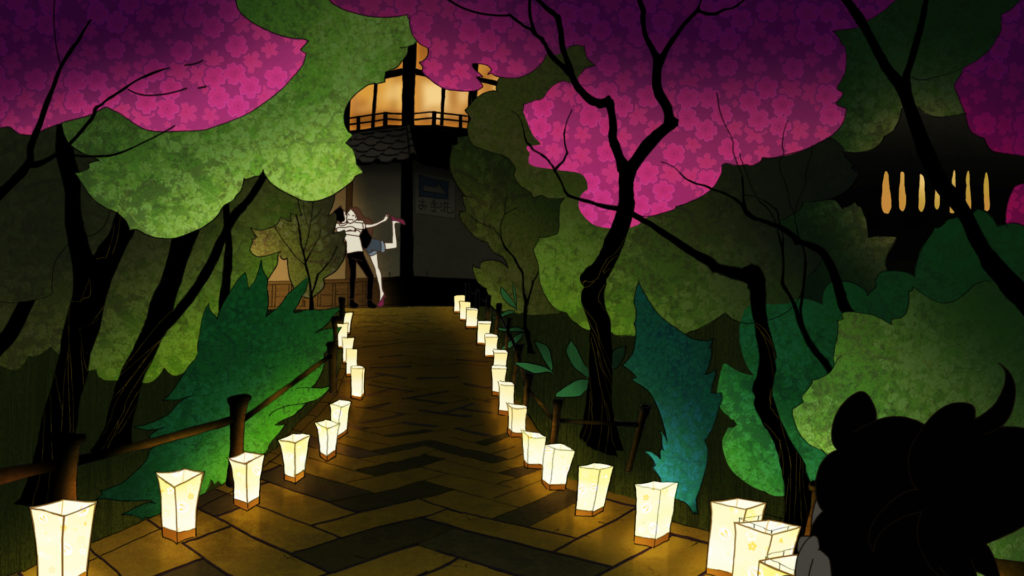
A Cinema of the Abstract Crossover

One of the latest projects of Masaaki Yuasa, one of my favourite directors work series like The Tatami Galaxy (2010), which this is set in the same world of. Its own story, but very much continuing on from the original material, it makes a nice circular experience when the early television series was one of the few titles available in the West for a long while, and was the only title of his I had ever seen originally.

You can read the full review, on my other blog, HERE

From https://gkids.com/wp-content/uploads/2018/
06/night_sAp_0199-1024x576.jpg

Wednesday, 22 August 2018

#63: A Branch of a Pine is Tied Up (2017)


Director: Tomoyasu Murata
Screenplay: Tomoyasu Murata

Synopsis: Following on from a major disaster, one half of two female twins contemplates the loss of her sibling.

It seems a rotten thing to cover this short, especially as after I'll praise it, you the reader will curse me as it'll be difficult to see. But to write about anime, I feel you have to step outside that term to also include Japanese animation in general, not only encompassing experimental work but areas like stop motion and puppetry. There's an unexpected delight in seeing eggs made from clay, painstakingly motioned into cooked ones in a tiny handmade pan, and as I hold animation above even most live action cinema, little details like this which have to be relied on to be made from imagination, reference and what materials are at hand are to be admired. To focus an image in movement to life is special in two dimensional animation, and likewise stop motion from any country is a tactile, arduous medium which ultimately rewards the creators.

From https://d32dm0rphc51dk.cloudfront.net/
KoAtSTsBDWwAnjLqHU_twA/larger.jpg

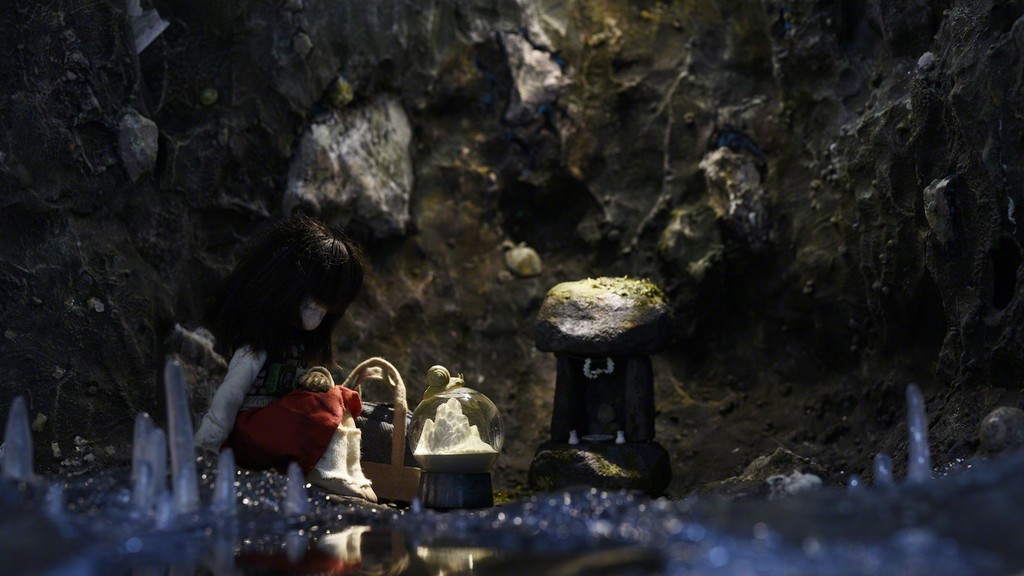
And in this particular case, seeing the literal gray sludge hand animated to subsume a model village, director Tomoyasu Murata is using the medium to touch upon centuries long history in Japan of natural disasters, the 2011 earthquake and tsunami one which is immediately evoked by the story of the film. That incident, and all the fallout from it including the Fukushima power plant crisis, has been burnt into foreign viewers' minds just from news images. But imagine actually being Japanese, seeing these images in a place on the other side of your country, or living where one of many entire towns that were swept away into nothingness were, or losing a loved one in such a town. Such images clearly had a direct influence on Murata's short, which uses a fairy tale aesthetic to deal with the loss that such an event would cause. Through two twin girls with doll like appearances - no lips until, when see using makeup in a fail, they're painted on, big eyes and identical appearances behind black hair - they are expressed as archetypes of curious, youthful figures caught in the midst of this.

Enough is painted about them to have sympathy. A mother briefly seen, with a haggard grey doll mask used enough before her disconnected sitting position is, and throwing an ashtray at one of the daughters' head when they squabble over a jigsaw, revealing more of her before that single scene leads to her immediate departure. The crammed, murky home with a full sink and dripping tap, tiny representations of junk food when the girls are left by themselves for a long time, representing their world isolated together before the disaster comes. A sense of playful joy when they spray paint on an outer wall, or when they are in the woodlands. Even a pastiche of the type of anime on their handmade television, involving a giant robot, normally thought of as Japanese animation briefly seen.

From http://voltashow.com/fileadmin/_processed_/
5/1/csm_MOMO2_38ced85d43.jpg

The fantastical elements feel less like escapism but part of the symbolism of loss and Murata's clear interest in the spiritual in terms of the material. A humanoid rabbit who, when we first see him, is actually performing a prayer ritual when the girls find him in a flower enriched woodland field. The giant snow globe of a mountain, connected to a realm one of the girls ends up in after the disaster, becomes as much a fairytale McGuffin as it tragically causes the separation, after a violent argument, between the girls. What the ending actually means, with one being with the humanoid rabbit, and shots of someone between them floating in the air, is entirely subjective but it cannot help but feel like a happy ending in spite of the tragedy that took place.

The resulting short, only seventeen minutes long, is beautiful. The music by Tatsuhide Tado, ethereal with tradition Japanese influences, helps as much as a marriage of visuals to sound, enough spoken without any dialogue. Again, it is a shame the short will be more difficult to find as it is the sort of work that many could love, maybe even find more accessible than more easily available "anime", but gets stuck in a festival cycle and never leaves it. Sad as it touches upon a deeply serious subject matter in a sensitive, exquisite animation style. Enough that I hope Tomoyasu Murata will eventually make a feature work or at least have a healthy filmography even of merely shorts, whichever way getting a wider access beyond his homeland.


From http://voltashow.com/fileadmin/_processed_
/3/0/csm_MOMO3_133793003b.jpg

Friday, 17 August 2018

#62: Bubblegum Crash! (1991)

From https://m.media-amazon.com/images/M/MV5BZGNmNWE5NDYtNmNhMS00YT
diLTk1NDgtNDFjN2ZmYzBlYzBlXkEy
XkFqcGdeQXVyNTAyODkwOQ@@._V1_SY1000_CR0,0,712,1000_AL_.jpg


Directors: Hiroshi Ishiodori (Episodes 1 and 3), Hiroyuki Fukushima (Episode 2)
Screenplay: Emu Arii
Voice Cast: Akiko Hiramatsu /Barbara Barnes [Manga UK Dub] as Nene Romanova; Michie Tomizawa/ Stacey Gregg [Manga UK Dub]  as Linna Yamazaki; Ryōko Tachikawa/ Julia Brahms [Manga UK Dub] as Priscilla S. "Priss" Asagiri; Yoshiko Sakakibara/ Tamsin Hollo [Manga UK Dub]  as Sylia Stingray; Kenyuu Horiuchi /Michael McGhee [Manga UK Dub] as Daley Wong, ; Toshio Furukawa /Matthew Sharp [Manga UK Dub] as Leon McNichol
Viewed in English

Synopsis: 2034, two years after they helped Tokyo deal with rouge "Boomers", humanoid robots who have malfunctioned, the all female group known as the Knight Sabres have vanished from the scene. Three members - pop star Priss Asagiri, hacker Nene Romanova and Linna Yamazaki - presume, as their leader Sylia Stingrayhas been absent, that their previous role is over. When Sylia returns however, it's time for them to put the powered armour back on as a series of Boomer related incidents rock Tokyo again.

In 1987, a straight-to-video series started called Bubblegum Crisis. Futuristic Japan, directly inspired by Ridley Scott's Blade Runner (1982) (and Walter Hill's rock 'n' roll action oddity Streets of Fire (1984), which was much more successful in Japan than in its homeland). A story where mass produced robots nicknamed "Boomers" exist, only for there to be the problem that exists in most anime and manga stories, that they can go kill-crazy and malfunction all the time. Four female leads donned cybernetic power armour, dubbed themselves the Knights Sabres and over eight episodes in 1991 dealt with tasks even the A.D. Police, specifically founded to deal with Boomer related crime, cannot handle. Bubblegum Crisis was a success, not only in Japan but with a following the West for a certain generation. Naturally striking the iron whilst it was still hot, not always something anime producers have done, this popular series was followed by two tie-ins. Inexplicably, whilst Bubblegum Crisis was released in the UK, you're more likely to find these tie-ins second hand still than the original, as they were licensed by our home-grown company Manga Entertainment, which gives you a peculiar issue where some have probably never seen the original unless they got those episodes from a separate company or imported US releases.

In general the story of the franchise after Bubblegum Crisis is not that well regarded either, lasting to 2003 and really given a critical dubbing. One of the only tie-ins to succeed for some, and it's a divisive creation for some still, was one of the entries Manga Entertainment picked up named A.D Police (1990). Made part of the way through the main series' releases, it is in vast contrast to the original or its sequel, A.D. Police not only a prequel set before the Knight Sabres existed, but a lurid and nasty cyberpunk noir with more gore, sleazy sexuality and a very bleak tone, even to the point of ridiculousness of how masochistic the dialogue could be. Less regarded however, out of Manga Entertainment's acquisitions, is the actual sequel Bubblegum Crash! started the same year Crisis finished. Even in context of one of their lesser releases - part of The Collection of licenses transferred from VHS to DVD, ropey English dub and removing the end credits screen for a black one with text - it feels like a bad follow on. Even without seeing the original Crisis, which I have to confess now before I feel like I'm lying, I utterly see why Crash! is not well regarded as, even without the original context, it's not a good sci-fi action anime even by itself.

From https://m.media-amazon.com/images/M/MV5BYTEwNjViZTM
tZjBjNi00YzY0LWI4YmYtNjh
kMGZjODE0MjJiXkEyXkFqcGdeQXVyNTAyODkwOQ@@._V1_.jpg

Crash!
, contrary to my original opinion, only takes half of its first episode to bring back the heroines properly, who stay as friends but returned to their old lives, rather than a whole episode. However, as the OVA series consists of only three episodes in the first place, there's not a lot of time to work with and what does happen it exceptionally bland. A little joy is found in Crash!, at least in its awesome opening theme song of eighties synth rock, but the rest feels like a missed opportunity. Episode one, having to devote time to bring back the gang, skims over a mercenary army with cybernetic implants, all part of the series wide plot of a shady figure behind the machinations as that particular group rob banks. Pretty basic, cheerful action sci-fi. More egregious, and wasting a whole episode with its clichés, is Episode  2 following a more advanced form of Boomer with its own consciousness who is the target for theft. The member of the Knights Sabres who hates Boomers, Priss, is naturally the one who ends up with him and, not justifying its tale of her overcoming her hatred for robots to admire him, is syrup poured onto clichés, death to sit through. Neither does it help that, without the context of the original series, these characters for all the series are not interesting. Figures without the spark and colour their appearances and power armour suggest. The English performances are egregious as well, particular as for the Manga UK release an entirely different English language cast for the four main leads was hired, in contrast to the same one for an alternative dub who played the characters in Bubblegum Crisis.

The only interesting aspects of the first two episodes are the background details, a world with its own character that should've been pushed into the foreground more. Advertising and goofy promotional films for the A.D. Police, who are practically useless through these episodes. How the two A.D. Police with personality, Leon and Daley, get scenes like having to deal with a female cafe Boomer whose internal coffee machine has failed, pouring out coffee beans instead of the desired beverage. Material that makes the first two episodes more tolerable, at least more interesting. It's also specifically the comedy and exponential material which has nothing to do with the Knight Sabres as, especially in the English dub, what should be by all right interesting, tough female characters are the blandest gang of four you can get, where someone like Priss (here tough and hard boiled, and little else) is out staged by how camp the English voice for her slimy music producer is.

From https://m.media-amazon.com/images/M/MV5BZjM3N2IyY
TYtOWYwYS00NDA3LWI3ZDEtMDE5
NWNmN2NlN2ZmXkEyXkFqcGdeQXVyNTAyODkwOQ@@._V1_.jpg

Episode 3, starting with construction site Boomers in hard hats and robo-dungarees going murder-death-kill on humans, is the one truly redeemable part of Bubblegum Crash. Still an average series, but in context of the motley group of titles Manga Entertainment put together called The Collection, the only episode out of three where there's the trashiness I can enjoy as in some of the dumber entries from that series. It's certainly a lot more energetic and proudly trashy in an inventive way, when Boomers on mass crowd in the streets due to a virus that causes them to rebel, forming together into a giant bio-mechanical beast latched on a skyscraper, and leading to the heroes having to fire at it from an aerial vehicle. Something that's at least novel next to the predictability of the rest before, at least with the English dub providing a hoot of a line where the monstrosity screams, after it intends to kill them, to steal their data in that order. The episodes reintroduces a character from the prequel, making it the only episode of importance even if the plot's built from the first two, and generally has more on the line. A nuclear power plant in danger that could blow up all of Tokyo. A giant, street sized war machine on treads. The Knight Sabres in actual trouble, with inventive and scary looking robot designs. Even my pet obsession with characters entering phantom zones out-of-body makes an appearance, common in these old Manga Entertainment acquisitions, in this case an excuse for nudity and floating above the Earth for a weird cross pollination of sci-fi and psychic imagery.

In lieu of all the old licences Manga Entertainment put together as The Collection, Bubblegum Crash! is one of only two that [so far in 2018] have been made available on DVD in the 2010s. (The other is unfortunately the infamous Violence Jack OVAs, but that's for another day's review). They make a vast contrast next to the company in the current day who licences more respectable work like Dragonball Z and live action Power Rangers series. Out of those so far in The Collection, however, Bubblegum Crash! barring that final episode is one of the least rewarding I've seen, even with the third episode sadly both the most well known of two but the least interesting even paired next to the likes of Psychic Wars (1991) [Reviewed HERE] or the shambolic South Korean failure Armageddon (1996) [Reviewed HERE], bland and adequate rather than an utter, compelling disaster or something good.

From https://m.media-amazon.com/images/M/MV5BYTFm
MGNkNDAtY2ZmNy00YTllLWE5N2UtZ
WE5MWZjNjY4ZGY5XkEyXkFqcGdeQXVyNTAyODkwOQ@@._V1_.jpg

Thursday, 16 August 2018

#61: Gdgd Fairies (2011-13)

From https://encrypted-tbn0.gstatic.com/images?q=tbn:ANd9GcTL1mtVcnoDOF9qjMiW5
KstnGzW13ldCFNbVIZgQYAHXLylcbrW


Director: Sōta Sugahara
Screenplay: Kōtarō Ishidate [Season One], Kazuyuki Osabe and Taizō Yamamoto [Season Two]
Voice Cast: Suzuko Mimori as pkpk; Kaoru Mizuhara as shrshr; Satomi Akesaka as krkr
Viewed in Japanese with English Subtitles
A Cinema of the Abstract Crossover

When you expect fairies at the bottom of the garden, you do not expect three female ones arguing about whether sorting laundry would be a waste of the last day of mankind or not over tea. Nor role-playing a superhero rescue where one of the heroes worries he's punching villains too hard.

From https://img.fireden.net/a/image/1507/71/1507717608149.jpg

Welcome to the Anime World Order and Mike Toole (from Anime News Network) approved comedy gdgd Fairies, where terrible character models and animation can be used as a great art form especially when the writers are penning the strangest, funniest material they can come up with, and the sole three voice actresses are more than capable to follow on from that written madness. As there are some anime that are appropriate to review on my other blog Cinema of the Abstract, about unconventional and weird cinema, I felt that review this two season oddity was more appropriate over there. You can find the full review to read HERE.


From http://i.imgur.com/Qutj0Qb.png

Friday, 10 August 2018

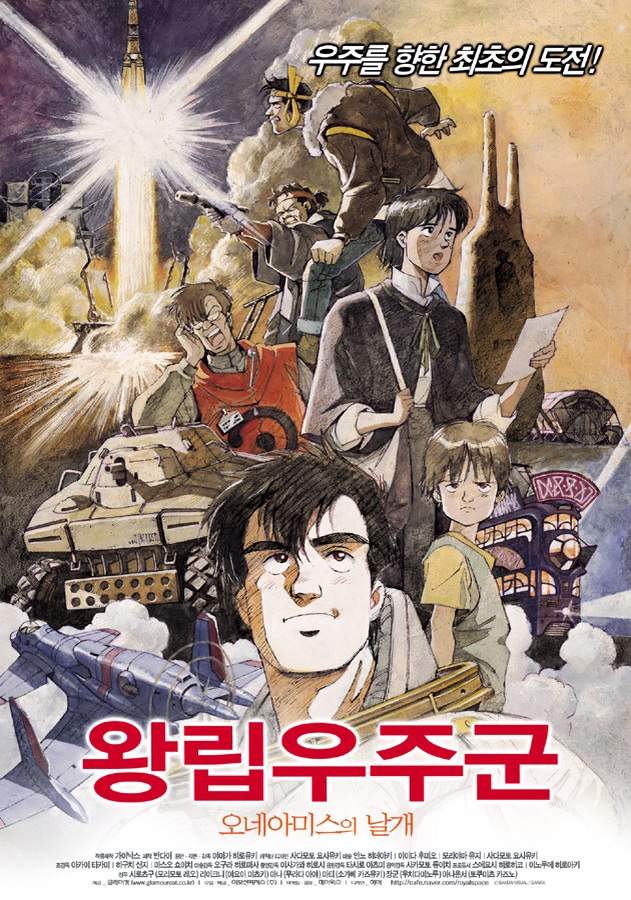
#60: Royal Space Force: The Wings of Honnêamise (1987)

From https://pm1.narvii.com/5628/06a50a48d4
626d2002b86f2ab8882362be39b45e_hq.jpg


Director: Hiroyuki Yamaga
Screenplay: Hiroyuki Yamaga
Voice Cast: Leo Morimoto as Shitotsugh Lhadatt; Mitsuki Yayoi as Riquinni Nonderaiko; Aya Murata as Manna Nonderaiko; Bin Shimada as Yanalan; Hiroshi Izawa as Darigan; Hirotaka Suzuoki as Domorhot; Kazuyuki Sogabe as Marty; Kouji Totani as Tchallichammi; Masahiro Anzai as Majaho; Masato Hirano as Kharock; Yoshito Yasuhara as Nekkerout
Viewed in Japanese with English Subtitles

Synopsis: On a planet similar to ours, the laid back slacker Shitotsugh Lhadatt works at the Royal Space Force of the Kingdom of Honneamise, seen as a joke by everyone with the kingdom as they have never succeeded in sending rockets to space. On the eve of the government finally removing their budget and ending them, the Space Force make one last ditch attempt, an ambitious and dangerous mission to send one member into orbit. Influenced by his attraction to Riquinni, a devoutly religious young woman he has met, Shitotsugh volunteers himself to be that test subject, only for the weight of his mission, the danger and the political machinations around the Royal Space Force to drastically change him as a human being spiritually.

The reputation Royal Space Force has is greater knowing of its origins. Gainax, who most will know as the studio who created the Neon Genesis Evangelion franchise, was always seen as the studio created by fans who managed to get their foot into the door of the anime industry. Figures like Hideaki Anno, before the reputation of the likes of the Evangelion series, who were just fans of anime and the likes of Ultraman who starred in their own fan films. Once they were a group whose first major animation projects, the Daicon III and IV opening films (1981 and 1983 respectively), where made for fan conventions and had to recycle animation cells by washing the paint off them after each segment. They impressed Bandai who, back when projects like this could be a worthy risk, they gave these people the chance to create a theatrical film. Even though, in the time in-between, members of the Gainax worked on big projects as animators, the group who'd become a fully fledged studio in the nineties and into the Millennium still had to hire students to help finish Royal Space Force. The company that'd eventually triumph with Evangelion, FLCL (2000) and Gurren Lagann (2007), but were also fraught with constantly financial problems, having prominent members like Anno leave, and be challenged by the likes of Studio 4°C in terms of being innovators, were a mere glint in the eye still here. And yet with Royal Space Force, you have an incredible one-off, alien to juvenile otaku fetishes and taking on such an ambitious, psychologically and morally complex science fiction story, one even spiritual and philosophical as it follows a character in an alien world through a drastic existential change.

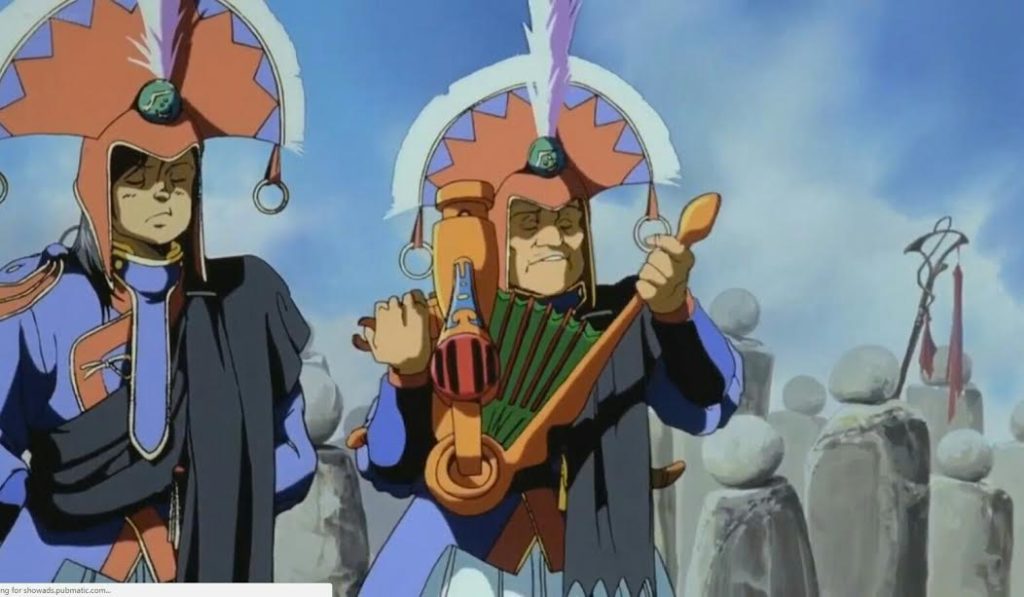
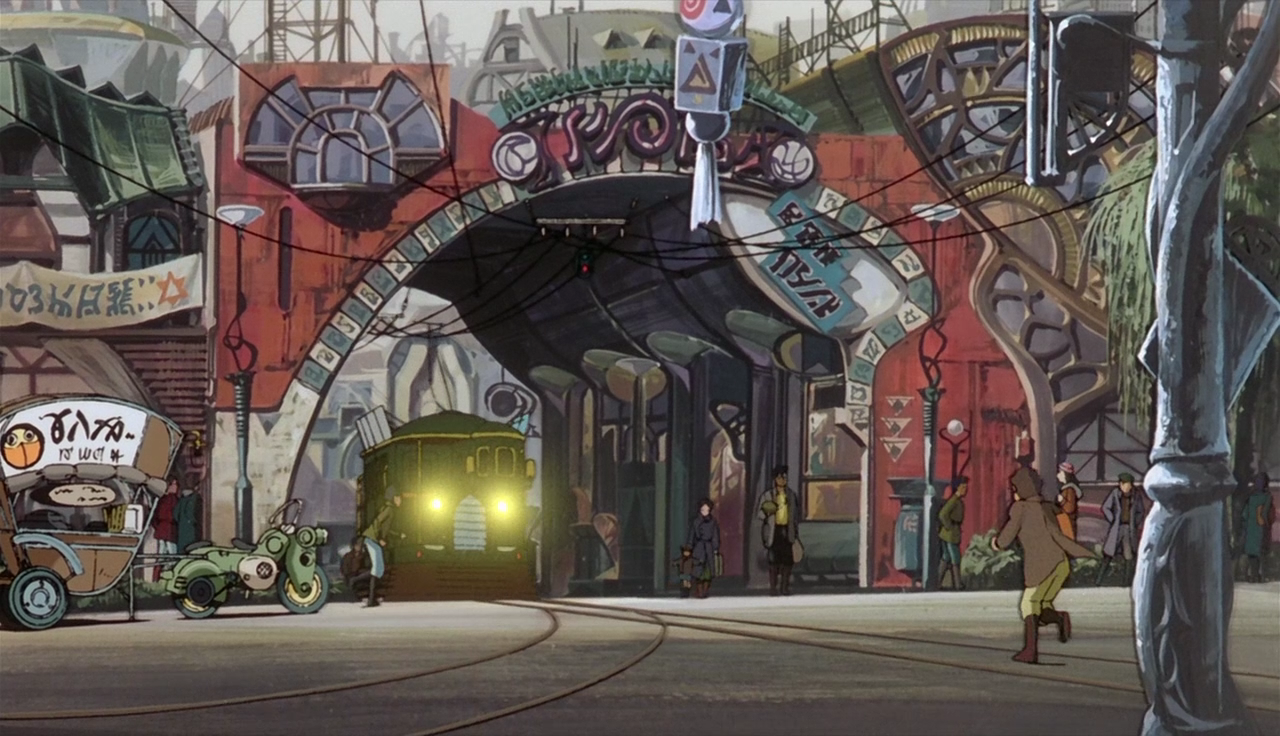
Royal Space Force exists in its own world. Like ours but fleshed out as a planet with its own fashions, languages (at least for a foreign nation who feel the space launch is a political threat), even having the cutlery on tables that's unique. It isn't exaggerated to the point of being flimsy either, worn and fully developed as a pre-fifties world, if to tie it back to our own, a form of dieselpunk sci-fi where everything is heavily mechanised, with elaborate city sprawl, but the idea of space rockets is seen as insane and has claimed the lives of the Royal Space Force many times before. Seen as embarrassments compared to the air force, closer to our own modern military airplanes, they are an absurd dream who attempt one last time. All with the knowledge, in a country with sprawling poverty and constant work strikes, that they are seen as much as a waste of money as much as a popular media event. It builds in terms of storytelling naturally, before the personal journey of Shitotsugh clashes more with political and moral issues which conflict with the dream. As their own government is purposely flexing its muscles with a rival nation, the inherent chance he could die is there too. As is the fact they might've only been allowed to go with the rocket test for military purposes.

From http://www.simbasible.com/wp-content/uploads/
2016/09/unnamed-1-10-1024x597.jpg

Whilst there are a few action scenes, the most prolonged an attempted assassination with purposely drags out into a messy, streets long scramble, this is the slowest of burns in terms of drama. Shitotsugh decides to be the pilot only because he can impress a girl named Riquinni he is attracted to. Deeply religious, she only pays interest to him baring as a friend due to her admiration of the Royal Space Force wanting to enter space rather than commit war. Through severe questions to his own moral compass, through his relationship with Riquinni as well, he is to be challenged for his decision to go into space. The level of complexity goes as far as even include religion, which is rarely done in anime or done well, usually terrible or with foreign religions like Christianity being used symbology to look aesthetically interesting rather than with context. (Something Gainax's own Evangelion has been accused of). Here the religion, even if created for this world, is visibly taking parallels from real ones. The Greek legend of Prometheus stealing fire from the Gods. Eastern beliefs and especially Christian morality, the concern of sin and redeeming oneself felt throughout. It's a film, surprisingly for the science fiction genre when it is more cerebral or action packed in anime, which gets progressively more spiritual as it moves along, following Shitotsugh's own realisation of the worst in humanity as well as wondering if his own kind, through this rocket launch, could strive for better.

It's not a simple moral film either. Shitotsugh is not a perfect, virtuous character, and likewise Riquinni is not a conventional love interest, her devotion to her faith leading her to only seeing him as a friend. Details of her are subtly hinted at, details never explained like the small girl, dressed as a boy, who lives with her like a sister, who possibly could be a daughter as its never explained where she comes into Riquinni's life. Royal Space Force is truly a film in need of multiple viewings, likely to grow for the character details told without dialogue you miss and plot details with are given more meaning with what is discovered later in the running time.

All the following could easily be superfluous if the project wasn't exceptional technically too. How beautifully made and intricate it is as an animated work. How Ryuichi Sakamoto the legendary musician and composer - alongside collaborators Yuji Nomi, Koji Ueno and Haruo Kubota - can add Royal Space Force in his unconventional and fascinating career through an atmospheric score that pushes the material to greater heights, sandwiched between his Oscar winning score for The Last Emperor from the same year and the children's film The Adventures of Milo and Otis in 19861. Finally seeing the film, in the best version possible for me for the first time, it amazes me how it manages with such subtlety to both build its world and how emotionally complex it is. Anime fans pride themselves, as I do, that our favourite work is emotionally complex and mature, but the medium can also be idiotic and trite at its worse; watching Royal Space Force is amazing when you consider how young everyone who worked on the film was, members of Gainax who were once just fans of anime and self professed otaku who decided, when given their first major project, to create a complex and even existential story.

From https://i.warosu.org/data/g/img/0552/04/1466602735623.jpg

[Major Spoilers Warning]

There is one detail, justifying a Trigger Warning, however that has made Royal Space Force impossible for some to love. A sequence under ten minutes long, and it's a moment part of the moral and psychologically complexity to the film which is still talked of to this very day and members of the production consider a mistake. I'd be delusional not to deal with what has caused viewers to dismiss the film's entire series of virtues, a scene of attempted sexual violence which is deliberately more problematic as it is our protagonist Shitotsugh himself who is attempting to molest Riquinni. Abrupt, but a major plot event, one which with our liked protagonist of before dissolves the initial view of him and complicates him to a very uncomfortable territory of characterisation. 

The issue is that it is sewed carefully into the plot, as carefully done as possible, but is a major  challenge to the viewer. He pauses mid attempt, visibly regretting mid way before Riquinni strikes him in the head with an object to knock him unconscious. As much as the controversy is the aftermath and is itself even more dark, as she forgives him the next day as if nothing has happened, Shitotsugh utterly remorseful and shocked by her reaction. I will say that, if anyone is uncomfortable with the sequence, I completely understand them. It is however, whether a justifiable risk or not, as subtly and done as well as such a scene could be. It's also part of a level of moral complexity even live action films do not dare to tread into, which is why even if you ask if it is an acceptable scene there's the inherent challenge of it. A viewer tends, unless they are claimed to be a villain, to sympathise fully with a protagonist of any story, making an act like the one Shitotsugh commits, when we see him as a lovable oaf, problematic and a violation of that trust between story and viewer. For myself the film is completely succinct in dealing with the subject, and it has a purpose that is not a cheap shock tactic but part of its overall existential concerns.   

From http://www.ricedigital.co.uk/wp-content/uploads/2015/
04/the-wings-of-honneamise-thora-113010.png

On the cusp of potential legacy or death, Shitotsugh as he is already challenged by the pressures surrounding him and falls into the worse of human tendencies. His attempt at romance with Riquinni is doomed, and in his lowest moment he commits such a horrible act, one he hesitates whilst knelt on top of her when she knocks him unconscious. Aware of how horrible his act was, Riquinni's blithe reaction is also far from a deeply misogynistic reaction, and anime and manga tragically has a lot of this, but a complex and troubling one for many viewers as it deals with a religious person able to forgive even their own trespasser. (Outside of animation, Abel Ferrara dealt with this in one of his most well known films, Bad Lieutenant (1992), where to the absolute confusion and repulsion of the anti-hero played by Harvey Keitel, a nun who raped by two men and whose case is he investigating has already forgiven the perpetrators their act due to her moralistic religious beliefs, a type of belief few viewers are comfortable to even consider when, rightly, we punish those who commit sexual violence as with other crimes).

It is a dangerous moment for a very young studio to have made, and whilst Gainax have challenged their viewers in the future, none are with this type of discomforting moral greyness. For me personally it is not the moment which capsizes the film, for whilst I sympathise with those who find it offensive, it's one of the few moments that a production is tackling this type of material with the psychological complexity it requires. When anime has an awful track record of offensive and tasteless material, utterly reprehensible material even, Royal Space Force's controversial scene is in a morally higher, more artistically minded place even if some would prefer that Gainax took a different direction More so as, whilst it ends with Riquinni forgiving him, their relationship is tainted by this. It is arguably the catalyst for Shitotsugh himself, through this sin of his, to be pushed towards a spiritual change which, on the day of the rocket launch, he sees the world around and starts to question mankind's tendency to violence, the moment of his own violent behaviour among others forcing him to re-evaluate the mankind itself. Arguably the sin he has nearly committed as much infuses the haunting final monologue where he wonders if they as a species can transcend themselves, followed by the final montage of ordinary life on the planet in its variety. Again, few live action films tackle this. Sadly in cinema we have accepted moral black and whiteness, simplified, to such a point that a story which challenges this is just dismissed when it should be properly pondered as much as asked whether the scenes of controversy were acceptable.

[Major Spoiler Ends]

From https://images.justwatch.com/backdrop/8786003/
s1440/royal-space-force-wings-of-honneamise

Altogether Royal Space Force is a difficult film. A film structurally and in plot which is challenging in its slow paced character study. A challenge just for its notorious and divisive scene still talked of in the current day, but also for how the film even without that sequence is a drama about human complexity. All whilst justifying itself as being acquisitively made, utterly absorbing and one of the few anime films that is truly intelligent. It was the creation of a small group who took such a huge risk and, even if not financially successful, it was a symbol of pride for Bandai. Gainax would continue on with challenging and rewarding material with Neon Genesis Evangelion. For less sombre material, for a sense of fun and energy, no one could argue as well with the virtues of FLCL, Gurren Lagann and Panty and Stocking With Garterbelt (2010). Unfortunately Gainax also become the company who made This Ugly Yet Beautiful World (2004) and shows pass the 2000s, barring one or two, which are not held up high regard or even known in the West. Where the "Gainax Ending", where everything was turned upside down to the surprise of the viewer, can easily be viewed like M. Night Shyamalan plot twists once were as a punch line joke as it was part of their virtues. Long before this twin sided mask, this company just before they wore it however made a film like Royal Space Force which is held in high esteem even next to the incredible work also being produced in Japanese animation in the eighties. Seeing the film for the first time, I am not surprised now.

=======
1 Sakamoto's filmography as a composer is fascinating by itself. Merry Christmas, Mr. Lawrence (1983) obviously. Three films for Bernardo Bertolucci. Donald Cammell's last film Wild Side (1995). The bizarre TV mini-series Wild Palms (1993) [Which I reviewed on my other blog HERE]. Pedro Almodóvar, Brian De Palma, Takashi Miike, Alejandro G. Iñárritu...alongside video games, like the ill fated attempt at modernizing Seven Samurai (1954) with the additional help of French artist Mœbius, Seven Samurai 20XX, and  Sakamoto's first ever film score for Ryu Murakami, the famous author who Sakamoto also worked with on Tokyo Decadence (1992). A film called Daijoubu My Friend (1983) that has American actor Peter Fonda  as a space alien in Japan. That eccentric, strange list is enough to praise Sakamoto for alongside the reputation as a great musician and composer.