Friday, 10 May 2019

#99: Ghost Stories [English Dub] (2000-2001)

From https://ssl-gfx.filmweb.pl/po/99/28
/309928/7077103.3.jpg


Director: Noriyuki Abe
Screenplay: Hiroshi Hashimoto
Based on the book series by Toru Tsunemitsu
Voice Cast: Hilary Haag as Satsuki Miyanoshita; Chris Patton as Hajime Aoyama; Christine Auten as Keiichirou Miyanoshita; Greg Ayres as Leo Kakinoki; Monica Rial as Momoko Koigakubo
Viewed in English Dub

The town of Ghost Stories is very haunted, beyond its bright colours a morbid place. This is apparent in that, over twenty episodes, even if anyone does die in the prologue for each episode, no one really bats an eye to this or any potential supernatural scenario. Clearly they're aware of how many monsters and ghosts occupy the world or are totally oblivious to this to the point of full amnesia, something to take in mind as all the beings sealed away by Satsuki's late mother have been reawaken due to major construction across town. Armed with her mother's (sometimes unreliable) ghost journal, Satsuki with her classroom friends must re-seal them all over again.

Just in the school, rebuilt but with the original decrepit school house still nearby on the property, there's enough to worry about, from demon hands forcing you to choose between red or blue toilet paper to one student resurrecting a school rabbit from the dead, let alone the entire town being occupied by the likes of headless bikers to cursed tower blocks. It also exists with a mirror world to itself. Not the mirror world of evil doppelgangers in one episode, who all wear glasses which are their own eyes and play video games on TVs with white noise, but an entire mirror world where one version has everyone being sincere and speaking in Japanese, the other full of foul mouthed vulgar heathens filling the English language full of laments of Christian Slater's failed career.

It feels like déjà vu, but I covered Ghost Stories before in its Japanese dub, the studio Pierrot production doing so poorly that it was felt that, when ADV Films got the license in 2005, they had to allow them carte blanche with the English dub to sell it to the States provided they kept character and ghost names; so ADV Films gave the dub director role to Steve Foster, a man whose relationship with faithful translations of anime scripts is like oil to water. Thus in his dark arts, creating two very different shows from the same footage, there was the original version and this new one. The original could frankly drag a lot; the problem, taking over four months to finish it, was that Ghost Stories' plots were the exact same, the group of lead characters encountering a new ghost or monster, trying to find a way to stop it, highlighted in the English version to sometimes be convoluted or the monster literally changing its mind at the last second, and repeat for the next episode. The version which Bloom brought in with the voice actors, improvised, turned it into a comedy with equal opportunities offensiveness.

Here, Satsuki (Hilary Haag) is no longer the plucky schoolgirl, Haag's trademark high voice portraying the brash and usually pissed off figure who, with a convoluted family background, has a gay deceased mother, a father who is a drunk perv, who finds herself constantly questioning her own sexuality, and has a little brother Keiichiro (Christine Auten) who has a learning disability and becomes incomprehensible in speech when he is emotional, leading to one of the many moments the world of Ghost Stories has dated drastically in ten years plus with jokes about this like using the term "shortbus".

Nerdy friend Leo (Greg Ayres) is now Jewish in this version, leading to some tasteless humour, alongside the running gag that he may be secretly gay. Hajime (Chris Patton) is now openly a pervert, which considering what are inappropriate amounts of underwear shots, considering Satsuki is a younger teenage girl in a children's show, is almost asking for such a character direction for Hajime to go further by turning him into a sex pest. Then there's Momoko (Monica Rial), once the meek older girl Satsuki's mother keeps possessing, now an Evangelical Christian, every stereotypical idea which keeps in mind that the dub was recorded in the midst of George Bush Jr.'s presidency and a lot of a Republican bashing which, alongside pop culture references, are entirely stuck within 2005 in reference.

This cast, nigh, no one in the town in this version of Ghost Stories is above comments about race, gender, sexuality and lots of material that over ten years later would have been flushed out when political correctness entered. They still live in a town with Japanese kanji everywhere, but everyone is now American, not only an excuse for cheap Asian jokes but with these amateur ghost hunters to obsess over mid 2000s references, voice actors working at ADV Films and the failing career of Christian Slater; thus what was a doll cemetery in the original for a cursed doll to be deposited to, where dolls of the dead are kept, is now in this world a place where gay publishers spend their free time recreating Slater films, the doll of use to play Tara Reid in Uwe Boll's Alone in the Dark. Before we continue, considering a lot of the references I have made have talked about a lot of gay and lesbian jokes, I must point out dub director Steve Foster is an openly gay man, so he has a lot of jokes involving gay Hell's Angel's and female ghosts looking like drag queens; he also uses the word "fag", characters having lisping voices and gay panic jokes however, which may un-impress LGBT viewers completely.

From https://img.sharetv.com/shows/episodes/standard/925822.jpg

The mirror worlds are in a strange position as, in both cases, the repetition of the plot structures is the huge handicap both had, let alone that with its bright aesthetic style. Ghost Stories is caught between wanting to be creepy but still a lot lighter in mood than horror usually is, what with the opening credits sequence juxtaposing horror imagery with a nice day at the beach, the end credits infamously having an utter earworm by CASCADE, a great song but in lieu to the audience meant originally to be family friendly, with inappropriate sexual connotations in the lyrics and the chorus including the phrase "sexy, sexy". It was cursed by simply being in a minor work in horror anime, not atmospheric enough and the English dub even mocking animation flaws in forth wall breaking.

The original version is sincere however - episodes are usually one-offs, but the nature of the mother's death is a major part of the show, the talk about life and death covered in a couple of episodes in a bitter sweet way that cannot help but be meaningful, even if one is in the episode where a bunny rabbit is resurrected from the dead and munches on everything that moves. Naturally, the other versions take the ever loving piss out of these serious segments as well as eventually lose steam, where even the sense of shock value is ebbing away in the final five episodes. Its arguably, when they beeped the swearing originally, when they given up with this and just have the expletives heard, a literal sense of giving up and with the sense that the English version is time stamped by its references and moments everyone is bond to cringe once at.

It does however have the more interesting characters as, unlike the original world of Ghost Stories, a lot more is to be found in the reoccurring jokes per characters that, even if they are stereotypes, they develop personalities. Even one off characters get more sometimes when the script's bothered to be more inventive - a creepy doll and its posse of toys is actually scarier when they're arguing which horror film to recreate on our protagonist as well as funny. Some of the characters get more from their voice actors and a few good one liners. I haven't even mentioned that, alongside having to rid the entire town of ghosts, Satsuki and Keiichiro's pet cat in the first episode is now possessed by the great demon Amanojaku, whose Japanese actor Ryusei Nakao is also great but gets interesting when Rob Mungle plays him in the English dub as a know-it-all egotist, reemphasising that, as he now enjoys licking himself as a cat, Amanojaku in both versions is an arse who until the final moment changes his mind and helps the cast, the charm in how much of a bastard he is and when he does sincerely show concern for the kids, even if the ending episode in the English dub is him wanting an Oscar winning performance before the show finishes.

The other standout, which interlinks with the amusing and actually emotional relationship between Satsuki and her late mother, is Momoko, who I was prepared to be a one note joke that'd get tiresome. Thankfully as the show goes on, whenever Monica Rial drops her high pitch voice down and Momoko's mask slips, some of the funnier lines of the entire show are to be found, not the sophomoric targeting at Evangelical Christians but when one in this case is a lot more complicated due to the script wanting to find more jokes for her. When she has more base thoughts and, in the funniest episode about a ghost nurse, has a more complicated back-story including an apple juice addiction. It's still very childish, trampling on one of the episodes entirely about Satsuki's mother, but it's the one moment the dub, which squanders itself for the most part of dumb humour, actually gets somewhere interesting.

These two versions exist in an odd couple fashion. More know and love the English dub, but time has immediately dated ADV Film's work; it even had a second (accurate) English dub from Aniplex, which just adds to the absurdity. Personally, it actually gains much more when you watch both - a mere change of dialogue literally creates two worlds from one, the first sluggish at points but with a fun to it, the other profane, frankly lazy, but more fascinating as occasionally it succeeds and when you know the source text its trampling on. Also, as I have spent nearly half a year watching this series twice, forty episodes altogether, it's stuck in my mind even if I tried to perform a mental exorcism.


From https://img.sharetv.com/shows/episodes/standard/925838.jpg

Thursday, 9 May 2019

#98: Urusei Yatsura 2: Beautiful Dreamer (1984)

From https://images-na.ssl-images-amazon.com/
images/I/51ZCHjkRLJL._SY450_.jpg


Director: Mamoru Oshii
Screenplay: Mamoru Oshii
Based on the manga by Rumiko Takahashi
Voice Cast: Fumi Hirano as Lum Invader; Toshio Furukawa as Ataru Moroboshi; Akira Kamiya as Shutaro Mendou; Kazuko Sugiyama as Ten; Saeko Shimazu as Shinobu Miyake; Machiko Washio as Sakura; Mayumi Tanaka as Ryuunosuke Fujinami; Shigeru Chiba as Megane; Akira Murayama as Perm; Shinji Nomura as Kakugari; Issei Futamata as Chibi; Kenichi Ogata as Ataru's Father; Natsumi Sakuma as Ataru's Mother; Michihiro Ikemizu as Onsen-Mark; Masahiro Anzai as Ryuunosuke's Father; Tomomichi Nishimura as the Principal; Ichirō Nagai as Cherry; Takuya Fujioka as Mujaki
Viewed in Japanese with English subtitles

Coming up to their school festival, the cast of comedy fantasy series Urusei Yatsura, from dumb horny Ataru Moroboshi to space alien princess Lum, slowly realise the day repeats over and over again. As people vanish and the world changes, questions arise to how this has come about in this Mamoru Oshii directed and scripted tale. Now with this premise in mind, to come to the world of Beautiful Dreamer (as I have) blind to the Urusei Yatsua franchise does add another detail to this plot that, whilst Beautiful Dreamer has gained a reputation by itself, you're throw into the deep end with these characters already existing. That the plot is about something else asks where the space princess who can fly and shoot lightning comes from alongside all the other miscreants who are our protagonists.

Some of you are probably blanking over the fact that, yes, you'd never presume the serious director Mamoru Oshii once animated comedy before he made films like Ghost in the Shell (1995).

Let's go back in history then to explain....legendary manga author Rumiko Takahashi, who'd create hits like Ranma ½ and Inuyasha thus becoming one of the most successful and financially well off manga authors of all time, started Urusei Yatsua in 1978, which was successful enough to start an animated series in 1981. It was only when Oshii, who started on the first episode, and the production changed the tone of the series halfway through that it is said the series gained its own successful reputation, a madcap series which lasted four seasons, six films (which Beautiful Dreamer belongs to) and twelve OVA episodes up to 2008. It was a franchise which played on absurd premises, comedy and mythology, Lum the space princess in her trademark tiger print bikini explicitly referencing a costume of Japanese omi (demons) among generally ridiculous jokes.

The premise is that Ataru Moroboshi, your typical sex obsessed teen male, was chosen as the human being to protect the Earth from a race of aliens by means of a game of tag between him and their representative Lum, an event explicitly reinterpreted in a later segment of Beautiful Dreamer. A misinterpretation, whilst he won, caused Lum to think he proposed to her as a wife, thus leading to her living on Earth, electrocuting him with super powers whenever he pervs on others; the other male students, led by military obsessed Shutaro Mendou1, were not happy of this situation so, as referenced in the film, have a group to protect Lum from him or at least try to make his life a living hell. Neither was Ataru's original human girlfriend Shinobu Miyake impressed too, a girl with superhuman strength stuck on the side to this farce.

From https://i.imgur.com/x3siNcbh.jpg

Beautiful Dreamer
is a film given a huge amount of weight by itself due to Mamoru Oshii's history, a director of a lot of comedy as well as cerebral material even into his early nineties run of live action work, something we don't know a lot about past the Millennium when he fully dived down on sombre writing. The sole screenwriter, lifting from a premise they used in an episode of the series but expanded in scope to full blown surrealism, this is still visible Oshii's work and no one else's. That it's in lieu to a comedy, and a beloved franchise that was already using carte blanche in its premise is the truly unique thing at hand; even without the original context, I was looking at something, even if Beautiful Dreamer was not a high budget work in its time, which went beyond and magnificently into the experimental and creative.

In this world, the introduction immediately sets up the chaotic slapstick and chaos when the initial premise is preparing for a school festival, the incredible energy and invention of the animation team felt fully. The characters are numerous, but you can establish their personalities with ease from their quirks, particularly as, when the film occasionally becomes very serious and existential, their simplicity allows them to suddenly develop nuisance. Even when there's material that might raise an eyebrow, the Nazi themed cafe somehow a good festival choice for your class, there's plenty already in the initial premise onscreen, like the numerous ridiculous pratfalls and sight gags, to amuse and catch your attention away. Even the issue that one of our protagonists is a pervert, Ataru, is thankfully something that also becomes nuisance, his clear romance with Lum something which becomes a huge part of the plot in the end; even when literally given his fantasy, as a result of plot machinations, her absence from him is felt and immediately called out. Plus there are so many characters onscreen, and others who take on just as many important roles, that it balances everything out. The truth is that, ironically, it's Lum herself despite being a huge figure in the franchise, and of this film's crux in terms of the resolution, who takes a background part, an interesting issue when a sci-fi supernatural figure like herself would've been the central premise in any other circumstance.

As for the world itself, of these lovable food obsessed and manic figures, their idyllic farce is undercut by the scenario when reality itself is distorted, where even when Lum exists as an alien who can fly and has a miniature friend called Chibi she is no way near as odd as when the tank abruptly appears in the school swimming pool, puddles of water teleport people, and individuals vanish. As time stops, enough for a room to be entirely covered in fungus and dust, and people eventually start to disappear, the film for all its light heartedness gets serious when it needs to, two diametrically different tones managing by pure, perfect preciseness to succeed. The constant changes to reality are vividly depicted, the various houses of the world being altered, from new floors to the school becoming a M.C. Escher illustration that bend physics, to the plot eventfully turning the world into a post apocalypse where the rules are even odder about their environment yet the buildings are ruined. Knowing Beautiful Dreamer is not the highest budgeted work, but still from this era of hand drawn animation, adds to how incredible an achievement it is, especially as the later plot machinations go as far as to include turning into genre vignettes and full blown cosmic psychedelic with characters on strands of DNA. When its revealed what is going on, thankfully it has a personification that its immediately memorable as a figure, one who you feel sorry for even if they are as much responsible for turning the film into an even greater spectrum of strangeness, between sci-fi pulp tragedy to even half finished scenarios built with cardboard.

And the style is matched by the moments of seriousness, which never override its comedic tone but work around it to actually have a startling effect. The Oshii I grew up with is here, first witnessed fully in one of the best scenes when nurse Sakura encounters the being behind it in a taxi cab, possessing the driver and getting into a conversation in a dark tunnel about how time is merely a construct of human beings, a sober atmosphere but detailing Oshii's obsession with characters having long philosophical discussions. Famously it would go even further to the point as if deliberately goading the viewer - his tie-in novel to Blood: The Last Vampire (2000) called Night of the Beasts, an action vampire story, stops halfway through for chapters of long discussion on vampire mythology around a table - but here it works perfectly. The legend of Urashima Tarō, a man who rode a turtle and did not age famous in Japanese culture, their equivalent to Rip Van Winkle, is evoked as is the idea of Zhuangzi, the Daoist thinker who dreamt he was a butterfly dreaming he was a man and developed an existential crisis as a result.

This all is still a comedy, one which resolves everything for a new day, a new story, but the production pushed the premise in drama and scope to an undeniable scale. It's for me because Oshii is such an obsessive for extrapolating on ideas, that he's able to push these premises into interesting tangents. Seeing one of his most overtly comedic works for the first time, it's also amazing for who could be a cold director to also see his heart, a whimsy here that is utterly lovably as well than absolutely suited to slapstick and school days bonding, something I've never seen yet in his career. Sadly he'd depart from the TV series by episode 106, going on far longer afterwards, his relationship with the original creator Rumiko Takahashi not by all accounts a great one and prone to conflict over ideas; what he produced here, resolved around the love between Ataru and Lum, is such a lovely, strange and delirious production I adored.

From https://i.pinimg.com/736x/3c/49/d4/3c49d4a5261cc6
1cb7e01f0109885356---anime-manga.jpg

=======
1) One character who immediately won me over, because his voice actor Akira Kamiya was incredible, is Shutaro Mendou, a diehard military obsessive who, in this world, can acquire an actual tank for the school festival cafe, has access to a fighter plane and yet, for his seriousness, can break out in a higher pitched exasperation when challenged or hoisted by his petard.

Monday, 6 May 2019

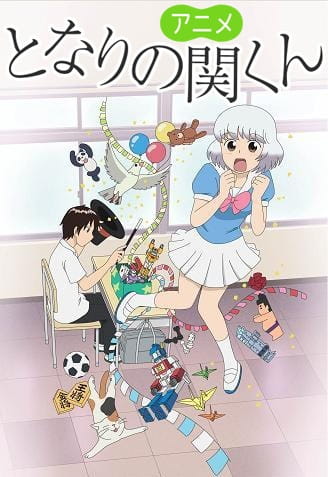
#97: Tonari no Seki-kun, The Master of Killing Time (2014)

From https://cdn.myanimelist.net/
images/anime/9/55489l.jpg


Director: Yūji Mutō
Based on the original manga by Takuma Morishige
Voice Cast: Hiro Shimono as Toshinari Seki; Kana Hanazawa as Rumi Yokoi; Satomi Satō as Sakurako Gotō; Shigeyuki Susaki  as Takahiro Maeda  
Viewed in Japanese with English Subtitles

In class, Rumi is constantly distracted by Seki, who never is paying attention to lessons but always indulging in peculiar or elaborate hobbies mid-lesson. Thus, as a micro-series goes over twenty one episodes, seven minutes each, The Master of Killing Time is a perfect example amongst them of how to use minimal lengths to an advantage. From those I have previously encountered, there was one called Sparrow's Hotel (2013) which, even if it has only three minutes per episode and amusing, didn't take full advantage of its story of a former female soldier working as hotel staff, whilst another about sentient farts, Onara Goro (2016), is weird enough to be compelling but was looking like it was about to wear the joke thin if it went any longer. And then Pop Team Epic (2018), which was a fifteen minute episode repeated twice with differences between the versions, has the issue of being so insular with its references the humour's only gained for a few, and so chaotic it actually becomes less weird than a premise which is straightforward but has a weird detail.

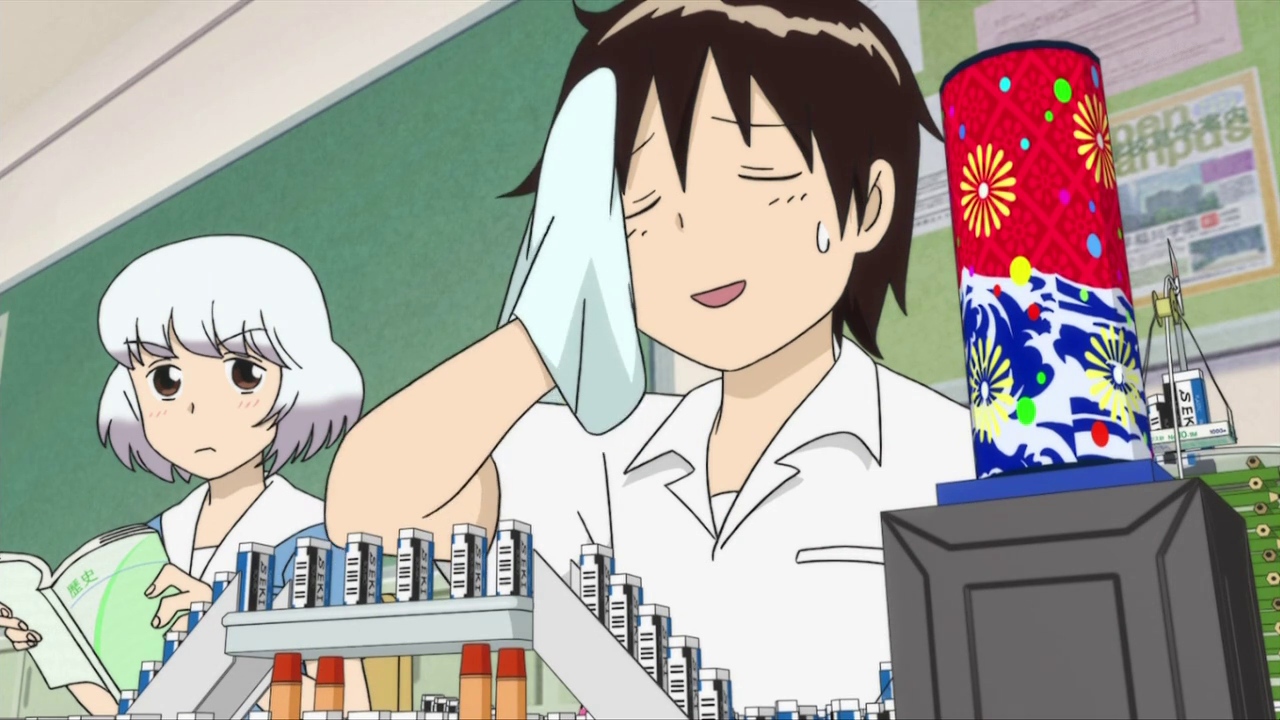
The Master of Killing Time in contrast takes an odd premise, of a student who engages in increasingly bizarre activities instead of studying, and repeats with the virtue of having his "straight man", white haired and plucky schoolgirl Rumi, being pitched as the perfect foil, in both heart and her comic reactions to his behaviour. It's one joke, as Seki go from performing magic tricks to her to really odd pastimes, like setting up an optician's mirror at his desk and trying glasses on he'll never wear, but he has his own charms. He's also a sadistic at times, from playing his shogi set off as soldiers by bashing the pieces, to his sausages at lunch being shaped liked squid, thus creating a horrifying story of preservation being concocted by Rumi as she imagines him a monstrous devourer of a benevolent race of sausage squids.

Rumi is the reason the jokes work, voice actress Kana Hanazawa a shining star alongside everyone who both drew her facial reactions and came up with her various flights of fantasy based on what Seki is doing. A friendly chemistry is between her and Seki, never romantic, but a greater reward is to be found in her hyperactive imagination when she over elaborates on the shogi game, imagining a fantasy epic of betrayed kings and star-crossed lovers, to the robot family, the one longer form running gag where Seki has three robot toys, designed like a father and a mother and a child, who do thinks so earnestly that Seki doesn't. This joke, in mind that The Master of Killing Time is a bright and warm work with some clear craft behind it, but still economic in presentation, even gets a parody of a classic vocal song usually found in old animated robot shows in Japan, a reference you don't need to get when the song is so bombastic but the lyrics are about everyone loving scrambled eggs and robo father sleeping in late.

From https://ikilote.net/Galeries/News/Anime/AR/
Tonari_no_Seki-kun_-_ep01_047.jpg

Noticeably, with the seven minute lengths also including the opening and ending credits, a lot of the humour is able to work constantly as the joke is based on drawing it out over a long time, the elaboration and silliness based on the tension Rumi puts in her investment in the activities. The great structure is emphasised when a side character Sakurako Gotō gets to be the lead for two episodes; believing Rumi and Seki are actually romantically together, the two episodes are great themselves, particularly when she perceives a game of miniature golf on a larger shared desk is actually them engaging in some very personal romantic hijinks to her blushed shock.

It's a great example of creativity in minimal resources, quite a well animated work but in that it uses the limited movement of anime to its advantage, how the gags are based on sudden shocked reaction in Rumi's voice or a sudden change in facial movement. Its tells a lot from one joke, and to consider that the entire series, like the source material, is based on simply this peculiar premise, the kind you'd be hard to find in a lot of mainstream Western animation, is something to admire. Obviously the premise is helped by being minimalist - baring Gotō and the robo family, the only other true side character, whilst in populated classes, is Takahiro Maeda, a student who is oblivious to the odd behaviour Seki is doing on the desk behind him, even if it's using his back to represent a mountain for robot toys to perilously climb.

The sense of personality even comes around to the opening and ending credits too, not only in the good music but what they repeat - playful pop over the opening, Seki elaborately animating a scene of himself and Rumi like an actual anime production, the ending a lovely jazz piece that, as he plays an improvised instrument from materials like a pencil case, adds to the sense of Rumi secretly liking him for all his irritating habits. That there is no real conclusion to the series, barring the final episode adding the risk of him being caught for his shenanigans, isn't a disappointment but a natural ending, that unless the manga took a different direction, or amped the stakes to funnier heights, Seki is still going to be doing this, and Rumi is going to always miss something off the board to write down for her work.


From https://theglorioblog.files.wordpress.com/2014/03/seki-kun_6-9_4.jpg

Friday, 26 April 2019

#96: Paranoia Agent (2004)


Director: Satoshi Kon
Screenplay: Seishi Minakami and Tomomi Yoshino
Voice Cast: Daisuke Sakaguchi as Shonen Bat; Mamiko Noto as Tsukiko Sagi; Halko Momoi as Maromi; Makoto Tsumura as Shogo Ushiyama; Ryūji Saikachi as Old Person; Shōzō Iizuka as Keiichi Ikari; Toshihiko Nakajima as Masami Hirukawa; Toshihiko Seki as Detective Maniwa                                       
Viewed in Japanese with English Subtitles

Synopsis: One night a female illustrator Tsukiko Sagi is assaulted by whom she describes as a young male wearing golden inline skates with a bent, golden baseball bat. Thus "Lil' Slugger" (or Shonen Bat in the original Japanese) is christened, and to the police's bafflement, he can abruptly appear to all his targets, all of which are seemingly people either connected to each other and/or pushed to the edge of despair.

In his short and tragically short career, only living to forty six due to pancreatic cancer, Satoshi Kon made four films and this one anime series, but has developed a cult reputation that has even stepped outside of anime itself. When being in your forties is still considered a young upstart in the anime industry, Kon could've (and likely) would've pushed the medium of anime into more idiosyncratic directions. Based around various strands of ideas he felt shouldn't be wasted, what Paranoia Agent is isn't necessarily vignettes but all tied into a very elaborate thirteen episode series. Contrary to my original beliefs, such a long time since seeing this series, Paranoia Agent is a very precise tale.

Ten episodes follow the tale of Lil' Slugger, an urban legend who yet is actually responsible for smashing people in the skull with a golden baseball bat, strangely targeting people all interlinked by them reaching a crisis point in their lives. The three episodes which feel like side plots, the entirety of disc three of the original UK DVD release, back when anime used to be (inexplicably) released by three or four episodes over many months, are still connected to the main story and add character to the world being depicted.

In said world, as his other work, Kon blurred reality itself with the exception of Tokyo Godfathers (2003), tackling subjects like dreams or subjectivity under mental distress. Even when Paranoia Agent can only work as being supernatural for certain plot incidents, it's using a lot of visual metaphors to depict the distorting mental states of its cast. Flights into an idolised youth, literally a cardboard town of two dimensional people, a woman whose split personality in combat with her leaves answering machine messages, a police interview which (in the funniest episode) turns into a stereotypical Western high fantasy quest based on delusions of being in a video game, or the first victim of Lil' Slugger, character illustrator Tsukiko Sagi, having her mascot character Maromi as a talking figure who constantly tells her to just ignore any prang of concern she has about anything.

Ultimately, Kon emphasises a long trodden obsession of his of the absolute dangers of escaping reality no matter how painful it is, one of the only exceptions being Millennium Actress (2001), a tale of an aging actress which was clearly indebted to real life Japanese actresses Setsuko Hara and Hideko Takamine. Here in Paranoia Agent is his most overt thesis of this concern as it's the central plot. Following intertwined characters - Sagi, two cops Keiichi Ikari (older and old fashioned) and Mitsuhiro Maniwa (younger and dangerously open minded), and various reoccurring side characters - the tale of Lil' Slugger, at first seen merely as a hoodlum, is visibly even in the subjective world view of the series a supernatural entity or one giant metaphor for escape that has become an actual, real destructive force. He targets those pleading to escape pain - neurosis, anxiety, a downward spiral of crime, general chaos in one's life - called in hope he'll roll in on golden inline skates and in one case knock someone's skull in so hard they completely forget who they are and all they've suffered through.

From https://i0.wp.com/the-avocado.org/wp-content/uploads/
2018/02/PA12_shot4.png?zoom=2.625&resize=371%2C173&ssl=1

Not desiring to spoil the series, his mirror is Maromi, that lovable cartoon dog that Tsukiko Sagi created at the beginning of the series, a stand-in to a phenomenon like Hello Kitty who is an immediate success and becomes an insanely huge marketing property that the populous becomes obsessed with. We'll get to Susumu Hirasawa's music later, but it's not a surprise in lieu to how sinister this dog's influence is, at least in Kon's eye, that the end credits has every character laid asleep around a giant version of Maromi, in a grassy field, whilst an unnervingly calm but eerie piece of music is playing.

The series also an attempt at tackling various cultural issues; Kon's work all did, Tokyo Godfather breaking a taboo by talking about the homeless in Japan, but Paranoia Agent is basically sewing together various different issues at once through one long form project. The anime obsessed otaku, a minor side character, who in the gaze of all his female figurines hires a sex worker. The gossiping women, who have an episode, trying to have more elaborate tales about Lil' Slugger over the others. The episode on suicide, as three members of an online forum for this act meet up, an elderly man and a young man horrified the third in a young girl.* The general sense, coming to ahead in the finale, of a collective attempt to bury one's emotions that becomes completely destructive.

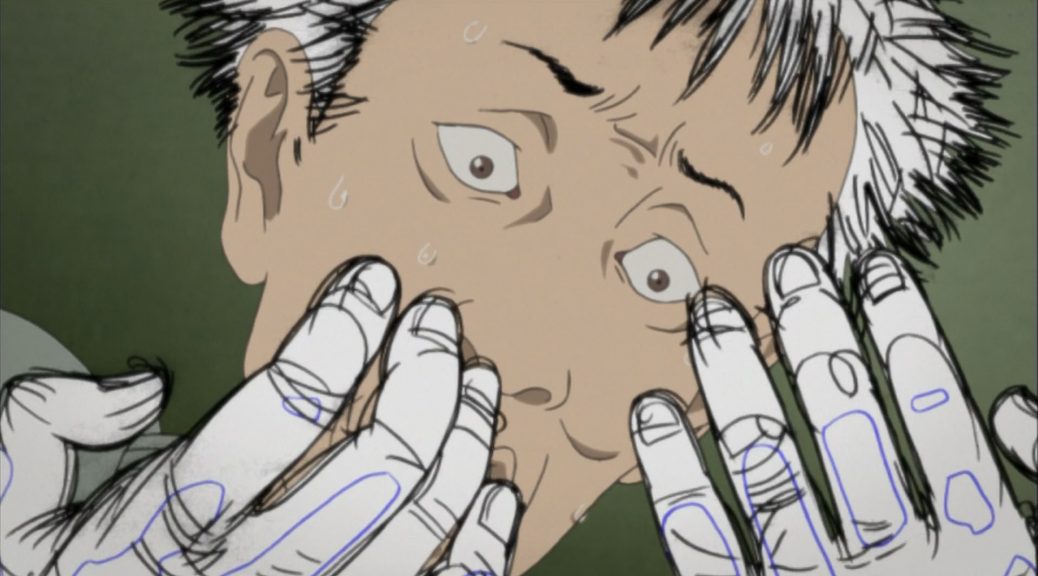
In lieu to how TV anime is likely more hectic to produce and with less time to manage resources, Paranoia Agent is still a great series in terms of craft, even with a sense of humour at the expensive of this area of the medium being incredibly stressful as, for an episode, it follows a lowly and useless staff member on an upcoming Maromi animated show, explaining various details of real staff member positions in digressions and probably touching on some real angst, being let out, of how utterly agonising working on a show production schedule probably is. Kon is also a fascinating case where, an absolute definition of an "auteur" where his directorial work bares his obsessions, he also shows how many auteurs how important voices working under them who don't negate their status as directors, but are great collaborators. Character designer Masashi Ando, who worked on him on Tokyo Godfather and his last film Paprika (2006), has helped a lot in terms of the trademark realistic character designs which have allowed a grounded sense of reality to these works, perfect for when they transition into the unnatural.

Likewise is his frequent musical collaborator Susumu Hirasawa, who started working with Kon fron Millennium Actress and, alongside his work in anime like the soundtracks for the various Berserk adaptations, is likely better known through them than his musical albums in the West. This is sad, but not a detrimental argument against said soundtracks, Paranoia Agent just as compelling. The best way to describe him is Peter Gabriel's soundtrack to Birdy (1984) crossed with New Age and electronic pop, folk ideas matched with all the peculiar electronic equipment he has had on stage over the years, all matched by a falsetto to die for. That, and I swear to this, even yodelling or the closest thing to it. Seeing his work in a TV series, whilst it does repeat motifs, is a very interesting change of pace, even an amusing choice of using the opening theme within an episode to freak a character out. And befittingly, whilst it's joyful, the lyrics in translation are aptly dark and for consideration alongside the opening credits animation itself, held with high regard as an opening itself by a puzzle box to decipher. Even the next episode previews, including a side character of an old man who is presumed to be delusional but has a strange knowledge, add to this by using animal nicknames for characters for part nonsense, part clue based monologues.

Sadly, this was Satoshi Kon's only television series, but among his small output, Paranoia Agent stands out as also one of the best series from the 2000s with good cause. Arguably, with a career that beforehand included being a manga author and working up in the anime industry itself to also consider, Kon had one of the best runs as a director regardless of medium, four films and one series which are as high a bar in talent as you could get. Again, its stepped in tragedy and loss, but God he was good.

From https://blog.sakugabooru.com/wp-content/
uploads/2017/12/tfw-houkai-1038x576.jpg

======
* Unfortunately, within the UK, whilst the offending scene is seen in the next episode preview beforehand, that episode was censored for a hanging scene and is still like this in 2019. At the same time, when this took place, an episode of Ren & Stimpy was censored for a gag about hanging too for DVD; despite Paranoia Agent being an adult work still rated for only eighteen year olds to see due to this episode, I have always speculated that it was picked on as well for being animated and depicting a form of suicide as well. It's still one of the biggest reasons, despite all their good virtues, I have always had a distrust of the British Board of Film Classification (BBFC) where every motion media work has to be rated through.

Tuesday, 9 April 2019

#95: The Special Duty Combat Unit Shinesman (1996)

From https://childrenoftheburningfist.files.
wordpress.com/2011/11/index1.jpg


Director: Shinya Sadamitsu
Screenplay: Hideki Sonoda
Based on the manga by Kaimu Tachibana
Voice Cast: Daiki Nakamura as Shi Nakamura; Hekiru Shiina as Princess Hekiru Shiina; Hiroko Kasahara as Hitomi Kasahara; Kenichi Ono as Shotaro Ono/Shinesman Sepia; Kōichi Yamadera as Shogo Yamadera/Shinesman Grey; Noriko Hidaka as Riko Hidaka/Shinesman Salmon Pink; Nozomu Sasaki as Sugura Sasaki; Rica Matsumoto as Youta Matsumoto; Sho Hayami as Ryoichi Hayami/Shinesman Moss Green; Toshihiko Seki as Shujin Seki; Yasunori Matsumoto as Kosuke Matsumoto/Shinesman Red; Yoshiko Sakakibara as Kyoko Sakakibara
Viewed in English Dub

Synopsis: Kosuke Matsumoto, when he joins the Right Trading company as a paid employee, is surprised to learn that, alongside his normal salaryman responsibilities, he's also hired by the head of human resources Kyoko Sakakibara for the Shinesman project, as a super sentai team with four co-workers who don costumes and fight evil.

Director Shinya Sadamitsu has had some bad luck - Dragon Half (1993), a beloved piss take on high fantasy, only got two half hour episodes before it was canned, and Shinesman whilst not cancelled also only got two half hour episodes. Sadly, whilst it has its moments, Shinesman (about a corporate superhero team) suffers more from its brisk length, never taking full advantage of its premise as I'd wish. It starts off well, with the team fighting a horrible monster that was stealing/sabotaging corporate information, but sadly, the show drifts off into a simplistic tale against two aliens, posing as humans, trying to take over the world that isn't taken advantage of for its slight length.

A shame as, in the twilight years of OVAs in the late nineties, brightly coloured and so very different to modern anime in style, there's a lot here of promise and that shines through occasionally. The heroes, baring lead hero Kosuke Matsumoto in red, are fellow office staff in ill-advised colour choices even their leader, head of human resources Kyoko Sakakibara, hates, the co-workers fitting stereotypes - Riko Hidaka (Salmon Pink) is the only female member, an office girl stuck constantly getting drinks and cigarettes at the vending machine for staff when she's a lot more tougher than she looks, or Shogo Yamadera (Grey) whose passion and romantic life is entirely for his car, a Montero, not to mention the others have for costuming sepia and Moss Green. There's even a fake in-anime ad for Shinesman themed bath merchandise, where the two episodes should've gone in less than sixty minutes in terms of playing up to this absurd premise, alongside the fact that their business themed weapons (like the business card cutter) are bemoaned as usually being useless.

It's all reminiscent of Samurai Flamenco (2013-14) in all honesty, where this type of hero was taken on a much more serious and expansive version with the humorous contrast between the heroics and banal life even more creative and fleshed out. The length didn't stop Dragon Half cramming enough jokes (and a Beethoven piece with new lyrics about lunch over the end credits) to thus become an iconic work even in the 2010s, but Shinesman decided to try to have a story when there wasn't enough time to without feeling paltry. A shame as, as part of the tone, the villains are also set up with ripe comic potential - posing as business men for another corporation, an alien overload and his assistant are trying to take over through corporate tactics. Unfortunately, in the biggest plot piece, the overlord's sister has appeared and presumes the Earth is like the cartoon recordings sent back, emphasising that whilst its broad and wooden at times, the English dub was regarded well for good reason for how it played up Shinesman's moments of comic goodness, particularly with playing up how these villains, stuck as unthreatening figures in truth, have to get around their own banal problems.

From https://i.ytimg.com/vi/dSZDimSu6IQ/hqdefault.jpg

It's a shame that, to pinpoint where the two episodes falter, the second episode tries to focus on plot knowing all too well there's not enough time to care for it in investment. Episode 2, where the villains try to take over a fairground exhibition, goes for a conventional story with jokes, weaving plot threads left unattended to like the minion's sister being secretly part of the hero's side, an alien herself trying to snap him out of being brainwashed, or the sister being romantically connected to the hero. Dragon Half managed to survive, and even get a Discotek re-release in the 2010s, because in spite of its stunted length its legacy was managing to pull off so much with what was there to stand out. Shinesman in hindsight should've followed this same template, and it's a wise reference to make as, not only are they from the same director, but Dragon Half's reputation is enough that the manga from 1988 was finally being released in the West from 2017.

Shinesman instead belongs to that period especially in the nineties of OVAs which were made as manga tie-ins, with the problem that without the source material being released in the West, they were merely references, like apocrypha for a sacred anime text. A shame as, considering Samurai Flamenco promised and executed it perfectly, this idea of combining superheroes ordinary lives had legs; hell, even Excel Saga's 1999 TV anime has a sub plot about a corporate superhero team too, the idea of marketable heroes a joke that is practically money on the table for anyone to do a story upon. What little of Shinesman got to this, like the Shinesman soap and towel set, showed what we should've gotten.

Even more interesting, and barely covered, is knowing that this was a shoujo manga, meaning that its target audience was initially for women, an interesting detail as, whilst the men in the hero and villain sides are all very handsome, even the older father with a daughter who is Shinesman Sepia, there's a sense here of demonstrating just how diverse a genre tag like "shoujo" actually is as would be its mirror Seinen, targeted to young men. It offers a nice bow to know that a great premise like this has no defined bias for its target audience.


From http://3.bp.blogspot.com/-b0pqnF-T0iY/UxaMDqynPLI/
AAAAAAAADoc/JGhSwPdlAJw/s1600/Shinesman+1.jpg

Saturday, 6 April 2019

#94: Ai City (1986)

From https://m.media-amazon.com/images/M/MV5BZjgxMDM2NjQtZDY2Zi00Nj
UzLWE0MGMtYTQyOGQ3ZTdkZTQ0XkEyXkFqcGdeQXVyMTA1OTEwNjE@._V1_.jpg


Director: Kōichi Mashimo
Screenplay: Hideki Sonoda
Based on the manga by SYUFO (Shuuhou Itahashi)
Voice Cast: Hirotaka Suzuoki as Kei; Yuki Ueda as Ai; Mami Koyama as K2; Banjou Ginga as Ii; Ichirō Nagai as Rai Ro Chin; Issei Futamata as Ryan; Jouji Yanami as Ti; Kenyuu Horiuchi as Mister J; Kiyoshi Kobayashi as Kuu Ragua Lee; Nachi Nozawa as Raiden; Seiko Nakano as S; Takeshi Watabe as Aroi
A Cinema of the Abstract Crossover

Fancy something strange and (frankly) batshit from the eighties? Covered HERE on my other blog, full spoilers but not in the slightest capturing the experience of viewing the directorial work of studio Bee Train's founder Kōichi Mashimo, Ai City is what happens when in the midst of a craze for psychic and ESP stories someone decided to make the eventual anime which is as mad as a box of frogs. No way near as difficult as I have heard it be, gorgeous to look at certainly, but I'm not going to suggest it's anything but incomprehensible at times.


From https://cdn.animenewsnetwork.com/thumbnails
/max1000x1500/cms/feature/106042/image08.jpg

Tuesday, 2 April 2019

#93: Samurai Flamenco (2013-14)

From https://static.tvtropes.org/pmwiki/pub/images/
samurai_flamenco_1705.jpg


Director: Takahiro Ōmori
Screenplay: Hideyuki Kurata
Voice Cast: Tomokazu Sugita as Hidenori Goto; Toshiki Masuda as Masayoshi Hazama/Samurai Flamenco; Chie Nakamura as Sumi Ishihara; Erii Yamazaki as Moe Morita; Haruhisa Suzuki as Haiji Sawada; Haruka Tomatsu as Mari Maya; Jūrōta Kosugi as Joji Kaname; Kenn as Anji Kuroki; Kōji Ishii as Shintarō F. Okuzaki; M.A.O as Mizuki Misawa; Satoshi Mikami as Akira Konno
Viewed in Japanese with English Subtitles

Synopsis: By day, Masayoshi Hazama is a model, by night (fixated since a child on superheroes) a wannabe crime fighter helping to fight even against littering. Thankfully with the help of Hidenori Goto, a policeman he bonds with after a chance encounter, his work starts to become more meaningful. Starting with the idol singer Haruka Tomatsu wanting to join in however, the story of his secret identity as Samurai Flamenco is going to get a life that is more elaborate, threatening and strange as he becomes a media sensation.

Spoiler Friendly Review
Samurai Flamenco is a gem - I'm surprised to learn it has been divisive for many. One detail that influenced this opinion, the notorious struggles the production had on a low budget and a deadline to animate each episode, leading to some notorious gaffs on the broadcast version, is just the unfortunate nature of televised anime, someone clearly cleaned up for the Blu Ray version I saw. The other issue is that Samurai Flamenco wrong foots its viewer, abruptly doing a hairpin turn from its modest, amateur vigilante beginning into something over-the-top and changing the reality of the world depicted onscreen.

I know where, in episode seven to be precise, the series "jumped the shark" for many, but from the beginning Samurai Flamenco is a tribute/meta commentary/pastiche of tokusatsu storytelling, in which even the West will recognise the imagery of a colour coordinated team that appears in various forms through the Power Rangers, a series adapted from the Japanese franchise Super Sentai and still chugging along in Westernised versions since the nineties. As a result, the idea of a character like Samurai Flamenco, and the various ones that pop up, can be grasped and even then, with some noticable differences from the American superhero, even that get briefly referenced in a character, and exists within the concept that, for all the times Flamenco gallops proudly through every clichés and plot twist it can sometimes pull out of its backside, it's also playing with the trope of imagining these heroes as regular folks and the world around them as a banal one, the titular Samurai Flamenco, Masayoshi Hazama, still having to work  as a model alongside the growing pains of his awkward first attempts to stop crime. He doesn't even begin the series with fighting abilities and how he finally does is as much because he ended up with a crazed showboat, posing as him, as his mentor.

Screenwriter Hideyuki Kurata is known for some hyper imaginative work; I know him warmly as the premise creator and writer on Read or Die (2001), an inspired smash hit which combined superhero action based around unlikely (real) historical figures for such a work like entomologist Jean Henri Fabre and aviation pioneer Otto Lilienthal. It's not a surprise, in lieu of this, he'd go for this series' whiplash inducing shifts and ambition.

Thankfully, director Takahiro Ōmori was hired too, the man who made Baccano! (2007) - a show difficult to reveal a lot of too in case of spoilers, but an ultraviolent  gangster farce in 1920s America with a non-liner plot structure for most its length - perfect for keeping things together. And he's helmed other work like Princess Jellyfish (2010), a complete tonal shift as a comedy about female nerds and a young man who dresses as a woman who befriends them, so he's as capable of dealing with the grounded, everyday banality Samurai Flamenco has in character building and for comedy.  
He's turning into a director of an underrated virtue, especially as he comes off in a work like this as an all-purpose figure able to work in any context. The production crew in general, in spite of the known issues with getting episodes completed, were also clearly inspired with a desire to make a great work, right down to the right soft jazz piece in the score to contrast the abrupt and bombastic sentai theme tune to proudly appears halfway though, everyone involved humanising the material. The series, as a result, is absolutely worth tracking down; any further detail would be spoiling it for the reader of this review.

From https://caraniel.files.wordpress.com/2013/11/commie-samurai
-flamenco-06-a38f6e35-mkv_snapshot_19-54_2013-11-16_13-00-19.jpg

Spoiler Heavy Review
Not bad for a series where, when episodes even introduces actual monsters after just ordinary hoodlums, Samurai Flamenco goes into full blown villain of the week twists with breakneck plot twists, but also contrasting it to ordinary life in a Japanese city. Even in a series where Masayoshi Hazama later encounters God, effectively so in the form of the voice of the galaxy who points out (with a literal shelf of Samurai Flamenco DVDS in a metaphysical store) his life as a hero is itself a story to be viewed by other dimensions, the unpredictability is contrasted by the bureaucracy of dealing with this even when they celebrate the heroes like Samurai Flamenco. Even the conspiracy plot point of government corruption is skewered in what can only be described as poll powered super armour. That sense of the banality behind the story is a risk, alongside having episodes which then switch between actual deaths and injury taking place against humour, but it works as it imagines how, even when a monster is vanquished, the police still have to do the paperwork. Where the final plot line, after literally invoking reality itself, is based on our hero facing the idea of love for himself and others to fight another figure.

And its kept together because the characters in the centre of it all are sincere and deep, potential one joke characters having newer layers to them as the series progresses with the advantage that, playing off the averageness of the world in spite of the plots, they have ordinary internal lives and all the emotionally baggage that comes with it, just in the midst of dealing with crazy (frankly silly) monsters.

Alongside Masayoshi is his friend and grumpy straight man Hidenori Goto, not only an implied homoeroticism played upon throughout, but with the added fact they are utterly lovable figures, Goto as a cop having his own right plot trajectory, both where his law enforcement changes depending on the circumstances of heroes and monsters appearing, alongside a huge subplot twist about his girlfriend and his mobile phone that turns Samurai Flamenco into even psychological drama. They're followed in tow by various great side characters - Sumi Ishihara, Masayoshi's strict but ultimately caring female manager, Joji Kaname, his mentor and eventually revealled as the leader of the Samurai Sentai Flamenger, a group of sentai heroes who (introduced halfway through) could've been too many additions weren't it the fact they all have fascinating aspects to them, from the stereotypical hot blooded anime lead if he was now nearing his thrities, and the open animosity between the sole female memeber and Kaname's wife visibly from a previous adulterous relationship. Even the Q of this series, Jun Harazuka, is working in stationary, basing Samurai Flamenco's tech on office supplies.

And then of course there is my favourite characters Mineral Miracle Muse, an idol trio who starts with main member Mari Maya, growing up with magical girls, deciding to become one by way of a magical wand/cattle prod/spike mallet hybrid and kicking men in the testicles a lot, eventually roping in Mizuki Misawa (serious minded) and Moe Morita (shy, explicitly romantically attracted to Mari). Their plot trajectory, even when they are sidelined for a chapter, are a great example of how the series in general succeeds; immediate jokes about them subverting magical girl tropes into violet interpretations, alongside the explicit yuri references and Mari's uniform fetish, give way to Mari's own existential crisis, some of the darkest material in the show, and the complex relationship between the three women that, in them being just as complex and diverse, keeps the viewer on their toes.

The subversion of the genre tropes allows Samurai Flamenco to get away with its whiplash inducing plot threads, a fleshed out world with ordinary characters that merely exist in this particular realm. It also, in among ridiculous villains who look like children's show rejects, a lot of serious moments and questions made of the tokusatsu genre itself. What it means to be a hero and fight for good, enhanced by the fact that not only is there real deaths, and even torture and psychological damage, but that two of the main villains throughout were even influenced by these heroes, one from growing up with sentai shows wanting to instead become a villain, the other inspired by Samurai Flamenco himself to become his ultimate nemesis. Even the humorous aspects of the jokes have weight to them, an early episode where a ransom being made on the internet to unmask Flamenco leads to one night becoming a nightmare for him, another in the From Beyond chapter, about such an evil group, eventually leading to so many monster fights in the metropolis that everyone becomes bored and apathetic.

As a result, I loved the series, an utter spectacle which was cleverly written and with a sense of its hecticness deliberately used to keep it being inventive and never slacking like many anime series, especially in their middle chapters, can get. Major plot threads in this series get finished in one episode in a way that's almost hilarious, and yet I never dismissed anything throughout Samurai Flamenco as anything but inspired.  


From https://caraniel.files.wordpress.com/2013/11/horriblesubs-samurai
-flamenco-08-720p-mkv_snapshot_13-10_2013-11-30_14-41-48.jpg