Saturday, 17 August 2024

#279: Giant Robo - The Day the Earth Stood Still (1992-8)


Studio: Mu Animation Studio (Episode 1–6)/ Phoenix Entertainment (Episode 7)

Director: Yasuhiro Imagawa

Screenplay: Yasuhiro Imagawa and Eiichi Matsuyama

Based on the work of Mitsuteru Yokoyama

Voice Cast: Kappei Yamaguchi as Daisaku Kusama, Sumi Shimamoto as Ginrei, Akio Ōtsuka as Kaei, Iemasa Kayumi as Chief Shizuo Chūjō, Kazue Komiya as Yōshi, Kazuo Harada as Dr. Shizuma de Montalban III, Kōichi Chiba as Dr. Franken Von Vogler, Masashi Ebara as Professor Go Gakujin (Wu Yong), Norio Wakamoto as Taisō, Rokurō Naya as Kōshin Chin Sanzan, Shinji Ogawa as Genya, Shōzō Iizuka as Tetsugyū, Tadashi Nakamura as Shokatsuryō Kōmei, Takeshi Aono as Issei (Gongsun Sheng), Tarō Ishida as Hanzui the Evil Messiah, Tomokazu Seki as Kaihō, Yasuyoshi Hara as Ivan, Yousuke Akimoto as Shockwave Alberto, Yūji Mikimoto as Inspector Kenji Murasame, Akio Ōtsuka as Professor Shimure, Chikao Ohtsuka as Jūjōji the Bell of Life, Fuyumi Shiraishi as Sanny the Magican, Hiroyuki Satō as Gen Shōgo, Hōchū Ohtsuka as Gen Shōji (Ruan Xiao'er)

Viewed in Japanese with English Subtitles


Giant Robo is not the best mecha anime ever made, but it is one of the best. That may seem a paradox, but I went into The Day the Earth Stood Still, an ambitious straight-to-video series with arguably too much build up as the best anime mecha work in existence. To those who know of this, it is a high bar for the genre, and thankfully by the final episode, it had earned that reputation, all in mind that with a protracted production length and a tragic inability to reach its intended original intentions, this could have easily become a flawed gem which we would have looked back on with a bittersweet "what if". It is more that to call something "the best" is a dangerous choice of wording, forcing a straightjacket which robs the power of the production, something that can be attested to when, to use another example from another medium, people may be put off from watching Orson Welles' Citizen Kane (1941) because when people called it the best film ever made, that forced it into a form of permanent stasis rather than the fact people love that film for a naturally developed admiration. Also it is impossible to say what the best mecha anime is as, being able to dig into the sub-genre, something as simple as a story involving a giant combat robot or two has been able to have so many idiosyncratic and inspired entries even in terms of flawed gems, let alone the canonical ones, that it seems pointless to compare them to find a superior one. The Visions of Escaflowne, a 1996 television series which finished its twenty six episodes when the final seventh episode was still being waited for from Giant Robo, is a completely different type of story set in an alternative fantasy world, making it ridiculous to compare it to Giant Robo's atompunk morality tale, or other works in their own molds, because they are drastically different to each other despite their genre tag.

Giant Robo could be called a throwback to an older school of mecha stories, but even that is not quite right, and not the same as mecha anime which were openly throwbacks, such as Masami Ōbari's Gravion (2002/4), with their own distinct touches. What I can call Giant Robo is a serious minded action tale at its heart, one that fully and totally succeeds in its conclusion, with a full narrative arch, in spite of the tragic knowledge this was always meant to continue on with more entries we will never get. This was originally meant to the second to last of a giant, ambitious tribute to the work of manga artist Mitsuteru Yokoyama. It adapts as its centre Yokoyama's 1967 manga Giant Robo, but one of the immediate things to point out is some of the idiosyncratic characters here. Set in the future, we have on Earth moved away from fossil or nuclear power to Shizuma Drive, a sustainable power source, whilst there is a war between the heroic International Police Organization and antagonists the BF Group (Big Fire) which involves a machine that can destroy this power source and send the world back into darkness. Part of the work’s idiosyncrasies is that for a modern day tale with giant robots, there are quite a few figures who have seemingly wandered out of an adaption of Chinese period epic. This is because, when the project was being put together, copyright meant side characters were not allowed to be used. Giant Robo had been adapted before, as a live action series screened in 1967 to 1968, and the confounding red tape which prevent most of the cast from the source being available lead to an inspired creative improvisation. This was that, with this a tribute to Yokoyama's work, they got carte blanche to use characters from his entire career, including so from an adaptation of The Water Margin, based on a legendary Chinese novel.

The decision had a drastic effect on the story, when the female lead Ginrei is from two manga, Wolf Constellation and The Name is 1011, which makes this an even more compelling tale if you knew of this, as this is legitimately a tribute to Mitsuteru Yokoyama‘s career. It is however not interested in pure service, but a serious story where characters do die and the stakes are legitimate in terms of dramatic tension. Even Big Fire is the same, with characters from a Romance of the Three Kingdom manga, and Yokoyama's magical girl Sally the Witch, one of the earliest examples, as the daughter of one of the villains1. With a story where even their morality becomes more complicated when facing the threat, a character from one of Yokoyama‘s period dramas, Genya1, is turned into the son of a scientist deemed responsible for destroying an entire country when experimenting with the Shizuma Drive, desiring to blackout the entire world in revenge for the distorted truth of that tragedy. Even characters from Tetsujin 28, Mitsuteru Yokoyama‘s other mecha creation, which is a huge influential entity in its own right, rock in for the story in probably the coolest nod to the show’s ambitious crossovers1.


The only characters from Giant Robo directly lifted include the main lead Daisaku Kusama, a young teen boy who has inherited the power of the titular Robo, who he can command from a wrist watch communicator. Whilst he has great power in his hands, alongside the fact it is later revealed Giant Robo is nuclear powered, causing concerns on his side of the potential threat if the machine malfunctions, he is a mere boy burdened with the chaos that will transpire. The villain has a justification for his rage, made worse as he is Ginrei’s brother, and the war to initially stop a series of experimental Shizuma Drive canisters getting into BF Group’s hands becomes one of dealing with an ultra powerful floating sphere which robs all energy sources of power in radius. Even among his side, there is the fact that, whilst she can teleport, Ginrei’s power sacrifices her life little by little using it, and that despite having a member who cannot die and is immortal, the International Police Organization throughout are fighting as the underdogs. The ironic tragedy of Genya's goal, what his father actually intended him to do with the power he weaponized, and all the sacrifices that lead up to this reveal makes this more potent. This is a case where, rather than the contrived sense that tragedy happens for upping the stakes, everything here is felt as dramatically powerful and this is where the legacy of this series is felt. It earns its drama, all through telling what a simple action story with giant robots lumbering around, all because it is taking itself seriously with the deftest of touches.

It is with knowledge the production was tumultuous. It started in 1992, and it took three years alone from episode six to get the final seventh one in 1998, enough time for director/co-writer Yasuhiro Imagawa to pen scripts for other work, including the 1997 Berserk adaptation, and direct the unconventional Gundam continuation Mobile Fighter G Gundam (1994-5), a big fifty plus episode production, whilst still helming the sixth episode from 1994. The solace is that these production issues are not seen in the slightest on the work itself. It has a strong aesthetic, arguably a “throwback” to older character designs from the decades before, but without any bias to this for me. By itself, this style is one of its own, based on its influence’s work, which provides its own distinct appearance. There is no sense that the time and budget that would have gone into this production, whilst likely torturous as was visibly a lot of resources, was compromised in the quality of the production. The closest thing to throwback it moving away from the kind of robots Gundam itself has, and whilst some in the story are more over-the-top in form, our titular Giant Robo whilst exaggerated feels like a construction built from pistons where each movement causes the earth beneath it to tremor, which adds to its own personality.

Considering what is on paper, a version of Giant Robo could have been a mess. It is a sci-fi giant mecha series with figures who have legitimate supernatural powers, from the ability to project fireballs to teleport, with the likes of a blue skinned Amazonian warrior from the Water Margins adaptation with a Monkey approved extending staff weapon among the roster, and a large amount of the cast not hidden in having ancient Chinese dress or military combat maneuvers in a story which has guns and air blimps.  Yet, it all gels together in a consistent logic of its own with spectacular set pieces and deep character telling, which is a huge accomplishment. There is of course the musical score, composed by Masamichi Amano with collaboration with the Warsaw Philharmonic Orchestra and Choir. A sweeping, appropriately operatic score to a production, it fits the tone alongside bucking trends, as it neither has any traditional pop songs for the opening and ending credits either that could have been sold off the back of the series. The gravitas of the story and how the production values is used to tell it, even in terms of how the likes of this score was chosen and put together, is why Giant Robo succeeds.

Sadly it was a work that struggled in its time, and only got the recognition it deserved as time went. My initial hesitance about the show, from all its weight of expectation, meant that it was a slow burn having to watch all seven episodes until the ending, where when the landing was fully executed perfectly in the last one. By its bitter sweet post-credits, it was a success entirely. Its pulpy veneer hides a pretty simple moral quandary – the idea of whether sacrifice is actually necessary to accomplish any event – and lets the characters and story run from this. Even if there is a nod to a future story that never came to be, it does not detract from the fact this does have a fully accomplished and told narrative by itself, and that in itself is a huge triumph.

======

1) Behind the Night's Illusions - the characters of Giant Robo: the Animation, originally published by Anime Jump in 1999. Archived from the original on 13th July 2003, and retrieved on the 1st January 2001.

Monday, 12 August 2024

#278: Cybervenus FeiFei (2001)


Studio: Blue Moon Studio

Viewed in Japanese with English Subtitles


In my obsession with digging up obscurities, I finally close off the trilogy of three Virtual Idol releases which got DVD releases in the United Kingdom. They exist in an unconventional place in terms of anime, as CGI productions connected to Pony Canyon, a publisher huge in the Japanese music industry with involvement other pop culture industries like anime, but as DVD directed collections of segments which were released in the boom period of British DVD distribution when the format was new. This film in its trailers promised a fourth, which feels like it was falling back into the idea of the sexy virtual female idols of the other titles I have covered, but the three we got were Yuki Terai - Secrets (2000), Virtual Stars (2002), and Cybervenus FeiFei, which focuses on a Chinese woman who was created through motion capturing the movements of real actress. It feels like, from the three we got, this was the most ambitious in terms of ideas and artistic presentation, making the fact this was not the final one somewhat strange. Virtual Stars was really falling back into the idea of sex appeal of their virtual starlets, whilst this feels more like it should be the conclusion, where Blue Moon Studio wanted to figure out where they could go with this production concept they had, as FeiFei becomes significantly more existential in tone than appealing to a cute idol who can appear in music videos.

Like the others, this is a collection of shorts, beginning with Doll, where FeiFei initially is wandering through giant cogs. Ahead of time, I find the computer effects here compelling, beautifully obsolete, especially in mind that there is a clear care to make FeiFei as realistic as possible, as will be seen in the later shorts, even if prioritized over overtly detailed locations. As a result, she is a proto-virtual idol in the truest sense of pushing the realism to a quality you can admire, but aside from actual live action footage being used later on, the journey through mazes in this first short is very abstract in comparison to the person wandering them. Add the ambient techno the scores the segment as she finds feminine robots and a transparent monolith, and it is brain candy for Millennials. RGB takes this further by looking like the cool Dreamcast game we never got, FeiFei cybersurfing a spiral environment in pure white void which wandered out of the videogame Rez (2001). Even the spoken word fuzz rock that scores this segment feels like something Sega would commission whilst she is riding a metallic shark in a green sea of fish. Arguably the best thing about this entire project, as here, is how work like this can have a pretense of a plot but also be purely dreamlogic as FeiFei’s birth, as this short is meant to represent, includes all the following but also requires her gaining colour pigmentation for his body beyond grey.


These shorts all have poetic introductions to them, suggesting Blue Moon Studio were more earnest in their work with this one in terms of meaning. Voice, as FeiFei travels through a room in its own existence and learns to speak, also brings in the touch distinct to this collection of animations, blending live action with FeiFei interacting with the real world. The soundtracks are a smorgasbord of the era – whale sounds, nu jazz, ambient lounge and dub music, sometimes in the same short as with Real, focusing on more live action as FeiFei sees the world through the pieces of recorded footage, and is interacting with a real actress who can talk to her through a laptop. These shorts build a narrative over these segments, unlike the others in the series, where she is slowly growing into a real person fully immersed in our world, which also makes understanding the dialogue more a concern. “Dream and reality are the same” is spoken at one point, and whilst we are seeing the limits of the animation at times, we see something very ambitious in spite of this. By Messenger, we are definitely seeing a more New Age tone to the project too, Messenger emphasizing this as an experiment in a character as a radio host, or waiting in-between her recordings of messages from listeners.  We have moved from random zombies being fought off by a sexy dancer in Virtual Stars or music videos to more perfected movements for speaking dialogue or communicating her messages of love in turntablism.

Labyrinth is the most ambitious of them all for being seventeen minutes long. Splicing our lead into real footage of Rome, they do have to fudge around her presence around real people in the streets, like a ghost no one sees, but even in painstakingly animating her operating a phone booth, the short is trying for a more ambitious short film with emphasis on mood. It begins attempting a plot of FeiFei trying to find a man she cares for living in Italy, only for reality to start to bleed and distort in digital code, all with knowledge eventually he has disappeared. As she travels around Rome, witnessing masks with her face on them in store windows or with the walls closing in on her, it is cool to see Blue Moon Studio suddenly take the project series to this point, feeling like the last thematically in their ambition in spite of the true chronology of the releases. After FeiFei goes to a church the short becomes more abstract, a mood piece where she is transported to a tropical island, eventually to her painting herself on the moon on grassy field. It might be seen as a cop-out, but in mind that this entire product feels like the right mix of old CGI, dream logic and these moments of expanding the production with ambition, I would let Labyrinth have a pass if it was entirely just obsolete CGI being used in imaginative ways by this studio, only to also admire that they were wanting to push their interest in terms of artistry too. Sadly, this entire series of works are as obscure as you could get, and in mind that we even got DVD releases of these in the United Kingdom, I ponder whether any of this, from the films themselves to the making of documentary material also included, are even properly preserved. Finally closing the trilogy off they are a compelling dead end in the history of Japanese animation, though it is clear to see that we would have not gotten a Cybervenus FeiFei even if the project continued into the 2010s. When Virtual Stars was released, the production realized the sex appeal sold more, so even if they were able to prosper, this more esoteric tone would have likely been ditched soon after anyway.

Saturday, 20 July 2024

#277: Casshan - Robot Hunter (1993–1994)


Studio: Tatsunoko, Artmic

Director: Hiroyuki Fukushima, Masashi Abe and Takashi Watanabe

Screenplay: Emu Arii, Hideki Kakinuma, Hiroyuki Fukushima and Shō Aikawa

Based on Neo-Human Casshern

Voice Cast: Takeshi Kusao as Tetsuya Azuma / Casshan, Yumi Touma as Luna Kozuki, Hirohiko Kakegawa as Admiral Montgomery Dr. Lester, Ikuya Sawaki as the Narrator, Issei Futamata as Akbone, Isshin Chiba as the Operator, Junichi Sugawara as Barashin, Juurouta Kosugi as Commander Tork, Keaton Yamada as Dr. Kotaro Azuma, Kenichi Ogata as Elder Asari, Kenji Utsumi as Buraiking Boss

Viewed in Japanese with English Subtitles


Tatsunoko, over its decades of existence since Tatsunoko, has been retelling and rebooting its franchises repeatedly, always trying to keep them in consciousness, and to their credit, they take artistic risks to do this. It is not just the nostalgic market or all the video game tie-ins over the years, but how their retellings of their most popular characters over the years can vary from the pretty radical, or in a case like this, at least stepping up to the new decade they were made within. It does not always work - rebooting Speed Racer (1967–1968) in the nineties led to an animated series Mach GoGoGo (1997) which most may not know of, a take which told one giant race for a large portion of its length alongside changed the character dynamics. Some have been really drastic, like Gatchaman Crowds (2013/2015), readapting its tokusatsu team dynamic that some may know from its Westernised Battle of the Planets form, and turning it into something which striped the costumes, changed the tone, and was a superhero series over two seasons about mobile phone and online technology's potential to corrupt but also do good. Casshan himself has had some really idiosyncratic takes, created in 1973 as a superhero of android form defeating the robot empire of Buraiking Boss, who have enslaved humanity as this nineties re-adaptation sets up.  I think if I was to return to it, I would even defend the 2004 live action film, which was done in then-era CGI green screen with more emphasis on philosophical dialogue, for at least trying to be different. The 2008-9 Casshan Sins adaptation is the more radical for being a depressing epilogue to the original story, suggesting Earth is doomed anyway, as there is a rust-like virus even kills robots, and Casshan has to accept he is to blame for it over the series.

Robot Hunter is the least radical of the three, closer to its source premise even if with dashing of more adult content for the straight-to-video market, four half hour episodes released between 1993 and 1994, compiled into a feature length work for the Western Manga Entertainment release. In the world, robots have taken over and enslaved humanity, effectively predating The Terminator in the 1973 source material if with the caveat that, rather than kill us all, the Buraiking Boss realised we could be useful as slave labour in his robot factories. Casshan is spoken in reverence here, before his real introduction, as someone who will save humanity. He is actually Tetsuya Azuma, who in this story was a young man who willingly sacrificed himself to place his consciousness into an android to fight the Buraiking Boss, someone who, as in a lot of Japanese anime in terms of moral complexity, saw the only solution to preserve the Earth's natural resources and save the planet was to take over the planet.

The biggest issue with this adaptation is its length. It is nearly two hours long altogether, but if ever there was an anime that needed more episodes or lengthier ones over the forty minute mark even, Robot Hunter could have done with more elaboration on plot details. His father created Buraiking Boss whilst his mother's soul, literal and not metaphorically, was preserved by Buraiking inside a mechanical swan who without him realising she is passing her son information on his plans. There is enough in that in it, let alone the other plot aspects, to add greater melodrama to the proceedings. There is enough here even in this simple premise to pull form for at least a few more episodes, to elaborate on its science fiction premise, not just Casshan himself, accompanied by his android dog, man's best friend with flamethrower abilities, but also the human resistance. They still have enough forces and resources to fight back around the globe, but having to fight on the back foot. This includes the female lead Luna Kozuki, a love interest from Casshan's past that is yet emphasised as a member of the human resistance who is capable of handling herself.


She does emphasise the few moments of edginess this adaptation has too, not just the fact that, even in the apocalypse, she can dress resplendently in short skirt and immaculate ponytails. More telling alongside the few moments of blood, it is from an era where if even Chung-Li, the Street Fighter 2 video game character, had a gratuitous shower scene in the (uncensored) version of Street Fighter II: The Animated Movie (1994), and there is a blatant one here for Luna. That is crass to have to point out, but whilst she thankfully has enough moments of being a competent heroine herself, Robot Hunter's more curious aspects are these nudges of adult content which stick out more because most of this is not close to the edgier titles Manga Entertainment were realising in the United Kingdom for the "beer and curry anime" image on videotapes. Most of this could be shown to a younger audience than the one it has for a few scenes, rated as suitable for twelve year olds in Britain, and with content in live action that would be fifteen certificate if still tamer than most action films at that rating. Barring the few nude scenes, the grittiness of seeing people shot by the villains, and one revolutionary's unfortunate end, crushed under a bridge girder with lots of raspberry jam around him in one moment in episode three, it really is not a gritty adaptation whatsoever, with the robot enemies effectively allowing one to get away with cartoonish violence. Maybe it is over thinking this when the bar for edginess, even in terms of additional swearing added to the English dubs from Manga Entertainment, but it feels like a concession with some of these scenes for this release. The shower scene especially feels like fan service for the sake of it.

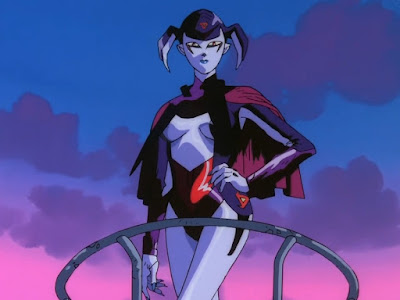
The actual production is solid, though this is a case where three directors and four screenwriters does evoke, even if not necessarily the issue here, of a title which lack a complete voice of one figure. There is Shō Aikawa among the screenwriters, once a notorious screenwriter of ultra-violent work who became a more acclaimed one, but there is also the consistent voice of Yasuomi Umetsu as one of the production's two character designers. Notorious for his work in hentai, and titles like Kite (1998) that could only be created originally under that genre, Umetsu is nonetheless well regarded for his craft and detail, and alongside Tomonori Kogawa as his co-character designer, you get a then-update to the franchise which is good and would have been spectacular to image with an expanded narrative which let the pair take the designs they had further. Even Luna's character design, despite my joke about her immaculate costume jarring against the world, is still memorable, alongside whoever (including other designers on the title) who decided to give the Buraiking Boss a Goth female robot henchwoman, looking like cyber harlequin in black eyeliner. (For obvious reasons as well, with its elaborate action scenes, the mecha designers and animators also deserve their credits for their hard work too). Working with Tatsunoko, the studio Artmic are a product of this era, with their last work in the late nineties. Their catalogue of films and straight-to-video work is a cornucopia of nineties and eighties anime aesthetics and tropes in a filmography, from Bubblegum Crisis (1987-1991) to Genocyber (1994), always collaborating with other studios on their projects.

All my issues are with the plot structure. The plot as it is mapped out makes perfect sense - setting up the world and Casshan, with the final conflict as played here between him and Buraiking Boss as well done as you could hope - but is more the sense we could have done with more story beats. There is teased more androids with the ability to control the ecosystem, living on an isolated island, who sadly never properly appear, and the middle of the production, episodes two and three, could have been have multiplied and increased into more tangents and depth to details like these figures, from episode three, or the main characters themselves. Casshan himself, alongside the limitations of his body, including requiring solar energy to power, has the additional primary crisis of whether he will lose consciousness and become a killing machine, whilst Luna, from the original series, has the conflict of needing to both help save humanity, but naturally concerned for the man she loved and hoping for the likelihood of him becoming Tetsuya Azuma again once the fight is over. There could have, in general, been more elaboration on the scenario, more emphasis on the human rebellion and the Buraiking Boss' forces, including a general sense of the grit and stakes at hand, especially with the uncomfortable idea leant into Buraiking's desire to replace humanity comes from his belief we humans will just destroy our planet, our failure to preserve it causing his existence to be. The slightness of some straight-to-video works has been a problem I have seen in quite a titles, and sadly this is a case, where everything here is perfect and could have been spectacular even as just a fun OVA, but we are just missing enough detail to nag.

Friday, 31 May 2024

#276: Venus Wars (1989)


Studio: Kugatsusha

Director: Yoshikazu Yasuhiko

Screenplay: Yoshikazu Yasuhiko and Yūichi Sasamoto

Based on a manga by Yoshikazu Yasuhiko

Voice Cast: Katsuhide Uekusa as Hiroki Senō, Eriko Hara as Susan Sommers, Gorō Naya as Gary, Hōchū Ohtsuka as Will Harris, Kaneto Shiozawa as Gen. Gerhard Donner, Shūichi Ikeda as Lt. Geoffrey Kurtz, Yūko Mizutani as Maggie (Margot Nakamoto), Yūko Sasaki as Miranda Cocker

Viewed in Japanese with English Subtitles


You’re more dangerous than the tank.

Until 2015, director/animator/manga author/character designer Yoshikazu Yasuhiko retired from animation after Venus Wars. For a long time, this was his last directorial work, an acclaimed figure who is important for numerous positions in the seventies and eighties era of anime, including his involvement for the original Mobile Suit Gundam TV series in 1979. Admittedly, weirdly, despite his directorial career being straight-to-video and theatrical films that would have been seen as easier to sell at a time when TV series were not, we in Britain never get his work with great ease beyond Venus Wars itself. I can proudly say, as evidence of this, my first viewing of Venus Wars, despite being truly of the DVD generation of anime fans of the 2000s, was a Manga Entertainment videotape found in a charity shop, viewed on my grandmother old VHS player, with the stickers and catalogue of their titles all intact inside the plastic case.

This is a case of a small narrative within larger science fiction world building, how in the past established in opening narrative, an ice asteroid hit the planet Venus, changing its atmosphere into one which could make the planet habitable by Earthlings. Unfortunately, whilst civilization has developed, and in a funny touch in a background detail, is a far flung future where the musical The Wiz is still popular and performed, the habit of humanity for war is still here, as the story itself is set between a civil war between those for Ishtar and those of Aphrodita. In a world tense enough that Earth reporter Susan Sommers is given a gun alongside her camera by her contact when she reaches the planet, she and a team of battlebike racers, a motley group of punks with our headstrong lead Hiro, will find themselves dragged into total war when the Aprodita city capital of Io is taken over by Ishtarian forces entirely.

The eighties’ last year, including the weight of eighties anime production, is seen in all its splendor here alongside the synth driven J-pop, a film whose view of war really, sadly, is still relevant as the leads are forced into the front line as bystanders, the beauties of the metropolis like the shopping mall not safe from the ravages of war, and gunfights break out in the streets as Ishtar take over Io but loyal civilians are fighting to regain control. There is some humour, even Andrew the cat, the pet of Hiro’s love interest Maggie who is always hungry, especially when she forgets to get him cat food, and tries to give him a raw fish and a slice of bread in his dish, but even that joke is set in the context of her having to get shopping in a place now with curfews by the invading leaders. This is very serious action sci-fi as the battle bike team, when they decide to blow up an Ishtarian tank for revenge for parking on their battle bike stadium, kick off their involvement in the rebellion against the occupying forces as a result of this decision. Barring their one female badass named Miranda, they are guys out of their depth in a real war even if the older mechanic they are helped by is smuggling real firearms in the midst of this, Hiro himself among them a brash hothead who is stuck in the midst of this with no sense of duty until he sees the full issue of his home city being taken over.


Alongside one homophobic bit, which is out of nowhere and leaves a sour taste to a solid film, the real issue many might have is Hiro may be unlikable. He is quite angry and hostile for the sake of it most of the film, an arrogant figure even when he is entirely out of his depth, and when Susan the reporter and the battle bike team step back in the narrative, he is the figure meant to be followed as he will end up in the rebel forces hiding in the desert, forced to serve against his will initially until he realizes the severity of the situation, including Maggie’s life under threat in Io which changes his mind. This is, whilst a film with a potent theme in itself, also a work emphasizing its action scenes, which means that the plot is very simple barring the small details. It does not really even have a true antagonist – one is set up, leading the Ishtar forces, but he is just a grunt in the wider war machine for their side, out of his luck as attempting to keep Io starts to be a struggle. He is close to even being caught entirely were it not for someone not knowing how to fire a handgun, so he is as human as everyone else in the proceedings.

There is one interesting, and very curious experimental touch, a scene of real recorded footage of a vehicle of a desert location, to represent a camera strapped to one of the sci-fi monobikes, which involves animated figures drawn on the images. It is an odd but stand out attempt at experimentation, but for the rest of this theatrical feature, Venus Wars is very solid, very accomplished animation. Considering this was original a manga by Yoshikazu Yasuhiko himself, there is a sense of him really caring for bringing out its story into the other medium fully, especially as this alongside the film Arion (1986) came from writing manga first which worked as pitches for the filmic productions themselves1. The composer, to really emphasis the production’s scale, is also Joe Hisaishi, who is already at this point working on the likes of My Neighbor Totoro (1988) and Beat Takashi Kitano’s first film when he contributes to this film. Most of the potential issues with Venus Wars is general is Hiro himself, and that feels befitting if you can expect this story idea of even a punk, one who is immature and not always someone you want to hang around with, having to grow up as he will when life is under threat. It is admittedly telling the studio behind the production, Kugatsusha, only made one other production with nothing else – also directed by Yoshikazu Yasuhiko, it was The Poem of Wind and Trees (1987), a yoai straight-to-video drama, adapting a culturally significant Keiko Takemiya manga from the seventies, about a romance between two students at an all-boys boarding school in late 19th-century France. With Venus Wars produced after, there is the telling sense that, whilst an admirable production, it took so much to make the studio stopped existing afterwards.

Yasuhiko is known for being quite self defeating on his work, despite his eighties directorial work being acclaimed in the modern day, with his belief that on Arion, a fantasy epic based on Greek mythology, was made by himself “in a half-dead state”. For a time in Japan, he even kept Venus Wars off from being physically released on the likes of DVD with a very down attitude to the production1. His retirement, instead focusing on a career as a manga author in the nineties, including works based on both the life of Joan of Arc and Jesus Christ, clearly came from a sense of burn out which looked to end a short directorial career were it not for returning in 2015 with Mobile Suit Gundam: The Origin (2015-2016) as chief director. Likely to be his last film will be Mobile Suit Gundam: Cucuruz Doan's Island (2022), but that is idiosyncratic as it is an adaptation of an infamous episode of the original Gundam animated series, one which needed to be outsourced with notorious animation issues, that Yoshikazu Yasuhiko felt had themes and a story worthy of a re-adaptation. That in itself tells a lot of his attitude to his work, and whilst Venus Wars is not perfect, I already see a strong figure in Yasuhiko who has to be admired for his craft.


======

1) Interview with Yoshikazu Yasuhiko on Gundam: The Origin (Animage, June 2015/Vol. 444). Originally printed in The June 2015 issue of Animage. Translated into English translated by Hyun Park and published on Wave Motion Cannon on January 31st 2017.

Saturday, 25 May 2024

#275: Dominion Tank Police (1988-1989)


Studio: Agent 21 and Toshiba Eizo Soft

Director: Kōichi Mashimo

Screenplay: Kōichi Mashimo

Based on the manga by Masamune Shirow

Voice Cast: Hiromi Tsuru/Toni Barry as Leona Ozaki, Masaaki Ohkura/Steve Graf as Al, Ichirō Nagai as The Chief/Jesse Vogel, Jouji Yanami/Marc Smith as Buaku, Kōji Totani/John Bull as Mohican, Michie Tomizawa/Alison Dowling as Unipuma, Yūko Mita/Alison Dowling as Annapuma, Takkō Ishimori/Peter Whitman as Father (Chaplain), Yūsaku Yara/Sean Barrett as Brenten

Viewed in English Dub


Most will know Masamune Shirow for Ghost in the Shell, his 1989 manga which gained even further traction when the animation adaptations, in a variety of tones, started from Mamoru Oshii's 1995 theatrical film. Appleseed, his 1984 manga, had a few adaptations over the years as well. Dominion, alongside the fact that the original manga surprisingly only has one single volume in the end, completed over a year from 1985 to 86, and a few additional stories written after that time, may have been sadly become marginalised in his career. This is a shame as for this adaptation, this takes the route of a more overtly humorous but still dystopian science fiction work in his career. It may have not aged well for making jokes about police brutality, as this opens with the tank police comically having a suspect on a chair with a live grenade in his mouth for information and slapstick, but that feels like a deliberately absurd sense of humour which has unfortunately seen the decades after make it less comfortable. What has still stayed timeless, unfortunately but with weightier relevance, is the setting of Newport, Japan, where the environment for the entire world has collapsed, causing the atmosphere to become toxic until civilisation adaptive a natural resistance, and the police have been forced to have an entire division with military tanks to deal with the crime rates.

Despite the tone, including an extended gag (literally) of inflatable phallus being used as a police deterrent, the context for Dominion's setting, the severity against the humour, is one of the most interesting things here out of the gate, which is apt for how Ghost in the Shell, in its own variety of tones, had a lot to work with through its own interpretation of heavy science fiction themes. The atmosphere is decimated, leaving the air outside is toxic, as public service announcements warn of even if everyone has a resistance when the clouds roll in. Even if the first two episodes have a clear sense of humour, that its McGuffin is that a group are trying to steal urine samples from "healthy" people, the context is still salient and meaningful even in a more cartoonish presentation like a good sci-fi story should be able to, especially as the samples were taken from are those without the resistance of the toxic atmosphere but the physical health from a time before.

That your sympathetic heroes are the tank police, who stick said live grenades into suspects' mouths during interrogations, or set up spin the wheel game shows with them with throwing knives, is a sense of dark humour and a sense this is a Japanese production taking a gleeful humour to the trope of on-the-edge police. From director-screenwriter Kōichi Mashimo, it is in a context of depicting a form of police that is deliberately absurd, rather than realising how history would go after 1988 in the West particularly, and that makes this a lot bleaker humoured even if these particular officers are actually likable. Into this is our female protagonist Leona, a former motorbike officer who is transferred over to the group, initially viewed with hostility by their headstrong head Brenten. Another younger male member Al develops a crush on her, and despite the incident that sends their captain's beloved tank to the scrap yard in the sky during training, from its scrap metal comes Bonaparte, a mini-tank who is clearly a predecessor to the Tachikoma tanks from Ghost in the Shell, as cute military weaponry, that Leona can use with greater ease with the advantages of being a squat and faster vehicle in the team that suits her driving skills.


Whilst this straight-to-video production will get more serious with heftier themes, Dominion is a comedy at heart. It feels like the prologue to what should have been a longer franchise that could stretch this inherently fascinating premise further - New Dominion Tank Police comes in 1993-4, but sadly Tank Police Team TANK S.W.A.T. 01 (2006) by Romanov Higa, a one-off with 3D character designs, faded into obscurity and was clearly not well received, with no other adaptations beyond this let alone actual manga pages written. A shame, as the juggling of heavier themes with humour makes a good change, where despite all the property damage, including legendary pieces of art and historical artefacts in the second half, it is played with a madcap tone exemplified by the sympathetic antagonists, Buaku who is revealed as an artificially created android, and the two women who became the poster cat girls for this entire franchise, literally as they are superhuman anthropomorphic cat girls, Unipuma and Annapuma, who help cause mischief and mayhem. Buaku himself does get a weightier back story involving a portrait which used him as a subject which had more to it than others may know, but they still are part of the humorous tone. Even the English dub, which glibly steers the dialogue into more broad humour, and obsessed with the human urine subplot as an excuse to use the word "piss", is really fun even when it clearly breaks from the script. Whether it is letting the actress Alison Dowling behind the cat girls play with Jane Austin era English accents for a joke parodying Austin era stereotypes, or Peter Whitman as the Christian chaplain officer who talks of Christian forgiveness but is gleeful for mayhem, the British made Manga Entertainment dub, unlike some others which are funny for the wrong reasons, still shines.

The first act really works setting up the tone, dealing with Leona's first days and first encounters with who is being sent to get urine samples, something whose plot is ever fully explained, either as a joke or that there was an ongoing plot with the mafia group wishing them which never came to be. It does not take itself seriously, such as those aforementioned phallic police deterrents, or the complete disregard for property damage even if, in another context, the jokes about severe police tactics and arguing with the female major, clearly inspired from the American action films from the eighties being exaggerated here, would have aged badly now without that context. The last two episodes get more serious, with Buaku's back story and him teaming up with Leona when a suspicious private mercenary force get involved, which allows the world to get new layers. The juxtaposition is helped greater by the aesthetic of the era; we are nearing the end of the eighties and a golden era for hand drawn anime just from the mechanical designs in this production, but also in terms of this being a comedy sci-fi still set within a grungy metropolis which fully embraced the type of sci-fi which lead to cyberpunk. This is a comedy which is still set in a place you would not normally have for a location for this type of story, the rundown nature of the futurescape noticeable in that, for all its luxurious streets, it is barely functioning with its crime rates and poisoned landscape.

Strangely the first Dominion adaptation is split between two production companies, neither with large filmographies at all. Toshiba Eizo Soft was mostly a distributor, only doing production on this or two pieces of a horror anime long forgotten despite the manga being well regarded, called Karura Mau, an enticing one of young female shaman dealing with supernatural forces, beginning with feature length story, and then followed by a six part straight-to-video series. Agent 21, who worked on these titles too, were producing more mostly straight to video work, including hentai, some action, and Dirty Pair: Flight 005 Conspiracy (1990) for that legendary franchise, as well as infamously Dark Cat (1991), a horror anime that is not well regarded. Judging from the time periods of their collecting, tiny filmographies, all their titles come from that golden age of eighties anime and the straight-to-video boom for the medium, with the sense that as time went on they could not last. This is not to mention the end of the eighties Japanese bubble economy expansion that allowed straight-to-video culture to flourish, including live action genre films, collapsed into the early nineties, and whilst studios could survive into the new decades, and straight-to-video work was still alive and healthy up to the Millennium, I suspect these two studios were casualties to the market. Director-writer Kōichi Mashimo however was able to keep going, even founding the studio Bee Train, with his career including a series of television action series with female protagonists capable in gun shootouts like Noir (2001), the first of these. Whilst he had not really directed much into the 2010s, effectively retiring with Bee Train not creating any more productions when he stopped, he had a prolonged career from the seventies over a good few decades that outlasted the studios behind this production.

The set up for a wider world thankfully comes in New Dominion Tank Police, but already I get the sense this franchise could have been expanded further from the premise, which I think is a positive compliment to Dominion. Arguably one of the bigger reasons Dominion is obscurer now, alongside how significant Ghost in the Shell became in the West over other Masamune Shirow titles expect Appleseed, both in its animated adaptations but the original manga being a staple of the manga section of bookstores, is that this animated adaptation has not really being readily available. Lost to the online rips, and the Maiden Japan DVD release of the sequel long out of print in the USA, it is disappointing with the virtues it has that Dominion itself is not as readily available when it is very digestible and memorable.

Monday, 8 April 2024

#274: The Big O (1999–2003)


Studio: Sunrise

Director: Kazuyoshi Katayama

Screenplay: Chiaki J. Konaka, Keiichi Hasegawa, Masanao Akahoshi and Shin Yoshida

Voice Cast: Mitsuru Miyamoto as Roger Smith, Akiko Yajima as R. Dorothy Wayneright, Motomu Kiyokawa as Norman Burg, Tesshō Genda as Dan Dastun, Unshō Ishizuka as Alex Rosewater, Emi Shinohara as Angel, Gorō Naya as Gordon Rosewater, Hōchū Ohtsuka as Beck Gold, Katsunosuke Hori as Michael Seebach / Schwarzwald, Issei Futamata as Alan Gabriel (Season Two)

Viewed in Japanese with English Subtitles


The Big O begins with Batman. The animation studio Sunrise was commissioned to help on the legendary Batman: The Animated Series (1992-5), and in the creation of The Big O, you have a work paying tribute to this and Western popular culture like film noir films. They were also clearly inspired by older manga and anime such as Mitsuteru Yokoyama's Giant Robo, which is important as director Kazuyoshi Katayama and others on this series worked on Giant Robo: The Day the Earth Stood Still (1992-8), an straight-to-video production which adapted the source manga but also a tribute to Yokoyama's other manga, including characters from even period tales being placed into this sci-fi narrative. The final show inspired from these two sides of influence in The Big O however could have ended up a different way though. It was also a series which managed the near impossible, of how it was not actually a success in its first season in Japanese broadcast, to the point it was cancelled, but was able to continue and finish the narrative for a second series because of its importation to the West and success on Cartoon Network’s Toonami slot on television, commissioning the second series when it did well and the abrupt end the first season came to be.

The Big O is set in Paradigm City, where forty years earlier a cataclysm left it seemingly the last city, part protected in domes and everyone forgetting memories of the past. Enough survived for a proper urban civilization to still function, and latent memories still allow figures to operate even giant robots. One such figure is the Bruce Wayne of this world, Roger Smith a former member of the military police who is now a “negotiator”, a cross between what you would expect for the title and a detective. Good at his job but with eccentricities, like everyone working for him having to wear black and refusing to use a gun on the job, he also has latent memories that gave him access to the titular O, a member of multiple “megadeus“, a giant robot clearly inspired by the comic character Popeye in the piston arms as much as a tribute to the likes of Giant Robo and Tetsujin 28, especially as like those robots, Smith uses a wristwatch communicator to bring him when needed to his location.

His Alfred the butler is Norman, who is also a cool butler, with a clear military history, and calm enough to be cooking dinner whenever Roger is on the job knowing his boss will return at the right time for a fight to enjoy it. The best side character though has to be Dorothy Wainwright, and that is in mind this is one of the strongest casts in general for an anime series, so that is a high bar. Her full name is R. Dorothy Wainwright, and that is explicitly referencing how Isaac Asimov, the legendary sci-fi author, had androids name themselves, as she is one of the few androids in the cast, though explicitly the one who looks entirely human and seemingly is. The show, among tropes it explores, includes how these figures are so close in seemingly having freewill, such as her deadpan rebuttals of Roger’s moments of heroics, that they bleed the lines of what consciousness. She is also just an awesome female character to have, with the amount of times she is threatened with being hacked or destroyed in the series meaning a lot more because she is a perfect foil to a great lead, introduced over the two part first episodes for the show. The English dub for this series is as well regarded as the Japanese one, but I have to confess as much the virtue for this character is Akiko Yajima's robotic yet almost human sense of bluntness, making the fact her most prolific voice acting role funny in a great way, being Shinnosuke "Shin-chan" Nohara, the lead of the hugely popular Crayon Shin-chan franchise. Whilst bowing out as the lead voice for the character eventually, the fact this is the same actress who played a sarcastic and scatological obsessed five year old boy from the first anime adaptations in 1992 to 2018 is evidence of the talent of a lot of voice actors and actresses in their diverseness.

That cast is one of the best aspects of the show, even when I will admit there are some visible pacing issues in the plot that will be addressed later in this review. Office Dastun, who knew Roger Smith in the military police force and stayed friends, is a great side character who has a lot of angst to also work with, as the military police he is part of, the closest to enforcement, is under the pocket of the shady group who run Paradigm City, and are powerless when they need to constantly bring in Smith and The Big O to deal with threats they cannot even with tanks and military weaponry.  Antagonists are the same: Alex Rosewater is perfect as the sinister head of Paradigm City, given more by the second series as he collects fallen foes of Smith’s, resurrecting the robots and unlocking their memories for nefarious means. Beck Gold, who looks like a parody of Lupin the 3rd, is a lovable git even if his constant crimes and smugness definitely makes him a villain, and thankfully he gets a few episodes for himself, including a parody of Japanese super robots, and even stays by the end of series two when you would presume he would stay merely a tertiary figure. Then there are the more ambiguous figures. One, the femme fatale for Roger Smith named Angel, will become a much more complex character, seemingly a “foreigner” in a world without other countries, by the end an integral part to the complicated twists that key screenwriter Chiaki J. Konaka set up. The other is the one character who should have had more time devoted to him, though thankfully in a form he gets to the ending of his goals: that will be a former journalist who became Schwarzwald, seemingly a villain in his mission to cause mayhem but, standing out for his bandaged visage, he is a figure who will use any means to learn the truth of Paradigm City and open the public’s eyes to the reality of the world. He emphasizes how, from the get-go for all the episodic stories, the huge concern in the series' narrative is how this amnesiac city came to be and what is the truth of its origins, which Schwarzwald is obsessed with learning.


Schwarzwald‘s smaller role does present the issues with The Big O, that whilst it leads to a proper conclusion, and that I already view this as a gem from the era it was made, it suffered in terms of pacing itself out and telling said story. When I first saw the series, it was only season one I had access to, which has episodic stories I now enjoy more but were clearly the backdrop for a larger story already being drip fed. Infamously, when cancelled and seemingly gone for good, the first series ended on an abrupt “To Be Continue” moment without any chance for anything to be explained. Sadly when I first saw this, the Bandai DVD releases in the mid-2000s in Britain, through their Beez Entertainment arm in Europe, never released the second series, leaving this with some disappointment. Thankfully we did get that second series in the first place even if it never had a UK physical release, one I have now seen and was able to finally complete the story as supposed to be told, all because of this being one of those cases, in its form getting good ratings on Cartoon Network, where a Western company invested in the franchise seeing potential for more.

Set up in the final episode of season one, where Roger locates Rosewater's father, the founder of the city now going senile on a tomato farm in the countryside, and finds repressed memories are starting to cause him to question his position, it sets up Season Two where Chiaki J. Konaka wrote all the stories, rather than season one where three others contributed stories too. It however also leads to a conclusion itself which did not allow itself to breath, and all of this is entirely due to the final episode feeling rushed. The irony is not lost that, for a series I will praise to the high heavens for so much, the one caveat I have to make is that the final reveal, just the last ten or so minutes of the final episode, is likely to peeve or confuse a few people, and I say this as a person who likes and would normally defend the more unconventional and vague story reveals found in Konaka's other work, where they feel deliberate and not abrupt as here. Some may find the second series too esoteric when a more pulpy narrative twist would make sense, but for me, it is the case that everything works in logic, but that this literally rushed the final moments for what is a very existential story. [Huge Spoiler] That being that this literally all a stage, all an artificial construct but having gained existence and wanting to still exist [Spoilers End]. Thankfully so much works up to the middle of the last episode that means the ending does not ruin the show. So much before is set up well that it thankfully does not become a crushing disappointment for a show with a lot on its mind, merely one you are going to need to stop after finishing the series and digest carefully. Even by those last episodes a lot is already set up to the show's create to expose the real story, this being not a world of amnesia, people being killed for returning memories at one point, but that there is also by the end people who find their memories are being recreated on stages, and that Angel herself becomes far more important as mentioned to how the world works without realizing it. It is really a case that, for someone who even enjoyed Konaka's more vague endings for work like Malice @Doll (2001) that an exposition dump or a more visually explained conclusion for the last episode was really needed.

Thankfully so much did work, and that includes the plot build ups and the one-off stories. Stories of Dorothy adopting a cat in Season One, with its bittersweet end, or the abrupt Christmas episode involving a demon tree now stand out more for when they are connected to a story which, barring that final lack of clarity, get so much right. Even when Konaka took over the scripts for season two fully, he has his moments. to the season, Smith so unconfident his existential crisis literally throws him into an alternative reality of Paradigm City as a homeless man, is inspired as the Japanese robot parody is, the later more so for becoming as a work from a Japanese animation studio a parody of Japanese archetypes. Even plot growth works, between the growing involving of a splinter group of foreigners Angel is connected to, or the ways this can combine the episodic stories with this, such as a threat against all androids with memories like Dorothy which allows a story involving one android detective being brought in as an awkward buddy cop partner with Dastun.

It is a world too with so much rich detail that you do get some proper denouement over the second series, as Rosewater becomes more megalomaniacal and wanting to become God, and the sides clashing over it becoming more prominent, also introducing a season two only character, Alan Gabriel, as a suitably nasty sociopath on his side. It is also helped by the style being incredible through the two series. Inspired by Western works, and very clearly inspired by Batman in the Art Deco style let alone the character designs, it is a sumptuous looking series both visually and audibly, mixing its metropolis location and combining it by a jazz heavy score by Toshihiko Sahashi. Also of note for his own musical compositions is Rui Nagai, though his work sadly had to be re-dubbed over due to how heavily it paid tribute to other music. For the first broadcasts, season two used a piece indebted to British 1970 sci-fi series UFO's own theme, which was replaced quickly. Sadly that even included season one's awesome opening theme, which was on the DVD release I had, a Queen tribute specifically indebted to their song Flash for the 1980s Flash Gordon film, also eventually axed. Thankfully, Rui Nagai composed Big-O! Show Must Go On, as a replacement to both, which is awesome in its own way as a surf riff guitar song with a bad ass solo.

As a giant robot show as well, all this provides a distinct attitude for a title in the genre, especially as the aesthetic style is distinct. Batman and film noir are very distinct touches for a mecha show to have, feeling close to what Tim Burton brought to the Batman franchise with the 1989 film, which influenced the Batman animated series. Even its tribute to its own country's mecha stories is distinct though, as this also a world where these robots feel like giant tanks slowly lunging about, and where alongside its distinct “typewriter-punk” mechanics has details like how the robot punches are literally piston powered. Thankfully The Big O, despite not being a success for the first Japanese broadcasts, had its day in the sun eventually, with tie-ins like an audio drama, inclusion in the Super Robot Wars video game franchise with other cult mecha anime, and a lot of models/figures both for the Big O himself and its cast. It is a franchise I wish was better known in the United Kingdom, as nothing in this barring its final ten minutes rushing too fast would ever be challenged as being divisive. After my initial disappointment with the first series a long time ago, seen in its full form it is with positivity that they could have continued the story a little longer and avoided ever making a bad episode, still getting to the eventual final with everything as good as it was. If anything, this is the kind of show you introduce to someone curious about giant robot anime, and they could be made fans of the genre just from what this does differently whilst paying tribute to the genre's tropes, which is as high praise as I could write for this.

Wednesday, 3 January 2024

#273: Cyber City Oedo 808 (1990–1991)


Studio: Madhouse

Director: Yoshiaki Kawajiri

Screenplay: Akinori Endo

Voice Cast: Hiroya Ishimaru as Shunsuke Sengoku, Kaneto Shiozawa as Merrill "Benten" Yanagawa, Tesshō Genda as Rikiya "Goggles" Gabimaru, Emi Shinohara as Remi Masuda, Kyousei Tsukui as Versus, Mitsuko Horie as Kyōko "Okyō" Jōnouchi, Norio Wakamoto as Juzo Hasegawa

Viewed in Japanese with English Subtitles


Madhouse would have success with Wicked City in 1987, one of their more infamous titles which helped when its director Yoshiaki Kawajiri pushed for a theatrical release and it paid dividends for the studio1. That was however an adaptation, based on the work of author Hideyuki Kikuchi, and with Cyber City Oedo, Madhouse and Kawajiri decided to create their own original intellectual property, one which was meant to be a multimedia one. This came to be true as there was a video game, the 1991 game for the PC-Engine CD-ROM², and a novel1. Cyber City itself, made for the straight to video format, was only to last for three forty plus minute episodes, never leading to anything further, but still became a cult anime in the decades after, even if by way of alternative dubs and music tracks being created for the images as we will get into.

Oedo is a cyberpunk tale where, with criminal sentences possible to reach longer than the average human lifespan, prisoners are forced to live in the orbit of space, presumably in a way to extend their lives to suffer for their cybercrimes. Three prisoners housed in an orbital prison are offered an alternative by Juzo Hasegawa, a police chief, that they can reduce their life sentences for each criminal they bring in, with each having to ability to return with life on Earth but with explosive neck collars permanently on that, able to be timed, prevents any prisoner to take this offer to flee once they are back in public. This explicitly nods to period chambara tropes places in the future as "Oedo" is likely a reference to "Edo", the original name for Tokyo, whilst in Japanese history, the weapon they are all assigned, jitte, if a science fiction version of a weapon, with sai-like blunt ends, that was used by police in Edo-period Japan. Beyond this, the straight to video series is a hyper-exaggerated world, where in episode one, the main location is a space-scraper, a skyscraper so comically impractical in height, now in orbit at the top, that if the central threat managed to disable the gyroscope fully and cause it to fall, it would have led to a natural disaster of cataclysmic proportions. This has a variety of tropes and clichés of this type of “cyberpunk” of androids, cyborgs with psychic powers, and one of our leads having monomolecular wire, a concept the likes of author William Gibson, a huge figure in cyberpunk fiction, among other writers were obsessed with where you have weaponised wire so sharp on a molecular level that it could cut through anything, even through the neck of a cyber enhanced saber-toothed tiger. The leads, interconnecting as regular characters, however do get the starring role each for the three episodes, Shunsuke Sengoku the lead for episode one in the space-scraper. Sengoku is your typical hothead, who is heroic as an anti-hero figure but also anti-authoritarian, with a love-hate relationship with Juzo and especially against the sentient computer that occupancies them. This computer is arguably the fourth lead and deserving it, as the deadpan retorts in the Japanese dub are very funny, all from the perspective as an AI which cannot understand some of the insults thrown at it, such as when it has to explain how, with an internal geo-map system, it cannot possibly “get lost” on command. For episode one, with Sengoku and his constant argument with this robot, you get a great first episode to begin this work, where the serious tone in spite of how absurd this is in truth works fully.


Rikiya "Goggles" Gabimaru stands out as a character that would rarely get to be a lead in an anime, an older man if with a Mohawk, the more conventional of the noble anti-heroes despite his visual look.  His is the type of macho melodrama, which is secretly sentimental and melancholic if filtered through acion tropes, encountering an old partner of crime who was also his old flame, involved in a conspiracy involving the corrupt military project of psychic robots. The owner of the monomolecular wire, and lead of the third episode, is Merrill "Benten" Yanagawa. Benten inherently stands out of the cast as, among very distinct characters in the history of anime, even minor ones, you have here an ultra androgynous final lead, a really distinct figure who is probably the most iconic for the whole production, bringing up a combination of glam rock feminization, with red lipstick and hyper feminine features, with kabuki aesthetic and a shock white mullet, aged in designed but entirely timeless. His episode also is the most idiosyncratic even in a very stylish and creative production, in that this brings horror tropes into science fiction with artificially created vampires. The result of this brings a gothic and moody sensibility to the proceedings with the first ounces even of tragedy to the production, as it involves a woman cryogenically preserved doomed in this life forced onto her by another, as it ups the gore in imagining an undead individual being driven out an airlock in space. It is this episode particularly where the show's ability to be serious despite also being ridiculous shows the virtue of this tightrope act, intentionally and unintentionally.

It is a ridiculous anime in a good way, where we are dealing with a premise where there is never a moment stopping to question its own logic or feeling contrived in a way that undercuts faith in the material. Cybernetic saber tooth tigers is a high watermark in the absurd, as mentioned earlier in the review, but found in episode three, this takes it further with them kept in a cryogenic hub in tubs among three hundred year old patients, a place in outer space connected to a hospital by a space elevator, and armed with lasers, with the anime managing to add more flourishes to these sort of moments. This is throughout each episode with all these "questionable" moments becoming highlights alongside the tone and style of the work winning you over. The seriousness of the production helps, feeling like the delirium usually found in a video game from this time, and helping this is how this is Madhouse at their highest of quality. Yoshiaki Kawajiri is an insanely talented figure in anime, even when he is in the animation department after his directorial career seemingly ended into the 2010s, but as much of the virtues is the entire staff too, where your mechanical animation director for an example is Takeshi Koike, the future director of Redline (2009), one of the most underrated theatrical anime in need of greater attention and showing where his work here before came from.

The audio is its own curious history for the OVA. I watched this in the original Japanese version, but the history needs to be marked how, whilst Manga Entertainment bought the license with great interest, they took their own decisions which added more to the story beyond a good pulp anime. They were known infamously for "fifteening" their dubs already, where to increase the age rating with the British film classification for all physical home releases, they added swearing into the dialogue alongside adding their own flourishes. This is an idiosyncratic production however in that they went further in changing the music track. I like the moody synth provided by composer Kazz Toyama, but if you are talking of Cyber City Oedo, specifically to its British release as the Central Park Media/U.S. Manga Corps release decided to not go forwards with this choice in the United States, you have to talk about this version as it is part of the legacy in the West. Rory McFarlane's contribution, combining hard rock, thrash metal and synth, even influenced by Mountain's Nantucket Sleighride (to Owen Coffin)1, is a distinct score to hear, and thus it is worth talking about too as a highlight even heard in snippets. For Kawajiri himself, this is getting into the golden period of his career between the late eighties to the 2000s, one where you see here that, for all his notoriety with certain titles for their transgression, what his trademark was, whether the screenwriter of the story or not as in this case, his trademark where these kinetic stories of larger than life figures, in larger than life scenarios, which never for all their moments of absurdities feel entirely a high quality in grandeur for this era of pulp anime storytelling. Even Ninja Scroll (1993), which shared in the more notorious content of his career, showed this and, in spite of the knowledge Cyber City Oedo was not the biggest hit as Manga Entertainment hoped for1, that would benefit from the virtues found here, in a period chambara tale, and gain even bigger status in Western anime pop culture among the other titles Kawajiri would helm.

=======

1) Taken from the documentary Inside Cyber City Oedo (2020), directed by Andy Hanley.