Sunday, 30 August 2020

#156: Please Tell Me! Galko-chan (2016)


Director: Keiichiro Kawaguchi

Screenplay: Keiichiro Kawaguchi

Based on a manga by Kenya Suzuki

Voice Cast: Azumi Waki as Galko; Minami Takahashi as Ojō; Miyu Tomita as Otako; Ayaka Suwa as Iinchō; Daisuke Ono as Supoo; Juri Kimura as Nikuko; Kaede Hondo as Yabana; Mamiko Noto as the Narrator; Shizuka Ishigami as Agemi; Takahiro Sakurai as Charao; Yoshitsugu Matsuoka as Otao; Yuko Iida as Okako; Yuna Yoshino as Ōji; Ai Kakuma as Metako

Viewed in Japanese with English Subtitles


You go, tampon professor!

Another micro series, twelve episodes long about seven minutes each, but Galko-chan is also a case of not judging a book by its cover. In this case, just one character, the titular Galko, in any other context would be a fan service figure for male viewers, a blonde high school girl drawn with an insanely pronounced bust. Jokes do deal with this - the first of the entire series involves her female okatu friend Otako demonstrating to her how the size of the areola is bigger in lieu to the breast by drawing a dot on a balloon and having her inflating it. Galko-chan the micro series, as has been documented by others, is actually a sweet comedy which goes completely against expectations.

Namely, that this is a positive show about the two characters and their other friend Ojō, dubbed an airhead by the female narrator but lovably earnest, with references to her being of a rich family and still very good in school. The three bond and converse about subjects rarely dealt with in high school anime, like having one's period, dealing with the purchase of sanitary towels, or perceptions of gender stereotypes, such as the fact Galko is called that because she is a "Gyaru". This is a subculture of woman in Japanese who were originally influenced by Western figures like Pamela Anderson, dying their hair blonde or at least embracing the sense of style and accessories of Western pop culture, an added baggage here that characters make presumptions Galko is very promiscuous or very sexually open too. In reality, she is sweet, at times nervous on said subject, with a bad habit of sleeping during class in the mornings, and having almost everything one could need in her bad for an emergency. She is a legitimately kind and charitable if she was to exist in real life. A lot of the humour in general is about subverting expectations in character archetypes beyond her too.

Also, without showing anything, even if it does censor certain words in the Japanese dub, this gets away with sex and toilet humour in very charming and funny ways, even one about the dangers of eating spicy food and that this will need a cushion to sit on the next day, even very explicit subject matter like the hymen and how horse riding would affect this intimate part of the body. The series is vignette based, all of the episodes having segments based on old wives' tales, or questions which almost evoke a sex education class or the gossip of teenagers in some of the queries. Some are spurn from Otako being a bit mean to Galko, exploiting her moments of naivety by evoking exaggerated ideas of the body to tease her, Ojō usually taking a while to grasp the ideas being talked of in her long gestating thoughts bubbles as well.

Mostly set at their school, with a few exceptions like the water park episode where Galko helps out a young boy, you slowly add more and more of the class students as the show progresses on. Most of the cast is female; these are side characters you do not get a lot of time with which is sad, such as a girl nicknamed "Sonic Meat" who, pleasantly, is a very large girl in weight who yet is exceptionally good at athletics. The characters I wished had more time onscreen are the outsiders, specifically as, with one of the most unexpected and funniest jokes for myself, the member of the trio who is drawn as the most stereotypical short and cute moe schoolgirl, wearing glasses, is briefly explaining to her friend, who is a significantly taller girl who slouches and acts like the stereotypical outsider who is in a band, the differences between death metal and black metal without us getting context for the conversation.

The male classmates are there, and it is specifically three we follow, three guys are neither cheap depictions, nor obnoxious figures we are meant to like, but depicted as they should be as figures in their teenager years that have raging hormones and do not know what to do with them. They speculate about Galko being with men romantically, such as when one notices she is wearing a men's shirt and imagines a boyfriend, but they for all their speculation and psychological tests secretly about one's sexual preferences are like the female classmates, likable and naive at times. Even with some of the more ludicrous jokes there is a charming absurdity, such as the nerdy member of the three acquiring a bread making kit because kneading bread is compared to a close approximation to Galko's breasts in a conversation between her and her friends, a sense of yes, lovesick teenagers could do something this ridiculous in real life and not just in anime.

As a micro-series, there is no real sense of progression beyond jokes and some emotional weight, such as the final episode is actually a prologue to the series of how everyone met. For its director-screenwriter-story boarder Keiichiro Kawaguchi, considering that the series was popular, this is great example of having a production which would have not been very elaborate to create, but managing to show his talents off with rewards reaped. It does not even get as experimental or strange as some of the other micro-series I have witnessed - though it does have a trademark of sound effects to signify anything from chattering to a person's scent which is done in text onscreen but also by a voice actress - but is solidly made and never once having a bad joke. A testament to the series is that I had knowledge of this series without realising it at the time of its release, as by pure coincidence I saw memes on Tumblr that copied whole gags, shown in captures images with subtitles, for their inspired or amused fans. Finally getting around to the series, it is amazing to have encountered such a frank comedy that also managed to be extremely sweet at the same time. This, as a micro-series, perfectly shows what you can do with this format.

Sunday, 9 August 2020

#155: Virtual Stars (2002)

A short film compilation

Viewed in Japanese with English Subtitles


I'm your magnet of love, and I'm here to serve you.

The following is a very idiosyncratic release from the early years of British anime DVDs, and a return to the Virtually Real releases, a group of DVD compilations that I first came across years ago for my anime reviews with Yuki Terai - Secrets (2000), a compilation of music videos and shorts that were both tech demos and also trying to sell a virtually animated female character as a figure of affection and sensuality. Off the bat, whilst this is usually something we are meant to end a review on as the point, these six short films (usually around five minutes each) evokes for me that in so much culture in general people have attempted to capture an idealised form of femininity. This is a problematic idea, rightly challenged over the years by feminism, but it is also inherently a failed cause too. Called "computer-generated femininity" on the British DVD blurb, the six female designs here are meant to be attractive, in the same way in the modern day you have eroticised female drawings and even otaku rejecting the "three dimensional woman" for the 2D one, hug pillows and all.

This compilation, with connection to Pony Canyon, a music/anime/videogame company who I have come across for the notorious failure The Lost Village (2016), is long forgotten. In its obsession, which stems from many, of the idealised woman, an ideal which is ancient and can go as far back as fertility statues, this compilation is fascinating when you step back and take it into consideration from how it is trying to attain this inherently doomed goal as well as a snapshot of old computer animation. A form that is not appreciated, I find looking at obsolete animation strangely pleasurable and unique, even in this case too where there are complications to also bare in mind.

Hikary - A Jellyfish Day begins this with the girl next door, the notion of the idealised version of the woman you as a (male) viewer could meet in the street, here a normal young woman who, in this music video sung in English, is in a Laundromat mopping the floor singing directly to camera. The uncanny valley effect is felt here1, but with the irony knowing this idealised figure was still created by real people for her to even exist. Both by motion capture of an actor, and a real female singer recording the song, as seen in behind the scenes footage in the end credits, the vibrancy of a human being is noticeable over the equivalent of a statue made from 1s and 0s. Created by "Yamag's Garage", Ryoko - In Japan is a vast contrast. A glamorous figure - first with silver hair, silver (very) mini-skirt and top, and silver boots just walking in a corridor of silvery shapes. This music video also includes text, speculating about virtues of beauty from a perspective of a simplistic masculine view which can be brought into question. The animation for all the shorts has aged, but what is fascinating is how, having to worm with new technology, the female character designs have to pull back on aesthetic due to the materials they are working, the complexity established in how the DVD includes making of shorts going into various aspects of digital animation. Unlike the appraisable creativity I have encountered in other anime at this time, even if you cast "Ryoko" in skimpy clothes you have to deal with the fact that she has been created at a time where the animators, in their hard work, had to even attempt to bring a figure to life let alone concern themselves about aesthetic.

Misty is another character who just walks, only she is brash and confident. This if anything is a time capsule to the nineties - nineties techno music on the soundtrack and a sequence of car driving which leads me to not be surprised if any of the animators, creating the scene of a sports car speeding along to camera, worked on a racing videogame. The moon is so ominous and close to the skyscrapers in the city locations I was expecting a horror aesthetic, and that there would be tidal disruptions across the globe as a result. Yukari - Run & Run just go directly for the T&A, a figure who is insanely busty, barely kept in an insanely skimpy sci-fi bikini with giant unnatural eyes and also goggles attached to her head garment. Running in space, the jiggle physics for her bountiful bust are ridiculous though also crude; it evoked whilst I was watching the short, since we are on videogames, the beat em up videogame franchise Dead or Alive which became notorious not only for a jiggle physics for the first game in 1996, but that they kept developing it as the sequels went along. (Sometime into the mid 2000s, with a spin beach volley ball game, it was impossible not to get past the cheesecake fan service even if the main games were well regarded). Naturally this is one of the longer shorts, one where the earlier test footage showed fewer saucer eyed figures and less concerns about how one runs in heeled boots. Objectification like this, the insane exaggeration of the female body, is something you find in anime in general, this case so blatant it is frankly absurd.

Out of all the shorts, the following is the one which actually has anything explicit but also an attempt at something creative, called Super Sonic Jet Girl. It frankly becomes like a Robert Rodriguez fever dream in digital form, a director who has skirted a fine line with his super strong female characters who can yet wear fetishishtic costumes. Set in a dark dungeon that goes to a demonic nightclub, where a giant demon with a snake phallus sits watching and a skeleton band plays, an exotic danger in skimpy underwear and covered in tattoos dances until she has to right off zombies, rather than restage the Michael Jackson Thriller music video. The tattoos are a surprise as even in hand drawn animation from the nineties and eighties, even for theatrical, it would have been a nightmare to draw any character with a vast snake on their back alongside the variety on this female character's body. The joke reference to Rodriguez, and films like From Dusk Till Dawn (1996), is not out of place as this involves her acquiring a samurai sword and well as twin pistols, someone on staff for this production predating the neo-grindhouse films by a considerable time. In fact the one adult detail of this entire compilation, which is likely why it got a fifteen certificate alongside the other content in this segment, is that it ends with this figure topless covered in gore on her chest returning to dancing, which is definitely a distinction in terms of an idealised figure, closer to the alt and goth model movements in the West like SuicideGirls. It is still objectifying but it is at least fun, clearly a production where people were enjoying themselves and thus the best thing here.

Aya - Chat returns to the idea of the girl next door, an even meeker form who wears a long skirt and jumper, beginning with a montage of telephone lines set over real locations. This music video is interesting as it has the CGI character of Aya set over real standard definition shot real footage of streets and environments. It can be awkward, like when she is placed on a swing, but it is a fascinating aesthetic touch. Openly, I enjoyed the experience of Virtual Stars but with mind of how strange and frankly superfluous this entire project is, where the extra shorts, more cruder animation but with more variety, were at times more dynamic. At three of these sets exist planned, CyberVenus Fei Fei (2001) the other I am aware of. They are materials likely to be lost to time, and with good reason as for their problematic gender issues and technical obsoletion, but they would be fascinating to preserve as they raise aloft a case of attempting the idealised female figure, creating her artificially than with even an actress, that is against the reality of the vastness of human personality and individuality but is something that can be argued is an obsession the likes of even high art, painting and literature, became obsessed with for aeons, still representations to prod and scrutinise.

It has not even become aged as an idea as, in June 2020, a sci-fi production was backed with a robot named Erica as a star, an artificially created actress with artificial intelligence. Playing a robot, and a creation of Japanese scientists Hiroshi Ishiguro and Kohei Ogawa, Erica does nonetheless alongside raise the issue of an idealised female image, especially as unintentionally the fact her creators were both men does raise the concern of objectification, rather than if Hiroshi Ishiguro's own android double he has was cast instead2. That is not even including the pop culture figure that is Hatsune Miku, a Vocaloid software voice bank developed by Crypton Future Media and its official anthropomorph, who has become a popular figure or those aforementioned otaku obsessed with drawings over real women. Far from a cultural item doomed to irrelevance, Virtual Stars ironically was a good signpost, though not a trendsetter, to ideas we would be tackling with decades later, those which raise plenty of issues on the notion of representation, alongside gender politics, but still stuck ahead of us to scrutinise.

=======

1) Robotics professor Masahiro Mori coined the term in 1970, as "bukimi no tani genshō", before the term was first translated as "uncanny valley" in the 1978 book Robots: Fact, Fiction, and Prediction, written by Jasia Reichardt. It does connect back to the notion of the "uncanny", first introduced by  Ernst Jentsch and elaborated upon by Sigmund Freud, the idea of the "strangely familiar" which can cause ill-ease, something found in the likes of dolls, waxworks, and with the uncanny valley, robots and even CGI figures.

2) Source HERE.

Monday, 3 August 2020

#153-4: Rei Rei / The Gigolo (1993)

Today we deal with an obscure double bill, two erotic OVAs both from 1993 that were released together as a DVD in the United Kingdom in the very era days of the DVD market. These types of titles are fascinating to deal with as, whether good or not, this is an entire history worthy of prodding with morbid curiosity, titles which came, few remember, disappear, but could be found by pure look in a second hand DVD store. In this case, this also means talking about a company Kiseki Films, a long obsolete company whose licences were distributed between the UK, Australia and New Zealand, and ended as a company, to some testimony, when it was bought out by the British company Revolution Films1. Titles they released included Black Magic M-66 (1987), Urotsukidoji III: The Return of the Overfiend (1992)...but also Gunbuster (1988-9), which means this is not the first time I have covered one of their licenses from the early days of the DVD era.

This however, as a double bill, are two very different titles both under sixty minutes each which few may know about, which to my surprise were not what I was expecting for good and for bad in-between them.

 *****

Rei Rei (1993)

Director: Yoshisuke Yamaguchi

Screenplay: Mitsuru Mochizuki

Voice Cast: Naoko Matsui as Kaguya; Katsuyo Endou as Satoshi's mother; Keaton Yamada as the Narrator; Kenichi Ogata as Pipi; Kumiko Nishihara as Mika; Miho Yoshida as Dr. Manami; Misa Watanabe as Tanaka (female); Mitsuaki Hoshino as Satoshi's father; Shinichiro Miki as Satoshi; Takehito Koyasu as Dr. Okabe; Wataru Takagi as Tanaka; Yuri Satou as Ikuko

Viewed in Japanese with English Subtitles


I've got two cherries for you to chew.

Rei Rei was the one I had the most interest in, and it is a compelling premise, but tragically this proved the most problematic of the duo. There are quite a few titles in anime about supernatural figures, or those who dabble in that realm, becoming involved with the lives of normal people, including for sexual issues, but this is curious as our protagonist is Kaguya, with her diminutive assisting in a fetching purple suit called Pipi, a princess from the Moon who helps mortals who are in crisis with love. She is explicitly, clearly, based on the Tale of the Bamboo Cutter, a 10th century piece of prose about a princess from the moon found as an infant in a egg, a legendary piece of Japanese folktale which was adapted countless times centuries later in anime and manga, including Isao Takahata's last project The Tale of the Princess Kaguya (2014).

That the two thirty minute episodes has issues is more annoying because I love this idea, about a literal magical being, a beauty of unearthly form, who has decided to help mortals whose souls cry out of lovesickness. The first episode initially suggests where tone is going to stay, and how this premise could be sustained as an erotic series but also effectively a form of anthology story formed around a central figure, that of a guy who tries to flirt with a girl he loves called Ikuko, only for her to reveal that she is dating an older female doctor. Unfortunately, we are taken to a deeply problematic tale in which the older woman is a bad person, actually dating a male doctor and purposely injecting raw egg into Ikuko, deceiving her into thinking that it is Vitamin C, to cause anaphylaxis. This is not the aspect of real issue, but that it is compromised by a heteronormative conclusion, that Ikuko has to renounce herself and fall in love with the male lead, a dweeb with a terrible tendency for nearly being hit by vehicles.

It hurts worse for me as I could vibe greatly with the eeriness that this episode had, even having my trope appears where people are whisked off to an alternative dream reality, usually a bridge of symbolic form they have to cross naked in this case. Considering the first episode, by itself, manages to have sensuality and a grace to it, it is sad that this interesting premise, with the art style contrasting urban Japan with a figure of pure fantasy, turns out is more conservative than its own premise is, including some gay panic humour found between episodes. If made a decade later, Rei Rei (also known as Rei Rei: The Sensual Evangelist) could have hopefully embraced a more progressive attitude, particularly as you would not need to change the protagonist in the slightest, a completely supernatural figure who who can be invisible unless she desires to and flies as an ethereal figure leaving behind purple dust. Even her dialogue is completely ethereal too in the first episode - A love lorn soul, a true heart, is calling out in pain - suggesting that even if you could have funded a more sexually explicit television, which do exist either censored or pay per view channels, you could have even made this character actually feminist and ran with a lot of more enlightened (and frankly sexier) content.

And this is stranger as there is a tantalising and subversive streak when Kaguya helps the male protagonist by turning him into a woman. Where it leads to is not exactly progressive, but it definitely touches upon something subversive - that he is going to seduce the male boyfriend of the older female doctor, which really brings about gender fluidity that the show runs the opposite way from immediately when they are in the bedroom down to their underwear. Also, whilst again not necessarily progressive either, the more rewarding ending would have clearly been this boy willing to be a woman for the rest of his life, proudly, for the woman he loves, literally dangled as a premise in front of him in a bag of magical dust. If that ending had transpired, I would have been a drastically different opinion of the OVA even if the second episode had been the same as it was.

This plot point definitely reveals to the weirder side of Rei Rei, which would have been more rewarding if so much of the show had not undercut itself. It also has a weirdness which is also perverse at times to, preparing the viewer for the second episode when about the female doctor has a nightmare about Ikuko entering her body, in a sensitive place which (tastefully but provocatively) is shown in a split second shot. It is a curious mix of a program with a greater aesthetic grace than this type of genre might necessarily have, with clearly a potential for both being bizarre but also having a sensual elegance, only to have the production hit the brakes. One, despite its pleasant comedic tone, which has to cater to heteronormative values and a plot even boring to a heterosexual male like myself in how much of a coward it turned out to be in not taking a risk.

The stranger side grows and runs rampant by episode two, which  is again about another male client, another unlikable bland male dweeb, which is something I have witnessed in other genres and continually ask of in terms of who would think such characters are interesting as male representatives in the first place. This one has an inability to be around the opposite sex without his heart racing; it is a condition so bad he can suffer from sudden collapses where he goes unconscious to the point it can look like he is death, with a comically grimace on his face. This turns into a series of vignettes, with Kaguya now becoming much less serious as a character and a lot more cartoonish, such as when his id and soul are trapped in a "Bentendo" video game which she has to get him out of it. It promises something wonderful, with a world of eye craters and tongues in clouds, only to bring out tentacles for a joke that is thankfully skipped over.

This is however also the episode where Kaguya lets him becomes his girlfriend's bathwater, which is exceptionally bizarre...except that sadly gets to Kaguya letting him become invisible like mist in the shower to her, which he with some morals even questions when she recommends feeling her up to become more comfortable with her desires. The OVA never went beyond these two episodes, which was probably for the best as, tragically, this good premise worthy of a remake was already compromised. Even if it manages a plot threat I had never considered seeing - sexual breast feeding to exorcise his emotional pain from his mother abandoning him and his father - it is more as a peculiar oddity from the nineties than a show that I thought could have actually been good. If it had lasted, we would have gotten this as it stands, which would not be fun even if like car crash television at points. All the good virtues are squandered with what clearly was a show running on fumes and unenlightened ideas for good erotic stories, strange aspects otherwise.

*****

The Gigolo (1993)

a.k.a. The Gigolo - Dochinpira

Director: Hiromitsu Ōta

Screenplay: Wataru Amano

Voice Cast: Kōichi Yamadera as Jin Kaitō; Masako Katsuki as Ai Mizushima; Naoko Matsui as Ranko; Daisuke Gouri as Hazukura Boss; Hideyuki Umezu as Hazakura Yakuza; Hiromi Yokota as Body Conscious Girl; Kaoru Shimamura as Okamoto; Kenyuu Horiuchi as Suzuhata

Viewed in English Dub


They're real bullets!

So surprisingly what I considered the trashier of the double bill, which I doubt really was even hentai but just an erotic title, turned out to be a more enjoyable experience. Simply because I expected a censored, junky hentai about a male gigolo, with an insanely deep voiced male voice actor in the English dub2, only to get a c-grade pulp pulp tale which was nonetheless entertaining, a crime narrative where a gigolo finds himself crossing paths between the mafia (yakuza), and a female hit woman out for revenge for her family being killed during an assassination attempt at a restaurant when she was just a child.

Resplendently scored to guitar riffs, this lurid macho storytelling has ebbed away for the most part from anime into the modern day, at least in terms of those found in OVAs we got over in the West sold for their violence and sex, whilst there are likely titles still in existence which tackle this tone in different ways and institutions like the Fist of the North Star franchise still get adaptations but also self referential official parodies. The Giggolo is much more subdued take on, say, the Crying Freeman OVAs, with less of the open absurdities, or an erotic version of the more explicit action melodramas of the OVA era, although this is more tasteful in context and content then I had even considered.


Here a young guy out of his element is only a stereotype of being macho due to all the sex he has, because of his ability to seduce women for work, and having a female roommate happily letting him stay and being proto-friends with benefits. Even then, he gets his head kicked in by thugs until the woman he is with pulls a gun out, and never really is the decisive factor in any for the conflicts, just able to help. He encounters a sado-masochistic client, when it's too late to pull out from the client, who likes her whips and hot wax, and the hit woman even if she feels she has "become a woman" with him is still the one out for revenge, wagering a Cobra sports car for him to win if he can be the first male to actually being good in bed. If it not feminist in the slightest, but is surprisingly more interesting in the gender context because your lead, from his initial introduction as a cool lothario, has this veneer chipped away as the plot continues.

Yes, The Gigolo is still lurid, but considering its double bill title Rei Rei on the same British DVD disc, this tacky and less well made production was actually more defendable as it was also ridiculous. It is sexually explicit, but it deviates fully into its crime drama by the end, much more interested in fully committing to being a melodrama for men, of tears of screaming passion and a sports car full of flowers pushed into the sea like a Viking funeral. The pair does raise the issue of how one tries to write a story with sex as a prominent aspect, espcially as Wataru Amano made their career with titles in hentai like Demon Beast Invasion (1990) and Venus 5 (1994), the later a pornographic parody of the Sailor Moon franchise. Both of the titles I have covered are completely alien to each other in tone and presentation, and both of them offer some curious aspects to consider in terms of how sex is depicted for better and for worse.

Stepping back to these titles by themselves, they are a fascinating pair of oddities. As I am able to dig back and find these titles, I find amusement even in the fact that, as the one person still using a DVD rental service, I am likely the first person in a decade (if anyone at all) who requested this double bill DVD to be posted to me. A title from as far back that you can legitimately fear about laser rot, that sense of investigation in it is entertaining to the point it compensates for the disappointments I did have alongside the unexpected surprises I did have.

==========

1) We have to rely on Wikipedia for that detail, so take the fact with a pinch of salt. 

2) The English is ridiculous, with additional swearing, but especially as the male voice lead (who I thought I recognised but could not tell who) is so deep voiced to a youthful lead it added a level of absurdity to the production.

Thursday, 30 July 2020

#152: Hanebado! (2018)

Director: Shinpei Ezaki

Series Composition: Taku Kishimoto

Based on a manga by Kōsuke Hamada

Voice Cast: Hitomi Ohwada as Ayano Hanesaki; Miyuri Shimabukuro as Nagisa Aragaki; Ai Kayano as Yuika Shiwahime; Arisa Sakuraba as Nozomi Ishizawa; Asami Shimoda as Kaoruko Serigaya; Konomi Kohara as Erena Fujisawa; Mariya Ise as Conny Christensen; Mikako Komatsu as Miyako Tarōmaru; Nobuhiko Okamoto as Kentarō Tachibana; Sayaka Ohara as Uchika Hanesaki; Yuuna Mimura as Riko Izumi

Viewed in Japanese with Subtitles


With this, I begin my first foray into sports anime, a genre I had never really dived into at all until now. Sports shows in Japanese animation are numerous, and with cases like Star of the Giants (1968-71), a baseball series, they are important parts of the medium which have been neglected as in that particular case, that was a major mainstream success but has never been a title talked of in the West. In the West, few if any were imported into the United Kingdom, whilst they were never really financial successes for DVD runs in the United States. Now streaming exists this has opened the doors for them, and a title like Yuri on Ice (2016)¸ an ice skating series that also happened to be an LGBT drama, which managed to even gain recognition from professional ice skaters and be a cross-over hit, has helped considerably. I can see how sports titles can be sold to a Western audience, particularly now we do not have single disc releases of a couple of episodes like in the 2000s, but streaming and box sets.

Note the word "drama". That is the secret little detail, and that is where I am enticed now by this genre. I come to Hanebado, for example, expecting a badminton story about teen female players. Hanebado is actually a melodrama which drips with dark psychodrama, merely set in a world of girls' badminton, and it is compelling when this pulled the rug out from under me only a few episodes in. Premise wise, it sticks to two female leads Nagisa and Ayano. Both are traditional archetypes. Nagisa is the super tall and muscular tomboy, the powerful striking player who can hit the shuttlecock hard and would normally be the boss or minor boss in any other premise who joins the good guys, whilst Ayano is a quiet and meek girl who has to be dragged back into playing badminton by her best friend, quitting in spite of the fact she is insanely talented.  

Nagisa does at first have a withdrawn, cruel attitude to her fellow players in their badminton club, unresolved collateral damage to how Ayano beat her soundly, which she eventually overcomes to became a better person. Ayano, when returned to the game, turns out to be a monster, as seen in the first episodes, and psychologically damaged. Her mother, an international badminton champion, left her as a young girl, even currently in the story raising a protégée named Connie instead in another place, causing a huge psychological shock on Ayano where, when she fully absorbs herself into badminton again, she is remorseless and egotistical to even members of her own team. The show's hugest issue is that even at thirteen episodes, there is a lot that could have been fleshed out as well as it could have, particularly her relationship with her mother, but it is a surprise to find Hanebado is as it is. A huge factor to consider is that this anime takes drastic artistic license with the original source material, which is also liable to provoke controversy. Even without this detail, much to the horror of the Crunchyroll users following the comments section, this shows gets far more anguished then its light and artistically vibrant opening and ending credits suggests.

Inherently sports as a narrative, just seeing this, allows for stories of psychological growth. Nagisa, shaken by her defeat, is confronted for her selfishness early on by her best friend Riko, growing and preparing for a tournament in hope for facing Ayano again, also part of the same badminton club. Despite her size and prescience, Nagisa is an outsider, everyone from childhood presuming she had an innate advantage in games rather than from skill, significant as she has to overcome speed disadvantage and that using her power to win would not work against trickier opponents. Ayano is so insanely good, and having suffered emotional damage, that she almost has a split personality, the shy and almost childlike innocent who yet in wanting to symbolically abandon her own mother turns into a figure from Gothic literature plonked into a badminton story. She is still capable of being sweet and thoughtful, a simply signifier the cute whale keychain found on her sports bag, but like a succumbing poison, whenever she has a racket in her hands she gets intense and antisocial, even the production using creepy faces normally found in a horror anime. Whilst, again, the show does rush, this even gets to her best friend realising when it is too late how her own decision, playfully forcing Ayano's hand to join the club, has caused this to happen.

Ayano in particular, in my research, is one of the biggest changes from the source material. In taking a very big risk, turning a potential fan favourite into an at-times unlikable character, the production clearly wanted to take on the idea of how one's talent, and how one strives to win as is common sports drama, can actually turn one into a villain. A comment asked a few times between characters is why they actually play badminton, and whilst this is likeably to be even a cliché in the sports anime genre, it is already fascinating that this show tackles something arguably existential. One character, in the position of the ends justifying the means, becomes an innately sweet figure who yet when pushed turned into a demon, worse as Ayano, this aforementioned demon, is tragically a lost child, not that different from the young girl who kept wanting to play badminton even when her mother got tired and wanted to stop, seeking attention and ultimately love from another person. The gothic literature reference is not a joke in the slightest, as this kind of character whose fear of being isolated has added a toxic side to her personality, is a figure that has yet ended up in badminton, where it does make sense and not feel out of place. The character is likely controversial to fans of the manga this way - a depressed and emotionally broken one now - but as an outsider, her characterisation even if over-egged at times in the creepy faces is inspired.

Whilst badminton is still front and centre, there is a lot of drama alongside the doldrums of the activity. Here, when people loss they have to hold back tears. That there are members soon the graduate, with only one last chance to play the central narrative's tournament, comes to mind, alongside there still being practice and that, whilst the focus is on the female players, their club does have two male members who have to compete and ask whether they would want to keep on playing the game to a greater skill. There is one character who does stick out like a sore thumb, though I do like her, just because the figure of Kaoruko, with bright long pink hair and the demeanour of a cartoonish villain as Ayano's childhood rival, does suggest a figure from a more light hearted show (again) plonked into a more serious badminton show. Particularly as, alongside this show likely to enrage real sports players with a lot of the bad sportsmanship on play, the drama is central, so this figure who gets a little bit of time onscreen in the centre is a curiously flamboyant figure to even cross in real life if she ever was to exist.

Production wise, it is slick. A high bar has been reached in anime for me arguably, where unless you witness something really stumble, (cough, My Sister the Writer (2018)), there is not a chance of anything particularly dreadful appearing for the most part in the streaming era. It does mean that, if there is one potential issue for Hanebado entirely out of its hand, it is that, unlike Maasaki Yuasa's Ping Pong The Animation (2014), also a drama from the lens of male ping pong players but also wildly idiosyncratic in aesthetic, it does have to compete against other shows with similar character designs and high quality production even outside the sports genre, an annoyance as this does a lot of good things. I do have to admire the work Liden Films put into this project as an animation studio, and as they have only existed since 2012, they have a lot of potential in the future. I have to admire in particular the work they put into the actual scenes of badminton as, thankfully, there are no egregious attempts to work around movements, just a lot of hard work which was clearly put in. Those opening and ending animations are actually sumptuous too, the opening especially, more so as I have not really seen a lot of shows in my fandom where they have been really elaborate, a case of where even by itself as a mere music video, it looked like it had to be extensively constructed. It also works even in terms of drama, especially as even for all its lightness it does play to the psychodrama. I mean, with Ayano facing a figure on the other side of the net who is fragments of various characters' faces, including her own, before it turns into Nagisa, the badminton show is already getting in psychological metaphors 101 before it even started.

 Beyond this, the show baring Kaoruko's pink hair is fully grounded in naturalism, certainly staying to its drama and the excitement of the games contrasting each other. The only real aesthetic risk takes place in the last episode, when Nagisa and Ayano are playing each other finally over a three episode game, suddenly switching everything in terms of how the show has been presented as. Barring the requisite if absurd scenes of the cast at the sides, watching, explaining each person' special badminton techniques like fighting styles, the finale does escalate with their strain and anguish, going for everything and at their breaking points in the match, before suddenly everything shifts. Flashes of etched animation on white instead appear onscreen, the soundtrack entirely replaced by their breathing instead until the resolution abruptly happens. It is exceptional artistry pulled off fully, and it became the show's high point as a result.

[Major Plot Spoilers]

Those issues with the rushing of the plot do not help, but they could have been worse, and knowing this show actually took the risk to rewrite the source material, I suspect half of the issue is them having to adapt a long form manga, and also having to work with new ideas over only thirteen episodes, which for me is still not that many depending on the show. It is nice that, whilst she is still cocky at the end of the show, Ayano has her demons exorcised by losing the final game and is not just a bad person, just one needing a healthier environment, whilst Nagisa gets to prove herself with the drama around an injured knee meaning she has also had to overcome real adversity. Nagisa and Ayano softening can be seen for some as a cop-out happy ending, but it is established Ayano is a gentle figure, frankly a shy and damaged girl, the demonic personality only stemming when badminton became no longer a game but a psychological prison, both fed on a sense of superiority but mingled with fears of abandonment.

Her mother is the plot thread which could have done with more time - I can see where people are mortified when Ayano effectively forgives here, though it is not really forgiveness, just Ayano declining going out of Japan with her mother to stay with her team, arguably a subtle and more psychologically healthy form of distancing herself from her mother as she now has friends there for her. Her mother is also explicitly single, the father never seen, Ayano raised presumably by the grandparents, and admitting her failure, done to try to help Ayano become a better player but felt as a misguided action from an imperfect figure. She can still be seen as the most matter of fact of worst parents possible, a villain whose motivation is merely really bad parenting, but it is leading to the attempt by Hanebado to be psychologically complex. The commonts on Crunchyroll wishing Aynao had symbolically (or literally) slain her "evil" mother, enraged by the plotting, would have been childish and not fulfilling. Whilst I feel the show needed more time, it at least tried complexity and succeed for the most part. More so because the studio behind this show decided to write off the page, which was a bold risk and made the more darker, psychological melodrama actually more rewarding for me learning of it.

[Major Plot Spoilers Ended]

There could have been more episodes, to extrapolate and fill in potential narrative gaps especially for all the psychological wounds exposed. Hanebado as an anime was adapted considerably different from the source material which does actually bring a new question mind to how it could have extended the series without compromising its virtues. All this enticing drama is, by all accounts, not in the manga, so an extra episode or two from a source originally a sixteen volume manga could have scuppered the best aspects of the show. It also does the inspired decision of making Nagisa eventually the true protagonist and the most likable person once she grows, despite her appearance and demeanour a noble figure having to struggle through an existential crisis to becoming a better person and player. If Ayano was a more optimistic poster girl and a bigger central character in the manga, that could have lost me as a fan the way the show does make Nagisa earn that true protagonist moniker with a great final episode. So, I can live with what we got. What I got thankfully was a great introduction to the sports genre. Even next to giant robots, with all the sports (including made up ones) you could depict, this is a genre now that has a lot of common plotting tropes clearly visible, but a lot of ways you can tell them which is going to excite me, especially when one like this can improvise with its material and take a few risks. It has taken some knocks of derision, but those risks I have to admire.


Tuesday, 28 July 2020

#151: Lupin the Third: The Woman Called Fujiko Mine (2012)


Director: Sayo Yamamoto

Series Composition: Mari Okada

Based on the characters created by Monkey Punch

Voice Cast: Miyuki Sawashiro as Fujiko Mine; Kanichi Kurita as Lupin III; Daisuke Namikawa as Goemon Ishikawa; Kiyoshi Kobayashi as Daisuke Jigen; Kōichi Yamadera as Inspector Zenigata; Yuuki Kaji as Oscar

Viewed in Japanese with English Subtitles


The Lupin the Third franchise has lasted so long it became an institution. It could also develop time periods as a result. By 2015, we have Lupin the Third Part IV, and Part V (2018) later on, modern day reinterpretations after the Monkey Punch characters have had a long time to be entrenched in popular culture. Between animated television specials, a couple of OVAs and films, over the decades from the seventies when this franchise was first being adapted into animation it grew in significant. The television specials in particular were very regular, between 1989 and 2013 one per year being created, which changed with gaps after that year. One significant entry came in 2012 which is what we are covering here, part of the 40th Anniversary of the Lupin animated series, and the 45th Anniversary of the original manga, feeling in contest like a kick to a very different direction. It could easily be forgotten among all the other entries, but it is in hindsight a visually unique and risky production, with famous characters, directed by a woman, Sayo Yamamoto, with full creative control with another significant figure, as series compositor, also being a woman named Mari Okada. The bigger surprise is that they created a dark, more sexually explicit and adult version that is a return to the Lupin character's origins.

Contextually, whilst I confess to not be comfortably knowledgeable on the Monkey Punch character at all, I am very aware of how this franchise has changed continually. Lupin as an institution, let alone a character, had various forms over the decades, and a more family friendly version became popular as you get to the 2000s and animation TV specials for the franchise were more common. The character could be even boiled down, though likely to be far more complicated than this, to which coloured jacket he wore, a symbology to this colour coding with the two of importance here red and green. Red jacket was the one closest to the original Monkey Punch creation, a far more adult manga in tone. Green jacket was more accessible, and most know this version in the West likely due to The Castle of Cagliostro (1979), arguably the most known property of Lupin for many in the West due to it being Hayao Mizayaki's theatrical debut, his work on this film and the television series before having an influence on this version that toned down the edgier character.

It feels strangely symbolic, when you even had a crossover special with the Detective Conan franchise beforehand, that we got this production, one explicitly meant to look to the later author's original work, a much darker and lewder creation that was even influenced by MAD Magazine from the United States. Here, being with a spoken word musical piece called New Wuthering Heights, the sense of breaking from the trend is immediately set up for its opening credits does not start with the usual J-pop song over a glitzy opening, but a monologue from Fujiko herself (played in the Japanese dub here by Miyuki Sawashiro) about her desire to steal being existential, over highly detailed and surreal imagery, all of which is in monochrome and with Fujiko naked in them all. Directed references to Japanese pop culture from the seventies, Gothic and Western decadent symbolism, Greek statues and doppelgangers aiming guns at each other, all with a jazzy piece that begins the high bar of excellent and eclectic music pieces throughout the series. If you were planning to create a drastic shift in tone for this franchise into the new decade, this was an immediate success in laying your intentions out for the audience.

Having two female voices tackle Fujiko Mine, Sayo Yamamoto's the most in control, a character who has at times (like Twilight of the Twilight Gemini (1996)) been there for merely titillation and other times the femme fatale figure, is such an obvious thing to have done, but is inspired for being common sense. From a figure whose name is literally a pun on having a big bust, it is quite a distinct choice to actually let a female creator or two tackle this figure for their reinterpretation. Sayo Yamamoto is a director still in a minority, as there are still not many female directors in the anime industry. She has also only helmed three productions rather than be only an episode director on many others - they however happen to be this, Michiko & Hatchin (2008), a Brazil set series centred around female characters, and Yuri on Ice (2016), an ice skating drama which blew up as a crossover success and meant she has made an impact in the director's chair. Mari Okada - the series compositor alongside episodes scripted by Dai Sato, Itsuko Miyoshi, Junji Nishimura and Shinsuke Onishi - is a very prolific and well regarded scriptwriter, to the point she is a case (male or female) of a recognised figure too. Not everything has succeeded, as unless The Lost Village (2016) was intentionally a horror parody, but into the 2020s she is still a big figure.

What might surprise is that, even next to The Mystery of Mamo (1978), the first theatrical adaptation which was a deliberate throwback to the Monkey Punch version, this television series between them is exceptionally adult and dark even if it still faithfully tackles this world. This means nudity, morally grey versions of Fujiko and Lupin the gentleman thief, antiheroes who still kill people, and as the main narrative of the whole series continues on even tackling dark themes like child abuse and human experimentation inspired by the real life ones that transpired during the Cold War with hallucinogenic like LSD and mind control. The first half of the series waits before the main story fully arrives, a series of one-time stories set before the protagonists were together. This starts with Fujiko, the femme fatale, and then introduces Lupin, the main protagonist of the franchise, Daisuke Jigen, and original figure and expert sharpshooter, Goemon Ishikawa, literally a samurai in the modern day and meant to be an ancestor of real life outlaw hero Ishikawa Goemon, and Koichi Zenigata, meant to be the descendent of fictional Edo era policeman character Zenigata Heiji. In terms of characterisation, it will make some uncomfortable how darkly the characters are depicted even with context of the friendlier versions, but that is as much part of this production's goal, in returning to the template Monkey Punch set down, and adding its own touches.

Lupin himself is still a very clownish but very accomplished thief, but is also however a bit of a horn dog. The series begins with him first encountering Fujiko during their attempt to sneak into a secret island cult who uses a euphoric drug called "Dizzy", marking her leg with the statement, as the grandson of the French thief Arsen Lupin1 who also liked to proclaim his work before committing them, that he plans to steal her. Zenigata in particular is very different from others I have encountered, even in the Secret of Mamo, the Willie Coyote to Lupin's Roadrunner usually treated as a joke character. Now he is liable to being a letch and even cruel despite still possessing an honour in his job as a law enforcer.
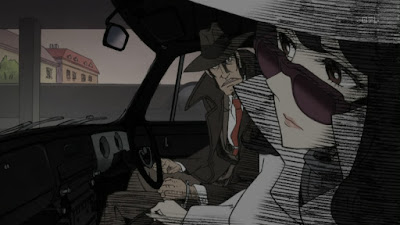
One character, who is only found in this story, is Zengata's lieutenant on the force Oscar, explicitly a young male officer who is attracted to Zenegata and, with a very elegant character design, does disguise himself a lot of times as women, even his name a reference to Riyoko Ikeda's The Rose of Versailles, a legendary shoujo manga series. His characterisation dances on a dangerous tight rope, but ultimately it is a tragedy that, immediately hating Fujiko (calling her a "spittoon" with all the gross connotations explicit) when she and Zenegata do have sex at one point. Oscar is a figure in love with someone who will not love him back, and embroiled into a sinister full series narrative about a cabal of owl men watching Fujiko from the sides, they will take advantage of this and lead to Oscar's downfall.

For the first half, this show follows the tradition of Lupin the Third as a series of globetrotting narratives, where (with made up names for some of the countries) you can go from tomb raiding in an Egyptian pyramid to a stand-in for Cuba and Che Guevara, involving an airplane hijack and tensions between the stand in for communist Russia and one for the United States. Notable details come to mind with the show already through these first episodes, the music already mentioned, Naruyoshi Kikuchi with anime director Shinichirō Watanabe as the music producer producing an eclectic soundtrack which can vary between jazz to full blown funk teleported from the seventies. The other most prominent detail is the show's most controversial aspect, the contribution of the third big voice of the show Takeshi Koike through his character designs and style. Koike, student of Yoshiaki Kawajiri and director of the sublime Redline (2009), is connected already in Sayo Yamamoto's history as she worked on Trava: Fist Planet (2001-2), his experiment set in the Redline world originally released as part of a Japanese "DVD magazine". He learnt from his master Kawajiri well, but the art style for The Woman Called Fujiko Mine is very idiosyncratic, with heavy use of dark lines, using the hatching technique and detail, murkier yet very stylish. Everyone still carries their usual appearance, but this probably has some of the most dynamic versions of these legendary characters as a result.

Especially Fujiko Mine. She is not central for parts of the series, and a lot of nudity does transpires, even one with her bound to a bed after being caught, but she is the future everyone, the cast and us, are obsessed over. It says so much how Mari Okada and Sayo Yamamoto wanted to pay tribute to this stereotypical femme fatale and amplify it, pulling off a subversive feminist streak here. She is a manipulator - she has morals occasionally, when it involves the Che Guevara stand-in or the children of a country's leader when she poses as their governess, but Fujiko thinks for herself usually only, for wealth and pretty (stolen) trinkets. She is an extreme of seductive femininity, based on what was clearly Monkey Punch wanting to draw the ultimate sexy woman who uses her allure always, but added with a spike to her personality here which is compelling and strong.

[Major Spoiler Warning]

The series starts to splice in, and been putting the pieces in already from the first episode, an over looking narrative that is "the story of Fujiko Mine". Then by the final episode, the series dismisses this as entire wrong pulls the rug out under the viewer. This series was still stuck with the issue that, with these characters existing for so long, unless they had the right to make a controversial alternative world version they could not include a drastic change to these characters. Instead, the production pulled off something more subversive, taking advantage of this flaw as a virtue in terms of gender politics. Namely that it targets the stereotype of the damaged but strong woman of fiction by suggesting Fujiko is such a figure, as ultra creepy and surreal memories plagued her eventually with the idea of her being a child who was tortured by owl men. Even the end credits plays a subversive game that, over highly eroticised still images of who we presume was Fujiko as a young teen, as we learn that this probably not her.

A trope which is problematic is that for a heroine to be created, a female character must have entered their adult hood or changed due to abuse. An extreme example, which is not used here, is which rape is part of a simplistic explanation for a female character becoming a powerful woman. We are given an extreme and even blasphemous change to Fujiko Mine near the end, to the point inside a theme park built around her she is distressed and no longer the powerful femme fatale as she is become vulnerable due to these memories...only for all of them and her back-story to be a lie. We will never know the true Fujiko Mine, and as she herself states, with a little help from Lupin, she is selfish figure who is remote from such vulnerability, only leading to this here due to a deeply weird of mind manipulating circumstances.

[Major Spoilers Finished]

The show still, in spite of the fact it has to still be part of the Lupin the Third canon, and thus cannot change anything drastic, manages a lot of brave risks. Taking so many that, when the main plot slowly bleeds in, The Woman Named Fujiko Mine gets weird. The entire production team, even the people responsible behind the eerie electronic noises signalling Fumiko's strange series of memories, are the MVP collectively, when a Lupin story gets into drug induced hallucinations of owl people and butterflies, to metaphors and pure hyper erotic content. In knowledge that director Sayo Yamamoto had full control, and her work outside of her own projects, it would not be a surprise if some of the more idiosyncratic details are entirely her own creative choices. Even when the show is subdued early on, you have an episode very early on set at an all girls' school, explicitly playing up to a yuri romance drama, with Fujiko pretending to be a teacher all her students are crushing on as she quotes Goethe in class, with a lot of Gothic aesthetic influences as a lot of the one-shot stories are set in a Europe of this world. When the show fully embraces the strange, you have a perversion of Disneyland attraction of cute Fujiko dolls singing how everyone loves her and topless women turned into her armed with knives; it is bizarre, even in a structurally conventional series, even in mind that the pink shirt era of Lupin, which I have not brought up from the eighties, was a deeply controversial era that included actually real magic and aliens.

This show, in hindsight, was a noble experiment which paid off. The interesting thing is that, in the aftermath, as Mari Okada even went on to direct an animated film herself, alongside still writing scripts, and Sayo Yamamoto has continued and created the success that was Yuri on Ice, Takeshi Koike's career through the 2010s was more Lupin III titles based on his work here, creating a trio of OVAs based within this same version. In terms of women having a higher position in the anime industry since this series, we have a long way to go, but this was a big moment that should be looked to more and be available, entirely because of the fact that it was such a noble, edgy gem.


=====

1) To the uninitiated, Lupin III was in continuity a descendant from Maurice Leblan's French pulp creation. That was an issue in the West for copyright reasons until they finally expired.

Thursday, 23 July 2020

Bonus #12: Red Hawk: Weapon of Death (1995)


Directors: Jung Yul Hwang and Sangil Shim

Based on the original manhwa by Sang Wol Ji and Ju Wan So

Voice Cast: David Lucas as Jan Chang; Tessa Ariel as Hongylung; Dorothy Melendrez as Village Kid; George C. Cole as the Narrator; Jimmy Theodore as Liu; Jonathan Charles as Mounja; Mona Marshall as Ko Wan; Peter Spellos as Morlyung; Simon Isaacson as Lord Seobong; Sparky Thornton as Muklyong; Wendee Lee as Lunyung

Viewed in English Dub


Didn't they even give you a welcoming ceremony? How rude of them.

We return to a bonus review, a return to Korean animation, to which Manga Entertainment licensed two titles back in the era where, on VHS, they made themselves and their infamies within from the likes of The Legend of the Overfiend (1989) too. Armageddon (1996), becoming a guilty pleasure for me, and Red Hawk, in comparison a much more conventional and consistently put together production than that film or, (shudder), Blue Seagull (1994). This does raise an interesting question, in how things might have been different if Manga Entertainment, having decided to acquire these titles in the nineties, invested in others from other Asian countries beyond Japan alongside anime.

Sadly, as has been the issue with non-Japanese Asian animation and comic books, I seriously doubt they were released with any distinction of their origins, Red Hawk still finding itself in the Collection, my own personal obsession from the company, alongside Violence Jack (1986-1990) to Bubblegum Crash (1991) without any distinction. Tellingly neither Korean title even had an entry on the trailer to that Collection, burnt into my mind from playing it on their old DVDs for too long alongside Mad Capsule Market songs. Red Hawk was sold, likely, as the simple action tale it is. In period Korea in the past, a former ally of villains becomes Red Hawk, a mysterious hero for the people who is masked, wears red and has a hawk. He becomes embroiled in the death of an artisan and counterfeit money, all whilst a likable goof protagonist and a group of friends are on the same mystery. It does evoke how many of these titles were created for their own national audiences, which can be seen in the more esoteric anime which is based on lore or their history; likewise, alongside this, the English voice actors have to negotiate around Korean names as a further reminder of this.

Technically, it does feel more consistent to the other Korean animation I have seen. I will be honest that, however, whilst it is just okay, it is not really that interesting. The meat and potatoes are able to be turned into something interesting, even having a strong female lead who we are introduced to beating up a man the size of a small hill and his ninja lackeys, all of which could go to somewhere. The issue is entirely with execution, where there is a sense that Red Hawk was a production tentatively put together, possibly aware of Blue Seagull as a disaster, possibly not, but definitely cautious in its production. One of the directors made beforehand Street Fighter (1992), a knock-off of the Capcom videogame franchise with the cast now looking exceptionally cartoonish but definitely the copyrighted figures, meaning that this was definitely a foot into a different direction with higher aspirations.

There is a little spice, but this is a very basic film. It also shows that tropes do travel countries, as well as the fact that comedy and drama mix a great deal, as this has a lot of serious moments but also pure slapstick, the lead hero mostly acting like a prat, able to rescue a young girl from a bull but fleeing from being gored when she is safely out of its way. Unfortunately, the film is very predictable. The little spice is some of the few esoteric details - mainly one henchman who is a very elaborately dressed man, even designed to look flamboyant without becoming a stereotype, who deals in the likes of a "Dismal Spirit" poison down the throat that kills most people, to a dark room where spider web can be found that allows him to predict his opponents moves. He is the only idiosyncratic character on the villains' side, right down to the fact his boss still slaps him around despite being a dangerous figure, only acceptable because said leader, whilst an old man, can suddenly grow giant amounts of muscle and is clearly the final boss. It helps that, whilst the English dub is a terrible example of Manga Entertainment adding swearing to raise the age rating, this at least results with that henchman having a scathing comment when he is proved disposable.

Beyond this, sadly even Blue Seagull is compellingly awful, whilst this really does not stand out at all. This is a shame as, among the aforementioned Collection licenses from Manga Entertainment, this was the last of them for me to actually see, rather than review, tragically one of the least interesting of the lot. Beyond elaborating on the plot, which is a bad sign, even in terms of the production, it is not necessarily good or bad, just competent in context. (The only idiosyncratic touch turns out to be the nineties techno music that occasionally appears in the score.) Red Hawk leaves open the promise for a sequel which never came, as the real villain is left unscathed, but the two directors never went on to direct any more feature length anime.

Sangil Shim does have a career, which means I can at least be happy that they went on to continue working and with a lot of fascinating little tangents in their filmography, working in a lot of animation for the United States and Japan too, between Æon Flux (1991) and The LeBrons (2011) to Claymore (2007)1. If their IMDB credits are right, they have even been a "food and food stylist" which raises a fascinating little question of what that job entails, especially as it involved working on Park Chan-Wook's 2009 vampire film Thirst. Jung Yul Hwang I cannot find anything on, whilst another fascinating detail is that, for the Korean dub, the only figure who went on to greater roles is Gwang Jang, an actor who has acted in live action and for voice acting who has been prolific, especially into the 2010s, and even narrated Thomas & Friends, which means I can inexplicably end this review referencing Thomas the Tank Engine with credibility.

====

1) Also Skysurfer Strike Force  (1995-6), an American production I am amazed managed two seasons, one of the many ridiculous American cartoons that came from the nineties, though not one I watched, but trying to chase the trend for sky surfing. Yes, I would like to watch the two seasons.

Wednesday, 22 July 2020

101 to #150 Retrospective [Part 6]: Best TV Series and Best Theatrical Film

Best TV Series:


5) Now it might surprise you the reader that Virtual-San Looking (2019) is on this list, but honestly, whilst I did not catch most of the humour and this is likely to be a title lost in time once it leaves Crunchyroll streaming, it was a fascinating piece of culture to have sat through. There is many shows about characters just talking - one which only had one mention for a negative, Tesagure! Bukatsu-mono (2013), managed to have three seasons which I covered but have faded in memory. Many are meant to just be for light humour to unwind with (and accidentally only cover the second season of like Anitore XX). Virtual-San, with the bigger danger that it was not a micro-series, but full twenty plus minute episodes, managed however to both sincere and charming even in its flaws, and also magnificently weird even without the pop culture managing to pass over my head. As a snapshot of a trend which has not crossed over into the West, as much of the entertainment was seeing both outsiders to the medium, virtual YouTubers, putting on a show but for series length television, and the idiosyncrasies of watching what was never meant to be a wide reaching show.

4) On a more logical choice, I feel however that I like to have all three potential candidates share the fourth spot for various reasons, all in my first proper steps into the giant robot genre, and all three deserving this spot. They also make a fascinating trio representing a time period where, over the Millennium, the giant robot genre had to change to keep as substantial genre. Dai Guard (1999-2000), an early digital animated production and before director Seiji Mizushima made his hit Full Metal Alchemist (2003), negates any concern to change the template on this long existing genre, instead creating a unique premise of what would happen in regular white collar employees in an office had to operate a giant robot. Treating the tropes as a disaster story, not a disaster film but how fire station staff or a rescue team at an actual disaster would have to intervene, through the lens of giant robots fighting giant monsters is a rewarding story to tell. It has its flaws (and a clip show episode) but succeeds with the premise.

Gravion and its sequel series Zwei (2002 and 2004) is a pure throwback to the old giant robot tropes from Masami Obari, a veteran mecha designer. This two series story has one significant issue that, to cater to a wider audience, it had to front load so much fan service (skimpy costumes, big busts, maids, some creepier content) that it can put viewers off. It also happens to still be a compelling giant robot show which, paradoxically, has a larger female cast because of that need for fan service, but all whilst still treating them all as competent and with dramas for themselves. So, as a result, in spite of itself, its the version of the giant robot show from the burning passion, Go Nagai era of the genre. The throwback with its bombastic JAM Project songs, of not being remotely scientifically realistic (unlike Dai Guard which tries to for great dramatic weight) but piling on the melodrama for the second season to win me over.

Finally, there is Gun X Sword (2005), from the era where I had gotten into anime but one of the many titles from the time, released over here in the United Kingdom, I never actually got around to until now. Fully invested in the new digitally assisted anime era, from a time still where (like the other two) twenty plus episode seasons were more common, and following how a lot of anime shows were genre cocktails by having all manner of pieces mashed together here. In this case, a sci-fi western where the revenging man with no name has a giant robot he can command from a satellite, but also because of the show being a comedy is a homeless vagrant who smears all the condiments on his meals. Yet this show, with its perfect balance, manages to make this still dramatically compelling and also fun, as it wisely uses its length to its advantage, a story of two halves between a romp searching for the villain who slighted him, with a variety of characters introduced, to the second where it pulls the rug out. When the road trip centres around a single spot in the second, a final conflict linking back to every character from the first half, it manages to succeed.

All three of the shows, flaws and all, were a perfect trio of obscurities which showed me how rich and diverse something of deceptively simple as a giant robot show, about giant robots fighting things, can still go on decades after its initial golden era for children's shows in the seventies. And considering how Gun X Sword had a cameo, with its cast and robots, in the videogame Super Robot Wars t alongside more famous titles, these shows have a rabid diehard fan base who remember them, so all three could (fingers cross) get re-releases on streaming and maybe even physical media again.

3) Sarazanmai (2019) marked the return of Kunihiko Ikuhara and a successful run in the 2010s. Beforehand, he had vanished from anime almost entirely after Adolescence of Utena in 1999, and it seems a wonderful experience for me, in terms of a time capsule, to have first learnt of him when he came back to the director's seat after a decade's absence. I learnt of him work, and admired it, when he came back with Mawaru Penguindrum (2011), grew further into my passion for anime by the time of Yurikuma Arashi (2015), and for Sarazanmai, still without a UK physical release sadly, the kind of eclectic anime viewer and purveyor of obscurities that could admire it fully. Both how, whilst the weakest of the three, this is still a gem from him, and that also the inherent oddness of the premise also wins me over. Who wouldn't want a musical fantasy action show which also has emotion and, tackling male protagonists for the first time in his career properly, has Ikuhara waving the LGBT whilst also getting into his fascinating ideas on modern life and communication. In an era where Masaaki Yuasa went from an obscure figure who was barely known in the West, but now has almost all his work available and is constantly directing output, I can see with hope that, unless Ikuhara likes to think of his projects, that whatever he does in the future, with co-director Nobuyuki Takeuchi here and studio MAPPA or not, still will be brimming with this level of creativity and be more likely to be funded.

2) Another figure came out of the 2010s as a king was Hiroyuki Imaishi, who really took advantage of the last ten years. Leaving studio Gainax, who have tragically faded into obscurity, founding Trigger who, for every title that has not necessarily hit it out of the park, is still a big studio, all whilst Imaishi himself has never really slouched. Even Space Patrol Lulico (2016), which I covered a long time ago, was just a victory lap which was for fun. Beginning the 2010s though, with what also feels like a last triumph for Gainax, he began his first productive year of the new decade with a bang, with the divisive but unique Panty & Stockings with Garterbelt (2010).

It is an acquired taste, both because it is openly a tribute to the type of American animation I myself was growing up with, the Cartoon Network animation of the late nineties and early 2000s, but is also openly profane, full of crude humour and a comical amount of English cursing. Wishing to push what was acceptable, Imaishi and the production however did something inspired in that a) their tribute to Western animation style led to them sacrificing detail for more fluid animation, drastically shifting the focus to some incredible sequences, and b) that everyone from the musicians composing the score to the animators who blow up hand sculpted versions of the ghosts never got predictable, having fun but pushing themselves. It is still such a fun, unpredictable and at times bizarre gem as a result.

1) But, fittingly it goes to a show that, when I first had gotten into anime, was a programme I initially did not like, only to track down on (once second hand and long out of print) DVDs and slowly grow fonder of. Serial Experiments Lain (1998) is an older title, over two decades old now, which is still available in the United Kingdom and it has grown for me considerably. Honestly, just go to the review, and it is explained what grew for me fully.

=====

Best Theatrical Feature:

Three honourable mentions come first. Knowing how deeply flawed it is, I cannot include X - The Movie (1996) but I have a love for the film in spite of this. Tekkonkinkreet (2006) is an obscurer gem, an important one knowing Michael Arias achieved a historically important moment in being the first gaijin (non-Japanese] anime director, making this colourful and idiosyncratic production with Studio 4°C. Also an entry you would find in the dictionary to define "idiosyncratic" would be The Burning Buddha Man (2013), with its distorted and strange world filled with paper cut out characters, bookmarked by live action sequences and using real liquids (fake blood, fake tears), already a compelling independent piece of animation, painstakingly put together and crafted with its director's distinct vision.

5) Beginning the list, and sadly not a title not really discussed a great deal until now, is Project A-Ko (1986), whose history including theatrical releases in Japan and France allows it on the list. Originally meant to be hentai, this became instead on a decision of the creators a playful, action packed approximation of eighties anime, both in its creativity and all the references to has. From its technical quality to its sense of fun, it is still highly regarded in the modern day for good reason, a rare case of indulgence which is artistically satisfying.

4) The Strange Case of Hana & Alice (2015) sits as a fascinating curiosity. A prequel to a live action film, Hana and Alice (2004), made by the same director Shunji Iwai but negotiating around the fact his returning leads Yū Aoi and Anne Suzuki, originally playing teenagers, would have aged over ten years adults by making the new movie a rotoscope animated production. And, without the original context, it is still a sweet and utterly enjoyable gem, a mystery story with unfolds and undercuts the mystery to reveal warmth, all whilst the art style itself is distinct and having justifiable weight rather than to have made this story as live action.

3) Pom Poko (1994) was the first Studio Ghibli title covered, and is obscurer even in their canon, entirely because Isao Takahata's work for the animation studio, in contrast to Hayao Miyazaki's, was already more esoteric and at times only possible to appreciate as an adult. Pom Poko is a fun film at times, but between its complex take on an environmental message, despite being obviously pro-environment, as well as a tribute to Japanese folklore, it always kept me enwrapped by where the story was going, never going for the obvious solution to this story. That the ending does not turn out how it usually does in Western storytelling adds a greater sense of weight, never going for an easy answer even in a film that  is completely accessible.

2) Night on the Galactic Railroad (1985) has been talked of a lot in this series, and with good reason as an under seen and unique theatrical release that, whilst meant to be suitable for families, is also tackling death and existentialism with a depth that contrasts this. It was a film I had wanted to see for years, and finally able to, it did live up to the experience fully.

1) Also covered a great deal so far, and another film I have wanted to see for many years, the winner is Adolescence of Utena (1999). It was a film if you were just talking about the first two-thirds that would have not qualified as a great film; just a fascinating and surreal production instead trying to condense a narrative based on a thirty plus episode television series. The final third, including the unexpected change of pace for the ending, achieves so much in what is unexpected, what is symbolically and emotionally powerful, and how incredibly accomplished it is as animation that this became a special viewing experience to finally see.


And with that, so ends the second season, and roll forth reviews #151 to #200.